Written by:
Editorial Team
DSG.AI
A digital twin is a virtual model of a physical asset, process, or system. In manufacturing, it is not a static 3D model. It is a dynamic replica of a factory floor component, like a CNC machine, or an entire production line, updated in real-time with data from sensors.
This connection allows managers to run simulations, monitor performance, and predict outcomes in a virtual environment without interrupting physical production.
From Static Blueprints to Living Models
Manufacturing has long relied on static documents like CAD drawings and process flowcharts. These are necessary for initial design but become historical records once production begins. They do not capture the operational realities of machine wear, raw material variations, or changes in ambient temperature.
This limitation forces teams to react to problems after they have already caused downtime or material waste.
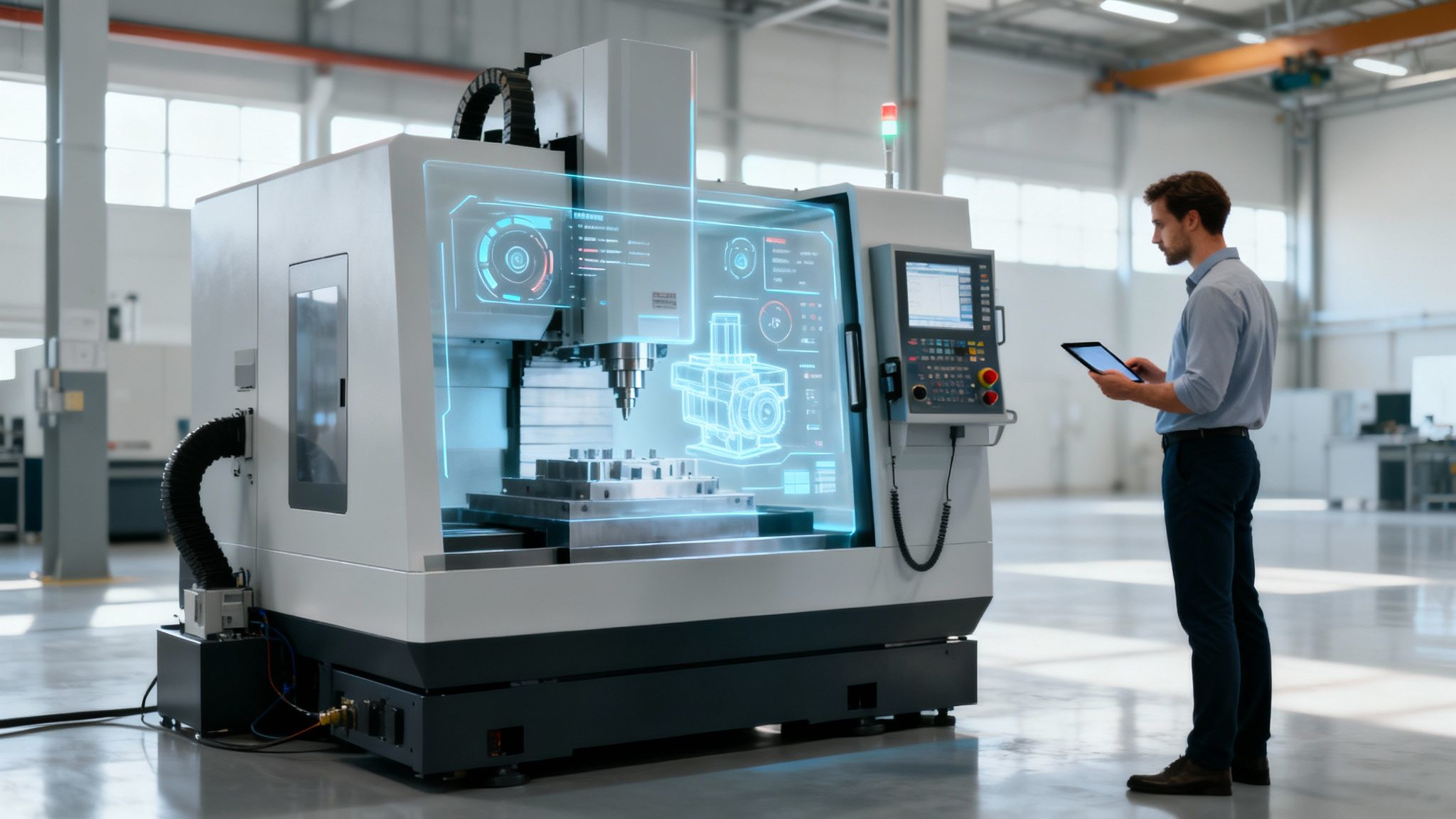
Digital twins in manufacturing change this reactive model. By creating a live, two-way data link between a physical asset and its digital version, the technology provides a constantly current view of operations. The digital twin evolves as the physical factory operates.
The Core Components of a Digital Twin
A functional digital twin is a system built on several technologies working together. Understanding these components explains how a virtual model can accurately mirror and predict physical operations.
This table breaks down the core elements.
Key Components of a Manufacturing Digital Twin
| Component | Description | Example in Manufacturing |
|---|---|---|
| Physical Asset | The real-world object or system being modeled. | A CNC machine, a robotic arm, or an entire assembly line. |
| Virtual Model | A detailed 3D and physics-based digital representation. | A CAD model enhanced with operational physics, like thermal dynamics or stress simulations. |
| Data Sensors (IoT) | Devices that collect real-time data from the physical asset. | Vibration sensors on a motor, temperature gauges in a furnace, or vision systems on a conveyor belt. |
| Data Connection | The communication link between the physical asset and virtual model. | Industrial Ethernet, 5G, or other low-latency networks that ensure data flows instantly. |
| Analytics and AI | The software that processes data to generate insights and predictions. | An AI algorithm that predicts machine failure by analyzing subtle changes in vibration data. |
At its core, a digital twin bridges the physical and digital domains by turning raw data into meaningful information.
A digital twin bridges the gap between information technology (IT) and operational technology (OT). It translates raw sensor data from the factory floor into actionable business intelligence in the virtual world.
This constant flow of information shifts operations from reactive problem-solving to proactive optimization. Instead of asking, "What just happened?" managers can ask, "What is likely to happen next, and what can we do now to achieve the best outcome?"
How Digital Twins Reduce Costs and Improve Output
The value of a digital twin in manufacturing is measured by quantifiable business results. By creating a virtual model that mirrors physical operations, managers can identify and prevent problems before they occur. It transforms complex machine data into clear actions that improve efficiency, cut costs, and increase production predictability.
Let’s review specific applications.
Slashing Unplanned Downtime
Unplanned downtime stops production and threatens deadlines and budgets. Digital twins are an effective tool for reducing it. They enable a shift from reactive or calendar-based maintenance to predictive maintenance. A digital twin receives real-time data from sensors on equipment, such as vibration, temperature, and power draw. AI algorithms analyze this data to find subtle patterns that signal an impending failure.
This provides the maintenance team with advance warning. They can identify a potential problem weeks in advance and schedule repairs during planned outages, avoiding emergency shutdowns.
Synthetic Example: An automotive parts supplier creates a digital twin for its critical CNC machines. The system flags potential bearing failures two weeks in advance with 85% accuracy by analyzing small shifts in vibration and heat data. This results in a 25% reduction in unplanned downtime for those machines in the first year.
Boosting Production Throughput
Hidden bottlenecks can limit output even with optimal equipment. Identifying these bottlenecks has traditionally involved guesswork and physical trial-and-error, which disrupts operations.
A digital twin of a production line provides a virtual environment for experimentation without affecting physical equipment. Managers can run "what-if" scenarios to find the optimal configuration.
- Simulate the addition of a new robotic arm to measure its impact.
- Test a different material flow virtually to see if it is faster.
- Validate a process change in the twin before implementing it on the floor.
Simulation insights can lead to measurable improvements. Facilities have reported increasing their overall output by 8% to 15% by using simulations to reconfigure existing assets. This approach uses data-backed decisions to unlock hidden capacity.
Driving Down Scrap and Rework
Poor quality directly impacts profitability through wasted materials, lost time, and rework costs. Small deviations in production parameters like temperature, pressure, or material mix are common causes.
A digital twin monitors these critical parameters in real time, comparing live data to ideal specifications. If a process begins to drift, the system can alert an operator or, in some automated systems, adjust machine settings to correct the deviation.
This feedback loop helps produce more consistent, higher-quality products. For example, a plastics manufacturer using a twin to monitor injection molding temperatures could identify and correct thermal variations before they cause defects, potentially cutting its scrap rate by 10% in six months. This has a direct impact on profitability.
A Phased Roadmap to Implementation
Implementing a digital twin is a strategic project, not a single installation. Successful deployments typically follow a phased approach. This method builds momentum, demonstrates value early, and manages risk by breaking a large initiative into smaller steps.
Phase 1: Pick Your Pilot Project
The first step is to select the right pilot project to secure an early win and gain stakeholder support.
Look for a process or asset that is both high-impact and has low-complexity. A single, critical machine that is a known bottleneck or a frequent source of downtime is often a good candidate. Focusing on one asset allows the team to learn the fundamentals of data collection, modeling, and analysis in a controlled setting. This approach delivers tangible results quickly and builds a business case for expansion.
Phase 2: Get Your Data Infrastructure in Order
After selecting a pilot asset, evaluate your data infrastructure. A digital twin's effectiveness depends on the quality of its data. Assess your current ability to collect and transmit real-time information.
This involves answering a few key questions:
- Sensor Coverage: Does the machine have the necessary sensors (e.g., for vibration, temperature, pressure) to capture critical data?
- Connectivity: Is your network (Industrial Ethernet, 5G) robust enough to handle a constant, low-latency data stream?
- Data Quality: Is the collected data clean, consistent, and reliable, or does it contain noise and gaps?
Addressing these questions upfront ensures a solid foundation before building the virtual model.
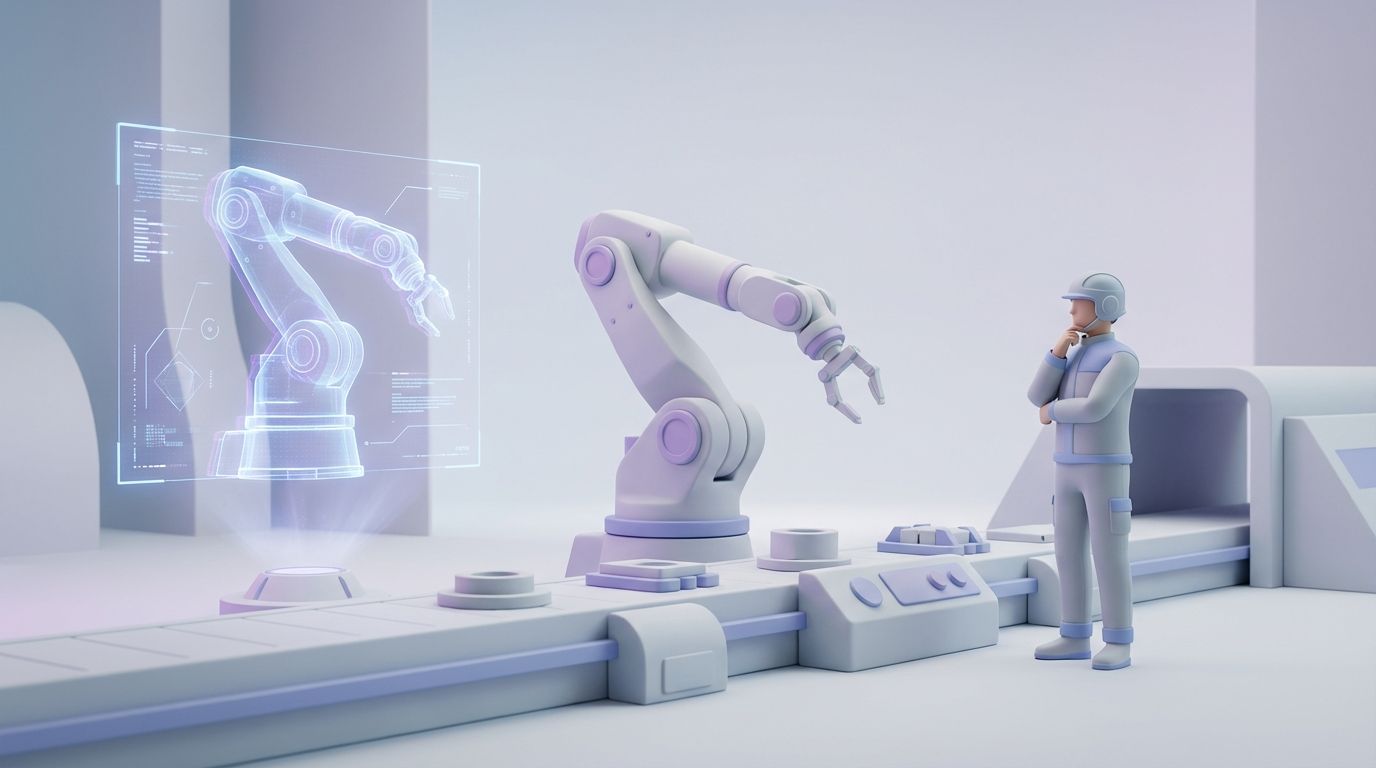
The diagram below shows how a digital twin functions on the factory floor, supporting maintenance, operational tuning, and employee training.
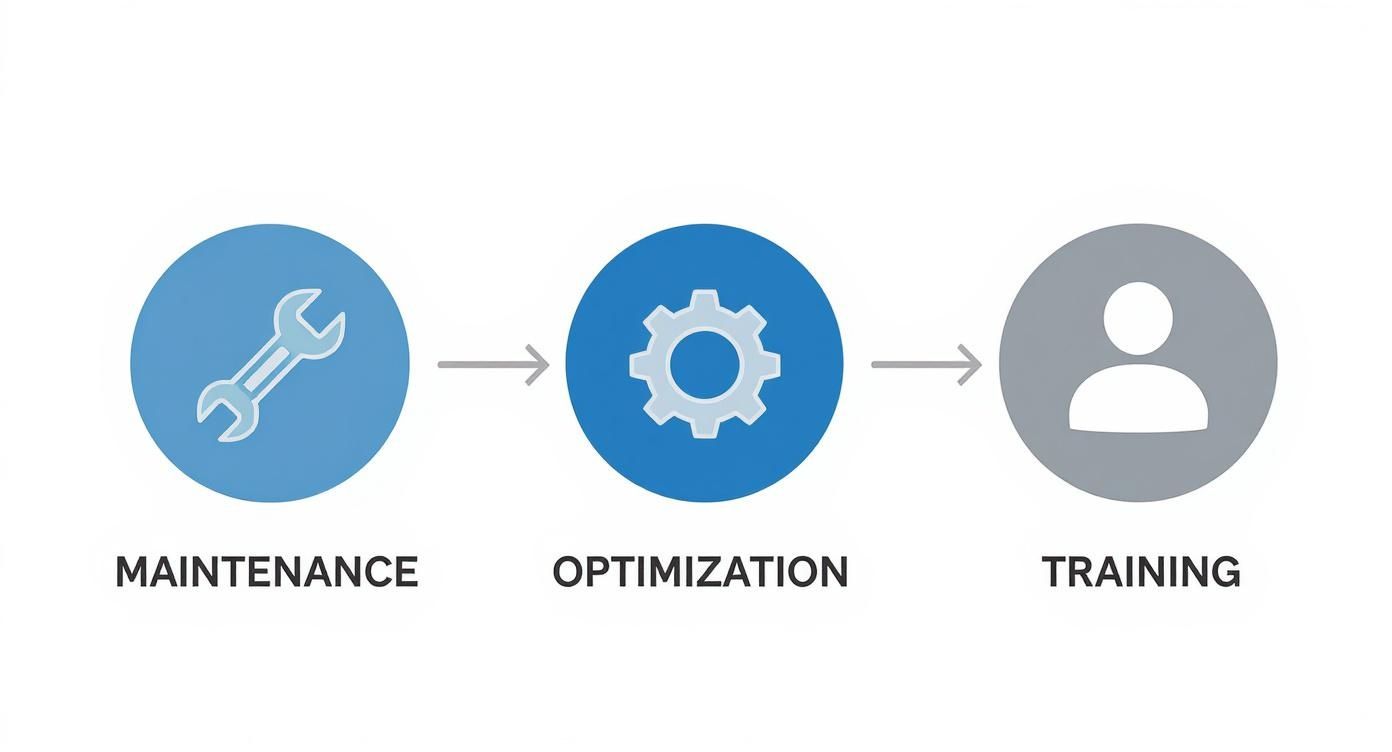
This process shows how a single digital twin can become a central tool for improving multiple aspects of an operation.
Phase 3: Build and Validate the Model
In this phase, the virtual version of the asset is created. The team uses specialized software to build a detailed model that mirrors the machine’s physical properties, mechanics, and operational rules. This model is then connected to the live data streams established in the previous phase.
Building the model is not enough; it must be validated. You must confirm that the virtual model behaves exactly like its real-world counterpart.
Validation involves running the physical asset and the digital twin in parallel. You compare their outputs and sensor readings to confirm the model’s accuracy. This process builds trust in the twin’s predictions and ensures its insights are reliable for decision-making.
Phase 4: Integrate and Scale Up
With a validated pilot twin delivering value, the final phase involves connecting it to core business systems and planning for wider deployment. Integrating the digital twin with a Manufacturing Execution System (MES) or Enterprise Resource Planning (ERP) platform creates a unified operational command center.
This integration allows insights from the twin to trigger actions automatically, such as creating a maintenance work order in the ERP when the twin predicts a potential failure. As you scale, having tools to oversee the system is necessary. For a deeper look at AI monitoring, explore our resources on how to manage your AI initiatives effectively.
The lessons from the first pilot project serve as a guide for expanding the program to other production lines or facilities. This is why the digital twin market, valued at USD 13.6 billion in 2024, is growing. This growth is driven by results, such as efforts in the U.S. to reduce chip manufacturing costs by over 35% using this technology.
The Technology Powering Digital Twins
A digital twin is not a single piece of software but an ecosystem of technologies that must work together. Leaders evaluating this technology must understand these core components.
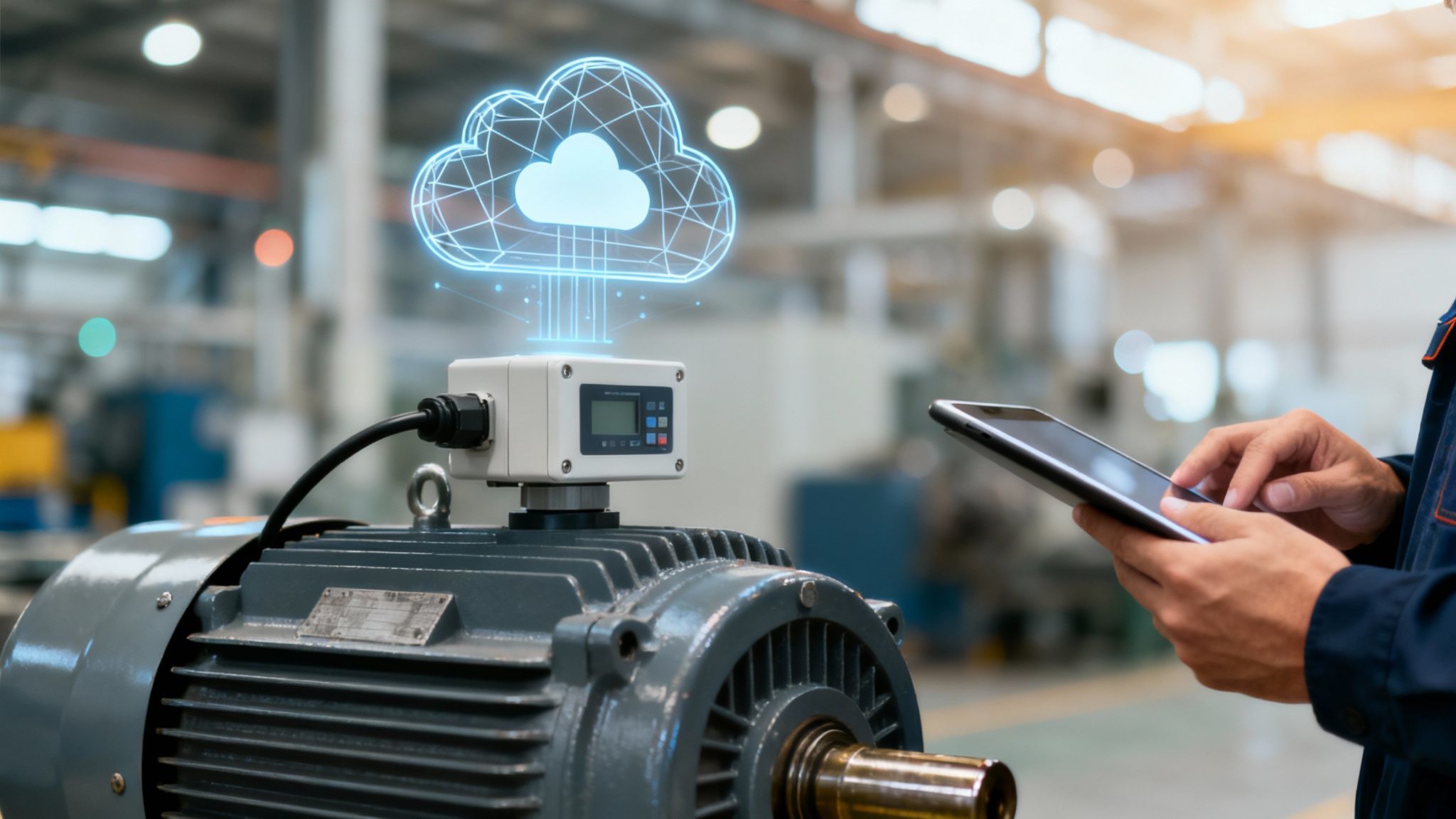
This interconnectedness is driving market growth. The global market for digital twins in manufacturing was valued at approximately USD 3.6 billion in 2024. Projections show it increasing to around USD 42.6 billion by 2034 as adoption grows.
The Foundation: Industrial IoT and Connectivity
The digital twin concept relies on a constant stream of high-quality, real-time data from the Industrial Internet of Things (IIoT).
-
IIoT Sensors: These devices—vibration monitors, temperature gauges, pressure sensors, and cameras—are the digital twin’s senses. They capture raw data directly from machinery on the factory floor.
-
High-Speed Connectivity: Technologies like 5G and industrial ethernet provide the low-latency, high-bandwidth connection needed to ensure the digital twin is a real-time mirror of its physical counterpart. Without this, the twin would have a time delay, reducing its usefulness.
Foundational elements like industrial controls automation are critical for both feeding data to and executing commands from these digital twin models.
The Engine: AI and Machine Learning
If IIoT sensors are the senses, then Artificial Intelligence (AI) and Machine Learning (ML) are the brain. These algorithms process large volumes of incoming data, identify patterns, and generate the actionable insights that make a digital twin valuable.
This technology enables predictive maintenance by detecting small anomalies in a machine’s vibration that signal a future bearing failure. It also powers simulations that run "what-if" scenarios to find new efficiencies.
Without AI, a digital twin is a dashboard. With AI, it becomes a predictive tool. You can learn more about making these complex systems work together in our guide to AI workflow orchestration.
A digital twin without AI can tell you what is happening now. A digital twin with AI can tell you what is likely to happen next and recommend what you should do about it.
The Blueprint: 3D Modeling and Simulation
The virtual model provides the visual and physical context for the data and analytics. It is the digital representation of the physical asset and must be accurate.
-
3D Modeling Software: This is used to create a geometrically accurate, visually realistic replica of the machine, production line, or factory.
-
Simulation Software: This software adds physics to the 3D model, simulating real-world forces like heat, stress, and fluid dynamics. This ensures the virtual model behaves like its physical counterpart under various conditions.
Together, these tools allow for experiments in a safe, virtual environment before implementing changes to physical equipment. This is useful for testing new layouts and training operators. Our internal link to learn more about our AI-powered quality control solution explains how assureIQ helps automate quality assurance processes.
Measuring Success and Calculating ROI
Investing in a digital twin is a business decision that requires a clear, quantifiable impact on the bottom line. Tracking the right metrics from the beginning is essential for securing long-term support.
Before starting a pilot, establish a baseline for the target asset or process. This baseline serves as the standard for measuring all improvements and demonstrates the technology's value with credible numbers.
Key Performance Indicators to Track
To prove the value of your digital twin, focus on operational metrics that directly impact cost, efficiency, and quality. These KPIs will show a clear before-and-after picture of your investment's results.
Focus on these key indicators:
- Overall Equipment Effectiveness (OEE): This is a standard measure of manufacturing productivity. A digital twin that improves processes and reduces downtime should increase your OEE score, often by 5% to 15% within the first year.
- Mean Time Between Failures (MTBF): This measures equipment reliability. As a digital twin enables predictive maintenance, the time between major breakdowns should increase, indicating a more stable production environment.
- Scrap Rate Percentage: This KPI tracks material waste. By identifying process deviations in real time, a digital twin can reduce scrap rates, often by 8% to 20%.
Tracking these numbers provides concrete evidence that the technology is delivering real value.
A Simple Framework for Calculating ROI
With performance data, calculating your Return on Investment (ROI) is straightforward. The goal is to show that the financial benefits from operational improvements outweigh the cost of the digital twin solution.
Your ROI calculation demonstrates how a budget item translates directly into a more profitable factory floor.
You can frame the calculation with a simple formula that compares gains to costs.
1. Quantify the Financial Gains:
- Reduced Downtime Costs: Calculate savings from preventing unplanned shutdowns. If one hour of downtime costs $20,000, preventing ten hours a year saves $200,000.
- Lower Material Waste: Sum the savings from reduced scrap. A 10% reduction in waste for a process that previously lost $500,000 in materials annually adds $50,000 back to the budget.
- Increased Throughput: Determine the value of additional units produced due to improved efficiency.
2. Tally the Total Costs:
- Implementation Costs: Include all expenses: software licenses, sensors and hardware, integration services, and initial model-building work.
- Operational Costs: Account for ongoing expenses like software subscriptions, data storage, and any specialized staff needed to maintain the system.
Comparing these two sides provides a clear ROI percentage to present to leadership. This data-driven approach shifts the conversation from what the technology could do to what it has done, making it easier to justify the initial investment and build a case for scaling.
Frequently Asked Questions About Digital Twins
When considering a major technology investment like a digital twin, practical questions about cost, disruption, and required skills arise.
Here are the questions we hear most often from operations leaders.
What’s the Real Cost to Implement a Digital Twin?
There is no single price. The cost depends on the scope of the model—a single machine versus an entire facility. The asset's complexity, the number of data sources, and the depth of integration are key factors.
A pilot project for one machine might cost in the tens of thousands of dollars. A full-scale digital twin of an assembly line could cost hundreds of thousands or more. The recommended approach is to start small and scale. A targeted pilot proves value and delivers a quick ROI with a manageable upfront cost. This initial success builds the business case for a wider, phased rollout, allowing future stages to be funded by generated savings.
Do We Have to Rip and Replace Our Old Equipment?
No. A common misconception is that digital twins only work with new, "smart" machinery. Most legacy equipment can be integrated by retrofitting it with modern IIoT sensors.
The goal is not to replace trusted assets but to make them smarter. Adding sensors for vibration, temperature, or power consumption connects older equipment to your digital ecosystem, allowing you to collect valuable data.
How Do We Keep Our Operational Data Secure?
Security is a top priority. Connecting operational technology (OT) with IT networks involves sensitive intellectual property and production data. With a reported 71% increase in cyberattacks on manufacturers between 2024 and early 2025, security cannot be overlooked.
Here are essential best practices for securing a digital twin:
- Zero Trust Architecture: Operate on a "never trust, always verify" basis. Every user and device attempting to access the network must be strictly authenticated, regardless of location.
- End-to-End Data Encryption: All data must be encrypted, both in transit from a sensor to the cloud and at rest in a database.
- Network Segmentation: Isolate the digital twin's network traffic from other corporate networks. This creates a barrier to prevent a potential breach in one area from spreading to mission-critical systems.
What Kind of Skills Do We Need on the Team?
A successful digital twin project requires a cross-functional team. It is not solely an IT or engineering task but demands collaboration across departments.
Build a team with these key roles:
- Operations Technology (OT) Experts: Engineers and floor technicians who understand the machinery and physical processes.
- Information Technology (IT) Professionals: The infrastructure team that manages the network, cloud services, and data security.
- Data Scientists and Analysts: The individuals who build analytical models and use AI to translate raw sensor data into predictive insights.
Bringing these groups together ensures the digital twin is technically sound and aligned with the realities of the factory floor.
DSG.AI delivers enterprise-grade AI solutions that create measurable business value, turning your operational data into a competitive advantage. Explore our successful projects and see how we can help you design, build, and operationalize a digital twin tailored to your unique needs at https://www.dsg.ai/projects.