
Written by:
Editorial Team
Editorial Team
Fleet maintenance management is the system for keeping a company's vehicles operational, safe, and cost-effective throughout their lifecycle. This is not a simple repair schedule; it is a core business function that uses data to balance proactive care with reactive repairs, aiming to reduce total cost of ownership.
Defining Your Core Operational Strategy
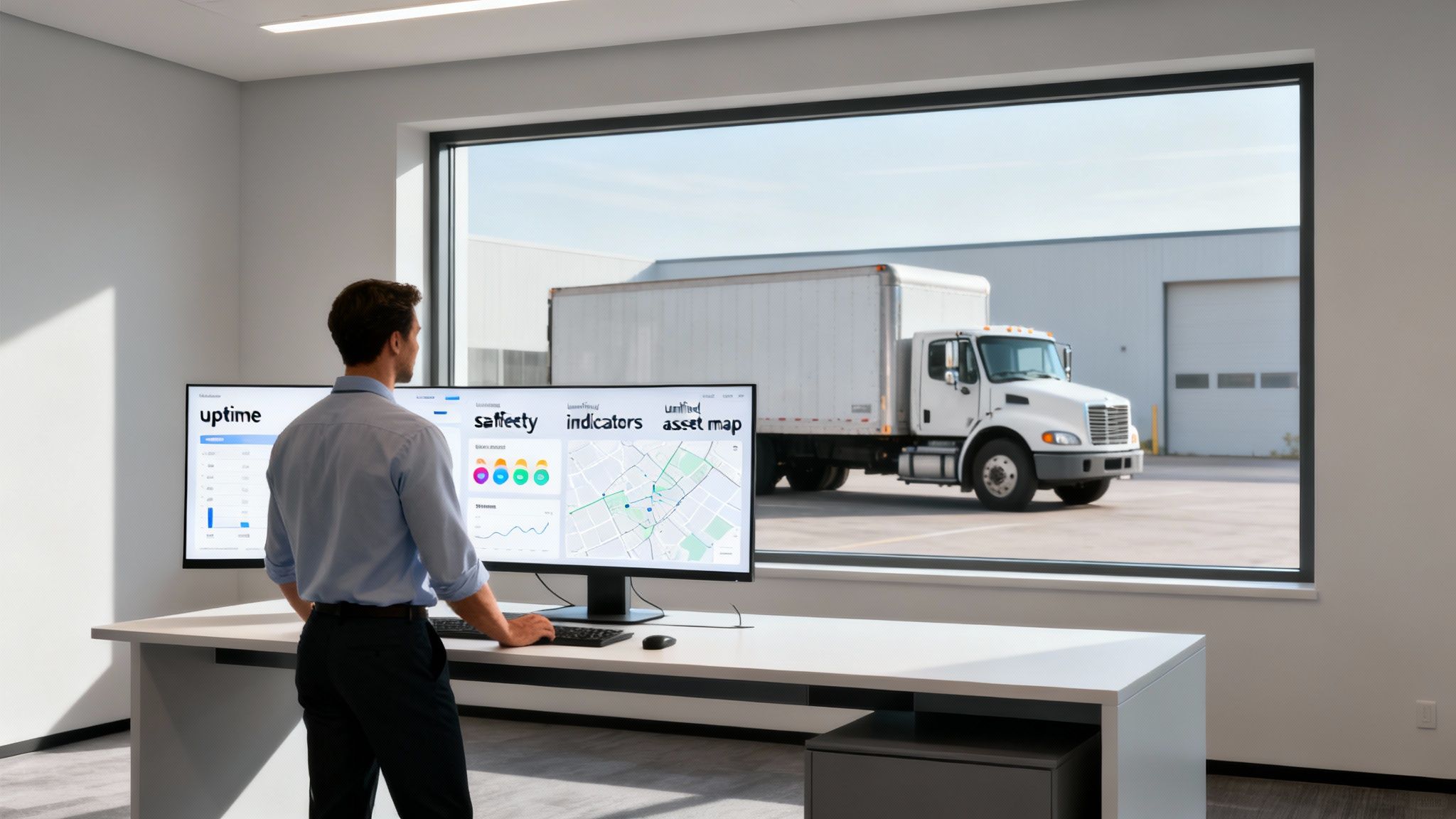
For a large operation, treating fleet maintenance as a reactive expense leads to operational failures. When a delivery truck has an unexpected breakdown, the cost includes the repair, delayed shipments, missed service level agreements (SLAs), and a loss of customer trust.
A modern approach prevents failures before they happen. This requires integrating data from telematics, inspection reports, work orders, and parts inventory. The goal is to create a single data source that shifts the operation from reaction to prediction. This directly reduces unplanned downtime and extends the operational life of each vehicle.
Pillars of Modern Fleet Maintenance Management
An effective strategy is built on four interconnected pillars. Each addresses a different aspect of vehicle health, cost control, and operational readiness.
This table breaks down these core components and how they contribute to a comprehensive maintenance program.
| Pillar | Primary Goal | Key Activities |
|---|---|---|
| Preventive Maintenance | Maximize vehicle uptime and lifespan by addressing issues before they cause failure. | Scheduled inspections, routine servicing (oil changes, tire rotation), component replacements based on mileage or time. |
| Predictive Maintenance | Anticipate failures by analyzing real-time vehicle data to perform maintenance at the optimal moment. | IoT sensor monitoring, telematics data analysis, AI-driven failure prediction, just-in-time parts ordering. |
| Compliance and Safety | Ensure adherence to all regulatory standards (e.g., DOT, OSHA) and internal safety protocols. | Automated inspection records, compliance reporting, driver safety monitoring, audit trails. |
| Cost and Inventory Control | Optimize maintenance spend and manage the total cost of ownership (TCO). | Parts inventory management, technician productivity tracking, warranty recovery, budget forecasting. |
These pillars provide the practical foundation for a high-performing fleet operation.
The Critical Role of Compliance
Maintaining a safe and compliant fleet is a requirement for risk management. According to one industry study of fleet managers, 87% consider overseeing maintenance compliance a core part of their job.
However, only 5% of those surveyed achieve compliance rates between 95% and 100%. This gap shows a disconnect between priorities and process capabilities. Modern systems are designed to close this gap.
A well-defined fleet maintenance program drives operational performance. Building a reliable, cost-effective operation starts with a solid foundation, which is why adopting proven methods like these 10 Fleet Management Best Practices is crucial.
Moving From Preventive to Predictive Maintenance
The foundation of most maintenance programs is preventive maintenance. It is similar to the checks an airline performs after a set number of flight hours. The goal is baseline reliability. Inspections and component swaps are scheduled to address wear before it causes a major failure, keeping the fleet operational.
This calendar-or-mileage-based approach creates a predictable schedule. Tasks like oil changes and brake inspections occur at regular intervals, which helps prevent common mechanical issues. But this model has a significant cost.
A rigid schedule often results in replacing parts that are still functional. For example, an aircraft engine component might be swapped out when it could have safely operated for another 500 hours. Across a large fleet, this practice increases parts and labor costs. The method is reliable but not efficient.
The Strategic Shift to Predictive Interventions
Predictive maintenance is the next evolution. It uses real-time data to determine the right time to act.
Instead of relying on generalized timelines, this approach uses a constant stream of data from telematics and IoT sensors. These systems monitor data points—from engine temperature and oil pressure to vibration patterns and voltage fluctuations—to detect early signals of a potential problem.
Predictive maintenance identifies a high-probability window for a failure to occur. This insight allows you to schedule the repair proactively, turning an unplanned breakdown into a controlled event.
This data-driven approach changes maintenance from a fixed cost to a dynamic operation.
From Theory to Real-World Application
The operational difference is significant. With a preventive schedule, a truck's alternator is replaced every 150,000 miles. With predictive maintenance, the system monitors that alternator's real-time voltage output daily.
If the system detects a slight but consistent drop over several weeks—a pattern a driver would not notice but a machine learning model would identify as a signal of impending failure—it triggers an alert. The system can then automatically schedule a replacement during the vehicle's next planned stop, order the part, and assign a technician before the truck is at risk of a breakdown.
This shift is already underway. One 2023 survey found that 65% of large fleets are implementing or planning predictive maintenance programs. This trend is also contributing to a 35% increase in the use of mobile maintenance services, as fleets dispatch technicians to perform data-driven repairs on-site to reduce asset downtime. You can get more details on how fleets are planning for the future on oxmaint.com.
The Business Impact of Predictive Analytics
Adopting a predictive model provides operational and financial benefits beyond avoiding roadside breakdowns.
- Reduce Unplanned Downtime: Turning potential emergencies into scheduled appointments increases vehicle availability and service reliability. This helps logistics companies meet delivery windows.
- Optimize Parts Inventory: Predictive insights allow a shift to a just-in-time inventory model, which reduces carrying costs and frees up capital.
- Lower Overall Maintenance Costs: Technicians spend less time on unnecessary replacements and can focus on more critical tasks. Maximizing the safe operational life of each component directly reduces parts expenditures.
This shift uses vehicle data as a tool to cut costs and improve operational performance.
Building Your Fleet Data Architecture and KPIs
You cannot manage what you do not measure. A proactive maintenance strategy depends on clean, reliable data. The goal is to focus on a few Key Performance Indicators (KPIs) that connect maintenance work to business outcomes like profitability and operational readiness.
The problem for most large organizations is not a lack of data, but that the data is siloed. Telematics data comes from vehicles, work orders are in an Enterprise Asset Management (EAM) system, and financial details are in the company's ERP. When these systems are not integrated, reports can be conflicting, making strategic decisions difficult.
A solid data architecture connects these systems and enables the shift from scheduled to predictive maintenance.
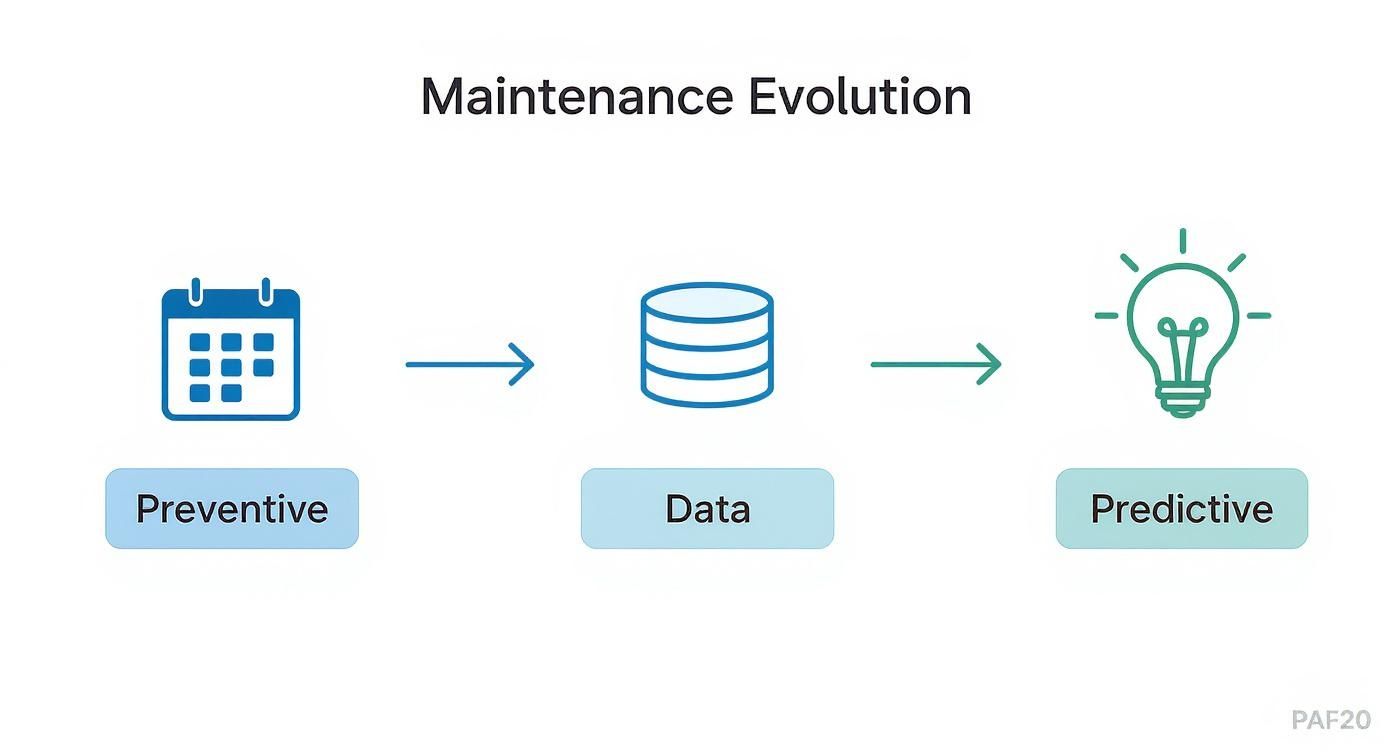
As the diagram shows, integrating data is the foundational step that enables a move beyond simple schedules toward anticipating failures.
Establishing a Single Source of Truth
The first step is to establish a single source of truth. This is a technical requirement for a data-driven strategy. It means building a centralized data architecture where information from separate systems is consolidated.
This is typically done using APIs (Application Programming Interfaces) to funnel data from telematics, EAM, and ERP platforms into a central data warehouse. This unified repository is the foundation for any analytics. It ensures that all teams are using the same, accurate numbers for reporting and analysis.
Key Metrics for Strategic Fleet Management
With integrated data, you can track KPIs that measure fleet health and efficiency. These are diagnostic tools for your operation.
KPIs are like vital signs for your fleet. They help you identify underperforming assets, find workflow bottlenecks, and quantify the financial impact of your maintenance strategy.
The following are essential KPIs for any large-scale fleet.
Strategic KPIs for Enterprise Fleet Maintenance
| KPI | Formula / Definition | Strategic Importance |
|---|---|---|
| Vehicle Uptime | (Total available hours - Downtime hours) / Total available hours | Measures operational readiness. High uptime is required to meet service level agreements (SLAs) and maintain customer satisfaction. |
| Planned Maintenance Percentage (PMP) | (Hours on scheduled maintenance / Total maintenance hours) x 100 | Shows the proactiveness of the maintenance program. A high PMP (target >85%) correlates with lower emergency repair costs. |
| Mean Time Between Failures (MTBF) | Total operational time / Number of failures | A pure reliability metric used to compare different asset classes. It informs decisions on vehicle retirement and procurement. |
| Maintenance Cost per Mile/Hour | Total maintenance cost / Total miles driven or hours operated | Normalizes costs for direct comparison between assets, helping to identify vehicles that are too expensive to operate. |
These metrics provide an objective view of asset and process performance.
Turning Measurement Into Action
Tracking these numbers is the first step. The next is using them to drive change.
For example, if the MTBF for a specific truck model is 20% lower than the fleet average, this is a signal of a reliability issue that requires investigation and may influence future purchasing decisions.
If your Planned Maintenance Percentage is consistently around 50%, this indicates that your team is in a reactive cycle. This insight provides the justification to reallocate resources and adjust maintenance scheduling. This is how a data-driven fleet management program operates in practice.
Putting AI to Work for Smarter Fleet Maintenance
Once you have a clean, reliable data architecture, you can use artificial intelligence (AI) and machine learning (ML) to move from tracking past events to predicting future ones.
AI is a tool that enhances the expertise of your technicians. It gives your team the ability to make decisions based on probabilities derived from large datasets, turning data into actionable intelligence.

This shift from a reactive to a proactive model is becoming the standard. According to a report by Element Fleet Services, 80% of fleet managers view data analytics as a core part of optimizing their operations. They use monthly reports on vehicle availability and downtime to identify inefficiencies. As explored in how data is shaping future fleet strategies at oxmaint.com, the most significant gains come from more advanced applications.
Here are three areas where AI is already delivering value.
Predicting Component Failures with Precision
A primary application for AI in fleet maintenance is predicting when a specific part will fail. Machine learning algorithms analyze historical data—telematics, work orders, parts records—to learn the unique failure patterns of your assets.
An ML model can process thousands of sensor readings simultaneously, detecting subtle combinations of signals that are invisible to humans but often precede a failure.
The output is a specific forecast, such as a particular transmission clutch having an 85% probability of failing within the next 1,500 miles. This provides a clear, actionable window to schedule service before a breakdown occurs.
Detecting Anomalies Before They Escalate
While predictive models look for known failure patterns, anomaly detection finds the unexpected. These algorithms build a detailed digital baseline of "normal" operation for every vehicle under various conditions.
This baseline of normal behavior is constantly compared to real-time sensor data. The moment a vehicle deviates from its baseline—for example, a small drop in fuel efficiency or a slight increase in engine vibration—the system flags it as an anomaly.
This is a digital early-warning system. It catches problems that are too subtle for a driver to notice or a standard diagnostic code to trigger. This allows technicians to investigate an issue when it is still small and less expensive to fix.
By pinpointing these small deviations, anomaly detection can reduce diagnostic time. A 2022 study showed this can be by up to 30%, because technicians know where to begin their investigation. If you are considering this technology, you can assess your potential for AI integration with our specialized tools.
Optimizing Maintenance Schedules and Resources
AI can also solve complex logistical problems. An AI-powered scheduling engine can process numerous variables—predicted maintenance needs, technician schedules and skill sets, parts inventory, shop bay availability, and vehicle deployment schedules—to produce an optimized plan.
It answers questions in real time:
- Which repairs should be prioritized to maximize fleet uptime?
- How can jobs be grouped to return a vehicle to service in a single shop visit?
- What is the most efficient way to schedule work so the right technician and parts are ready?
As a synthetic example, a large logistics fleet using an AI scheduler could increase technician "wrench time"—the time spent actively working on a vehicle—by 15%. This is a direct productivity increase from eliminating time spent waiting for parts or bay availability.
Getting Your Fleet Management System Up and Running
Implementing a modern fleet maintenance management system is a significant project. It requires careful planning, disciplined execution, and a commitment to helping your team adapt. A phased approach is most effective for ensuring the technology serves business goals without disrupting daily operations.
This three-phase roadmap moves from high-level strategy to a full-scale deployment.
Phase 1: Planning and Discovery
This first phase is critical for project success. It is about establishing the groundwork and aligning stakeholders. Before evaluating software, you need to define what you are trying to improve.
Start by assembling a cross-functional team from operations, maintenance, finance, and IT. This group must define specific, measurable goals. Instead of vague targets like "improve efficiency," aim for concrete objectives like, "reduce unplanned downtime by 15% in the next 18 months" or "decrease our maintenance cost-per-mile by 8%." The final part of this phase is to assess your current systems, data, and workflows to identify gaps.
The most common mistake is treating this as an IT project. Success depends on connecting the technology to business outcomes from the start. Without this, even powerful software will not deliver the expected ROI.
Phase 2: System Selection and the Pilot Program
Once goals and requirements are defined, you can begin selecting a system. Vet vendors, review demonstrations, and choose a platform that fits your technical environment and workflows. After selecting a solution, the next step is the pilot program.
Do not attempt to deploy the system across the entire fleet at once. Instead, select a small, representative segment of your fleet—such as one vehicle type or a single depot—to test the new system. This controlled test allows you to:
- Validate the Solution: Confirm the system can deliver on its promised capabilities.
- Refine the Setup: Adjust workflows, dashboards, and alerts based on feedback from users.
- Achieve Early Wins: Demonstrating success on a small scale builds momentum and support for the full rollout.
The pilot serves as a proof-of-concept, reducing risk and ensuring the full implementation is built on a proven foundation.
Phase 3: The Full Rollout and Governance
Now, you can deploy the system across the entire fleet. This phase involves both people and technology. You must invest in comprehensive training for your technicians so they are comfortable using the new tools for managing work orders, logging data, and accessing vehicle histories.
This is also when you formalize new, data-driven standard operating procedures (SOPs). At the same time, establish a data governance framework to maintain data quality as the system scales. For AI-driven components, effective governance and monitoring are necessary for long-term value; you can learn more about how to manage AI systems for reliable performance with our resources.
A centralized system can also improve compliance by automating the documentation and reporting required for regulations like DOT inspections, creating a complete audit trail. This reduces administrative work and lowers enterprise risk.
Building the Business Case and Measuring ROI
Securing approval for a new fleet maintenance management system requires showing a clear path to a return on investment (ROI). You must build a business case that focuses on financial outcomes.
A strong business case frames the investment across three key areas to provide a complete picture of its value. This approach moves the conversation beyond cost-cutting and highlights the system's strategic impact.
Deconstructing the ROI
The return from a modern fleet management system is realized in several ways. The value is best demonstrated by breaking it down into hard savings, productivity gains, and risk mitigation.
-
Hard Cost Savings: These are the most direct returns. They include reducing emergency repairs, which can be 2-3 times more expensive than planned maintenance. It also means optimizing parts inventory to reduce capital tied up in stock.
-
Productivity Gains: This is about increasing the output of existing assets and personnel. Higher vehicle uptime leads to more completed jobs and deliveries. It also means technicians work more efficiently, reducing overtime.
-
Risk Mitigation: This category involves avoiding the significant, often hidden, costs of failure. Improved safety protocols can lead to fewer accidents and lower insurance premiums. Automated compliance tracking helps avoid regulatory fines.
Here is a synthetic example: A national distributor with 1,500 trucks implemented a predictive maintenance system and reduced unscheduled downtime by 22% in the first year. This single improvement was estimated to prevent $1.2 million in lost revenue and service penalties.
Quantifying the Opportunity
Attaching numbers to these benefits makes your case more compelling. For instance, shifting just 10% of maintenance from unplanned to planned work can generate significant savings due to the inherent efficiency of proactive tasks.
Market growth reflects this value. The global fleet management market was valued at USD 23.4 billion in 2023 and is projected to grow at a CAGR of over 16% through 2034. This expansion is driven by companies realizing a clear ROI. You can find more details in the full fleet management market analysis on gminsights.com.
A successful business case uses data to connect the technology investment to a safer, more productive, and more profitable operation. This is especially true for governance and compliance, where the right system creates a solid audit trail. You can ensure AI systems meet governance standards with assureIQ to see how this works.
By presenting this complete view of the ROI, you can justify the investment needed to turn fleet maintenance from a cost center into a competitive advantage.
Common Questions Answered
Here are answers to some common questions about implementing a modern fleet maintenance management strategy.
What’s the Biggest Hurdle in Moving to Predictive Maintenance?
The main challenge is not the technology itself, but rather establishing the data infrastructure and changing the organizational mindset.
Predictive models are only as good as their data. If telematics and sensor data are not clean and reliable, the algorithms will produce inaccurate predictions. Additionally, you must foster a culture that trusts data-driven insights over traditional calendar-based schedules.
The most difficult part of adopting predictive maintenance is often the cultural shift. It requires asking experienced teams to trust an algorithm that recommends replacing a part before it shows visible signs of failure.
A pilot program is a recommended starting point. Select a specific vehicle class, demonstrate the value, and resolve any issues before a full-fleet implementation.
How Does a New System Talk to Our Existing ERP?
Modern fleet maintenance platforms are designed for integration, typically using Application Programming Interfaces (APIs). An API acts as a secure connection that allows different software systems to share information automatically.
For example, when a repair is completed, the maintenance platform can send the final cost and parts used to your ERP. This updates accounting and inventory modules in real time without manual data entry. It is important to map these data handoffs before implementation to ensure a smooth connection and avoid creating new data silos.
How Long Until We See a Return on Investment?
While every fleet is different, most large organizations can expect a positive ROI within 12 to 18 months. Initial returns typically come from reduced administrative work and more efficient inventory management.
More significant savings, which come from reduced vehicle downtime and extended asset life, usually appear later. These financial benefits typically materialize once the system has collected enough data to optimize maintenance cycles, often within the first two years.
At DSG.AI, we build enterprise-grade AI systems designed to create tangible business value. To see how our architecture-first approach can help turn your fleet data into a powerful advantage, take a look at our past projects and case studies.