
Written by:
Editorial Team
DSG.AI
Persona: An Operations Manager at a mid-sized manufacturing or logistics company. Problem: The Operations Manager is facing pressure to reduce costs and improve output, but is constrained by manual processes, unplanned downtime, and inefficient resource allocation. Goal: Educate the reader on how to use AI to solve specific operational problems and generate demo requests for a pilot project. Funnel Stage: Consideration
Using AI for operational efficiency means embedding intelligent systems into your core business processes. The goal is to automate repetitive tasks, predict operational needs more accurately, and refine processes to reduce costs and improve productivity. It’s about making your entire operation work more effectively.
Beyond the Hype: Unlocking Real Efficiency with AI

Are you facing rising operational costs and persistent process bottlenecks? This is a common challenge for operations leaders. Manual workflows, disconnected data, and reactive decision-making can limit an organization's performance.
This guide explains how AI serves as a practical tool for solving these challenges.
Think of AI as a set of proven technologies ready to deliver measurable results. The core concept is converting business data into intelligent, automated actions that can reshape your operations. For a solid foundation on this, it's worth understanding AI in business and its role in driving growth.
The Shift from Manual to Intelligent Operations
The use of artificial intelligence in daily operations is growing. According to the 2023 AI Index Report from Stanford HAI, 78% of surveyed organizations reported using AI. This is an increase from 55% the previous year, highlighting how quickly companies are adopting this technology.
This is not just about new software; it is a fundamental shift in how work is performed. It addresses problems that stifle growth and reduce profits.
- From Repetitive Tasks to Intelligent Automation: AI can handle rule-based work like data entry or invoice processing. This allows your team to focus on higher-value, strategic tasks.
- From Disconnected Data to Unified Insights: AI can break down data silos by integrating information from various sources. This creates a single, reliable view of the business for faster, more informed decisions.
- From Reactive Fixes to Proactive Strategy: Instead of only reacting to problems, AI models can predict equipment failures, forecast demand, or identify supply chain risks. This allows you to address issues before they occur.
Artificial intelligence can enhance your team's potential by delivering personalized experiences that help people work more efficiently. This can lead to increased innovation and collaboration.
The table below shows how AI drives measurable improvements across different operational areas.
AI's Impact on Key Operational Metrics
This table summarizes the quantifiable improvements AI can bring to common business operations.
| Operational Area | Common Problem Without AI | Tangible Improvement with AI |
|---|---|---|
| Supply Chain | Inaccurate demand forecasting leading to stockouts or overstock. | 20-30% reduction in forecasting errors; optimized inventory levels. |
| Manufacturing | Unplanned equipment downtime and reactive maintenance schedules. | Predictive maintenance alerts can reduce downtime by up to 50%. |
| Customer Service | High call volumes, long wait times, and repetitive inquiries. | AI chatbots can handle 60-80% of routine queries, freeing up human agents. |
| Finance & Admin | Manual invoice processing and data entry prone to human error. | Automated accounts payable can reduce processing costs by 70%. |
The impact is direct and measurable. This guide provides a clear roadmap, starting with these core concepts and building toward an actionable plan. We will explore how AI delivers gains in cost reduction, time savings, and error minimization.
How AI Actually Works in Your Operations

You do not need to be a data scientist to gain value from AI. Think of it as having a team of specialized digital systems, each trained to handle specific business tasks with speed and precision. The key is to match the right AI tool to the right operational bottleneck.
This perspective connects the technology directly to problems your teams face daily. Let's look at the core AI components and how they function in real-world scenarios.
Machine Learning: The Tireless Analyst
At its core, machine learning (ML) involves training computers to find patterns in data. An ML model can analyze millions of maintenance logs, sensor readings, and production schedules without fatigue.
Synthetic Example: In a factory, an ML algorithm can monitor subtle vibrations and temperature changes from a critical machine. By comparing live data to historical failure data, it can flag a potential breakdown 7 to 10 days in advance. This insight changes your maintenance strategy from reactive to proactive, reducing unplanned downtime.
This predictive capability is fundamental to using AI for operational efficiency. It transforms historical data from a record of the past into a tool for preventing future problems.
Natural Language Processing: The Communications Hub
Your business processes a large volume of text daily—customer emails, support tickets, internal reports, and vendor messages. Natural Language Processing (NLP) allows computers to read, understand, and generate human language.
An NLP model can sort 10,000 incoming customer emails in an hour. It identifies the topic (e.g., billing, tech support) and sentiment (e.g., positive, negative), then automatically routes each message to the correct person, sometimes suggesting a response.
By automating this initial sorting, NLP can cut the time-to-first-response by up to 80%. This can improve customer satisfaction and allow your team to focus on complex issues.
Computer Vision: The Flawless Inspector
Computer Vision gives machines the ability to interpret the visual world. In operations, it can act as a quality control inspector, analyzing images and video feeds faster and more accurately than a person.
Synthetic Example: On a production line producing thousands of electronic parts per hour, a computer vision system with high-resolution cameras can spot microscopic defects like hairline cracks. Based on projects with similar goals, this can lead to a scrap rate reduction of 8 to 15 percent compared to a manual inspection baseline from the previous quarter.
Many of today's no-code automation tools package these AI capabilities into user-friendly interfaces, making them accessible without a dedicated tech team. The key is knowing where to start.
Real-World AI Use Cases That Deliver Results

Understanding the theory of AI is one thing; seeing it drive results is another. The use of AI for operational efficiency is happening now. Across different industries, companies are using it to solve persistent problems and see a measurable return on investment.
Let's look at a few examples, broken down into a problem-solution-outcome format. They show how businesses are tackling operational challenges and managing their operations proactively with data.
Manufacturing: Predictive Maintenance
The Problem: A mid-sized automotive parts manufacturer experienced frequent unplanned downtime. A critical stamping press would fail without warning, stopping production. Each incident halted the line for an average of eight hours, resulting in a loss of approximately $20,000 per hour in output.
The Solution: The company implemented a predictive maintenance solution based on machine learning. Sensors were installed on the press to capture real-time data on vibration, temperature, and hydraulic pressure. An AI model was trained on this data to recognize patterns that signaled an impending failure.
The Outcome: Within six months, the AI system predicted failures with 95% accuracy. It provided the maintenance team with an average of 72 hours' notice, allowing them to schedule repairs during planned downtime.
This resulted in a 25% reduction in total equipment downtime in the first year. The shift from reactive to proactive maintenance also extended the machine's operational lifespan by an estimated 15%.
Logistics and Supply Chain: Route Optimization
The Problem: A regional logistics provider managing a fleet of 200 delivery trucks faced rising fuel costs and delivery delays. Their static, pre-planned routes could not adapt to real-time traffic, weather, or last-minute changes, leading to wasted time and fuel.
The Solution: They integrated an AI-powered route optimization platform. The system analyzed thousands of variables in real time—traffic patterns, vehicle capacity, delivery windows, and driver shifts—to dynamically plot the most efficient route for each truck.
The Outcome: The results were immediate and measurable.
- Fuel Savings: They reduced fuel consumption by 14% in the first quarter.
- Customer Satisfaction: On-time delivery rates increased from 88% to 97%, reducing penalties for late arrivals.
- Fleet Utilization: The AI consolidated routes, allowing them to make the same number of deliveries with 10% fewer trucks on the road each day.
Similar efficiency gains are seen in other sectors. According to a McKinsey report, banks using AI have seen efficiency gains of up to 15 percentage points. This is largely because automating middle-office tasks led to a 50% productivity increase, freeing up half their staff to focus on higher-value work. You can find more data in reports on AI productivity statistics.
Healthcare: Administrative Automation
The Problem: A large hospital network found its nurses spent nearly 30% of their time on administrative work like transcribing notes, updating records, and managing forms. This created bottlenecks and contributed to burnout.
The Solution: The hospital implemented an AI platform using Natural Language Processing (NLP) to automate clinical documentation. With patient consent, the system listened to doctor-patient conversations and automatically populated the electronic health record (EHR) with structured notes.
The Outcome: The system saved an average of 10 hours per nurse, per week. This time was redirected to direct patient care, improving outcomes and staff morale. Automated data entry also led to a 15% decrease in documentation errors compared to the previous quarter.
You can explore a variety of data science and AI projects to see how similar solutions are applied in different fields. This demonstrates the broad applicability of AI in solving core operational challenges.
Measuring Success and Calculating AI ROI
Deploying new technology without a clear way to measure its impact is not a sound business practice. To justify the investment, you need to track metrics that matter to your bottom line.
This process starts with a baseline. Before implementing an AI tool, you must know how your current processes are performing. Without a clear "before" state, you cannot prove an "after" improvement.
Defining Your Key Performance Indicators
The right Key Performance Indicators (KPIs) provide evidence of how AI is changing your operations. These metrics must be tied to the specific operational problem you are trying to solve.
For example, to reduce costs in a warehouse, you might track:
- Cost Per Processed Unit: The total cost in labor, energy, and supplies to process one item.
- Order Fulfillment Cycle Time: The total time from customer order to delivery.
- Inventory Accuracy Rate: The match between system counts and physical stock.
In a customer service environment, you might focus on:
- First Contact Resolution (FCR) Rate: The percentage of issues solved during the first interaction.
- Average Handle Time (AHT): The average duration of a customer interaction.
It is advisable to select 3-5 relevant KPIs that directly address the operational pain point you are solving with AI.
The table below provides a starting point with common metrics across different domains.
KPIs for Measuring AI-Driven Efficiency
This table outlines key metrics to track before and after AI implementation to objectively measure its impact.
| KPI Category | Specific Metric to Track | Example Improvement Goal |
|---|---|---|
| Cost Savings | Labor hours per task | Reduce manual data entry hours by 40% in Q1 |
| Speed & Throughput | Order processing time | Decrease average order cycle from 24 hours to 18 hours |
| Quality & Accuracy | Product defect rate | Lower defect rate by 15% against the H2 baseline |
| Asset Utilization | Equipment uptime percentage | Increase critical machinery uptime from 92% to 97% |
Tracking these numbers provides the data needed to build a compelling business case.
Building a Simple ROI Model
With defined KPIs, you can build a model to calculate your Return on Investment (ROI). This involves weighing the total cost against the total value created by the AI.
The formula is: ROI = (Net Gain / Total Investment Cost) x 100
- Calculate Total Investment Cost: Include all costs, such as software licenses, data preparation, system integration, and team training.
- Calculate Net Gain: Convert KPI improvements into dollar values. This includes direct cost savings (e.g., reduced labor) and potential revenue gains (e.g., from fewer errors).
- Determine the Payback Period: Calculate how long it will take for the project to pay for itself.
A Synthetic Example: A Distribution Center
A mid-sized distribution center invests $50,000 in an AI-powered inventory management system.
- Investment: $50,000 for software, integration, and training.
- Gains: The system reduces mis-picks, saving $40,000 annually in labor and return processing. It also optimizes stock levels, freeing up $35,000 in working capital annually.
- Total Annual Gain: $40,000 + $35,000 = $75,000.
Over an 18-month (1.5 year) period, the total gain would be $75,000 x 1.5 = $112,500.
- Net Gain: $112,500 (Total Gain) - $50,000 (Investment) = $62,500.
- ROI: ($62,500 / $50,000) x 100 = 125% ROI.
This type of calculation grounds your AI project in financial reality and helps build a defensible business case.
Your Step-by-Step AI Implementation Roadmap
Introducing AI into your operations can be done through a structured, phased approach that proves its value and builds momentum. This roadmap breaks the process into manageable steps.
Start small, validate the business case with a clear win, and then scale what works. This method reduces risk, builds internal support, and helps ensure your investment in AI for operational efficiency delivers returns at every stage.
Phase 1: Find Your Biggest Bottlenecks
First, identify the problem. The right place to start is with operational pain points.
Look for processes that are repetitive, manual, and time-consuming. These are often good candidates for AI. Sit down with your frontline teams and ask:
- Which tasks require the most manual hours each week?
- Where do the most frequent and costly errors occur?
- What operational delays consistently affect customer satisfaction?
The answers will provide a shortlist of high-impact opportunities. Select one to solve first.
Phase 2: Launch a Focused Pilot Project
With a bottleneck identified, launch a small-scale pilot project. The goal is to prove the technology's value in a controlled environment. A successful pilot serves as a proof of concept that can gain support for wider adoption.
A well-executed pilot project should aim to deliver a quantifiable result within 60-90 days. This demonstrates tangible progress and builds the business case for further investment.
For instance, if manual invoice processing is your bottleneck, a pilot could involve using an AI tool to automate data extraction for a single vendor. You would then track improvements in processing time and error rates against your baseline to build an ROI case.
Phase 3: Choose the Right Tools and Partners
With a specific use case, you can evaluate the right tools. You will face a "build vs. buy" decision. Building a custom solution offers flexibility but requires in-house expertise, time, and resources.
Buying an off-the-shelf SaaS tool is often faster and more cost-effective for standard problems. For more complex challenges, partnering with an AI solutions provider can be a good middle ground. It provides tailored development without the long-term overhead of hiring a full data science team.
Phase 4: Integrate and Train Your Team
Technology is only part of the solution; your team is the other. Successful AI implementation depends on how well it integrates with existing systems and workflows. Your chosen solution must connect with your current Enterprise Resource Planning (ERP) and Customer Relationship Management (CRM) systems to avoid creating new data silos.
AI and data orchestration are important here. You need a system that can manage data flows and trigger actions across different applications. You can learn about building a cohesive AI orchestration strategy to make your systems work together.
Training is also crucial. Your team needs to understand how AI will enhance their roles. Frame it as a way to eliminate tedious work, allowing them to focus on more strategic activities.
This visual shows how these investments flow directly into measurable gains and a positive return.
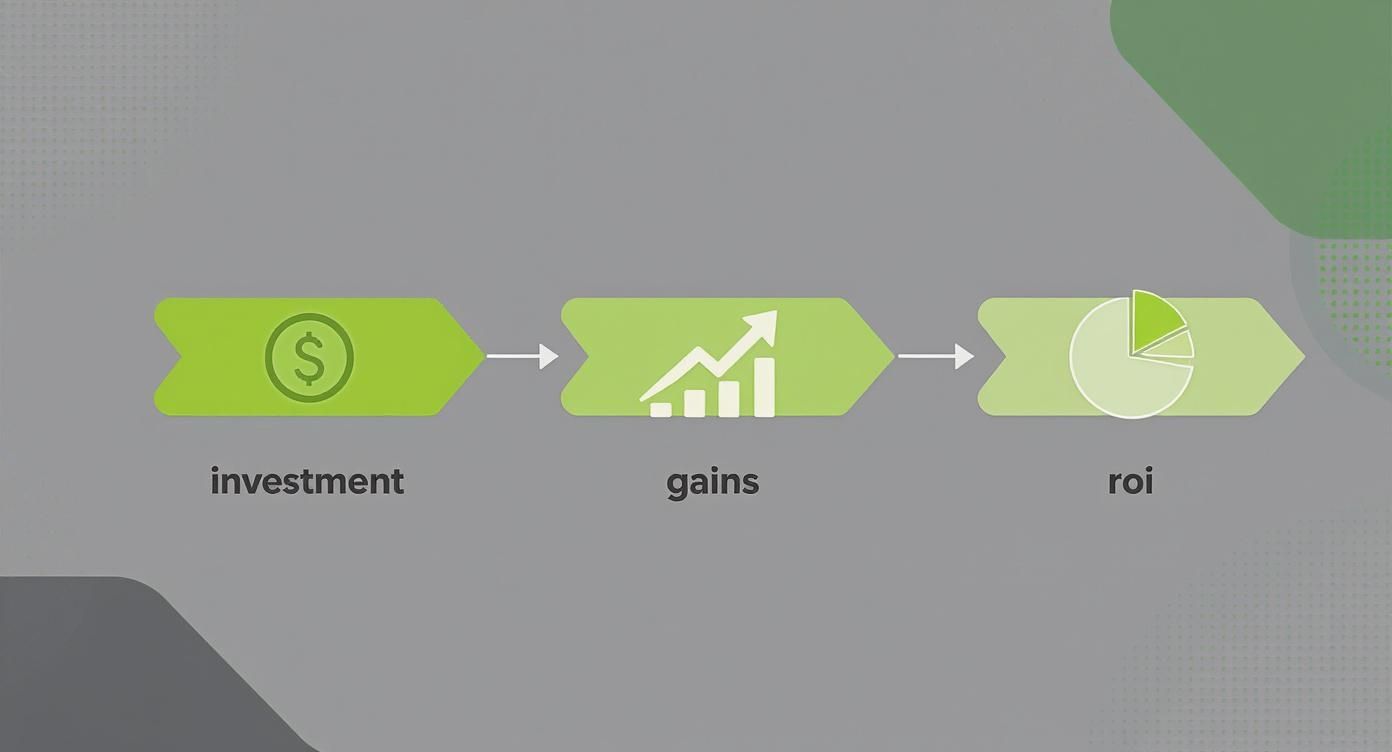
This graphic illustrates the financial journey from investment to operational gains and the final calculated ROI.
Phase 5: Monitor, Measure, and Scale
Implementing an AI solution is not the final step. Continuous monitoring is essential to ensure the models are performing as expected and meeting KPIs. Use this real-time data to fine-tune the system and identify new areas for improvement.
Once your pilot has proven its value, you can begin to scale. Use the lessons learned and the ROI data from your first success to identify the next operational bottleneck. This iterative cycle of proving, improving, and expanding is key to a sustainable AI program.
Turning Insights Into Action
Using AI to improve operations does not require a massive overhaul. A smart approach involves making targeted, incremental improvements that deliver compounding returns. AI is a practical tool for solving real-world problems.
The first step is to find a single bottleneck in your operations. This involves an honest look at where your team's time and energy are being misallocated.
Finding Your Starting Point
Ask this question: What repetitive, time-consuming process, if automated, would free up my team for more valuable work? This is the best place to begin an AI initiative. The goal is to find a high-friction, low-complexity task where a quick win can build momentum.
Consider daily tasks that cause issues:
- Manual Data Entry: Are people spending hours copying information between systems?
- Repetitive Inquiries: Do customer service agents answer the same questions repeatedly?
- Routine Reporting: How much time is spent compiling standard reports?
A successful AI strategy often starts by solving a specific, immediate problem. Targeting a bottleneck creates a focused project with a strong business case and a high chance of showing a measurable return quickly.
Taking That First Step
Once you have identified a candidate for automation, the next step is to scope a small pilot project. This initial test is about proving the value of AI for operational efficiency in a controlled, low-risk setting. It provides the data needed to justify larger investments and builds confidence in the technology across your organization.
This cycle—identify, pilot, measure, and scale—is how successful companies turn AI's potential into a competitive advantage. They start by solving one problem well, prove the value, and then move on to the next.
Frequently Asked Questions About AI in Operations
As leaders explore how AI can boost operational efficiency, some practical questions often arise. It is important to address these concerns before implementation. Here are answers to common questions from operations professionals.
What Is the Typical Cost of Implementing AI?
The cost varies depending on the project's scope. It could be a monthly subscription for a SaaS tool that handles a specific task, like automated invoice processing. Or it could be a larger investment for a custom, enterprise-wide system.
There is no single price. A good approach is to start with a focused pilot project. This lets you prove the technology's value and calculate a clear ROI on a predictable budget before considering a larger rollout.
Will AI Replace Our Existing Staff?
The goal is augmentation, not replacement. These systems are designed to take over repetitive and time-consuming tasks. This frees your employees to focus on strategic work that requires human creativity, critical thinking, and complex problem-solving.
When implemented correctly, AI enhances your team's capabilities. It handles mundane tasks, allowing your experts to focus on high-impact work that creates more value for the business.
How Difficult Is It to Integrate AI With Our Current Systems?
Integration concerns are valid. Most modern AI platforms are designed to connect with existing tools. Seamless integration is a core feature of effective operational AI.
These platforms use Application Programming Interfaces (APIs) and pre-built connectors to communicate with your existing software. This ensures data flows smoothly and securely between the AI and your core systems, like your:
- Enterprise Resource Planning (ERP) system
- Customer Relationship Management (CRM) software
- Other mission-critical operational platforms
This connectivity prevents the creation of new data silos and ensures the AI has the right information to function effectively within your established workflows.
Ready to identify the highest-impact AI opportunities in your operations? The expert team at DSG.AI can design and build a pilot project that delivers measurable results. Explore our work at https://www.dsg.ai/projects.