
Written by:
Editorial Team
DSG.AI
Reader: A Supply Chain Director at a manufacturing or retail company. Problem: Persistent stockouts on key products and high carrying costs for others are eroding margins, but the path to implementing a reliable AI forecasting and inventory solution seems complex and risky. Goal: Educate the reader on a structured, low-risk approach to implementing AI for supply chain optimization to generate demo requests. Funnel Stage: Consideration
Using AI in your supply chain is a shift from reactive problem-solving to a proactive, data-driven strategy. The objective is to apply machine learning to your operational data to anticipate disruptions, optimize inventory levels, and improve logistics. A well-executed AI project can increase efficiency and improve financial performance.
Defining Your AI Strategy and Success Metrics
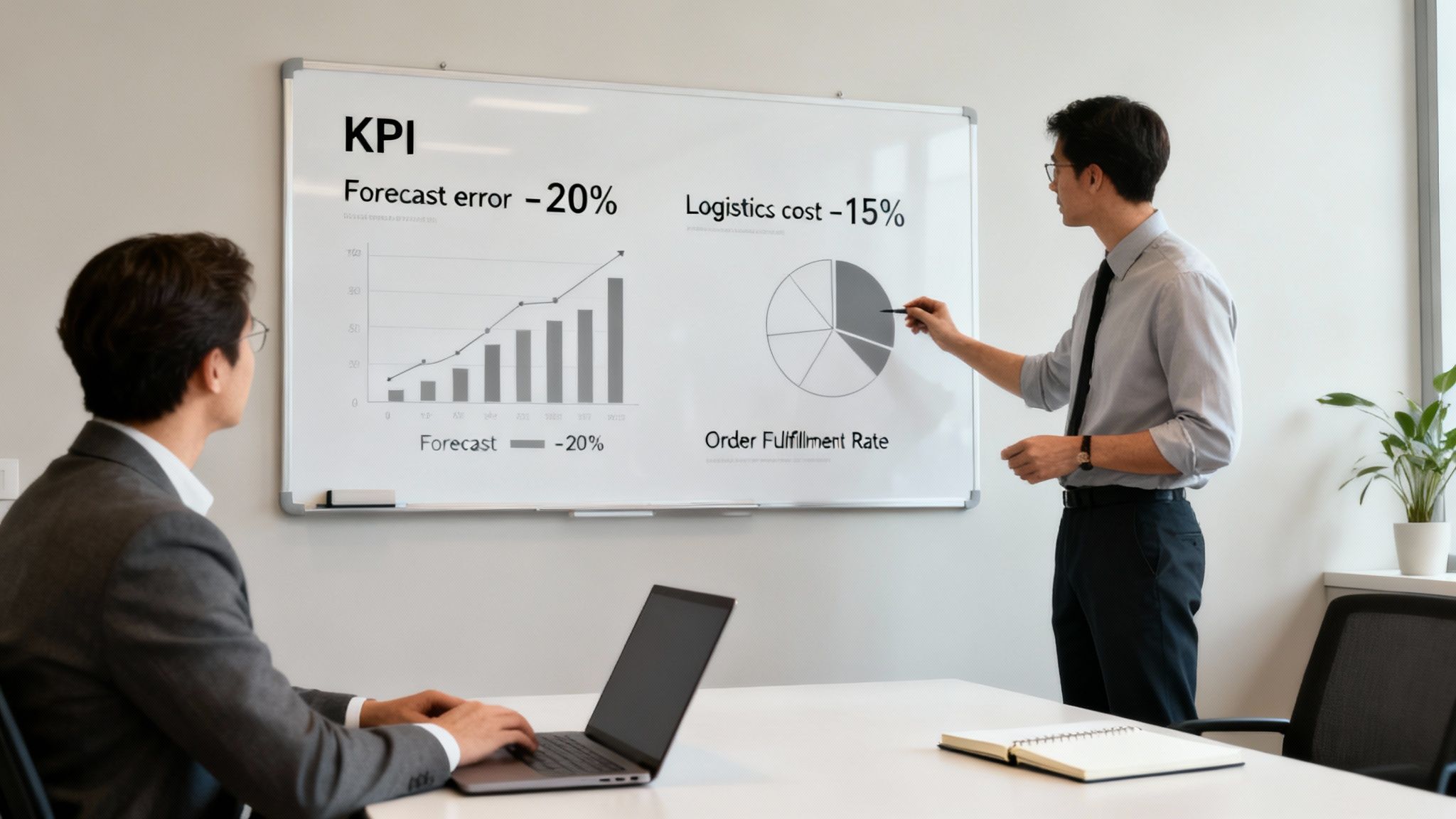
Before writing any code, define the specific problem you intend to solve. Many AI projects fail because they begin with vague goals like "improving efficiency," which is not an actionable target for an algorithm.
Translate broad goals into specific, measurable business outcomes. For example, the goal "reducing stockouts" becomes "decrease stockout instances for our high-velocity SKUs by 15% within six months." This provides a clear objective for the project.
Establishing Your Operational Baseline
To demonstrate the value of an AI project, you must first measure your current performance. Establishing an operational baseline involves analyzing historical data, typically from the last 12-18 months, to create a snapshot of key metrics. This benchmark is used to measure success and calculate the project's return on investment (ROI).
Common baseline metrics include:
- Order Fulfillment Rate: The percentage of orders shipped complete and on schedule.
- Inventory Holding Costs: The total cost of storing unsold goods, including warehousing, labor, and insurance.
- Forecast Accuracy: The variance between demand forecasts and actual sales, often measured using Mean Absolute Percentage Error (MAPE).
- Cash Conversion Cycle: The time required to convert inventory investments back into cash from sales.
Establishing this baseline is a critical first step. Before starting an AI initiative, it is useful to explore various strategies to improve supply chain efficiency to ensure you are targeting a genuine business bottleneck.
Setting Realistic and Measurable AI Targets
With a baseline established, you can set specific targets for your AI project that align with your key performance indicators (KPIs). Data from existing AI implementations shows what is achievable.
According to a 2023 McKinsey report, companies using AI in their supply chains have seen logistics cost reductions of up to 15%, inventory level reductions of up to 35%, and service level improvements of up to 65%. In demand forecasting specifically, AI models can reduce forecast errors by 20% to 50%. This can decrease lost sales due to stockouts by up to 65%.
An AI model does not need to be 100% accurate to provide significant value. For example, a forecasting model that improves accuracy from a 70% baseline to 85% can reduce safety stock requirements and free up working capital. The focus should be on incremental, high-impact gains.
The table below maps common supply chain challenges to specific AI solutions and the KPIs used to measure their success.
Mapping AI Use Cases to Business KPIs
| Supply Chain Challenge | Applicable AI Solution | Primary KPI | Example Success Metric |
|---|---|---|---|
| High Inventory Costs | Inventory Optimization Models | Inventory Holding Costs | 25% reduction in carrying costs for slow-moving stock versus Q3 baseline. |
| Volatile Customer Demand | AI-Powered Demand Forecasting | Forecast Accuracy (MAPE) | Improve forecast accuracy from 75% to 90% for key product lines over six months. |
| Inefficient Logistics | Dynamic Route Optimization | Cost-Per-Mile / On-Time Delivery | Reduce transportation costs by 15% and improve on-time delivery by 10% within one year. |
| Supplier Unreliability | Procurement Risk Analysis | Supplier On-Time-In-Full (OTIF) | Increase OTIF from 80% to 95% by predicting supplier delays based on historical performance. |
This mapping helps align technical efforts with business expectations.
Laying the Groundwork: Your Data and Technology Foundation
An AI model's effectiveness depends on the quality of its data. Preparing your data is a critical phase where most AI for supply chain optimization projects succeed or fail. Underestimating the effort required for data preparation often leads to delays and suboptimal results.
Identifying Your Essential Data Sources
First, identify all data streams relevant to your supply chain. This includes data from internal systems as well as external sources.
Essential data sources often include:
- Historical Sales Data: Granular data by SKU, location, and time period from your ERP system.
- Supplier Performance Metrics: Historical lead times, on-time-in-full (OTIF) rates, and quality reports.
- Logistics and Transportation Data: Shipping manifests, transit times, and carrier costs from your WMS or TMS.
- External Factors: Data on weather patterns, commodity prices, and public holiday schedules.
The main challenge is consolidating this data from different systems, which often use inconsistent formats. For more detail on this process, see this guide on building AI-ready data pipelines.
Getting Real About Data Quality and Standardization
Raw operational data is often inconsistent and contains errors that can negatively impact algorithm performance. A 2022 survey by the APICS Supply Chain Council found that over 70% of supply chain professionals cited poor data quality as a major barrier to AI adoption.
Data cleaning is a time-consuming but necessary process. For example, one system might record supplier lead times in calendar days, while another uses business weeks. An AI model using this conflicting data would produce inaccurate safety stock calculations, leading to both overstocks and shortages.
Fundamental data cleaning tasks include:
- Handling Missing Values: Using statistical methods to address gaps in the data.
- Correcting Inconsistencies: Standardizing units of measure, date formats, and product names across all sources.
- Removing Outliers: Identifying and handling anomalous data points, such as a one-time promotional sale, that do not reflect normal business patterns.
Integrating AI with Your Existing Tech Stack
A successful AI project should integrate with, not replace, your existing systems. The goal is for AI to work with the ERP, WMS, and TMS platforms your team currently uses.
A common approach is to use APIs to connect core systems to a central data platform where the AI models operate. This minimizes disruption. The models pull the required data, run their analyses, and then push recommendations—such as adjusted reorder points or optimized delivery routes—back into your system of record for execution.
Choosing the Right AI Models for Your Goals
With clean data, the next step is selecting the appropriate AI model. Matching the model's capabilities to the specific business problem is critical for achieving your supply chain goals.
AI models used for supply chain optimization generally fall into a few key categories, each designed to address a different type of challenge.
Models for Accurate Demand Forecasting
Demand forecasting is a common starting point for AI implementation. Small improvements in forecast accuracy can reduce both stockouts and excess inventory. This is a prediction problem that uses historical data to forecast future demand.
Two main approaches are used:
- Time-Series Models (e.g., ARIMA): These statistical models identify trends and seasonality from historical sales data. They are well-suited for products with stable demand cycles.
- Machine Learning Models (e.g., Gradient Boosting): These models analyze multiple factors beyond past sales, such as promotional calendars, competitor pricing, and weather, to create a more detailed forecast. They are effective in complex environments with volatile demand.
For example, a beverage company might use a time-series model for its core products and a Gradient Boosting model for a new seasonal drink, incorporating marketing spend and regional temperature forecasts for a more accurate prediction.
Reinforcement Learning for Smarter Inventory Management
Once you have a demand forecast, the next step is determining optimal inventory levels. Inventory optimization can be addressed using a technique called reinforcement learning (RL).
An RL model acts as a virtual planner, learning through simulations to find the optimal reorder points and safety stock levels for thousands of SKUs simultaneously. The RL agent is trained to balance competing goals, such as minimizing holding costs while maximizing service levels. Through millions of simulated cycles, it develops an inventory policy for each product, adjusting dynamically to real-time demand shifts. This moves inventory strategy from a static, rule-based approach to a dynamic system that responds to current market conditions.
Optimizing Logistics with Routing Algorithms
AI delivers measurable cost savings in logistics. Every mile, gallon of fuel, and minute of a driver's time contributes to overall costs. Routing algorithms are a type of optimization model designed to solve large-scale vehicle routing problems.
These models analyze multiple variables to plan efficient multi-stop routes, considering:
- Live traffic conditions
- Delivery windows and customer priorities
- Vehicle capacity
- Driver hours-of-service rules
Companies that implement AI-driven routing can lower their logistics costs by 5% to 20%. Much of this comes from automating scheduling and planning, which allows your team to focus on managing exceptions. You can learn more about AI-driven supply chain trends and how other organizations are using this technology.
A Synthetic Case Study in Action
Label: This is a synthetic example. Consider a mid-sized retailer facing frequent stockouts of popular items while other products accumulated in the warehouse. The company implemented a hybrid AI model combining a Gradient Boosting forecaster with a reinforcement learning inventory model.
The Gradient Boosting component analyzed historical sales, promotional data, and local economic indicators, achieving a 92.5% forecast accuracy—a 17-percentage-point improvement over previous methods. This forecast was fed into the RL model, which continuously adjusted reorder points for over 5,000 SKUs.
Within six months, the company achieved an 18% reduction in inventory holding costs and increased its order fulfillment rate by 22%.
Keeping Your Models Sharp with MLOps
Deploying an AI model is the beginning of the process, not the end. Supply chains are dynamic; market trends, customer behavior, and supplier reliability change. A model that performed well last quarter may become less effective over time. A Machine Learning Operations (MLOps) strategy is essential for maintaining model performance.
MLOps provides the operational framework to ensure your AI models deliver consistent value. For AI in supply chain optimization, this means building a system that continuously learns and adapts to real-world conditions.
Staying Ahead of Performance Decay
Once a model is live, its performance must be monitored. A key risk is concept drift, which occurs when the real-world data no longer matches the data the model was trained on. A sudden change in demand, a competitor's promotion, or a rise in raw material costs can all reduce a model's accuracy.
Track these metrics to detect drift early:
- Model Accuracy: For a demand forecast, a steady increase in the Mean Absolute Percentage Error (MAPE) is a clear indicator that the model's performance is degrading.
- Data Drift: Monitor the statistical properties of input data, such as average order size or supplier lead times, to detect changes.
- Business Impact: A decline in on-time delivery rates or an increase in stockouts can indicate that the model's recommendations are no longer effective.
Put Retraining on Autopilot
When a model's performance declines, you need a process for rapid retraining and redeployment. Automated retraining pipelines can trigger the retraining process automatically using the latest data. For instance, a pipeline can be configured to retrain a demand forecasting model monthly or whenever the forecast error exceeds its baseline by more than 5%.
This automation ensures that your decisions are based on the most current data, allowing your supply chain to adapt quickly. For managing multiple models, a dedicated AI monitoring solution provides necessary oversight and governance.
Closing the Loop with Real-World Feedback
Effective MLOps creates a feedback loop between AI predictions and actual outcomes. Systematically capture real-world results and feed them back into the system.
For a route optimization model, the system should track whether a truck was on time, how much fuel was used, and if there were any unexpected delays. This ground-truth data is used to refine the model's assumptions for future runs. Similarly, for inventory optimization, the feedback loop tracks whether a recommended reorder point led to a stockout or created excess stock. This continuous comparison between predicted and actual outcomes drives ongoing improvement.
Your Six Week AI Pilot Project Blueprint
Starting with a large, enterprise-wide AI deployment can lead to scope creep and budget overruns. A more effective approach is to prove the concept with a focused, time-boxed pilot project.
This six-week blueprint is designed to achieve a measurable result quickly, building momentum and creating a business case for a broader rollout. The pilot follows a three-stage process: define the problem, build the solution, and analyze the results.
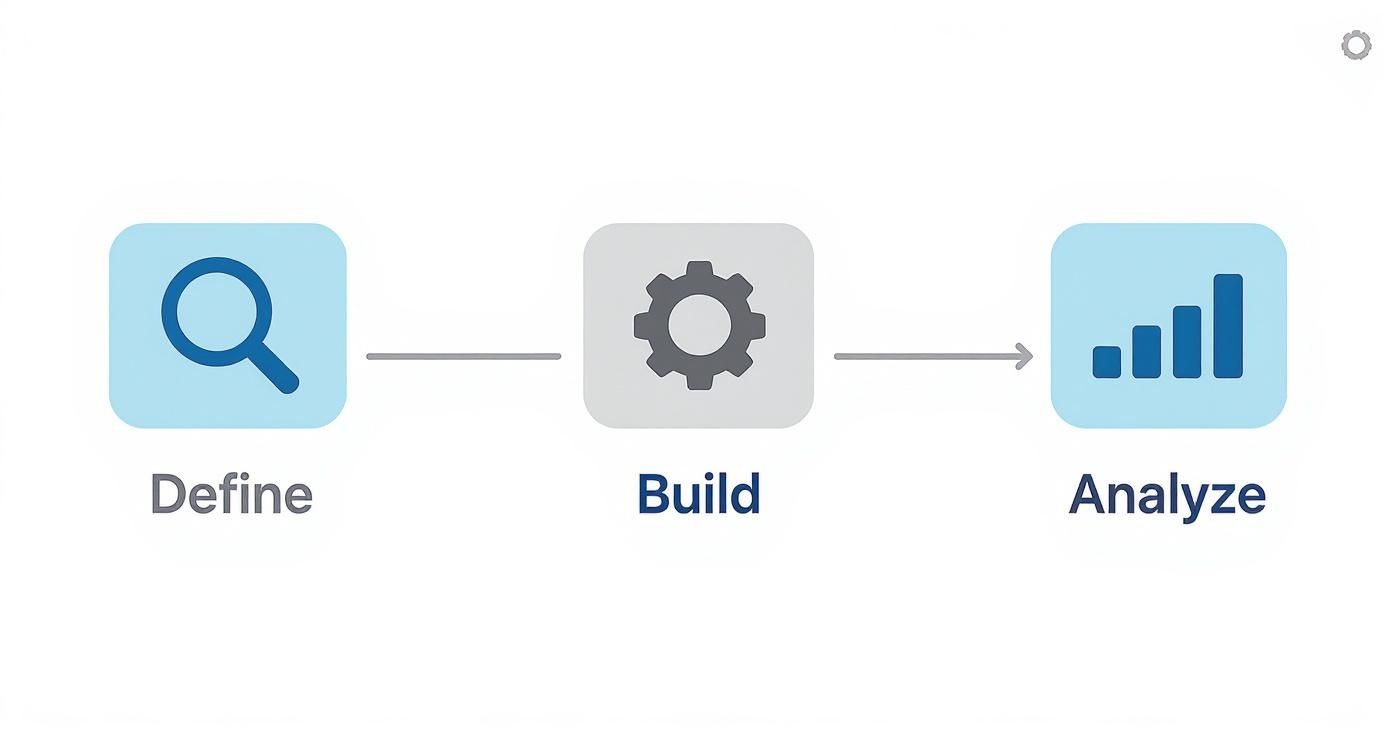
This structured approach ensures that technical work remains focused on business objectives, resulting in a clear, data-backed outcome.
Weeks 1-2: Nail the Scope and Round Up the Data
The first two weeks are for establishing a solid foundation. Select one high-impact, achievable problem and gather the necessary data. Focus on a specific pain point where success will be visible and meaningful, such as demand forecasting for a single, high-priority product category.
Key activities include:
- Stakeholder Alignment: Work with supply chain leaders to define the pilot’s scope and success metrics. Set a clear target, such as "reduce forecast error by 10-15% for our top 20 SKUs."
- Data Source Identification: Map all required data sources, typically including at least two years of historical sales data from your ERP, promotion schedules, and relevant external data feeds.
- Initial Data Extraction: Pull raw data into a staging environment to prepare for modeling.
Weeks 3-4: Build and Validate the Model
The next two weeks are dedicated to data science. The team will build, train, and test the initial AI model. The process should be iterative, starting with a simple model and adding complexity only if it improves accuracy.
The team will develop a prototype and validate its performance against historical data it has not seen before. This backtesting step is critical to confirm the model's predictive power before it is used in a live environment. The key question to answer is: "If we had used this model last year, what would the improvement in our forecast have been?" An effective pilot aims for a "minimum viable model" that demonstrates a clear improvement over the current baseline. A model that improves forecast accuracy by 12% in four weeks is a significant success.
Week 5: Run the Live Trial
In week five, run the AI model in a limited, controlled trial, comparing its recommendations directly against existing processes. A parallel run is often the best approach: your team continues with their standard forecasting method while the AI model generates its own predictions for the same period. This allows for a direct comparison without disrupting operations. At the end of the week, you can compare which forecast was closer to actual sales.
Week 6: Analyze the ROI and Build the Business Case
The final week is about translating the pilot results into a business case. Analyze the performance data from the live trial, calculate the potential ROI, and present the findings to stakeholders. Quantify the impact. For example, a 12% reduction in forecast error for the pilot product group could translate to a projected $1.2 million reduction in annual inventory holding costs if scaled across the business. The deliverable is a concise presentation that summarizes the pilot's success and outlines a phased roadmap for an enterprise-wide rollout.
This timeline breaks down the key focus areas and deliverables for each week.
Six Week AI Pilot Project Timeline
| Week | Key Focus Area | Activities and Deliverables |
|---|---|---|
| Week 1 | Problem Framing & Scoping | Conduct stakeholder workshops to define the business problem. Finalize scope, target KPIs (e.g., forecast accuracy), and success criteria. |
| Week 2 | Data Discovery & Ingestion | Identify all required internal and external data sources. Extract, centralize, and perform initial data quality checks. Deliverable: A consolidated dataset ready for analysis. |
| Week 3 | Exploratory Data Analysis & Feature Engineering | Analyze the data for patterns and correlations. Create new features that will improve model performance. Deliverable: An initial feature set and data insights summary. |
| Week 4 | Model Development & Backtesting | Build and train several candidate models (e.g., ARIMA, XGBoost). Validate performance against a hold-out historical dataset. Deliverable: A validated "champion" model. |
| Week 5 | Live Parallel Trial | Run the AI model alongside the existing process to generate forecasts for a live period. Collect performance data from both methods. Deliverable: Raw comparison data. |
| Week 6 | ROI Analysis & Final Presentation | Analyze trial results, quantify the business impact (cost savings, efficiency gains), and calculate projected ROI. Deliverable: A final business case presentation with a rollout roadmap. |
This six-week structure provides a proven path from idea to a data-backed success story. To see how these engagements are structured, you can review some of our past AI pilot projects.
Your Top Questions About AI in Supply Chain, Answered
When discussing AI implementation with supply chain leaders, several practical questions consistently arise. Addressing these upfront can build confidence and ensure a project starts on the right track.
How Much Does an AI Supply Chain Solution Cost?
The cost depends on the scope. A focused pilot project to demonstrate the value of AI for demand forecasting for a single product line typically costs between $50,000 and $150,000. This generally includes initial data integration, model development, and a short-term software license.
A full-scale, enterprise-wide rollout can range from several hundred thousand to millions of dollars. The primary cost drivers are the condition of your data infrastructure, the complexity of the models required, and the number of integrations with your existing ERP and WMS. A Software-as-a-Service (SaaS) model can be a cost-effective way to start, with a lower initial investment and predictable ongoing costs.
How Do We Handle Data Privacy and Security?
Data security must be a core component of the project from the beginning. Ensure that your approach complies with regulations like GDPR. Work with partners that provide end-to-end data encryption for data in transit and at rest.
Anonymize or pseudonymize sensitive information where possible. Implement role-based access control (RBAC) so that individuals can only access the data necessary for their roles. If using cloud platforms like AWS or Azure, verify their security certifications (e.g., ISO 27001, SOC 2). These security measures should be defined in your AI governance framework before the project begins.
What Skills Does My Team Need to Manage an AI System?
You do not need to hire a team of data scientists, particularly if you work with an AI partner. However, having key internal personnel is crucial for success.
- The Project Champion: An internal expert who understands your supply chain's business logic and can guide the project.
- The IT Liaison: An IT team member who can manage API integrations between the AI platform and your existing systems.
- The "Data Translator": An individual who can communicate business challenges to the technical team and technical solutions to the business team.
The most critical factor for long-term value is training your existing supply chain planners to interpret and act on the insights provided by the AI system.
Will AI Replace Our Human Supply chain Planners?
No. The goal is augmentation, not replacement. AI models can process large datasets to identify patterns and make recommendations at a scale humans cannot. They handle the repetitive, data-intensive tasks, freeing up planners for more strategic work.
Human expertise is still needed for managing exceptions, nurturing supplier relationships, and making strategic decisions that require context and judgment. An effective approach is a "human-in-the-loop" system, where AI automates routine tasks, allowing your team to focus on high-value work. This collaboration unlocks the full potential of AI for supply chain optimization.
At DSG.AI, we build enterprise AI solutions that deliver measurable business value. Our six-week pilot projects are designed to demonstrate a clear ROI and provide a scalable foundation for future innovation. Explore some of our past AI pilot projects to see how we address complex supply chain challenges.