
Written by:
Editorial Team
DSG.AI
Digital transformation in logistics replaces manual processes with connected digital tools. This guide explains how to move from paper manifests and phone calls to a data-driven system that provides a clear, real-time view of your supply chain. This shift helps logistics companies meet demands for speed, accuracy, and transparency.
Why Digital Transformation Matters in Logistics
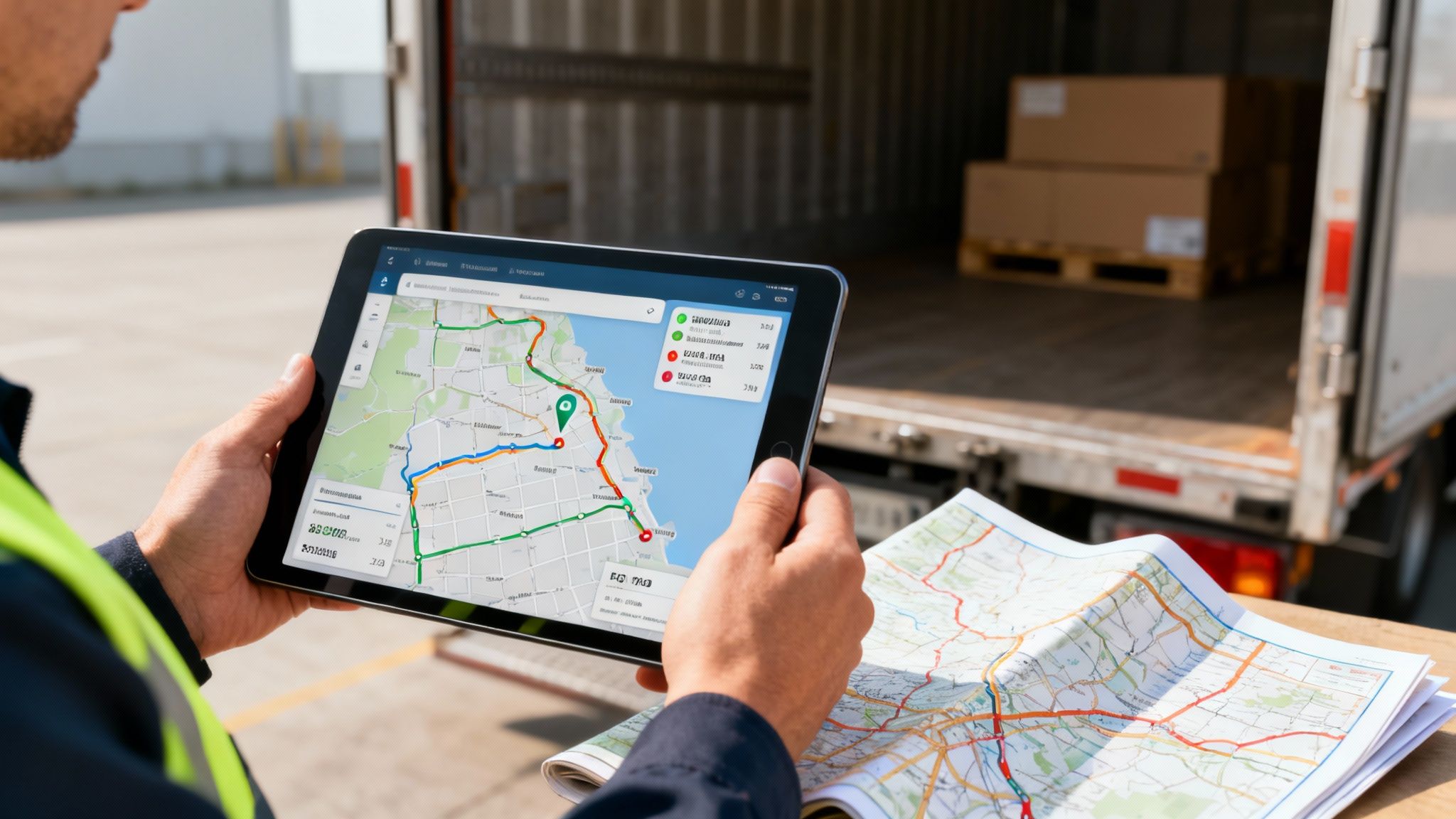
For decades, the logistics industry ran on paper, spreadsheets, and phone calls. This approach is no longer sufficient. Customers now expect fast, reliable, and transparent deliveries, which puts pressure on supply chains using outdated systems. These systems create friction, leading to costly mistakes and delays.
A traditional logistics operation is like navigating a cross-country trip with a paper road atlas. You know the intended route, but you have no insight into traffic jams, construction, or a newly opened, faster highway. A digitally-driven operation is like using a live GPS. It provides a static map and constantly analyzes conditions, predicts delays, and suggests the best path as conditions change.
The Cracks in Traditional Operations
Manual processes can lead to human error. A typo during data entry in a warehouse or a misheard detail about a shipment’s status can cause a series of problems. This lack of real-time visibility means that when something goes wrong—a delayed truck, a lost pallet—it is often discovered too late to fix.
This traditional model faces several core challenges:
- Data Silos: Information is often isolated in different departments or incompatible systems, making it difficult to get a single, clear view of the supply chain.
- Reactive Problem-Solving: Teams react to disruptions after they happen instead of anticipating them.
- High Operational Costs: Time spent on manual tasks, inefficient routes, and poor inventory control increase expenses and reduce profits.
The Market Momentum
The move toward digital technology is a significant economic shift. According to market analysis from Mordor Intelligence, the global digital logistics market was valued at USD 27.42 billion in 2024 and is projected to reach USD 76.43 billion by 2029, growing at a compound annual growth rate of 22.76%. This growth indicates that businesses are investing in smarter, more agile supply chains.
The difficulty of navigating complex customs processes and harmonized tariff codes increases the need for digital systems to reduce errors and speed up global trade.
By adopting digital tools, logistics companies have reported measurable results. For example, some have seen a 5% to 10% reduction in fuel costs from AI-powered route optimization. Others have reported a 15% to 25% improvement in warehouse picking efficiency with automation. These are fundamental improvements that directly impact financial performance.
Core Technologies Driving Real-World Results
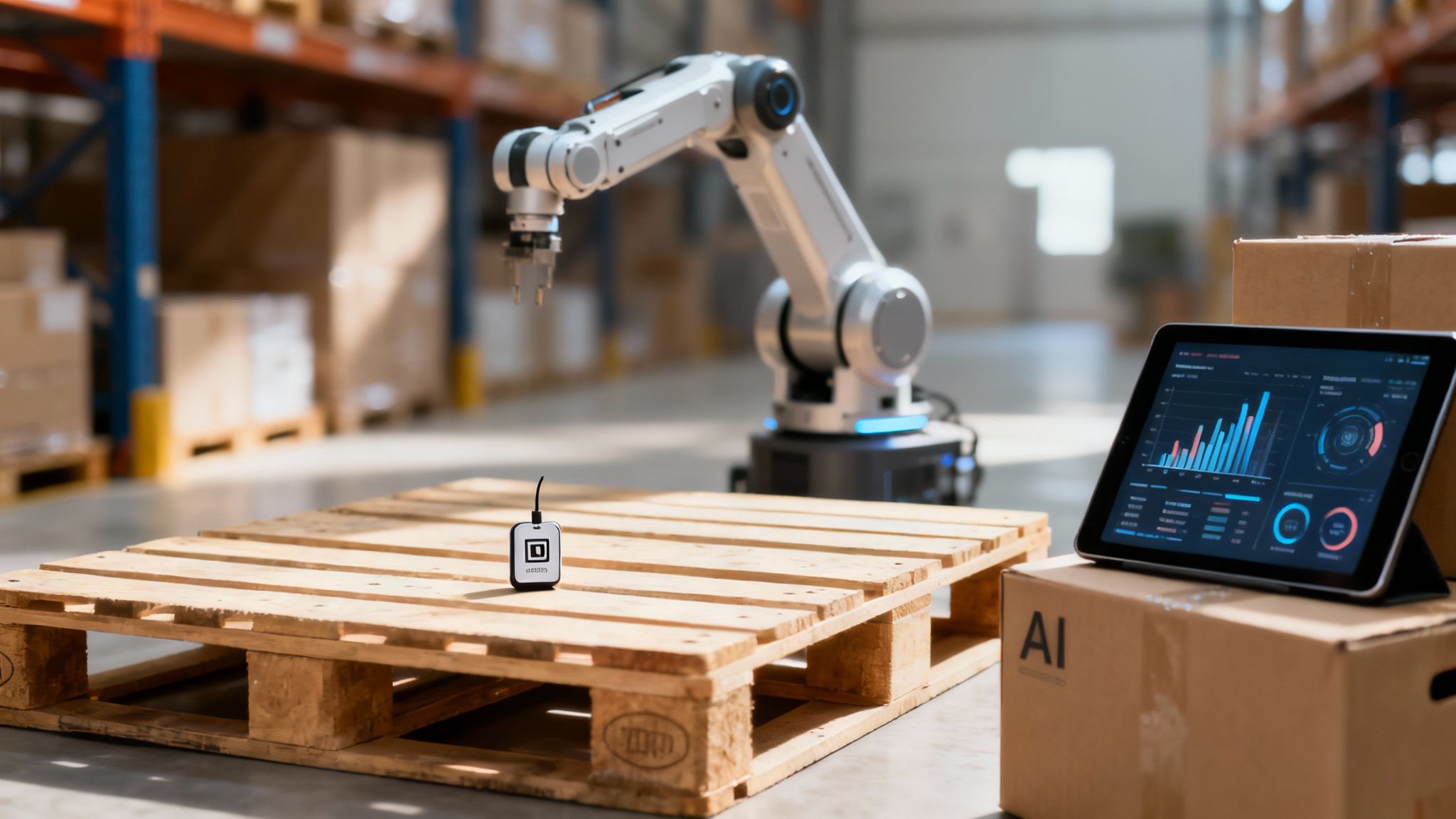
Digital transformation focuses on solving logistics problems, such as locating a missing pallet or anticipating port closures. Several core technologies help turn data into clear, decisive actions.
This process is like building a connected system for your supply chain. Artificial Intelligence (AI) analyzes complex information to predict future events. The Internet of Things (IoT) uses sensors to collect live data from trucks, containers, and warehouse shelves. Robotics and automation perform physical tasks with precision and speed.
Artificial Intelligence and Machine Learning
AI and Machine Learning (ML) shift logistics from a reactive approach to a proactive one. Instead of just tracking a shipment, these systems can predict its arrival time by considering traffic, weather, and historical data.
For example, in demand forecasting, AI can analyze sales history, seasonality, and market trends to help manage inventory levels. This can lead to a 10% to 20% reduction in excess inventory within the first year of implementation.
Route optimization is another area where AI provides benefits. AI algorithms can calculate the most efficient delivery routes, saving time and money. Companies often report a 5% to 15% decrease in fuel costs and an increase in on-time delivery rates. AI-powered orchestration connects these systems, ensuring that insights from one system, like forecasting, automatically trigger actions in another, such as warehouse staffing.
The Internet of Things
The Internet of Things (IoT) provides digital visibility for physical assets. By attaching sensors to containers, vehicles, or pallets, you receive a constant stream of data about their location, condition, and environment.
For example, a sensor on a refrigerated container carrying pharmaceuticals can monitor the temperature in real time. It can send an alert if the temperature deviates from the safe range, allowing for intervention before the product is compromised. This helps protect product integrity and meet regulatory standards.
The global market for IoT in logistics is projected to reach USD 116.70 billion by 2030, according to a 2023 report by Precedence Research. This growth is driven by companies recognizing the value of real-time asset tracking for improving accuracy and control. For fleets adopting this technology, a practical step is understanding the nuances of AOBRD and ELD systems to ensure a smooth transition.
Robotics and Automation
While AI and IoT manage data, robotics and automation handle physical work. In modern warehouses, Autonomous Mobile Robots (AMRs) bring shelves directly to human pickers. This change reduces walking distance and speeds up the order fulfillment process.
This technology addresses labor shortages and boosts productivity. Facilities that deploy AMRs typically report a 25% to 40% increase in order fulfillment speed and reduce picking errors by more than 50%. Automated sorting systems can process thousands of packages per hour with minimal human intervention.
The following table breaks down how these technologies translate into business value.
Key Technologies and Their Business Impact
| Technology | Primary Function | Key Business Benefit | Example Metric |
|---|---|---|---|
| AI/Machine Learning | Analyzes data to predict outcomes and automate decisions. | Reduces costs through proactive planning and optimization. | 15% reduction in fuel costs through optimized routing. |
| Internet of Things (IoT) | Gathers real-time data from physical assets using sensors. | Provides end-to-end visibility and protects asset integrity. | 99% accuracy in cold chain temperature monitoring. |
| Robotics & Automation | Performs physical tasks like moving, sorting, and packing goods. | Increases operational speed, accuracy, and throughput. | 40% increase in order fulfillment speed with AMRs. |
These technologies are most powerful when they work together.
An IoT sensor detects a delay. The AI system recalculates the delivery route and adjusts inventory forecasts. At the same time, warehouse robots re-prioritize the next urgent shipment.
This interconnected system is the core of digital transformation. It creates a supply chain that learns from disruptions, turning operational data into a competitive advantage.
How to Build a Business Case for Transformation
To get approval for a major operational overhaul, you must present a clear, data-backed path to a positive return on investment. A strong business case shifts the conversation from a concept to a concrete financial outcome, showing how new logistics technology will improve profitability.
Translate technology features into tangible business value. Pin down the projected impact on direct cost savings, productivity gains, and new revenue opportunities. Vague goals are insufficient; use specific numbers.
Quantifying the Core Benefits
Build your business case on realistic financial projections. Anchor your proposal with conservative estimates based on industry benchmarks and your specific operational challenges.
A strong pitch will detail the expected returns in these key areas:
- Direct Cost Reductions: Identify current expenses that technology can reduce or eliminate. This could include a 5% to 10% decrease in fuel spend from AI-powered route planning or fewer detention fees due to improved dock scheduling.
- Productivity Gains: Accomplish more without adding staff. A new Warehouse Management System (WMS) paired with handheld scanners could lead to a 15% to 25% improvement in warehouse pick rates, which directly boosts throughput.
- Revenue Growth: Better capabilities can open up new business opportunities. For instance, achieving 99% on-time delivery accuracy with real-time tracking can make you eligible for premium freight contracts that were previously out of reach.
A strong business case identifies the root of a business problem and draws a direct line from the investment to a measurable financial outcome.
A Synthetic Example From the Field
Consider a mid-sized distributor, "Reliable Goods Inc.," with a fleet of 50 trucks and a 100,000-square-foot warehouse. Leadership is hesitant about a $250,000 investment for a modern WMS and IoT fleet trackers. This is a synthetic example to illustrate the process.
The logistics manager builds a case by projecting a positive ROI in under 24 months, using these conservative estimates:
| Benefit Category | Current Annual Cost/Loss | Projected Improvement | Annual Savings/Gain |
|---|---|---|---|
| Fuel Costs | $1,200,000 | 8% reduction via route optimization | $96,000 |
| Lost/Damaged Goods | $75,000 | 40% reduction with IoT tracking | $30,000 |
| Warehouse Labor | $800,000 | 10% productivity gain with WMS | $80,000 |
| Customer Churn | $150,000 (Lost revenue) | 20% reduction from better service | $30,000 |
| Total Annual Impact | $236,000 |
This example shows that the initial $250,000 investment is nearly recovered within the first year, with a projected ROI over 180% by the end of year two. By presenting the argument in this structured, data-first format, the manager frames the expense as a strategic investment.
A Practical 12-Month Implementation Roadmap
A large-scale digital overhaul in logistics can be managed with a structured, phased approach that builds momentum and demonstrates value at each step. Breaking the journey into a 12-month roadmap turns a large initiative into a series of clear, measurable projects.
Think of it like building a house. You start with a foundation before framing the walls, installing utilities, and adding the finishing touches. Each stage prepares for the next, ensuring the project is stable and successful.
Quarter 1: The Foundation of Assessment and Planning
The first 90 days are for discovery and strategy. Before considering technology, you need an honest understanding of your operational bottlenecks. Map out existing workflows—from order intake to final delivery—and pinpoint where friction, delays, and unnecessary costs occur.
The main goal is to identify one or two significant pain points that offer a high potential return on investment. Once identified, you can define a focused pilot project.
Key activities for Q1 should include:
- Stakeholder Workshops: Talk to warehouse staff, drivers, and managers to understand their daily challenges.
- Process Mapping: Document current workflows to identify inefficiencies, such as manual data entry or redundant approval steps.
- KPI Baseline Establishment: Measure your current on-time delivery rates, order accuracy, and cost-per-shipment to establish a baseline.
- Pilot Project Definition: Select a small, contained area for an initial test. For example, equip a single fleet of five trucks with new IoT trackers.
Success in this quarter is defined by a well-defined pilot scope, a baseline of data to measure against, and agreement from key team members.
Quarter 2: The Pilot and Partner Evaluation
With a plan in place, Quarter 2 is for execution and learning. Launch your pilot project and begin evaluating technology partners. A small-scale test allows you to see how a new technology performs in your specific environment without disrupting your entire operation.
At the same time, you will vet potential vendors. A good partner understands your operational goals and offers support and training. The objective is to validate your chosen solution and select a partner who can scale with you.
A successful pilot should demonstrate a measurable improvement over the baseline. For an IoT tracking pilot, a realistic goal might be a 5% to 8% reduction in idle time or a 15% decrease in "where is my truck?" calls from customers.
By the end of this quarter, you should have conclusive data from your pilot and a signed contract with your chosen technology vendor.
This is where you begin to see how targeted improvements deliver business value, starting with lower costs and leading to better productivity and revenue growth.
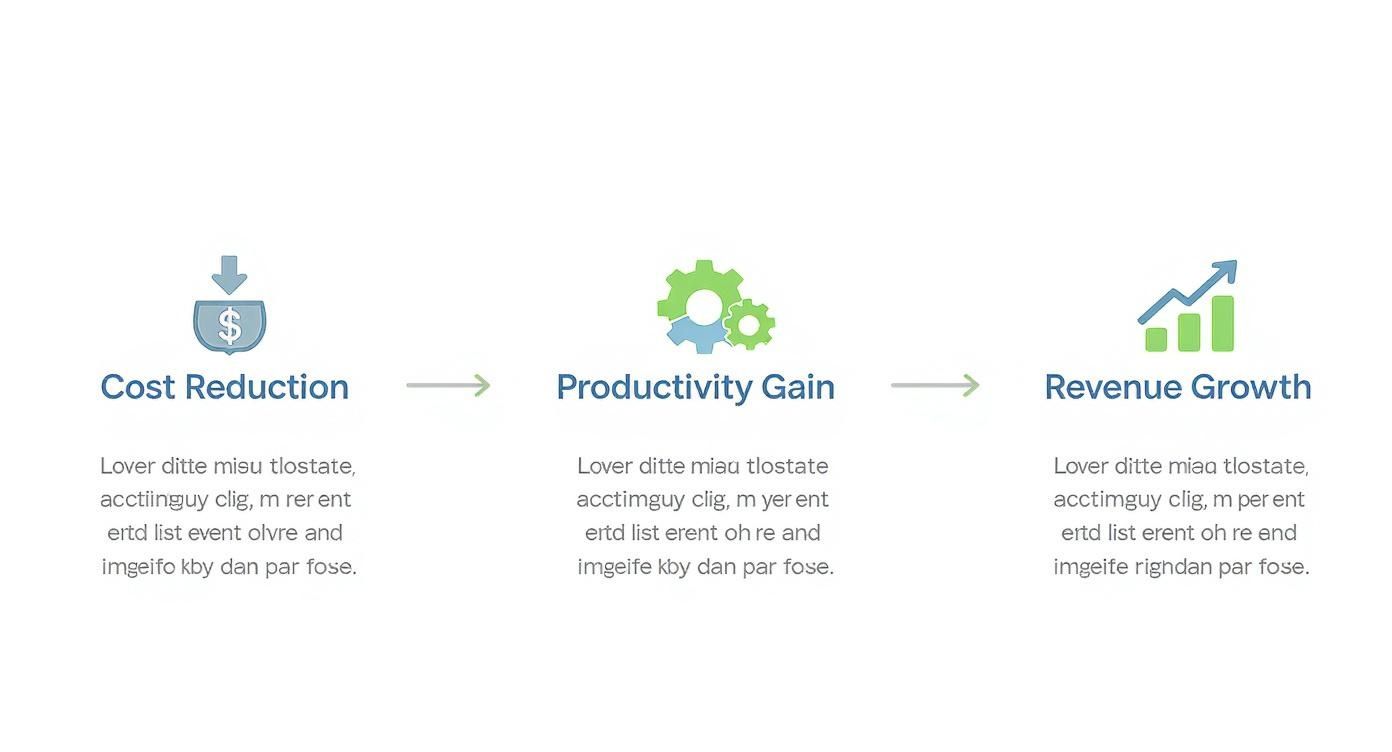
The image above illustrates that a successful pilot, focused on initial cost savings, creates the foundation for greater operational productivity and long-term financial health.
Quarter 3: The Phased Rollout and Training
Now it is time to expand. In Quarter 3, you will apply the lessons from your pilot and start a phased rollout across a larger part of your operations. This could mean outfitting the rest of your regional fleet or implementing a new WMS in one of your three warehouses.
This phase involves both people and technology. Change management is a primary focus. Invest in training your team, clearly communicating the benefits, and addressing any resistance. It is also important to ensure teams have access to governance tools that provide clear visibility and control. For more information, you can explore our guide on how to properly manage AI monitoring for better oversight.
The goal is a smooth, controlled expansion. Success is measured by user adoption rates and team proficiency with the new tools.
Quarter 4: Scaling and Continuous Optimization
The final quarter is about reaching full operational scale and adopting a mindset of continuous improvement. The technology should be fully integrated across all targeted departments or facilities. Your focus shifts from implementation to optimization, using the data from your new systems to find more efficiencies.
At this stage, your Key Performance Indicators (KPIs) guide your efforts. You will analyze performance trends, identify new areas for refinement, and work with your teams to maximize the benefits of your new digital toolkit.
The goal for Q4 is to make the technology an indispensable part of your daily operations and to build a culture that uses data for decision-making. A true transformation does not end after 12 months—it creates a new, more agile foundation for ongoing growth.
This table provides a high-level overview of the implementation plan.
Phased Implementation Plan
| Phase (Quarter) | Key Activities | Primary Goal | Success Metric |
|---|---|---|---|
| Q1 | Conduct stakeholder workshops, map existing processes, establish baseline KPIs, and define a pilot project scope. | Identify key pain points and create a strategic plan for a limited, high-impact pilot. | A clearly defined pilot project, baseline performance data, and stakeholder agreement. |
| Q2 | Launch the pilot project, gather performance data, vet and select technology vendors, and negotiate contracts. | Validate the chosen technology in a real-world setting and secure a long-term partner. | Measurable improvement in pilot KPIs (e.g., 5-8% efficiency gain) and a signed vendor contract. |
| Q3 | Begin a phased rollout to larger operational areas, conduct extensive user training, and focus on change management. | Achieve successful user adoption and expand the solution's footprint smoothly. | High user adoption rates (>80%), positive feedback from trainees, and successful deployment in the target area. |
| Q4 | Complete the full-scale deployment, analyze performance data, and establish a process for ongoing optimization. | Fully integrate the technology into daily operations and build a data-driven culture. | Meeting or exceeding target KPIs, and the establishment of a continuous improvement review cycle. |
Following a structured plan like this clarifies the process, making a year-long transformation a series of deliberate steps.
Real-World Success Stories and Measurable Wins
The real test of any digital transformation is its impact on business performance. Seeing how other companies have managed this shift provides a model for success, turning concepts into concrete, measurable outcomes. The proof is in the numbers—lower costs, faster operations, and fewer mistakes.
These outcomes are becoming more common as leaders invest in digital tools. A recent PwC survey found that 62% of operations executives see AI as effective for improving productivity and managing costs. The same study revealed that 96% of tech and telecom supply chain leaders confirmed that digital tools gave them visibility into their end-to-end costs. You can find more details in PwC's 2025 Digital Trends survey.
Large Retailer Cuts Freight Costs with AI
A large retailer was dealing with unpredictable shipping costs and inconsistent delivery times. This affected customer satisfaction and profit margins.
-
The Problem: Their route planning and carrier selection were manual and inefficient. They could not analyze freight options in real-time, which led to overpaying for last-minute shipments and missing opportunities to consolidate loads. This resulted in a high annual freight spend and an on-time delivery rate that was below competitors.
-
The Solution: They implemented an AI-powered Transportation Management System (TMS). The new platform analyzed historical shipping data, real-time carrier rates, and traffic patterns to automate route optimization. It could predict transit times with high accuracy and automatically select the most cost-effective carrier for each shipment.
-
The Result: Within the first year, the retailer saw an 8% reduction in its annual freight costs. Their on-time delivery rate increased by 12 percentage points, which helped improve customer retention and reduce service recovery costs.
This is an example of how AI shifts a logistics operation from reactive decisions to a proactive, data-driven strategy. Their success led them to explore other automation opportunities, which you can see in some of our enterprise AI case studies.
3PL Provider Boosts Throughput with Robotics
A third-party logistics (3PL) provider was under pressure to process e-commerce orders faster and with higher accuracy. Their warehouse used a manual picking process, which was slow, labor-intensive, and prone to errors, especially during peak seasons.
-
The Problem: High labor costs, a high number of picking errors, and an inability to scale for seasonal demand were impacting their profitability. Their manual system could not meet the fulfillment speeds required by major online retailers, which put important contracts at risk.
-
The Solution: The 3PL deployed a fleet of Autonomous Mobile Robots (AMRs) in their main fulfillment center. These robots worked alongside the human team, bringing shelves of products directly to packing stations. This eliminated the time employees spent walking through the aisles.
By redesigning the workflow around human-robot collaboration, the 3PL addressed its core operational bottlenecks—speed and accuracy—without a complete facility overhaul.
- The Result: The facility achieved a 30% increase in hourly order processing and a 50% reduction in picking errors. This efficiency allowed them to meet stricter service-level agreements (SLAs) and take on more clients without a proportional increase in staff.
Answering the Tough Questions About Logistics Transformation
Overhauling logistics operations is a significant undertaking. Leaders will have practical questions before starting. Moving from established processes to new, tech-driven workflows requires addressing common challenges directly.
A common mistake is focusing on the new technology instead of the process it is meant to fix. Buying a new TMS or WMS is not the final goal. The real goal is to get products out the door faster and with fewer errors. This means rethinking the workflow first, not just adding a digital layer to old habits.
But Can We Actually Afford This?
There is a misconception that a full digital overhaul is only for large companies. This is no longer the case. The rise of scalable Software-as-a-Service (SaaS) models has made these tools more accessible.
Small and mid-sized businesses can now use powerful tools without a large upfront investment.
Instead of a large capital expense, you can implement changes in manageable phases:
- Start with a small, high-impact pilot project to prove the ROI.
- Pay for the technology through a subscription, which fits into an operational budget.
- Expand the solution across the organization only after the business case is proven.
This approach breaks down a large project into a series of strategic, data-backed steps.
The real shift is in mindset. View it as a series of incremental improvements that de-risk the investment and allow the transformation to start paying for itself.
How Do We Get Our Team on Board?
New technology, especially automation, can cause concern among employees about job security. Addressing these concerns is an important part of leadership. This requires clear communication and framing the change correctly.
This is not about replacing people; it's about augmenting their skills.
An automated sorting system frees up experienced warehouse staff to handle more complex work, such as quality control, managing exceptions, and solving problems that a robot cannot. The conversation should focus on training and upskilling, showing your team how these tools make their jobs less repetitive and more valuable. When you involve them in the process and show them the benefits, you can turn resistance into engagement.
At DSG.AI, we design and build AI systems that solve operational challenges and deliver a clear return on investment. Our architecture-first approach ensures that your solutions are built to scale, are reliable, and integrate with your existing workflows. To see how we turn complex data into a competitive advantage, take a look at some of our past enterprise AI case studies.