
Written by:
Editorial Team
Editorial Team
An agentic AI workflow is a system where autonomous AI agents plan and execute complex, multi-step tasks to achieve a specific goal, without step-by-step human guidance. It acts like an expert project manager that can create a strategy, delegate tasks to different tools, adapt to unexpected issues, and use multiple software applications to complete its objective.
From Simple Automation to Autonomous Action
For years, business automation has focused on digital assembly lines. These systems are effective at performing the same simple, repetitive task with high precision. An example is a script that automatically approves any expense report under $50; it follows one fixed rule. This approach works for predictable, high-volume processes, but it fails when it encounters an unexpected event or a task that requires judgment.
An agentic AI workflow represents a different approach. Instead of merely following a command, an agentic system understands the goal behind that command. This understanding enables it to operate autonomously.
An agentic workflow changes automation from a static, rule-based process into a dynamic, goal-oriented system. It's the difference between a tool that follows instructions and a team member that solves problems.
Traditional Automation vs Agentic AI Workflow
To clarify the difference, let's compare the two approaches. The table below outlines the shift from legacy systems to modern agentic AI.
| Attribute | Traditional Automation | Agentic AI Workflow |
|---|---|---|
| Execution Path | Rigid and predefined script | Dynamic and self-generated plan |
| Core Function | Executes a specific, single task | Aims to achieve a broad, high-level goal |
| Adaptability | Fails on unexpected errors | Re-plans and problem-solves in real-time |
| Tool Usage | Limited to integrated, siloed tools | Accesses and coordinates a wide range of tools & APIs |
| Human Role | Sets the goal, reviews the final outcome | Constant oversight and intervention |
| Decision Logic | Simple "if-then" rules | Complex reasoning and contextual understanding |
This is not a minor upgrade. We are moving from systems that need to be told how to do something to systems that only need to be told what needs to be done.
Market demand reflects this shift. The global Agentic AI market is projected to grow from $61.4 million to $260 million by 2032, with a compound annual growth rate of 20.1% (source: Custom Market Insights report, May 2024). This growth indicates that businesses are adopting autonomous agents to handle complex processes.
Let's break down the key differences:
-
Static vs. Dynamic Execution: Traditional automation follows a hard-coded path. If step C fails, the entire process stops. An agentic workflow creates its own plan and can modify it if it encounters a problem.
-
Single-Task vs. Goal-Oriented: A traditional bot is built for one task, like "extract invoice data." An AI agent is given a broader goal, such as "process all incoming vendor invoices for Q3," and it determines the necessary sub-tasks to accomplish this.
-
Limited Tools vs. Broad Capabilities: Old automation is often confined to a single application. Agents can pull data from a database, search the web, interact with an API, and send an email as part of a single, coordinated effort.
For any technology leader, understanding this distinction is crucial. The quality of decisions made by these intelligent systems depends on the quality of the data they receive. A solid data foundation, like an automated document workflow for high-quality data retrieval, is essential. It provides the agent with reliable information needed for effective action. By moving beyond simple task execution, companies can build systems that add intelligence to their operations.
The Four Pillars of an Agentic AI System
An agentic AI workflow is a dynamic system built on four foundational pillars that work together to achieve complex, goal-driven tasks. Understanding these pillars is key to designing an effective agentic AI workflow.
This conceptual map shows how the core components—Agents, Tools, and Memory—are the building blocks of any agentic system.
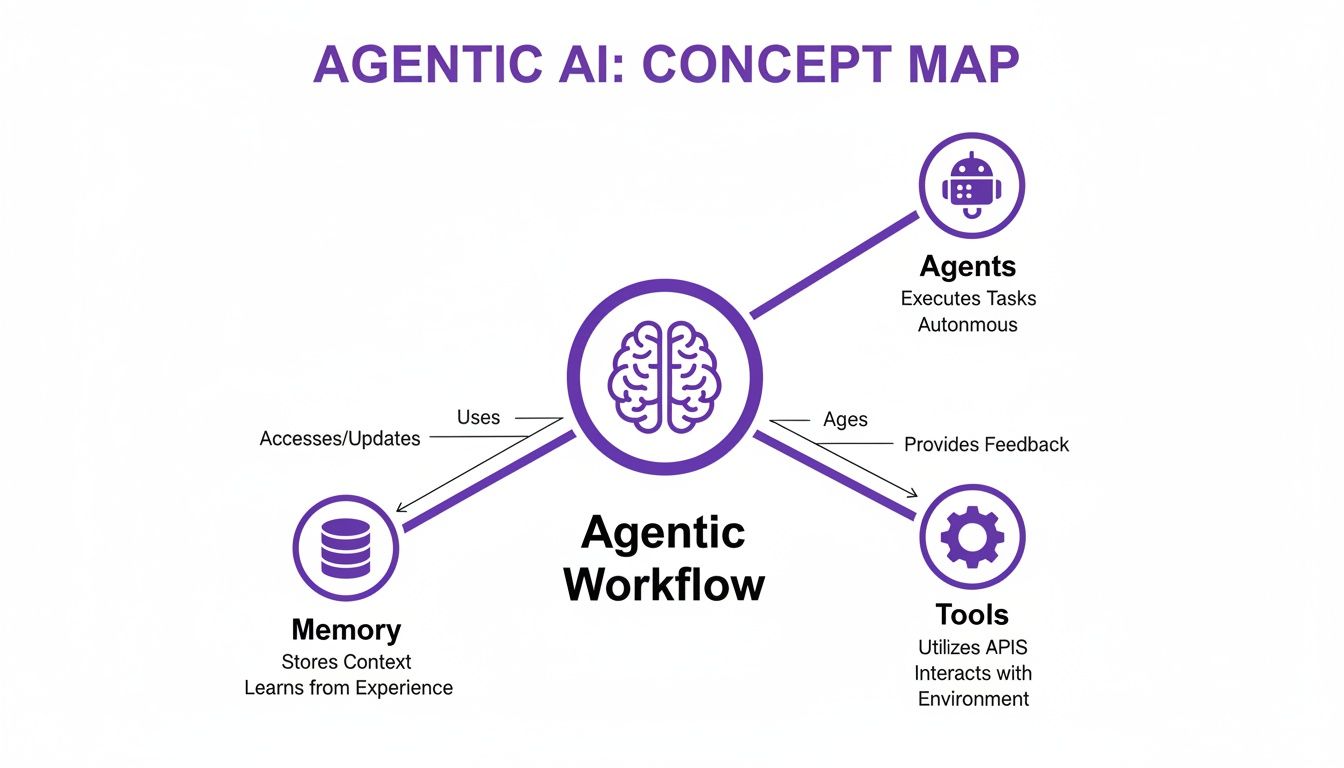
The central workflow depends on agents to make decisions, tools to take real-world action, and memory to maintain context and improve over time.
The Agent: The Decision-Making Core
The Agent is the "brain" of the operation, typically powered by a Large Language Model (LLM) that provides reasoning and planning capabilities. Its main job is to take a high-level goal and break it down into a series of smaller, actionable steps.
For example, consider the goal: "Generate the Q3 sales performance report." An agent might formulate a plan like this: query the CRM for sales data, connect to the finance database for revenue figures, analyze the combined data for key trends, and compile the findings into a summary document. This process of breaking down a large problem into smaller parts is called task decomposition.
Tools: The Bridge to Your Business Systems
An agent with a plan but no way to execute it is ineffective. Tools are the APIs, functions, databases, and other services that allow the agent to interact with enterprise systems and the external world. They are the agent's hands and eyes, turning plans into actions.
In an enterprise setting, an agent's toolkit might include:
- API Connectors: To pull data from systems like Salesforce, SAP, or internal microservices.
- Database Queries: To retrieve specific information from SQL or NoSQL databases.
- Code Interpreters: To run Python scripts for complex calculations or data manipulation.
- Web Browsers: To search for public information or monitor market activity.
By selecting which tools an agent can access, you define its capabilities and its boundaries. This is a critical governance step, ensuring the agent only performs authorized actions.
Memory and State Management
To handle multi-step tasks, an agent needs memory. Also known as state management, this allows the agent to remember what it has already done, what it has learned, and what feedback it has received. Without memory, every interaction would be a fresh start, making it impossible to complete a complex process.
Memory transforms an agent from a simple command executor into a persistent problem-solver. It enables learning and adaptation, which are the hallmarks of an intelligent system.
Memory can be categorized as short-term or long-term. Short-term memory holds the context for the current task, like remembering a user's previous question. Long-term memory stores learned information across different sessions, allowing the agent to improve its efficiency over time.
Orchestration and Decision Loops
The final pillar, Orchestration, is the engine that drives the process. It is the underlying logic that dictates how the agent plans, acts, observes the result, and then refines its approach. This is usually managed through a decision loop, a cycle of thinking, acting, and observing.
One common framework for this is the ReAct (Reason + Act) loop. In a ReAct system, the agent first reasons about the best next step, then it acts by using one of its tools. Finally, it observes the outcome of that action. This iterative cycle allows an agent to self-correct, navigate unexpected issues, and dynamically adjust its plan to stay on course toward its goal.
Choosing Your Enterprise Architecture Pattern
Implementing an agentic AI workflow in production requires a deliberate architectural strategy. A solid plan for how the system will operate, scale, and integrate with your existing technology stack is necessary for reliability, manageability, and business value.
The choice of architecture depends on the complexity of the task and the required level of oversight. Not every problem requires a team of collaborating agents, and not every decision should be made without human input. Let's examine three core patterns commonly used in enterprise settings.

The Single Agent Pattern
The Single Agent pattern is the most direct approach. One autonomous agent is assigned to a single, well-defined, and repeatable business process. This pattern is suitable for tasks that are too complex for simple automation but narrow enough in scope for one specialist to handle.
This focused design simplifies development, monitoring, and governance. A common use case is automating a support ticket classification system. The agent's job is to analyze incoming tickets, determine their priority and category (e.g., "Billing Issue" or "Technical Bug"), and route them to the appropriate team. This requires tools like API access to helpdesk software and a connection to an internal knowledge base.
This pattern can deliver quick wins and demonstrate the value of agentic AI. For example, some teams have achieved a 30% to 40% reduction in mean time to resolution for support tickets using this method, based on our project experience from 2023-2024.
The Multi-Agent Collaboration Pattern
When a business problem is too large or complex for a single agent, the Multi-Agent Collaboration pattern is used. This architecture assembles a team of specialized agents that work together, each with a unique skill. For example, one agent might specialize in data analysis, another in communications, and a third in executing system commands.
A central "conductor" or orchestration layer is essential for this pattern to work. This component acts as a project manager, delegating sub-tasks, managing information flow between agents, and integrating their individual outputs to achieve the main objective. For more details, see our detailed guide to AI workflow orchestration.
This pattern mirrors a human expert team. A supply chain manager coordinates a team of specialists to track weather patterns, negotiate with suppliers, and reroute shipments. Multi-agent systems operate on the same principle of distributed expertise.
A real-world example is supply chain optimization. The workflow might look like this:
- A Data Analyst Agent monitors inventory levels and sales forecasts.
- A Market Agent tracks supplier pricing and lead times using external APIs.
- A Logistics Agent determines optimal shipping and routing options based on reports from the other two agents.
Together, they can dynamically adjust purchasing and logistics to prevent stockouts or reduce carrying costs—a task too complex for a single agent.
The Human-in-the-Loop Pattern
Full autonomy is not always the goal, especially in high-stakes situations where an error could have significant financial or reputational consequences. The Human-in-the-Loop (HITL) pattern integrates human oversight at critical decision points within the workflow.
This model provides important guardrails without removing the agent's autonomy. The agent performs the analysis, data gathering, and preparation, then presents its findings and a recommended action to a human expert for final approval. This combines the speed and scale of AI with the judgment and accountability of a person.
Consider a use case in financial services, such as fraud detection. An agent can analyze thousands of transactions per second, flag suspicious activity based on complex patterns, and compile a complete case file. However, before taking an action like freezing an account, it submits its findings to a human analyst for a final decision. This hybrid approach is necessary for building trust and maintaining compliance in regulated industries.
Agentic AI in Action: Real-World Use Cases and Measurable Impact
The practical value of agentic AI workflows is demonstrated by their impact on business performance. The best starting points for implementation are often complex, multi-step tasks that are slow, prone to error, and consume significant human resources.
Let's look at some examples where agentic AI is a driver of performance, not just a futuristic concept.
Automating Logistics and Order Processing
Logistics operations often involve managing a high volume of unstructured emails. Teams spend hours reading orders, extracting key details like PO numbers and delivery dates, and manually entering that data into an ERP system before sending a confirmation. This is a high-value target for an agentic workflow.
An agent can be given a high-level goal: "Process all incoming orders from our main inbox." The workflow then proceeds as follows:
- The agent monitors the inbox for new messages.
- When an order arrives, it analyzes the email and attachments to extract critical data.
- It then executes by using an API to connect to the ERP system and create a new sales order automatically.
- Finally, it confirms by drafting and sending a standardized confirmation to the customer.
By automating this sequence, companies have reduced manual data entry by over 90%. The average order processing time can decrease from hours to less than two minutes. This directly improves customer satisfaction and frees up operations teams to focus on problem-solving. (Synthetic example based on typical process improvement outcomes).
Optimizing Fuel Consumption in Maritime Voyages
For a shipping company, fuel can account for 50% to 60% of a voyage's total cost. In this context, small percentage savings can translate into millions of dollars annually. An agentic workflow can act as an intelligent co-pilot for an entire fleet.
The agent's objective is: "Minimize fuel consumption for the voyage while meeting the scheduled arrival time." This is a continuous optimization loop run by a team of specialized agents.
- A Data Agent constantly pulls in real-time information: weather forecasts, ocean current data, and spot prices for bunker fuel.
- A Routing Agent uses this data to continuously recalculate the most fuel-efficient route and speed.
- An Execution Agent passes these recommendations to the ship's captain or, in some cases, directly to the onboard navigation systems.
This dynamic process has helped shipping lines reduce fuel costs by 8% to 12% compared to their baseline voyages, as observed in client projects. An agent actively manages the journey second by second, adapting to new conditions in a way that a human crew cannot.
Enhancing Marketing and Sales Intelligence
The commercial side of business is also seeing a major impact. According to a 2023 report from Talkwalker, more than half of senior executives are using AI agents in marketing and sales. The results from their survey (n=500 marketing leaders) include: 66% reported major productivity gains, 57% saw direct cost savings, and 55% were able to make decisions much faster.
To achieve these results, agents must be equipped with the right tools. For market analysis or competitive intelligence, integrating specialized utilities is key. For example, using AI search tracker tools can enable an agent to autonomously monitor competitor pricing, track brand sentiment on social media, or identify emerging market trends. This provides a constant stream of actionable intelligence to decision-makers.
Agentic AI Use Case Impact Summary
To put these benefits into perspective, the table below summarizes quantifiable business outcomes that organizations are achieving by implementing agentic AI across different functions. The ranges provided are based on our analysis of public case studies and internal project data from 2023-2024.
| Industry/Function | Use Case Example | Key Performance Indicator (KPI) | Typical Improvement Range |
|---|---|---|---|
| Logistics | Automated Order Processing | Order Processing Time | 95-99% reduction |
| Maritime Shipping | Dynamic Voyage Optimization | Fuel Cost Savings | 8-12% reduction |
| Sales & Marketing | Competitive Intelligence | Time to Insight | 70-80% faster |
| Healthcare Admin | Patient Appointment Scheduling | No-Show Rate | 15-25% decrease |
| Financial Services | Fraud Detection & Response | False Positive Rate | 40-50% reduction |
| Customer Support | Proactive Issue Resolution | First Contact Resolution | 20-30% increase |
These examples show that the impact is not marginal. Agentic AI is driving double-digit improvements in core business metrics.
7. Weaving a Safety Net: Governance and Compliance for Agentic AI
When an agentic AI workflow is given more autonomy, a strong governance framework is non-negotiable. For compliance and risk officers, this new wave of automation presents both an opportunity and a challenge. The goal is to enable innovation without exposing the business to operational or regulatory harm.
This requires a shift from monitoring static systems to actively managing the behavior of intelligent agents. This practice, often called AgentOps, provides the operational backbone for responsible AI. It involves real-time oversight of agent decisions, actions, and interactions to ensure they operate safely, reliably, and within ethical boundaries.
Creating an Unbreakable Audit Trail
The foundation of any agentic governance strategy is transparency. Every action an agent takes, every piece of data it accesses, and every decision it makes must be logged in an immutable audit trail. This is more than a simple log file; it is a tamper-proof, verifiable history of all agent activity.

This detailed record is critical for several reasons:
- Forensic Analysis: If an agent makes an error, the audit trail allows you to trace the exact sequence of events and logic that led to the mistake.
- Compliance Reporting: When regulators require it, you can provide a complete, auditable history of agent activity to demonstrate compliance.
- Performance Tuning: By analyzing decision paths, your teams can identify inefficiencies or biases in an agent's reasoning and make targeted improvements.
Demystifying Decisions with Explainability and Guardian Agents
Black-box AI is not acceptable in a regulated enterprise. Internal auditors and external regulators need to understand why an agent made a certain choice. Model explainability is a cornerstone of the framework. The logic behind an agent’s conclusions must be presentable in plain, human-understandable terms.
To enforce these rules, companies are using a special type of agent known as a guardian agent. Its sole job is to supervise other agents, acting as an automated compliance officer. It can stop actions that violate business rules, flag unusual decisions, and ensure ethical boundaries are not crossed.
Gartner predicts that by 2030, these supervisory agents will capture 10% to 15% of the market for AI governance tools. This is consistent with the finding that 87% of IT executives say system interoperability is essential, particularly as they try to avoid the 40% project cancellation rate Gartner forecasts for poorly integrated systems.
Getting Ahead of the EU AI Act and Other Regulations
With regulations like the EU AI Act on the horizon, a proactive governance plan is necessary. The Act imposes strict requirements for high-risk AI systems, covering data governance, technical documentation, transparency, human oversight, and cybersecurity. An agentic workflow running a critical business function will likely be subject to this scrutiny.
A well-designed Responsible AI framework turns governance from a compliance roadblock into a strategic advantage. It builds trust with customers, satisfies regulators, and gives your teams the confidence to deploy autonomous systems for your most important work.
Preparing for these rules means integrating compliance into your agentic systems from the beginning. This proactive approach avoids the need to retrofit controls later. For a deeper analysis of the requirements, see our guide to achieving readiness for the EU AI Act.
By embedding governance directly into your agentic AI workflows, you can ensure your systems operate safely, ethically, and in compliance with business goals and regulatory duties.
Your Six-Week Roadmap to a Production-Ready Workflow
Moving from an idea to a live agentic AI workflow should not be rushed. A "big bang" deployment without a plan can lead to scope creep, budget overruns, and disappointing results. A disciplined, six-week roadmap is a more effective approach. This method de-risks your first project, delivers a measurable win quickly, and builds momentum for broader organizational adoption.
This timeline breaks the work into focused, manageable sprints, ensuring each step is deliberate and tied to business goals.
Weeks 1-2: Discovery and Scoping
The first two weeks are for laying the groundwork. The mission is to find a starting point with high impact and low complexity. The use case should be visible enough to be noticed but simple enough to avoid significant organizational hurdles.
Your team's focus should be on two things:
- Pinpoint the Use Case: Look for internal processes hindered by repetitive, multi-step tasks. Invoice validation, initial customer support triage, or new vendor onboarding are often good candidates.
- Define Success: Before development begins, establish what "good" looks like. Set a clear, quantifiable baseline. For example, if an invoice currently takes 48 hours to process, set a target to reduce that time by 80%.
Weeks 3-4: Iterative Development and Prototyping
With a clear scope, the next two weeks are for building. The goal is not a final, perfect system, but a minimum viable agent—a functional prototype that can handle the core task and integrate with the most critical enterprise systems.
During this phase, you will connect the agent to one or two key data sources, such as a CRM or an ERP via its API, and build out its basic reasoning loop. This iterative approach allows you to test your core logic and show tangible progress to stakeholders. The objective is a working model.
This rapid prototyping is critical. It helps uncover unforeseen integration challenges and allows for early refinement of the agent's decision-making logic. It turns a theoretical plan into something stakeholders can see and interact with.
Week 5: Testing and Human Validation
Week five is dedicated to trust and reliability. The prototype undergoes rigorous testing, and the Human-in-the-Loop (HITL) pattern is implemented. The agent performs the work but requires human sign-off on its decisions at key checkpoints before any action is finalized.
This step is non-negotiable. It builds confidence in the system and ensures it operates safely and as intended. It also provides a feedback loop for identifying edge cases. For instance, the agent might flawlessly process 95% of standard invoices but fail on one with an unusual format, requiring human intervention. To monitor this behavior, a solid framework is needed; practical strategies for AI model management and monitoring here can help.
Week 6: Deployment and Monitoring
In the final week, the validated agent goes live. The initial rollout should be cautious and controlled, perhaps handling only a small fraction of the total volume at first. This allows your team to monitor its performance in a real-world setting without risking major disruption.
Simultaneously, you will establish continuous monitoring and AgentOps practices. Dashboards will be built to track your KPIs, and alerts will be configured to flag any unusual behavior. From launch, the agent's impact is measured and its operations are transparent, setting the stage for scaling up.
Frequently Asked Questions
When adopting a new technology like this, many practical questions arise. Here are answers to some of the most common ones we hear from tech leaders about implementing agentic AI workflows in an enterprise environment.
What Is the Difference Between an AI Agent and a Chatbot?
It is easy to confuse the two, but they operate at different levels.
A chatbot is designed to follow a conversational script. It is effective at answering questions within a specific, predefined domain—like a customer service representative who can only use a provided script.
An AI agent is different. You give it a high-level, complex goal, and it determines how to achieve it on its own. It breaks the goal into steps, uses tools like databases and APIs to execute those steps, learns from the results, and adjusts its plan without needing human direction at each step.
A chatbot is like an assistant who can look things up in a manual for you. The AI agent is the project manager who not only wrote the manual but has the authority to run the entire project.
How Do We Prevent an Agentic AI from Making Critical Errors?
Preventing major mistakes with autonomous systems requires a multi-layered governance strategy, not a single solution. The best approach combines thoughtful system design with constant, real-time oversight.
Here’s how you build that safety net:
-
Human-in-the-Loop (HITL) Architecture: For any high-stakes or irreversible action, build in a mandatory checkpoint. The agent must stop and get approval from a human expert before proceeding.
-
Robust AgentOps Monitoring: You need full visibility. Implement comprehensive monitoring that tracks every action the agent takes, logs its decisions, and automatically flags anything that appears unusual. This provides a clear, auditable trail.
-
Guardian Agents: An effective technique is to deploy specialized "guardian agents" to supervise the others. Their sole job is to act as automated supervisors, enforcing your specific business rules and compliance constraints. This creates a system of automated checks and balances.
How Do We Measure the ROI of an Agentic AI Workflow?
Determining the ROI for an agentic workflow begins before development starts. The key is to define your KPIs at the outset. By establishing a clear, quantitative baseline for your current process, you can measure the exact impact of the new system.
ROI metrics typically fall into four main categories:
- Efficiency Gains: This is about time. Track metrics like the reduction in manual hours required to complete a process. For highly repetitive work, a 70% to 90% reduction is an achievable target.
- Cost Savings: Look for the direct impact on your budget. This could be a 10% to 15% reduction in operational spending or lower overhead for an entire department.
- Revenue Growth: Can the agent's work be tied to top-line growth? Measure this with metrics like higher lead conversion rates (due to faster follow-up) or better pricing driven by the agent's analysis.
- Risk Reduction: Quantify how the agent helps you avoid costly mistakes. This can be measured by improved compliance adherence or a sharp decrease in expensive data processing errors, both of which have a real dollar value.
Ready to move from theory to production? DSG.AI partners with enterprises to design and build scalable, reliable agentic AI systems that deliver measurable business value in just six weeks.