
Written by:
Editorial Team
Editorial Team
Agentic Process Automation enables AI systems to manage complex, multi-step tasks that require real-time decision-making. This technology moves beyond rigid tools that only follow a script. These systems can reason, plan, and adapt to meet high-level business goals. For CIOs, this represents a shift from simple task automation to orchestrating entire intelligent workflows.
The Next Evolution in Enterprise Automation
For years, businesses have used Robotic Process Automation (RPA) for repetitive, rule-based tasks. An RPA bot is like a train on a fixed track. It is efficient for its predetermined route, but if the track changes or an obstacle appears, the process stops. The system cannot reason or deviate from its script.
Agentic Process Automation functions more like an expert logistics coordinator. This coordinator does not follow a static schedule. They make judgment calls, such as rerouting shipments based on live traffic, weather alerts, and changing warehouse capacity. They understand the goal is to deliver a package efficiently and have the independence to make the decisions required to achieve it.

From Execution to Reasoning
This advanced capability is driven by Large Language Models (LLMs), which act as the agent's reasoning engine. An agentic system uses an LLM to understand language, plan, and strategize. It can take a complex objective, break it down into a sequence of smaller steps, and then interact with different enterprise systems to execute them.
This signals a shift from simple task execution to intelligent workflow orchestration. For CIOs and CTOs, this is a strategic capability that enables more resilient and efficient operations, not just another tool.
The agentic AI market is projected to grow from USD 6.95 billion in 2025 to USD 47.50 billion by 2032, according to Fortune Business Insights. This reflects the demand for systems that can handle complex workflows autonomously. You can explore additional insights on the agentic AI market growth to see the full analysis.
An agentic system interprets intent, plans a course of action across multiple applications, and adapts its plan when it encounters unexpected variables. It also maintains a clear audit trail of its decisions.
To clarify where Agentic Process Automation fits, let's compare it with preceding technologies.
Agentic Automation vs Traditional Automation Capabilities
The table below breaks down the key differences between Agentic Process Automation (APA), Robotic Process Automation (RPA), and basic LLM Agents. It shows how each technology approaches tasks, handles complexity, and adapts to new information.
| Capability | Robotic Process Automation (RPA) | Basic LLM Agent | Agentic Process Automation (APA) |
|---|---|---|---|
| Core Function | Executes predefined, repetitive tasks based on rigid rules. | Processes and generates human-like text or code in response to a single prompt. | Autonomously plans, orchestrates, and executes complex, multi-step workflows. |
| Decision-Making | None. Follows a fixed script without deviation. | Limited to the context of a single query. Cannot plan or self-correct. | Dynamic. Reasons about goals, makes independent decisions, and adapts to new information. |
| System Interaction | Interacts with UIs of specific, pre-configured applications. | Typically interacts with users via a chat interface; limited direct system interaction. | Integrates deeply with multiple enterprise systems, APIs, and data sources. |
| Adaptability | Brittle. Breaks when UI or process changes. Requires manual reprogramming. | Not adaptable in a process context. Lacks memory of past interactions. | Highly adaptive. Can self-correct, handle exceptions, and learn from outcomes. |
| Use Case Example | Copying data from an Excel sheet into a CRM system. | Summarizing a long document or answering a customer's question. | Managing an entire supply chain disruption, from detecting an issue to re-routing shipments and notifying stakeholders. |
APA represents a shift from task-level automation to orchestrating entire business processes with intelligence and autonomy.
Grounding Technology in Business Outcomes
The value of Agentic Process Automation is measured by its business impact, not its technical novelty. The focus for enterprise leaders must be on how it improves key operational metrics. This technology can address complex processes previously considered "un-automatable" because they relied on human judgment.
By deploying agentic systems, organizations can:
- Reduce operational costs by automating end-to-end workflows across multiple departments and software platforms.
- Improve process integrity and reduce error rates by applying consistent, intelligent logic to complex decision-making.
- Increase operational resilience with systems that adapt to disruptions without human intervention.
Agentic Process Automation offers a clear path to managing intricate business processes with greater speed, accuracy, and intelligence.
Designing a Resilient Architecture for Agentic AI
Bringing agentic process automation into an organization requires a solid technical blueprint. An architecture-first approach is essential. Agentic systems must be built from the start for resilience, adaptability, and human oversight.
This blueprint consists of three core layers that work together as a cohesive system. They allow the system to perceive events, reason through a problem, and then take appropriate action within existing business processes.
The Core Architectural Layers
A successful agentic automation framework has a multi-layered architecture. This design ensures that each part of the process is handled by a component built for that specific job.
-
The Perception Layer: This layer is how the agent ingests data. It is responsible for collecting information from across the company—reading emails, scanning PDFs, understanding documents, or accessing system APIs. Its purpose is to translate raw business information into a format the AI can process.
-
The Reasoning Engine: This is the system's central processor. It is typically powered by a combination of Large Language Models (LLMs) and specific business logic. The engine receives organized information from the Perception Layer and creates a plan. It analyzes the final goal, breaks it into a logical sequence of smaller steps, and determines the best path forward. Managing these tasks effectively requires sophisticated agent orchestration.
-
The Action Layer: This layer executes the plan from the Reasoning Engine. It connects directly with enterprise tools like SAP or Salesforce—calling APIs, updating database records, or initiating other workflows to complete the task.
A resilient architecture ensures every action taken by an AI agent is intentional, auditable, and aligned with predefined business rules. It transforms a powerful model into a reliable and compliant operational asset.
An Architecture-First Approach in Practice
Building this type of system means establishing a correct foundation. Designing a resilient architecture for agentic AI requires following core software architecture best practices for scalable, AI-ready applications. This includes creating solid integration patterns for legacy systems, implementing strict data security measures, and setting up continuous monitoring to watch the AI's performance and detect issues early.
Let's review a synthetic example of how these layers work together.
Synthetic Example: Supply Chain Disruption Management
A manufacturing company receives an urgent email from a key supplier: a critical shipment will be late. An agentic system built on a resilient architecture can handle this situation autonomously.
-
Perception: The agent's Perception Layer ingests the unstructured email. It extracts key details: the supplier's name, the purchase order number, and the new estimated time of arrival (ETA).
-
Reasoning: The Reasoning Engine starts its work. It knows the goal is to minimize the delay's impact. It forms a plan: first, check current inventory levels for the delayed part in the ERP system (SAP). Next, check the CRM (Salesforce) for any open customer orders that depend on that part.
-
Action: The Action Layer executes the plan. It queries the SAP database and confirms that inventory will drop below the safety stock level. It then accesses Salesforce, identifies three affected customer orders, and automatically updates their records with a new delivery timeline.
Finally, the agent flags the issue, compiles a summary of its actions, and sends it to a human supply chain manager for review. This entire process, which could take a person hours, is completed in minutes. This creates an end-to-end, auditable workflow that turns a potential crisis into a managed exception.
Real-World Use Cases That Deliver Measurable ROI
Enterprise leaders need to see what a technology is doing in production environments before considering it. Agentic process automation is moving from development to live use, delivering value in complex business settings. The conversation is shifting from potential to proven performance.
By letting autonomous agents run entire workflows, companies see fundamental improvements to core business metrics. According to a 2024 survey of 500 IT decision-makers by Arcade, some organizations report cost reductions of up to 70% by letting agents handle tasks end-to-end. Additionally, 66% see quantifiable boosts in productivity. You can dig deeper into the rapid adoption trends of agentic frameworks to see how quickly this is taking hold.
This architecture allows agents to perceive their environment, reason through problems, and take meaningful action.
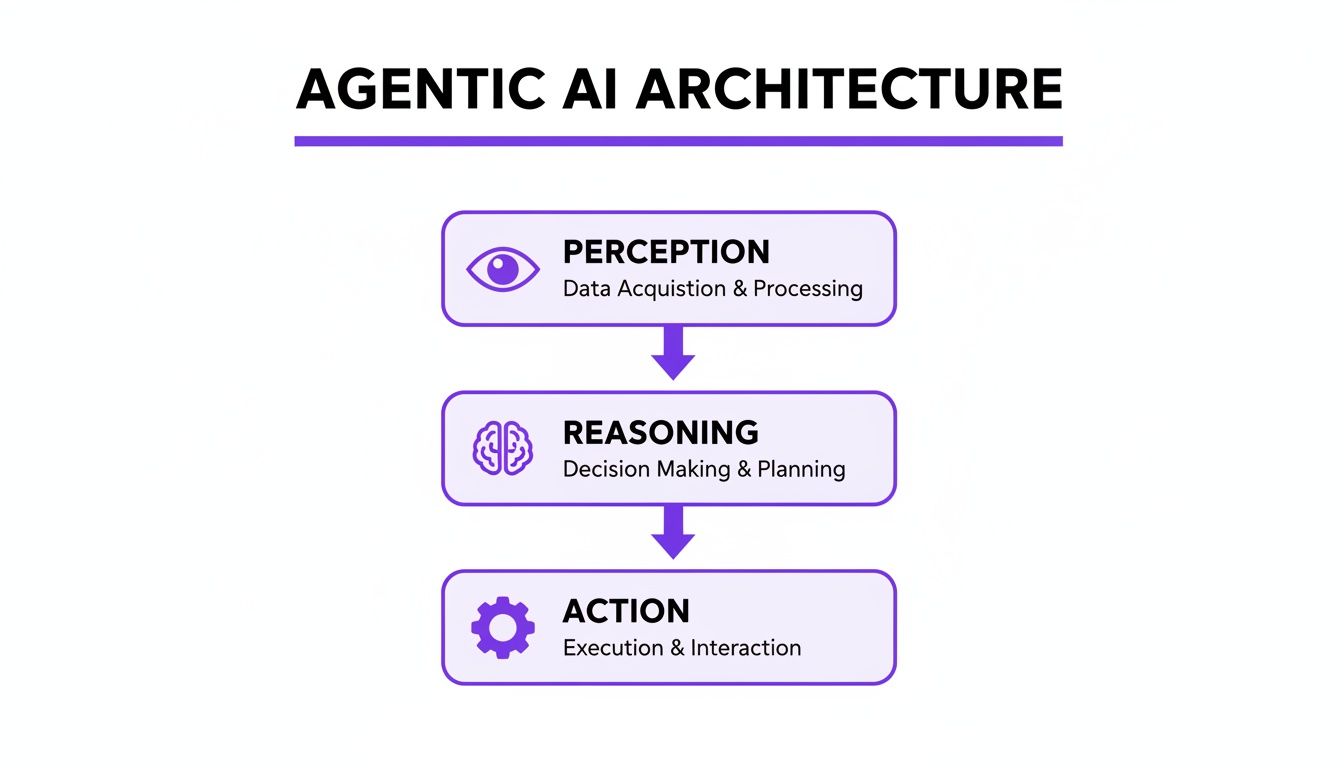
This layered model allows an agent to tackle real-world problems by cleanly separating how it ingests data, makes decisions, and then interacts with other systems to complete tasks.
Maritime Fuel Optimization
The maritime shipping industry operates on thin margins, and fuel is often the largest expense. This is a suitable area for an agentic system to act as an autonomous vessel performance analyst.
- The Challenge: Most vessel routes are planned with static data. This method ignores dynamic variables like changing ocean currents, weather, or engine efficiency dips, all of which lead to wasted fuel.
- The Agentic Solution: An AI agent continuously pulls real-time data from weather forecasts, oceanographic sensors, and on-board vessel diagnostics. Its reasoning engine processes this information, modeling thousands of possible route variations in minutes.
- Measurable Outcome: The agent provides the crew with specific, actionable recommendations on speed and route adjustments. For one fleet of cargo ships, this led to a 5% to 10% reduction in fuel costs against their Q1 baseline, resulting in millions of dollars in annual savings. (Synthetic example based on a composite of client projects.)
Retail Planogram Optimization
In retail, shelf space is valuable. The process of deciding product placement, known as planogramming, directly impacts sales.
Agentic process automation is effective in situations with many variables and a clear business goal. It takes complex, manual decision-making and turns it into an optimized, data-driven workflow.
Traditionally, merchandisers handle this job using historical data and intuition. This approach cannot keep up with real-time supply chain disruptions or sudden shifts in local customer demand.
An agentic system can dynamically build and update planograms to optimize shelf profitability.
- The Agentic Solution: The agent ingests point-of-sale data, current inventory numbers, warehouse stock levels, and local demographic trends. It then generates an optimized shelf layout for each store, balancing high-margin products with fast-moving items.
- Measurable Outcome: For a national retail chain, stores using agent-generated planograms saw an 8% to 15% increase in sales for targeted categories over six months. The improvement came from aligning shelf inventory with customer demand, which reduced stockouts of popular products. (Synthetic example based on a composite of client projects.)
Proving the Value to Leadership
These examples demonstrate applying intelligent, autonomous systems to solve specific, high-value operational problems. The results are quantitative.
When building a business case, focus on these metrics:
- Direct Cost Reductions: Show quantified savings in areas like fuel, inventory carrying costs, or manual labor.
- Efficiency Gains: Track the person-hours saved per week or month. This allows skilled employees to focus on strategic work.
- Error Rate Reduction: Compare the accuracy of agent-led processes to human-led baselines. A 20-30% drop in errors is common for data-heavy workflows.
By grounding the conversation in these concrete outcomes, you can build a business case that shows how agentic AI delivers a strong return on investment.
A Practical Roadmap for Enterprise Adoption
Rolling out agentic process automation should be a structured, deliberate process. A phased approach minimizes risk, builds internal momentum, and delivers early wins to justify broader implementation. This crawl-walk-run journey is designed to deliver value quickly while building a scalable foundation.
The first step is to select a high-value, low-complexity process for a pilot. The goal is to show a tangible return on investment in weeks, not quarters. Proving the technology on a smaller scale helps earn stakeholder confidence and backing.
Phase 1: The Crawl Stage
This initial phase focuses on discovery and proof of concept. You select the right pilot project and prove it works in a controlled environment. This is where you establish a repeatable blueprint for future implementations.
A focused, six-week sprint is an effective method:
-
Discovery (Weeks 1-2): We begin with intensive process mapping to understand every step, decision, and system touchpoint. We also assess your data readiness to identify quality or access issues. You can get a head start by using our complimentary AI Readiness Assessment.
-
Iterative Development (Weeks 3-4): With a clear process and clean data, our team builds the agent in a secure sandbox. Your team provides feedback in iterative reviews to ensure the agent's logic matches your business rules.
-
Deployment and Monitoring (Weeks 5-6): The agent goes live on the selected process, and we monitor its performance from day one. We track key metrics against the established baseline to confirm the ROI.
Phase 2: The Walk Stage
With a successful pilot completed, it is time to expand. You can apply the lessons learned to more processes, perhaps with greater complexity. This stage is about standardizing the approach to building, integrating, and governing AI agents.
Common challenges at this stage include:
- Poor Process Selection: Choosing a workflow that is too simple (better for basic RPA) or too ambiguous for an agent to handle effectively.
- Underestimating Data Needs: Assuming data is clean and ready is a common mistake. An agent's reasoning is only as good as its data.
- Neglecting Change Management: Failing to explain the "why" behind automation can lead to resistance. Prepare your teams for how their roles will evolve to work alongside AI.
Phase 3: The Run Stage
In the run stage, agentic process automation becomes a core business capability. At this point, you should have a center of excellence, solid governance frameworks, and a clear pipeline of automation opportunities. The focus shifts from deploying individual agents to orchestrating a network of them to manage end-to-end value streams.
This blueprint helps you achieve value faster while maintaining control. A critical outcome of this phased approach is that your organization retains full IP ownership and the source code. This avoids vendor lock-in and builds a lasting competitive advantage.
According to a Landbase survey of IT leaders, in early 2024, 79% of organizations reported having some level of agentic implementation. Furthermore, 96% plan significant expansions this year, with 71% deploying agents specifically to automate repetitive tasks. You can discover more statistics on agentic AI adoption and see how it’s boosting enterprise productivity.
Navigating Governance, Risk, and Compliance in the Agentic Era
Giving autonomy to systems offers a significant operational advantage, but it requires an equal measure of control. When you deploy agentic process automation, you introduce new variables to your risk landscape. These systems learn and adapt, which means your governance, risk, and compliance (GRC) framework must also be dynamic.
The objective is to maintain tight control and complete visibility while allowing agents the freedom to perform their jobs. Without a solid GRC strategy, you risk operational errors, data breaches, and regulatory fines. This is not about slowing innovation, but about building guardrails to enable safe, rapid progress.
Establishing Robust Monitoring and Oversight
Periodic audits are no longer sufficient. You must shift to continuous, real-time monitoring. You need to know what your agents are doing, why, and the outcome of every action as it happens. A dedicated agentic GRC framework is required to achieve this.
This framework must include:
- Performance Monitoring: Continuously track key performance indicators (KPIs) for every agent, such as task completion rates, decision accuracy, and processing times. This serves as an early warning system for performance issues.
- Automated Compliance Checks: Build compliance rules directly into the agent's logic. The system should automatically flag or block actions that could violate internal policies or external regulations.
- Explainable AI (XAI): Agent decisions must be transparent. Implement techniques that make their reasoning clear. This involves maintaining immutable audit trails that log all data an agent reviewed, every step it took, and the rationale for its final decision.
This level of oversight ensures that even when an agent acts autonomously, its actions are never a mystery.
True enterprise-grade agentic process automation isn't just about intelligent action; it's about auditable, explainable, and compliant action. Governance is a core architectural requirement for building trust in autonomous systems.
Human-in-the-Loop for High-Stakes Decisions
Full autonomy is not always the goal. For high-risk processes or critical decisions, a human-in-the-loop (HITL) model is necessary. This approach builds specific checkpoints into a workflow where an agent must stop and get approval from a human before proceeding.
For example, in invoice processing, an agent might autonomously handle invoices up to $10,000. An invoice exceeding that amount is automatically routed to a finance manager for review. This hybrid model provides efficiency for high-volume, low-risk work while keeping human expertise focused on important decisions. For a deeper look at these challenges, particularly in HR, this guide on Navigating AI Ethics, EPPA Compliance, and Risk Management in Human Resources is a great resource.
Aligning with Emerging AI Regulations
The regulatory landscape for AI is evolving. New rules like the EU AI Act are changing how organizations must develop, deploy, and govern AI systems. The Act uses a risk-based approach, classifying AI systems based on their potential for harm.
Agentic systems used in critical areas like credit scoring, hiring, or medical diagnostics will likely be classified as "high-risk." This classification carries new legal responsibilities:
- Risk Management Systems: You must have a formal risk management system covering the AI’s entire lifecycle.
- Data Governance: The data used to train and run your agent must be high-quality, relevant, and free from bias.
- Technical Documentation: You must maintain detailed documentation to prove your system is compliant with regulations.
- Human Oversight: The system must be designed for effective human oversight from the ground up.
Preparing for these regulations is a strategic imperative. Companies that build governance into their agentic architecture from the start will be more agile in adapting to new rules and will more easily earn the trust of customers and regulators. You can start preparing now by exploring our guide on EU AI Act readiness. By weaving GRC principles into your automation strategy, you build a foundation for agentic automation that is powerful, trustworthy, and durable.
The Future of Your Workforce with Agentic Automation
Integrating agentic process automation is a fundamental change in how work is done. This is not about replacing people, but about augmenting their capabilities. This creates a future where human ingenuity and AI efficiency work together.

This future is built around collaborative human-agent teams. Autonomous agents can take ownership of repetitive, data-heavy tasks that consume your team's time. For example, an agent can manage the entire invoice reconciliation process, freeing your finance team from tedious manual checks.
Elevating Roles and Driving Strategic Value
Offloading procedural burdens empowers employees to operate at a higher, more strategic level. Their roles shift from task execution to process oversight and exception handling. Instead of administrative work, they can dedicate their time to activities that grow the business.
This shift allows skilled people to focus on:
- Complex Problem-Solving: Addressing nuanced operational challenges that require human intuition.
- Strategic Initiatives: Developing new business models or improving customer engagement.
- High-Touch Customer Roles: Building stronger client relationships and delivering superior service.
The real return on agentic process automation isn't just efficiency; it's the elevation of your entire workforce. Your teams become strategic thinkers who guide intelligent systems, not just people who execute manual processes.
Building these AI-powered capabilities is essential for a durable competitive edge. The companies that lead will be those that successfully combine human and AI labor, creating a more resilient, innovative, and productive enterprise.
Every organization has processes ready for this change. The first step is to identify a workflow bogged down by manual effort and explore how a custom, governance-enabled agentic solution can solve its challenges.
To see how DSG.AI's architecture-first approach can help you build your future workforce, schedule a discovery call and let’s get started.
Unpacking Agentic Automation: Your Questions Answered
As CIOs and tech leaders investigate agentic process automation, several common questions arise. Here are clear, practical answers about what this means for your business.
How Is Agentic Automation Different From RPA or Other AI?
The key differences are autonomy and reasoning. A Robotic Process Automation (RPA) bot is like a digital assembly-line worker. It is effective at following a strict script for simple, repetitive tasks. If the user interface changes or an unexpected pop-up appears, it stops.
Other AI tools are often specialists, good at a single cognitive task like identifying an "urgent" email. Agentic process automation acts like a project manager. It takes a high-level goal, uses a reasoning engine to break it into logical steps, and then orchestrates different tools and systems to complete the job.
If an agent encounters a problem, it can adapt its plan, much like a human employee would.
What Are the Best Business Processes for Agentic Automation?
Look for complex, multi-step workflows that require judgment and decision-making. These processes often involve unstructured data (like emails or PDFs) and require employees to switch between multiple software applications. They are too complex for RPA but offer significant automation potential.
Examples include:
- Processing non-standard insurance claims: An agent can review policy documents, analyze damage reports, and check customer histories to make a recommendation.
- Managing supply chain exceptions: An agent can re-route shipments in real-time based on port delays, weather alerts, and changing inventory levels.
- Handling complex customer support tickets: An agent can diagnose a technical problem, check warranty status in the CRM, and schedule a field technician in a single process.
How Do You Keep AI Agents From Going Rogue With Company Data?
Security must be integrated from the beginning. A secure-by-design architecture is essential for deploying agentic automation safely in a corporate environment.
The core of our security model is the principle of least privilege. An agent gets access only to the specific data and systems it needs to do its job, and nothing more. Every action, decision, and API call is logged in a permanent audit trail, giving you complete transparency for compliance and oversight.
All your data remains within your secure perimeter, protected by your existing data governance rules. Every connection an agent makes is encrypted and authenticated with industry-standard protocols. This layered approach ensures that while agents have autonomy, they operate within strict, auditable guardrails.
At DSG.AI, we help enterprises build, deploy, and govern production-grade AI solutions. Our architecture-first approach ensures security is built-in, not bolted-on, delivering measurable value you can trust. See how our Agentic GRC products can help you adopt trustworthy AI by scheduling a discovery call with our team.