
Written by:
Editorial Team
Editorial Team
Artificial intelligence in operations management is no longer a future concept. Companies are using it now to solve complex logistics and production challenges. At its core, AI analyzes vast operational data sets to find predictive patterns and trigger automated actions, directly impacting efficiency and profitability.
This guide provides enterprise leaders with a clear, practical path from an initial idea to a fully functional AI system.
Why AI Is Now an Operations Priority
Operations leaders face constant pressure from volatile supply chains, customer demands, and the need to improve efficiency. Traditional management methods, which often rely on analyzing historical data and making educated guesses, are no longer sufficient.
Modern operations generate immense data, from IoT sensor readings on factory floors to real-time shipping updates. No human team can analyze this volume of information fast enough to make optimal decisions.

This is where AI in operations management provides a solution. It enables a shift from reactive problem-solving to proactive optimization. Instead of a report on yesterday's issues, AI can forecast likely events for next week and suggest the most effective preparations. Progress in fields like agentic AI in healthcare demonstrates how these systems streamline complex workflows, strengthening the case for their adoption in operations.
The Shift From Experiment to Core Function
AI has moved from research labs and small pilot projects to a mature technology that delivers measurable business results.
This shift is driven by several factors:
- Improved Algorithms: Current AI models are more accurate and can interpret unstructured data like text and images.
- Accessible Computing Power: Cloud computing makes high-performance resources available to most companies.
- Demonstrated ROI: There is growing evidence of clear returns, from significant cost reductions to increased production output.
AI's true power in operations is its ability to analyze millions of variables to identify the optimal path forward—a task impossible for humans. It transforms historical data into a strategic tool for decision-making.
This transition from experiment to core function is happening now. By 2026, operations teams are expected to be the primary drivers of AI adoption. Data shows that business leaders anticipate the greatest increase in AI integration within operations, signaling its move into essential business workflows.
What AI Actually Means in an Operations Context

For an operations leader, technical jargon is unhelpful. In practical terms, AI in operations management is like a team of digital specialists deployed across your business.
This team can process enormous datasets from machinery, supply chains, and workforces—far more information than any person could manage. Their role is to identify hidden patterns, early warnings, and overlooked opportunities, then provide clear, actionable advice.
These digital specialists operate 24/7 without fatigue, turning raw data into useful intelligence for daily problem-solving.
So, What Can AI Really Do for Operations?
AI is a toolkit of specific capabilities designed for specific problems. For operations management, several of these tools are particularly effective at increasing efficiency and system reliability.
Understanding these distinct functions is the first step in identifying where they can deliver the most significant benefits for your organization.
Here is a simple breakdown of core AI capabilities and the real-world problems they solve.
AI Capabilities in Operations Management
| AI Capability | What It Does (Simple Terms) | Example Operational Problem Solved |
|---|---|---|
| Predictive Analytics | Analyzes historical data to forecast future events with high accuracy. | Synthetic Example: It predicts a critical machine has an 85% probability of failure in the next 72 hours, automatically triggering a maintenance ticket. |
| Process Automation | Teaches software to handle repetitive, rule-based tasks currently performed manually by your team. | It automatically sorts, triages, and routes thousands of incoming logistics emails daily to the correct person without human intervention. |
| Optimization Algorithms | Analyzes millions of potential choices to find the best way to achieve a specific goal. | It calculates the most fuel-efficient route for a cargo ship, factoring in weather, currents, and port schedules to reduce consumption. |
These examples show that AI connects technology to tangible actions that improve business operations.
From Data Points to Real-World Decisions
The value of AI in an operational context is its ability to bridge the gap between raw data and informed decisions. A predictive analytics model doesn't just produce a number; it initiates a work order that prevents a costly breakdown.
An optimization algorithm doesn’t just suggest a route; it delivers a concrete plan that can cut fuel costs by 8% to 15% on a single voyage, based on historical performance data from similar routes. This is how AI becomes a driver of profitability.
Ultimately, these systems provide data-driven answers to your most urgent operational questions. They allow you to move from asking, "What just happened?" to "What is the best possible outcome, and how do we achieve it?" This shift helps build a more resilient and efficient operation.
How AI Delivers Measurable Outcomes in Key Industries
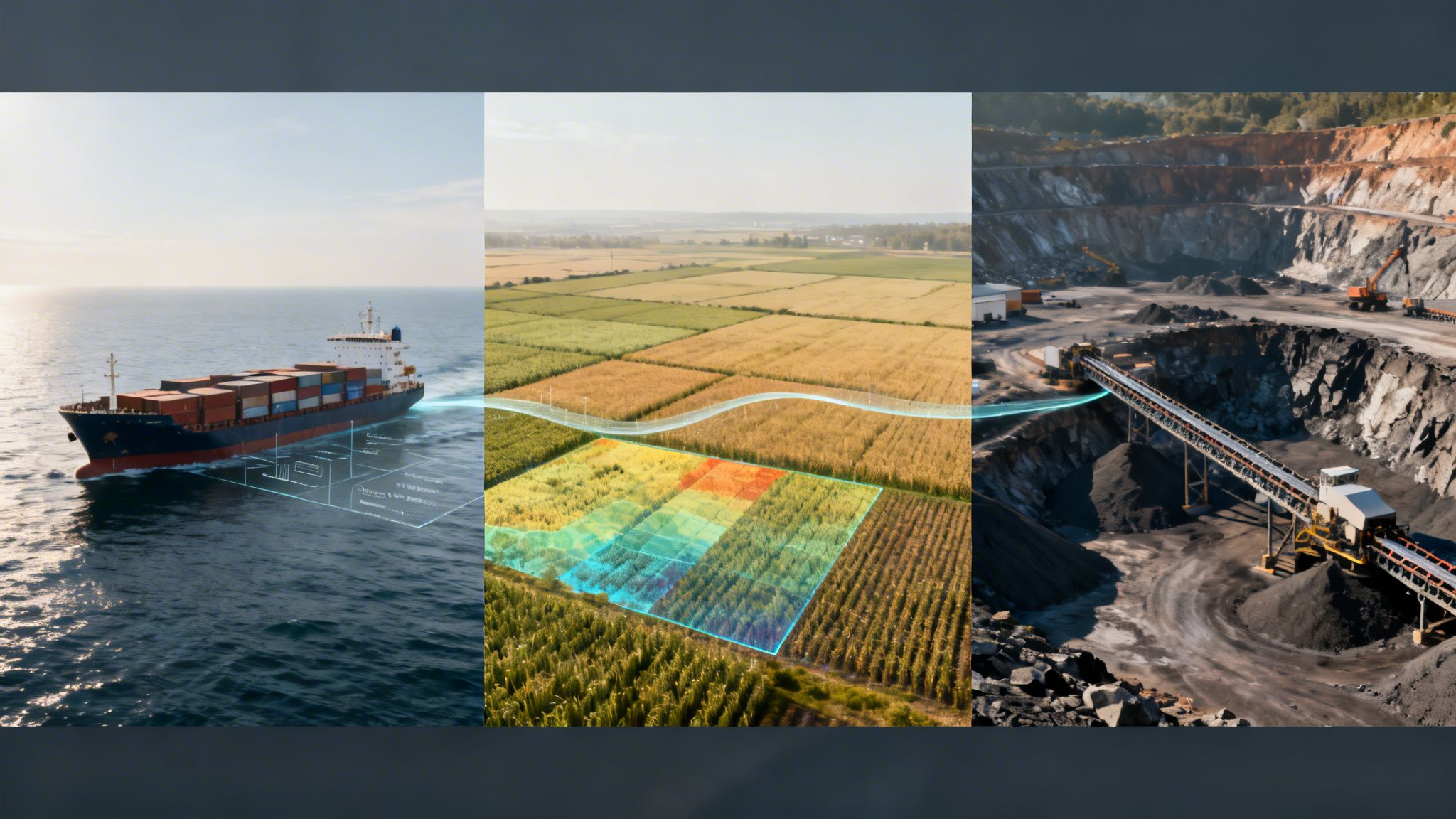
The true test of any technology is whether it delivers tangible business value. For AI in operations management, the results are quantifiable improvements in demanding industries.
These are not minor adjustments. AI-integrated maintenance systems have been shown to increase Overall Equipment Effectiveness (OEE) by an average of 8-11% while reducing repair times. AI is also effective at identifying "micro-stops"—brief downtimes under five minutes that can account for 40-50% of lost performance. A 2022 study by the World Economic Forum on a sample of 50 manufacturing plants showed that targeted AI interventions reduced these stops by 35%.
Examining real-world examples illustrates how AI-driven optimization and prediction translate into financial gains and operational stability.
Maritime Fuel Optimization
For global shipping companies, fuel is a major and volatile operating cost. A single vessel can consume thousands of tons on a long voyage, so small inefficiencies result in significant financial losses.
- The Challenge: Captains traditionally rely on experience and standard weather reports for route selection. This method cannot process the millions of variables—ocean currents, wave height, wind speed, engine performance—that determine the most fuel-efficient path in real-time.
- The AI Solution: An optimization model acts as a "digital co-pilot," continuously analyzing vast datasets, including live weather feeds, the vessel's performance data, and global oceanographic information, to calculate the optimal speed and route.
- Measurable Outcome: The AI-powered routing system consistently found routes that cut fuel consumption by 8% to 15% per voyage. This resulted in millions in annual savings and a significant reduction in the fleet's carbon footprint.
Agricultural Yield Forecasting
Large-scale farming relies on accurate predictions. Correct yield forecasts are critical for managing logistics, securing contracts, and planning labor. Inaccurate forecasts lead to wasted resources, spoiled crops, and lost revenue.
- The Challenge: Traditional forecasting methods, based on historical averages and manual field checks, cannot account for variables like microclimates, soil moisture, and sudden disease outbreaks. This often leads to forecast errors exceeding 20%.
- The AI Solution: A predictive analytics model was developed to process data from satellite imagery, in-field IoT sensors, and historical weather patterns. The model learned to identify subtle indicators of crop health and growth invisible to the human eye.
- Measurable Outcome: The AI system improved forecast accuracy by over 10% compared to the previous baseline. This allowed the company to fine-tune its harvest schedule and supply chain, reducing spoilage and strengthening its negotiating position on contracts.
Mining Process Improvements
In mineral processing, efficiency in extraction is key to profitability. The ideal settings for grinding and separation change constantly based on ore quality.
AI's core value here is its ability to make continuous, precise adjustments at a speed no human operator can match. This keeps a complex system running at peak performance 24/7.
The system must adapt in real-time to maintain high recovery rates.
- The Challenge: Operators typically adjust equipment based on periodic lab samples and visual inspection. This reactive process means the plant often runs sub-optimally between adjustments, wasting energy and leaving valuable minerals behind.
- The AI Solution: An AI model was connected to the plant's live sensor data. It constantly analyzes inputs like particle size, slurry density, and chemical mix to predict optimal equipment settings for the next 15 minutes. These recommendations are then sent to the control system or operators.
- Measurable Outcome: This AI-driven process control resulted in a 3-5% increase in mineral recovery. At the scale of a mining operation, this translated to millions of dollars in additional annual revenue.
AI is also essential for managing logistics complexities, where concepts like route optimization are fundamental to maximizing efficiency. In all these industries, AI creates the most value when applied to complex operational problems where data-driven decisions lead to substantial, measurable improvements.
Charting Your Course: An Enterprise AI Implementation Roadmap
Moving an AI pilot project to a full-scale operational solution is a significant challenge. Many initiatives fail at this stage, not due to flawed AI, but because of the lack of a clear implementation plan.
A well-defined roadmap reduces the risk of this transition. A structured, six-week process can take an idea from concept to an operational system. This disciplined approach prioritizes goal-setting, rapid iteration, and a focus on production from the start.
A Proven Six-Week Path to Production AI
An effective implementation plan is a strategic sequence of phases designed to align operations managers and data scientists before committing significant resources. The goal is to move methodically from a raw idea to a value-generating system.
A typical six-week cycle includes:
- Discovery (Weeks 1-2): We conduct intensive workshops with your key operations and data teams to define the specific business problem. We identify the most important KPIs and map all available data sources. The outcome is a clear problem statement and a technical blueprint.
- Iterative Development (Weeks 3-5): The build phase begins. We work in weekly sprints with constant check-ins, allowing your team to see progress, provide real-time feedback, and help us make adjustments. This feedback loop ensures the final AI model addresses the real-world operational challenge.
- Deployment and Handover (Week 6): We deploy the validated model into your live production environment, complete with monitoring dashboards and detailed documentation. We then conduct a full knowledge transfer, training your team to own and manage the new AI asset.
Why an Architecture-First Approach Is Non-Negotiable
Building a predictive model that runs on a developer's laptop is simple. Building one that can handle real-world operational data, integrate with existing ERP or SCM systems, and scale reliably is the real challenge for AI in operations management.
This is why we lead with an architecture-first approach.
It shifts the question from, "Can we build a model?" to "Can we build a model that will run reliably, integrate seamlessly, and scale in our live production environment?" This change in perspective separates successful deployments from failed science projects.
This means we design data pipelines, API endpoints, and monitoring frameworks alongside the AI model. It ensures the solution is an integrated part of your operational infrastructure, not an isolated tool.
Staying in Control: Technology Agnostic and Full IP Ownership
Vendor lock-in can stifle innovation. Building your core operational AI on a single proprietary platform reduces flexibility, increases costs, and makes it harder to adopt better technology later. A technology-agnostic approach avoids this by selecting the best tools for your specific problem, whether open-source libraries, cloud-native services, or specialized platforms.
Equally important is full intellectual property (IP) ownership. At the project's conclusion, you own everything: the source code, the trained models, and the documentation. For any organization building a long-term competitive edge with AI, this is essential. Owning the IP gives you the freedom to modify and evolve the solution as your business needs change, without permission or additional licensing fees. As you build more of these assets, you can explore our insights on AI portfolio management to learn more.
A successful roadmap is about more than just technology. It is about building confidence through a transparent process that leaves you with a scalable, ownable asset.
Navigating AI Governance, Risk, and Compliance
When AI is integrated into core operations, it becomes a strategic asset requiring serious oversight. Without a solid framework, you could deploy models that are biased, unreliable, or non-compliant with new regulations. Good governance is about building trust and ensuring your AI efforts are sustainable.
This requires a proactive approach. Waiting for regulations to be enforced or for a model to fail in a live environment is not a viable strategy. It is better to incorporate Responsible AI principles into your development and deployment cycle from the beginning.
Governance cannot be an afterthought; it must be part of every step of the AI solution lifecycle.
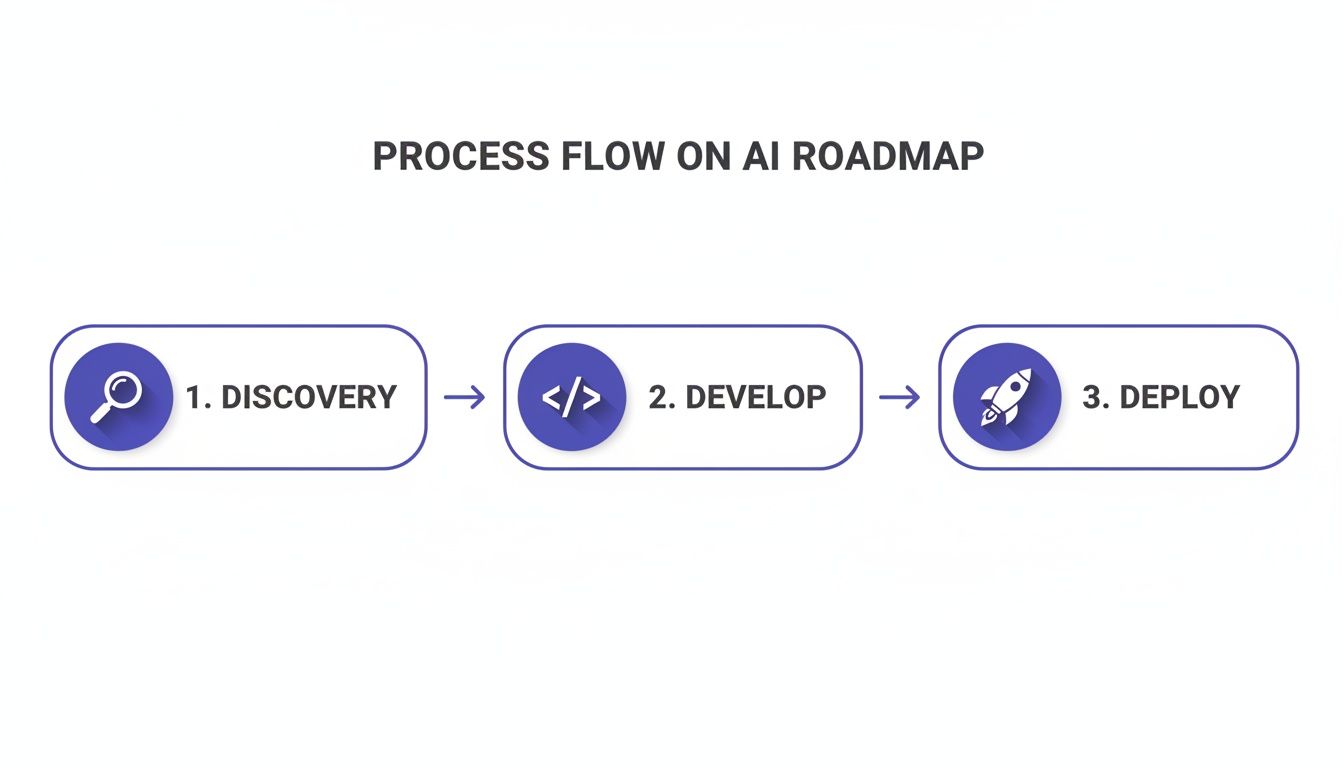
From the initial Discovery phase to the final Deployment, each stage has unique risks and compliance requirements that must be actively managed for a successful and responsible outcome.
Establishing a Framework for AI Oversight
Effective AI governance is an ongoing process supported by practical tools and clear ownership. The goal is to build a system where you can confidently answer questions about every AI model in your business.
A strong framework has three core pillars:
- Risk Assessment: Before deploying a model, you must understand its potential downsides. This includes identifying hidden biases, assessing its performance in unusual situations, and mapping its impact on business processes.
- Continuous Monitoring: An AI model's performance can degrade over time as real-world conditions change—a phenomenon known as "model drift." Continuous monitoring tracks the model’s accuracy, fairness metrics, and overall stability in real time.
- Automated Compliance: Manually documenting for regulations like the EU AI Act is not scalable. Modern governance tools can automate the creation of these reports, providing a clear audit trail. You can learn more with our guide on achieving AI Act readiness.
With agentic AI poised to automate significant portions of human work, solid governance is non-negotiable.
Practical Tools for Responsible AI
Moving from principles to practice requires purpose-built tools. Your operations teams need systems that integrate oversight directly into their existing workflows.
A core principle of modern AI governance is to make the right action the easy action. This means automating bias checks, integrating risk scorecards into project dashboards, and providing clear alerts when a model's behavior deviates from its expected performance.
Here is what this looks like in practice:
- Automated Bias Detection: A tool that scans training data and model outputs for statistical biases before the model is deployed.
- Model Risk Dashboards: A single screen that assigns a risk score to every AI model based on its potential business impact and complexity, helping focus oversight where it is most needed.
- Drift Monitoring Alerts: Automated notifications sent to the operations team when a model's accuracy drops below a set threshold, such as a 5% decrease compared to its Q2 baseline.
Robust governance turns AI from a potential liability into a reliable, transparent, and compliant advantage.
So, What's Your Next Move with AI in Operations?
The core message is that AI is now an essential toolkit for building an efficient and resilient business. It allows you to turn data into measurable improvements, such as better output, lower costs, and improved customer satisfaction.
However, technology alone is not enough. Success comes from a smart, architecture-first approach that is built to scale and integrate with your existing workflows. It requires a clear plan, solid governance, and ownership of the intellectual property you create. This is the difference between a temporary pilot project and a sustainable competitive edge.
Getting Out of the "Pilot Trap"
Many companies get stuck in a cycle of proofs-of-concept, exploring AI's potential without reaching production, where its actual value is realized. The key is to define what AI will do to solve your biggest operational challenges. You need a partner who can connect an idea to a production-ready system.
The most successful AI projects begin with a deep dive into specific operational pain points—bottlenecks, waste, and persistent problems. A great AI solution should be a custom-built extension of your expert team, not an off-the-shelf product.
Execution is what separates successful AI implementation from the rest.
It's Time to Put Your Data to Work
Your operational data holds the potential for significant performance gains. It's time to activate that potential with the right AI solution and start seeing quantifiable results.
Let's discuss how. I invite you to schedule a consultation with our team. We can analyze your specific challenges—in logistics, on the factory floor, or in compliance—and map out how a production-ready AI solution can be designed, built, and deployed in just six weeks.
Let’s explore how to turn your data into your most valuable asset. Contact DSG.AI today to start the conversation.
Frequently Asked Questions About AI in Operations
Leaders often have practical questions about implementing AI in their operations. Answering these questions is crucial for building the confidence needed for a successful rollout. Here are some of the most common questions we hear.
How Quickly Can We Expect a Return on Investment?
You do not need to wait years to see a return. By addressing a specific, high-impact operational problem, you can demonstrate value quickly. Many companies see a tangible return within the first business quarter after deployment.
These early wins often appear as direct cost savings or efficiency gains. For example, an AI model that optimizes logistics routes might reduce fuel costs by 5-8% in its first few months. This provides an immediate, measurable ROI. The key is to start with a single, costly problem instead of large, vague projects.
Will AI Replace Our Existing Operations Team?
This is a common misconception. AI should be viewed as a tool that amplifies your experts, not as a replacement. It is designed to handle tasks that are tedious or impossible for people, such as analyzing millions of real-time data points or running thousands of "what-if" scenarios.
AI acts as a force multiplier for your team. It automates heavy lifting and repetitive analysis, freeing up experienced operations professionals to focus on strategic decisions, handle exceptions flagged by the AI, and improve processes—tasks that require human experience and judgment. The AI provides insight; your team determines the strategy.
How Does AI Integrate with Our Current Systems?
Implementing AI does not require you to replace your existing technology. A modern, architecture-first approach designs AI solutions to integrate with your current tech stack, whether it is an ERP, a Supply Chain Management (SCM) platform, or a custom legacy system.
A well-designed AI solution should enhance your existing systems, not conflict with them. It should feel like a natural upgrade to your operational toolkit, pulling data from trusted sources and pushing insights back into the workflows your team already uses.
We typically achieve this integration using APIs and secure data pipelines. This technology-agnostic approach allows the AI layer to communicate with your core systems without disruption. It ensures data flows where needed and that AI recommendations appear in the tools your team uses daily, which simplifies adoption.
Ready to move from theory to tangible results? DSG.AI delivers production-ready AI solutions tailored to your unique operational challenges in just six weeks. Schedule a consultation today to discover how we can turn your data into a sustainable competitive advantage.