
Written by:
Editorial Team
Editorial Team
AI risk management software is a centralized system for monitoring, governing, and scaling an organization's artificial intelligence models. It connects disparate AI systems, enforces ethical and regulatory compliance, and helps prevent financial, operational, and brand-related failures. Without it, companies risk deploying AI that is unreliable, non-compliant, or biased.
Why AI Risk Management Software Is Now Essential

Many companies run AI initiatives without centralized safety and quality controls. This approach exposes the business to significant threats, such as models that suddenly fail and disrupt operations or produce biased outputs that damage brand reputation. As AI becomes more integrated into core business functions, this unmanaged risk is not sustainable.
For a CIO, the primary role is to ensure technology resilience and business continuity. Unmanaged AI introduces unpredictable, high-stakes risks that undermine this mission. Without a dedicated risk management framework, it is difficult to answer critical questions about an AI portfolio:
- Which models are in production and making automated decisions?
- Are they performing within acceptable accuracy thresholds, or has performance degraded?
- Do our systems comply with new regulations like the EU AI Act?
- Who has access to these models, and what changes have been made recently?
Turning Risk Into a Managed Asset
Effective AI risk management software converts uncertainty into a managed, strategic asset. By providing a governance layer, it enables CIOs to scale AI initiatives confidently. Instead of reacting to problems after damage occurs, these platforms help identify potential issues before they become crises. This shift from reactive fixes to proactive oversight provides a competitive advantage.
The market reflects this trend. The global AI model risk management market was valued at USD 5.47 billion in 2023 and is projected to reach USD 12.57 billion by 2030, growing at a 12.8% compound annual growth rate (CAGR).
By centralizing control and automating oversight, AI risk management software transforms AI from an experimental technology into a reliable, auditable, and value-generating business asset. It changes AI from a high-risk bet to a calculated investment.
A Practical Necessity Across Industries
This need solves tangible problems in every sector. In finance, a fraud detection model without monitoring could begin flagging legitimate transactions, leading to customer frustration and lost revenue. For a detailed example, consider how AI and data strategies optimize risk in the insurance industry. Similarly, a healthcare algorithm with undetected demographic bias could result in inequitable patient outcomes, creating significant ethical and legal liabilities.
These platforms are not merely defensive tools; they accelerate innovation. They provide the safety net that empowers teams to deploy more powerful AI solutions faster and more responsibly.
Navigating The New Landscape of AI Regulations
The need for robust AI governance is now a legal mandate, not just an internal priority. Governments worldwide are implementing regulations for artificial intelligence, creating a complex set of rules that businesses must follow to avoid significant penalties. This global shift makes AI risk management a required operational cost.
For CIOs, this regulatory environment adds a significant layer of responsibility. It is no longer sufficient for AI models to be effective; organizations must also prove they are fair, transparent, and compliant with laws that carry substantial fines. The EU AI Act serves as a key example, establishing a global benchmark for AI oversight.
Demystifying the EU AI Act
The EU AI Act uses a risk-based framework, categorizing AI systems based on their potential for harm. The strictest rules apply to systems designated as 'high-risk', which includes AI used in critical infrastructure, hiring, credit scoring, and law enforcement.
If a company uses an AI system in a high-risk area, it is required to maintain extensive documentation and ensure full operational transparency. This is not a simple paperwork task. Regulators require detailed, lifecycle-wide evidence:
- Data Governance: You must document the datasets used for training, validation, and testing—including their origin, scope, and main characteristics.
- Technical Documentation: Before an AI system is deployed, you must create detailed records proving it meets the Act's requirements.
- Risk Management System: An ongoing process must be in place to identify, analyze, and manage risks throughout the AI system’s lifecycle.
- Human Oversight: Clear mechanisms must exist for a person to intervene to prevent or minimize potential harm.
- Record-Keeping: AI systems must be designed to automatically log events (audit trails) to ensure their operations are traceable.
Managing these requirements with spreadsheets and disparate documents is not scalable and is highly prone to error.
From Legal Burden to Strategic Asset
This is where AI risk management software becomes a critical component of a CIO's strategy. It functions as a central hub for compliance, automating the collection of evidence, creation of documentation, and generation of reports. Instead of a difficult, manual effort to prepare for an audit, these platforms provide a single source of truth for all regulatory inquiries.
The core function of AI risk management software in a regulatory context is to translate complex legal obligations into a streamlined, repeatable, and auditable technical process. It operationalizes compliance.
For example, if a model is classified as high-risk, the right software can automatically begin generating the required documentation, tracing data lineage from origin to deployment, and maintaining an immutable audit trail of every decision and update. Compliance becomes a continuous, automated workflow rather than a reactive, project-based effort.
This capability is essential for any business operating in or selling to customers in regulated markets. For more on the strategic aspects of these challenges, see a CIO's guide to mastering compliance and risk management in the AI era.
Companies that proactively implement a solid governance framework gain a competitive advantage. They can launch AI tools into regulated industries with greater speed and confidence than their competitors. Effective management of compliance accelerates, rather than hinders, innovation.
What to Look For: Key Features of an AI Risk Platform
When evaluating an AI risk management solution, it is important to focus on core capabilities that solve specific operational problems. An effective platform is an integrated system designed to provide oversight across the entire AI lifecycle. For a CIO, the goal is to find a solution that automates manual, error-prone processes.
The need for these platforms is critical. The latest Allianz Risk Barometer ranked cyber incidents and AI as the top two global business threats. AI's ranking at No. 2, cited by 32% of risk experts, signals that managing AI risk is no longer optional.
This section serves as a practical buyer's guide, outlining the essential features that make AI governance a manageable reality.
A Centralized Model Inventory
Before implementing a management system, many organizations track AI models using a combination of spreadsheets and wikis. This method is slow and unreliable. The data is often outdated, making it impossible to get a clear, current view of the AI portfolio. Teams can spend weeks confirming which models are in production, what versions are running, and who is responsible for them.
A robust AI risk platform solves this with a centralized model inventory.
- Before: Teams often spend 15-20% of their time on manual model tracking. This leads to version control issues and "shadow AI"—models operating without oversight.
- After: A single source of truth is established. A real-time, automated dashboard displays every model—whether in development, testing, or production—along with its owner, version, and performance history. This alone can reduce administrative overhead.
A centralized view is the foundation of all other governance activities. Without it, managing risk at scale is not possible.
This is how effective software connects regulatory requirements with the evidence needed for compliance.
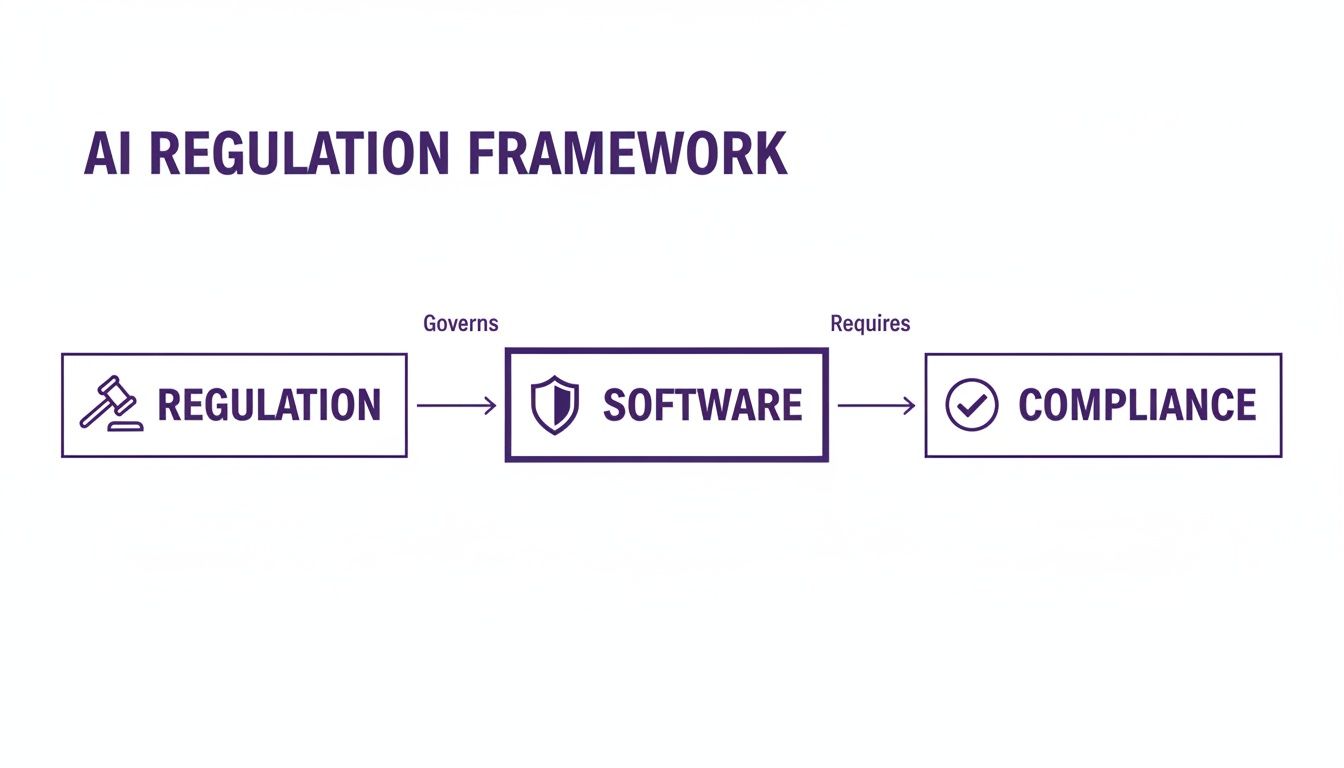
As shown, regulations define what the software must do. The software, in turn, generates the evidence required to prove compliance.
Real-Time Model Monitoring and Drift Detection
Once a model is deployed, it operates in a changing environment where data patterns can shift. This phenomenon, known as model drift, occurs when a model's predictive accuracy declines because the real-world data it processes no longer matches its training data.
Without automated monitoring, drift can go undetected for months. During this time, the AI could be making increasingly inaccurate or biased decisions, causing silent failures that result in significant damage.
A model that is not monitored is a liability. Real-time monitoring functions as an early warning system, shifting teams from reactive problem-solving to proactive performance management.
An AI risk management platform automates this entire process. It continuously tracks key metrics for data drift, concept drift, and overall model health. When performance drops below a predefined threshold, it sends an alert, allowing data science teams to intervene before the issue impacts business outcomes. To assess your organization's vulnerabilities, a comprehensive evaluation like DSG.AI's assessAI is a practical first step.
Automated Bias Detection and Explainability (XAI)
One of the most significant risks in AI is its potential for bias. A hiring model that favors one demographic or a loan model that discriminates based on location can cause major reputational and legal damage. Auditing a model for bias manually is a complex and time-consuming process.
Modern AI risk platforms include automated tools that test for fairness and bias across protected attributes like gender, race, or age, making the process faster and more thorough.
In addition to bias detection, these platforms provide Explainable AI (XAI). AI "black boxes" are complex models, particularly deep learning networks, where the internal logic is not fully understood even by their creators. XAI tools provide clear, human-readable explanations for why a model made a specific decision. This is essential for troubleshooting, building user trust, and meeting regulatory demands for transparency.
Building The Business Case and Measuring ROI

To secure approval for a new software investment, it is necessary to connect the technical capabilities of AI risk management software to bottom-line business metrics. The case should position the software as a direct contributor to operational efficiency, risk reduction, and revenue protection, not just another IT expense.
The conversation shifts when you move from abstract concepts like "model drift" to its financial impact. An unmonitored model with degrading performance is not just a technical issue; it is a financial liability that costs the business money daily. Framing the investment around clear Key Performance Indicators (KPIs) makes the software’s value clear.
Defining Your Key Performance Indicators
To demonstrate value, it is essential to track the right metrics. Focus on tangible, quantifiable improvements that show a clear before-and-after impact.
Here are several metrics to start with:
- Model Incident Response Time: The time required to fix a model after an issue is identified. An effective platform can reduce this time by 40% to 60% with instant alerts and diagnostic tools.
- Compliance Reporting Costs: The hours your team spends manually gathering data for audits. AI risk management software automates this, reducing these costs by 15% to 25%.
- False Positive Reduction: In areas like fraud detection, the number of legitimate customers incorrectly flagged. Reducing this rate saves money on manual reviews and improves customer retention.
- Time-to-Deployment for New Models: The speed at which a new model can be moved from development to production. A solid governance process can safely accelerate deployment, allowing for earlier realization of business value.
A Simple Framework for Calculating ROI
A straightforward Return on Investment (ROI) framework is often the most effective tool for gaining financial stakeholder approval.
ROI Formula = (Cost Savings + Revenue Gains + Risk Mitigation) / Software Cost
This approach provides a complete picture. Cost Savings come from automation and efficiency. Revenue Gains result from better-performing models and faster deployments. Risk Mitigation assigns a dollar value to avoiding negative events, such as a regulatory fine or a brand-damaging incident.
Putting It All Together: A Synthetic Example
Consider a financial services firm managing its fraud detection models.
The Problem: The firm's primary fraud model flagged thousands of legitimate customer transactions monthly. This high rate of false positives created an operational bottleneck, as analysts had to manually review each flag, and it frustrated customers whose payments were blocked.
The Solution: The firm implemented an AI risk management software platform. Its real-time monitoring capabilities quickly identified a subtle data drift that was reducing the model's accuracy. The data science team used these insights to retrain the model with fresh, relevant data.
The Outcome: The results were significant. The retrained and continuously monitored model led to a 30% reduction in false positives. This had a direct financial impact:
- $700,000 saved annually in operational costs from fewer manual reviews.
- $500,000 in retained revenue from improved customer satisfaction.
With a total value of $1.2 million in the first year, the CIO demonstrated that the software investment generated a positive return multiple times over. This is how to build a solid business case and secure ongoing support for an AI governance program.
Gaining Control Without Vendor Lock-In
Choosing an AI risk management platform is a long-term strategic decision. Many CIOs are wary of large, monolithic platforms that claim to do everything. While they may seem comprehensive, they often create deep dependencies that lead to vendor lock-in, making it costly and complex to switch providers later. This can limit an organization's ability to adapt and innovate.
A more flexible approach focuses on owning the technology stack. A technology-agnostic platform works with existing tools rather than requiring a complete replacement. This architecture-first mindset means the governance layer integrates into your MLOps pipeline, augmenting current workflows. This approach protects existing investments in technology and expertise.
The goal is to achieve enterprise-grade governance while maintaining full control over intellectual property and strategic direction.
Why an Agnostic Architecture Matters
An integrated suite of tools is a more practical alternative to a closed, proprietary system. It allows you to add specific capabilities as needed—such as starting with risk assessments and adding model monitoring later—without being forced into a single vendor's ecosystem. This modular approach is crucial for adapting as your AI program matures and regulations change.
This flexibility is a business necessity. The market for risk management solutions is growing as companies face data breaches and complex threats. One forecast predicts the risk management software market will increase by USD 13.28 billion in the next five years, growing at a 19.2% compound annual rate. Building on an open architecture future-proofs your technology stack, ensuring you can integrate the best new tools as they become available.
Synthetic Example: Optimizing Maritime Fuel
A global shipping company developed an AI model to optimize fuel consumption for its fleet. The potential benefits included millions in savings and a significant reduction in carbon emissions. However, deploying such a high-stakes model involved serious risks.
- Operational Risk: A bad prediction could cause a vessel to run low on fuel at sea.
- Financial Risk: Small errors in fuel estimates, multiplied across the fleet, could eliminate expected savings.
- Compliance Risk: The model had to adapt to changing environmental regulations, such as the Carbon Intensity Indicator (CII).
The company needed a robust governance framework that could integrate with its custom AI system without a complete overhaul. They implemented a dedicated AI monitoring solution that connected to their existing data pipelines and model infrastructure. This provided a real-time command center to monitor model performance, track predictions against actual fuel use, and receive instant alerts if accuracy degraded.
This case highlights a key point: effective AI risk management enables innovation rather than slowing it down. By de-risking a critical AI system, the governance framework gave the company the confidence to deploy a model that now delivers substantial business value.
This architecture-first strategy allowed the shipping company to retain full ownership of its core IP—the fuel optimization model—while adding best-in-class risk management capabilities. The result was a successful deployment that balanced high performance with necessary safety and reliability. For teams looking to build a similar foundation, the next step is to master the principles of effective AI model orchestration.
Your Next Steps Toward Enterprise AI Resilience
The main takeaway from this guide is that AI risk management software is essential for any company serious about scaling AI responsibly. We have reviewed the regulatory, operational, and reputational risks. The right platform helps manage these issues, turning them from liabilities into assets.
Operating without a central system to govern and monitor AI models creates an unnecessary blind spot.
Now is the time to apply this knowledge. The vendor evaluation features discussed earlier can serve as a roadmap. Start by assessing your organization's needs to align key stakeholders and prioritize challenges.
From Theory to Practice
Reading about features like real-time monitoring or automated audit trails is one thing; seeing them tested against your own models and business challenges is another. The best way to understand the benefits is to see the technology in action.
A live demonstration makes abstract concepts concrete. It allows your team to understand how an architecture-first, non-locking approach can secure your most important AI projects.
Watching the software work firsthand clarifies how it can deliver business value more quickly. It shows exactly how the governance requirements you are concerned about are managed by the tools your team will use daily. This clarity is needed to make a sound investment.
This is about building a concrete plan for AI resilience, not just buying a tool. It bridges the gap between knowing you need a solution and seeing precisely how the right one will fit into your organization, enabling safe and confident innovation.
Frequently Asked Questions
When considering new enterprise software, practical questions arise. This is also true for AI risk management software. CIOs and technical leaders often ask about integration with existing technology, the implementation process, and the required user expertise.
Here are answers to some common questions.
How Does This Software Integrate With Existing MLOps Tools?
This software acts as a central governance layer, not a replacement for your team's existing MLOps tools. It is designed to connect with your current toolchain.
Through robust APIs, it integrates with your model development environments, CI/CD pipelines, and data stores. The objective is to pull necessary metadata and performance signals to provide a single view of risk and compliance. This allows your data scientists to maintain their workflows while you gain the required oversight without replacing your current setup.
Can We Start With A Phased Implementation?
Yes, a phased approach is recommended. The most successful implementations begin by addressing the most urgent issue first. For many organizations, this involves gaining control over high-stakes models already in production.
Starting with a focused, high-impact area like model monitoring delivers quick wins and demonstrates tangible value early on. This builds momentum and internal support for expanding the governance framework across the entire AI lifecycle over time.
By starting small, you can quickly address critical risks like data drift or performance degradation. This solves an immediate problem while building the foundation and internal support for a more comprehensive strategy. It is a pragmatic approach that respects your team's time and budget.
What Level of Technical Expertise Is Required?
Effective AI risk management software is designed for a broad audience. While machine learning engineers will use the deep diagnostic tools, the platform's main strength is its ability to translate technical data into business-level insights.
The best systems feature intuitive dashboards and automated reports designed for non-technical users, such as risk officers, compliance managers, and executives. The goal is to make AI governance accessible to all stakeholders, ensuring that both the teams building the models and the leaders making decisions share the same understanding of risk and performance.
At DSG.AI, we specialize in building enterprise-grade AI systems that are secure, compliant, and deliver measurable value. Our architecture-first approach ensures you gain full control and IP ownership without vendor lock-in. See how we de-risk AI initiatives by exploring our work.