
Written by:
Editorial Team
Editorial Team
AI solutions for business are strategic capabilities designed to automate processes, generate insights from data, and create new revenue streams. For a large enterprise, this means moving beyond consumer-grade tools to deploy secure, scalable systems integrated into existing operations to deliver a clear, measurable return.
Defining Enterprise AI Beyond the Hype
The term "AI" is often associated with consumer applications. For a CIO, the definition must be more precise. An enterprise-grade AI solution is a resilient, secure, and fully integrated system engineered for a specific business outcome. For example, a consumer chatbot is different from an automated customer service platform that securely accesses inventory, shipping, and CRM data to resolve a customer's issue without human intervention.
This distinction is critical. Consumer tools often lack the robust controls for data governance, security, and scalability that an enterprise requires. True AI solutions for business are built on a foundation of reliability and designed to function within a complex corporate IT landscape, meeting strict compliance and privacy mandates.

The Shift from Experimentation to Integration
The pace of AI adoption in business is accelerating. According to a 2024 IBM survey, 42% of enterprise-scale companies have actively deployed AI in their business. Generative AI adoption, in particular, has grown from 33% in 2023 to 71% in 2024, with companies now running AI across an average of three different departments. You can explore more data on AI adoption to see how the landscape is changing.
This growth indicates a fundamental shift. Companies are moving past isolated pilot programs and are now focused on scaling AI capabilities across the organization to drive operational improvements and gain a competitive edge.
This guide provides CIOs and technology leaders with a practical framework for this transition. We will focus on a deliberate, value-first approach. The goal is to provide an actionable plan for building a business case, creating a realistic implementation roadmap, and measuring the impact of AI investments.
Core Pillars of an Enterprise AI Solution
An AI system must meet several non-negotiable criteria to be considered "enterprise-grade." These pillars form the foundation of a sustainable AI strategy.
- Scalability: The solution must handle growing data loads and user demands without performance degradation.
- Security: It must integrate with existing enterprise security protocols, such as access controls and data encryption, to protect sensitive information.
- Reliability: The system must produce consistent, predictable, and accurate results for mission-critical tasks.
- Governance: There must be clear, auditable processes for monitoring model performance, tracing data lineage, and ensuring compliance with regulations like the EU AI Act.
Mapping AI Solutions to Business Value
A successful AI strategy connects an AI capability to a real-world business outcome. Instead of focusing on technical specifications, ask two questions about any proposed AI solution: What does it do, and what is the business outcome? This reframing turns a complex technology landscape into a set of strategic choices.
For instance, think of predictive analytics as a tool for your supply chain. It analyzes historical data to identify patterns, allowing you to anticipate demand spikes and prevent stockouts. The business value is lower inventory carrying costs and improved on-time customer order fulfillment.
Similarly, Natural Language Processing (NLP) enables machines to understand and respond to human language. For a global company, this can translate into 24/7 customer support agents that resolve common queries, freeing up human teams to handle more complex, high-value conversations.
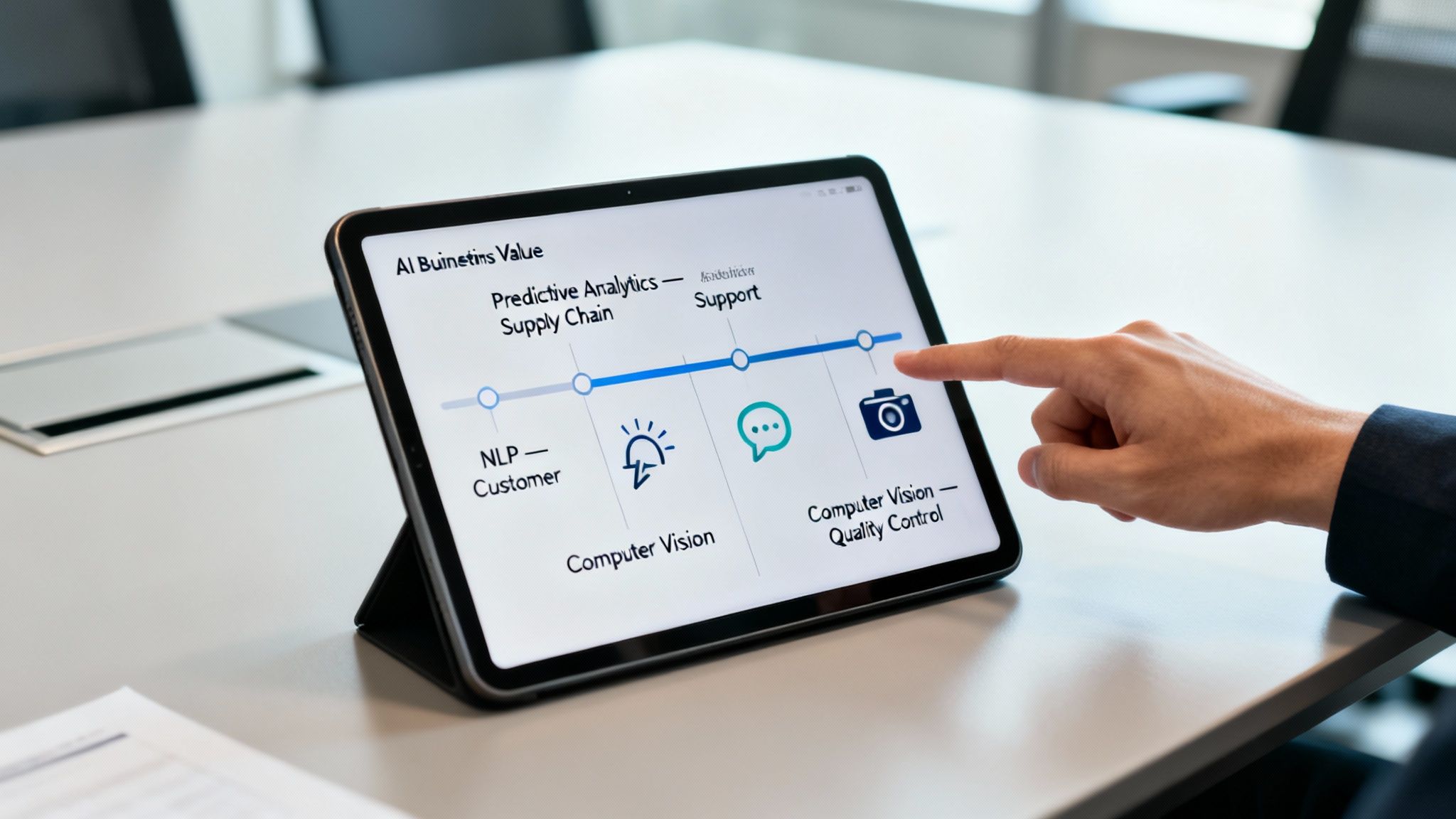
Connecting Technology to Tangible Outcomes
Map each AI solution directly to a specific business function and a quantifiable result. This shifts the conversation from IT to the boardroom, where operational impact is the primary language. Every business area—from finance to marketing to operations—has processes that can be improved with the right AI tool.
A logistics company, for example, might implement a machine learning model for route optimization. The technology finds the most efficient delivery paths, which directly translates to lower fuel costs and better on-time delivery metrics. These are outcomes that are easy to measure.
Gaining a clear picture of these connections is an essential first step. Tools like an AI readiness assessment can help identify promising opportunities within your organization.
The goal is to create a direct link from a specific AI capability to a key performance indicator (KPI). When you can state that implementing a computer vision model will reduce manufacturing defects by 8 to 15 percent, you have a strong starting point for an investment discussion.
The financial stakes are growing. The global AI market is projected to expand at an annual rate of 26.6%, reaching a valuation of $1.01 trillion by 2031, according to Precedence Research. The AI application sector specifically is projected to grow from $4.5 billion in 2024 to $156.9 billion by 2030. You can discover more insights about AI adoption rates to understand the market's momentum.
Mapping AI Technologies to Business Functions and Outcomes
To make this mapping exercise practical, leaders can use a framework that connects AI technologies to business functions and their potential outcomes. This table provides an organized view of the possibilities, helping prioritize initiatives based on their potential impact.
| AI Technology Type | Business Function | Example Application | Potential Business Outcome |
|---|---|---|---|
| Predictive Analytics | Operations & Supply | Demand forecasting and inventory optimization. | Reduce inventory carrying costs by 10-18%. |
| Natural Language Processing (NLP) | Customer Service | Automated email and chat ticket classification. | Improve first-contact resolution by 25%. |
| Computer Vision | Manufacturing | Automated quality control and defect detection on production lines. | Decrease product scrap rate by 5-12% vs. prior quarter. |
| Machine Learning | Finance & Risk | Anomaly detection for fraudulent transaction identification. | Lower financial losses from fraud by 15-20%. |
This structured approach grounds AI in familiar business contexts. By presenting AI solutions in terms of their contribution to efficiency, cost reduction, or revenue growth, CIOs and CTOs can communicate their value more effectively and secure the necessary buy-in.
Calculating the Real ROI of Your AI Investment
Board approval for a major AI initiative often depends on the business case. A credible Return on Investment (ROI) model is necessary. A solid financial forecast shifts the conversation from viewing AI as a cost center to seeing it as a strategic investment, showing how the technology will drive growth and efficiency.
Building this model requires a thorough analysis of both costs and benefits. Costs are rarely limited to the software license. It is important to consider the total cost of ownership.
Understanding the Full Cost Structure
Before discussing returns, you must understand the full investment. A complete cost analysis for an AI solution typically includes several components.
- Technology and Licensing: The subscription or license fee for the AI platform.
- Infrastructure Upgrades: AI models require significant computing power. Budget for additional cloud services or new on-premise hardware for data processing and model training.
- Specialized Talent: Skilled data scientists, ML engineers, and project managers are needed. Include their salaries, benefits, and ongoing training.
- Change Management Programs: The cost of training employees on new workflows, communicating changes, and ensuring the new system is adopted.
Mapping Costs to Tangible Value Drivers
Once costs are clear, the next step is to link them to the value the AI will create. Benefits usually fall into three main categories, each with trackable key performance indicators (KPIs).
The most successful AI projects deliver a clear, measurable business impact. According to a 2023 McKinsey report, organizations seeing profit improvements of 5% or more achieve this by redesigning entire workflows and scaling AI across the company.
This strategic approach has shown results. In retail, for example, a study found that 69% of companies using AI report higher revenue, with almost a third of them seeing gains between 5% and 15%. You can read the full analysis of AI's financial impact to get a better sense of potential returns.
A Synthetic Example: Route Optimization AI
Here is a practical, though synthetic, example. A national logistics company implements an AI-powered route optimization engine.
1. Annual Costs:
- AI Software License: $120,000
- Cloud Infrastructure: $50,000
- Talent (2 ML Engineers): $300,000
- Change Management & Training: $30,000
- Total Annual Investment: $500,000
2. Annual Value Generated:
- Operational Cost Reduction: The AI engine analyzes data on traffic, weather, and delivery schedules to map efficient routes. This leads to a 12% to 20% reduction in fuel costs. Based on a $4M annual fuel spend, a 15% reduction saves $600,000.
- Revenue Growth: Better routing improves on-time deliveries by 15%. This service level retains existing customers and attracts new ones, contributing an estimated $250,000 in new and retained business.
- Risk Mitigation: The system helps reduce driver overtime and the risk of compliance violations for driving hours, saving another $50,000 a year.
- Total Annual Value: $900,000
3. Calculating the ROI:
The calculation is: (Total Annual Value - Total Annual Investment) / Total Annual Investment.
In this example: ($900,000 - $500,000) / $500,000 = 0.8.
The projected first-year ROI is 80%. This is a data-backed number that can be used to secure budget and executive buy-in.
Building Your Pragmatic AI Implementation Roadmap
An ROI model can secure the budget, but a solid implementation plan is needed to bring an AI solution to life. Many promising AI solutions for business stall because they lack a clear, structured roadmap.
A more effective approach is to "start small, prove value, then scale fast." This philosophy uses a series of focused sprints designed to move from an idea to a live pilot in approximately 90 days. This creates momentum through quick, measurable wins that demonstrate value and build organizational trust for a wider rollout.
Phase 1: The First Four Weeks – Discovery and Alignment
The first month is dedicated to identifying one high-impact, low-complexity use case. This is not about solving the biggest problem first; it is about picking the right problem to start with.
This involves:
- Stakeholder Workshops: Involve leaders from IT and the target business unit (e.g., operations, finance). The goal is to brainstorm pain points and opportunities where AI could make a difference.
- Use Case Prioritization: Score each idea based on potential business impact and technical feasibility. The ideal first project is in the "high-impact, high-feasibility" category.
- Data Readiness Assessment: Ensure you have sufficient clean, accessible, and high-quality data for the project. Data lineage and integrity must be confirmed.
The key deliverable after four weeks is a one-page project charter. It should state the business problem, the proposed AI solution, the key people involved, and specific success metrics, such as a 10% reduction in processing time.
This logic—turning costs into measurable business value—is central to a successful AI project.
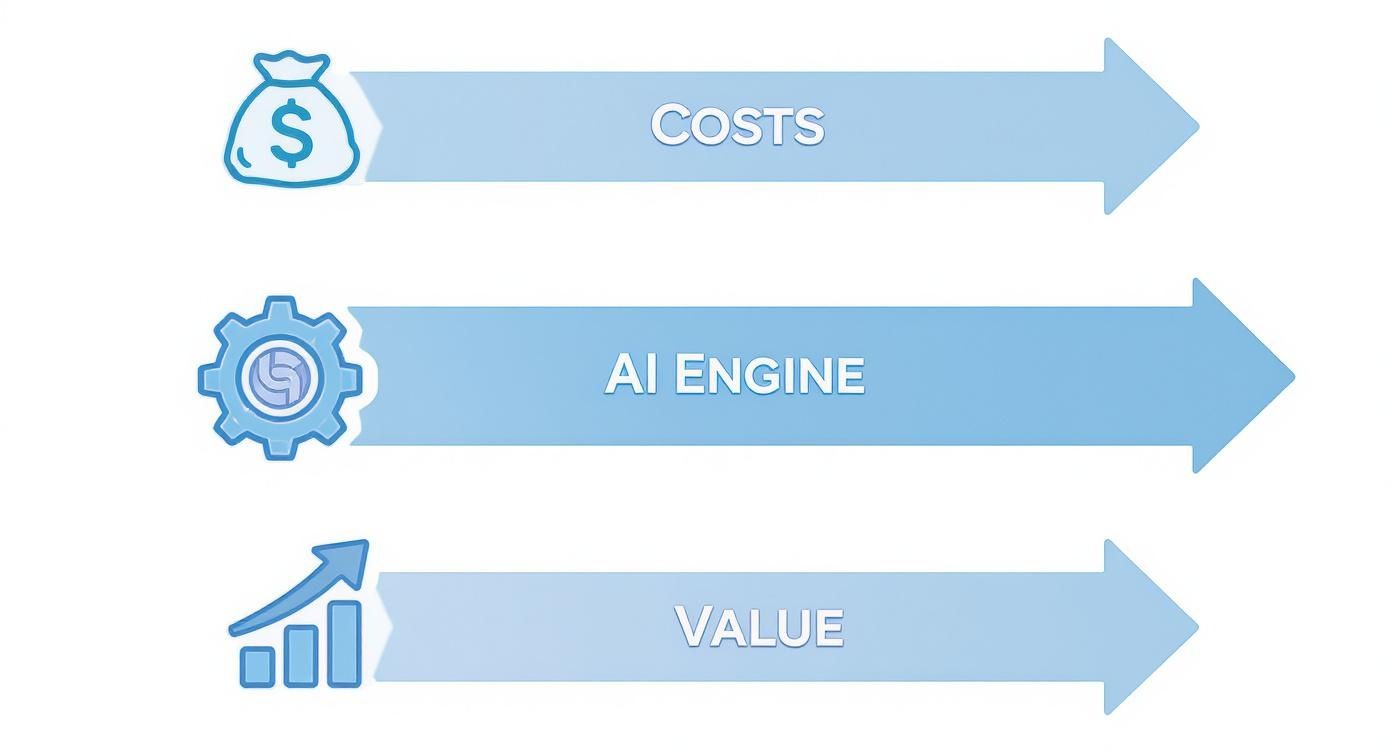
Every dollar invested in an AI engine must generate a quantifiable return.
Phase 2: The Middle Four Weeks – Design and Development
With a clear target, the next four weeks focus on connecting the business problem to a technology solution. This is where you move from strategy to execution, whether building in-house or working with a vendor. This phase should follow a rapid, iterative cycle.
Getting expert advice on how to implement AI without the guesswork can be beneficial.
During this sprint, your team will focus on:
- Conducting Vendor Demos: If buying a solution, shortlist 2-3 vendors for a demo. Provide them with your project charter and a sample dataset to see how their platform handles your specific problem.
- Developing a Proof of Concept (POC): Your technical team or vendor partner builds a lightweight version of the model to prove the technology works and can meet accuracy targets.
- Defining the Integration Plan: Map out how the new AI tool will interact with existing systems like your ERP or CRM. This includes defining API calls, data workflows, and the user interface.
Phase 3: The Final Four Weeks – Pilot and Measure
The last month is for launching the pilot to see if the theoretical value from the ROI model is realized. Deploy it with a small, controlled group of users in a live environment.
Measurement is key in this phase. Relentlessly track the success metrics defined in Phase 1 against the established baseline. This hard data will justify scaling the solution.
The final sprint involves deploying the model, training the first user group, and monitoring its performance. As you manage more of these projects, establishing a central oversight function is essential. Our guide to building an AI portfolio management strategy offers practical guidance on this.
Completing this 90-day cycle provides a proven business case, a tested process, and the organizational momentum needed to scale your AI efforts with confidence.
Weaving in Strong AI Governance and Compliance
Responsible AI deployment is as important as the algorithms themselves. A strong governance framework transforms a promising technology into a trusted business tool. This means addressing AI ethics, risk management, and regulatory compliance from the beginning.
Governance should be seen as a competitive advantage. A solid governance plan builds customer trust, protects your brand, and keeps you ahead of changing regulations. It allows you to scale your AI solutions for business confidently.
Turning Regulations into Real-World Rules
Regulations like the EU AI Act can be translated into practical, day-to-day requirements for your data scientists and development teams. This means setting clear standards for key areas:
- Data Privacy and Security: Establish rules for how personal and sensitive data is gathered, used, and stored for model training, including data anonymization and secure handling protocols.
- Model Transparency: Document every step of a model's lifecycle, from the training data to the logic it uses for decisions. This "explainability" is crucial during an audit.
- Bias Mitigation: Proactively identify and eliminate demographic or algorithmic bias in your models before and after deployment. Define what "fairness" means for your use case and have a plan to retrain models that show bias.
Good governance is about accountability. You must be able to explain how an AI model made a specific decision and prove you have systems in place to monitor its behavior.
While building internal controls, you must also monitor external risks. Staying current on emerging AI-powered cyber threats is a critical part of modern risk management.
Assembling Your Responsible AI Steering Committee
Governance requires a dedicated, cross-functional team with the authority to create and enforce policies. A Responsible AI Steering Committee is an effective way to achieve this. Our guide on EU AI Act readiness offers more specific steps for this process.
This committee should include leaders from across the business.
Key Roles for Your AI Steering Committee:
- Executive Sponsor (CIO or CDO): Provides high-level vision and resources and ensures governance is taken seriously.
- Legal and Compliance Lead: Translates regulations like GDPR and the EU AI Act into clear, actionable policies.
- Lead Data Scientist or ML Engineer: Provides technical expertise on model validation, bias detection, and MLOps best practices.
- Business Unit Representative: Ensures governance rules are practical and do not hinder business operations.
This team creates and maintains your company’s AI governance playbook, ensuring every AI project meets high standards for safety, ethics, and compliance.
Common Questions About Enterprise AI
Here are straightforward answers to common questions from CIOs and CTOs exploring AI.
Should We Build Our Own AI or Buy a Vendor Solution?
The "build vs. buy" decision depends on your strategic goals and resources. Buying an off-the-shelf solution offers speed and predictability. It is suitable for common business problems like CRM optimization or automated support ticket routing.
Building an AI capability in-house is a long-term strategic investment, best for creating a proprietary system that provides a lasting competitive edge. Most companies use a hybrid model: buying vendor tools for common tasks while building their own AI for strategic differentiation.
What’s the Biggest Reason AI Pilots Don't Make It to Production?
The most common reason AI pilots fail to scale is a weak connection to a real business problem. Many pilots are treated as technical experiments by IT instead of strategic initiatives championed by the business.
Without a dedicated owner in a business unit and clear success metrics tied to revenue, cost savings, or risk reduction, a pilot will often stall after the technical proof-of-concept.
To scale a pilot successfully, an integration and change management plan is needed from the start. Frame the project around its business value, not its technical novelty, to get the buy-in and resources for a full rollout.
How Can We Keep AI Models Accurate and Fair Over Time?
Maintaining AI model integrity requires a solid Machine Learning Operations (MLOps) framework. AI needs constant oversight.
The main challenge is model drift, where a model’s performance degrades because real-world data no longer matches its training data. To keep models accurate and unbiased, you need:
- Automated Monitoring: Alerts that trigger when a model’s performance drops below a set threshold.
- Regular Audits: Scheduled reviews to check for algorithmic bias using fairness metrics.
- A Clear Retraining Plan: A documented process for retraining models with fresh data when they drift.
Treat your AI models as critical business assets that require ongoing maintenance and governance to continue delivering value.
At DSG.AI, we help enterprises design, build, and deploy high-impact AI solutions with a clear path to ROI. Our architecture-first approach ensures your systems are scalable, reliable, and built for your unique operational needs, ending with full IP ownership and zero vendor lock-in.
See how we turn complex business challenges into production-ready AI capabilities. Explore our enterprise AI projects.