
Written by:
Editorial Team
Editorial Team
A Chief Technology Officer at a global logistics firm faces a critical data problem. The company's network of vehicles, automated warehouses, and sensor-equipped packages generates massive data streams. Sending all this data to a central cloud creates significant network traffic, which leads to processing delays and high bandwidth costs. A delay of just a few hundred milliseconds can disrupt supply chain automation and impact operational efficiency. The problem is how to process large volumes of time-sensitive data at the source to make immediate decisions without overwhelming the network.
This article educates technology leaders on how edge computing solves these performance and cost challenges.
1. Reduced Latency and Real-Time Processing
Edge computing reduces latency by processing data at or near its source. Instead of sending raw data to a centralized cloud for analysis, edge devices perform computations locally. This architecture eliminates the round-trip time of cloud communication. It can cut response times from over 200 milliseconds to under 20 milliseconds.

This near-instantaneous processing enables applications where immediate action is critical.
Impact and Enterprise Use-Cases
The ability to act on data in real time creates new efficiencies and safety protocols.
- Industrial Automation: On a factory floor, an edge-enabled vision system can detect product defects on a high-speed assembly line in under 20 milliseconds. This allows for immediate removal, which can reduce scrap rates by 8 to 15 percent compared to a Q2 baseline.
- Autonomous Vehicles: An autonomous car processes terabytes of sensor data locally to make split-second decisions like collision avoidance. Relying on a cloud connection would introduce fatal delays.
- Healthcare: In a hospital, edge devices monitor patient vitals in real time. They can detect anomalies and alert staff instantly without depending on a congested hospital network or internet connection.
Implementation and Measurement
To use this benefit, organizations must identify processes where latency is a bottleneck.
- Actionable Tip: Audit your workflows to find processes requiring a response time under 100 milliseconds. For example, a logistics company can reduce package sorting errors by a projected 8 percent by using edge-based computer vision for conveyor belt analysis. This can achieve response times under 50 milliseconds.
- Key Metric (KPI): Measure "End-to-End Latency," which is the total time from data capture to action. A successful edge deployment should show a 90-99% reduction in this metric compared to a cloud-centric architecture, based on internal testing.
2. Bandwidth Optimization and Reduced Network Costs
Edge computing optimizes network bandwidth and lowers associated costs. By processing and filtering data locally, edge deployments reduce the volume of information sent to a central cloud. Instead of sending a continuous stream of raw data, only relevant summaries or alerts are sent over the network.
This approach is critical in environments with limited, unreliable, or costly connectivity.
Impact and Enterprise Use-Cases
Significant bandwidth reduction leads to lower operational costs and better application performance in constrained environments.
- Smart Cities: A network of security cameras can generate petabytes of video data daily. Edge processing allows video analytics to run on-site. This setup transmits only clips of specific events, like traffic accidents, instead of 24/7 high-resolution streams. According to a 2021 NVIDIA study, this can cut data transmission needs by over 95%.
- Precision Agriculture: IoT sensors in a field collect data on soil moisture and nutrient levels. An edge gateway can analyze this data and send only a daily summary or critical alerts to the cloud.
- Remote Industrial Sites: A remote wind farm with thousands of sensors can analyze turbine performance data locally. Predictive maintenance alerts can be sent over a satellite link, avoiding the high cost of transmitting terabytes of raw operational data.
Implementation and Measurement
To achieve bandwidth savings, organizations must deploy data filtering and pre-processing logic at the edge.
- Actionable Tip: Define clear criteria for what data needs to be sent to the cloud. Start by implementing data aggregation and compression on your edge nodes to consolidate raw sensor readings. For video, use motion detection to transmit data only when activity is present.
- Key Metric (KPI): Track "Data Volume Transmitted per Node" in GB per day. A successful edge implementation should aim for a 75-95% reduction in data sent to the cloud compared to a direct-to-cloud model.
3. Improved Reliability and Offline Functionality
Edge computing ensures operational continuity even when network connectivity to a central cloud is lost. By processing critical data locally on edge devices, systems can function autonomously. This decouples core operations from reliance on a constant internet connection.
This resilience is a key design feature for environments where connectivity is not guaranteed. Systems continue to operate, collect data, and sync with the cloud once the connection is restored.
Impact and Enterprise Use-Cases
The ability to operate offline builds a resilient and dependable infrastructure.
- Retail Operations: A retail store using an edge-based point-of-sale (POS) system can continue processing transactions during an internet outage. Transaction data is stored locally and synced to central systems once connectivity resumes.
- Remote Industrial Sites (Synthetic Example): An offshore oil rig can run autonomous safety systems on-site. These systems function without depending on a satellite link, which could be affected by weather. This can reduce operational risk by a projected 15-20 percent in such scenarios.
- Logistics and Warehousing: In a large warehouse, automated guided vehicles (AGVs) can continue to navigate using local processing maps if the central Wi-Fi network fails, maintaining operational throughput.
Implementation and Measurement
To achieve this reliability, organizations must architect applications to function independently of the cloud.
- Actionable Tip: Design applications with a "sync-later" model. Use data queuing and synchronization protocols to manage data collected during offline periods. For example, a quick-service restaurant can use edge devices to continue taking orders, queuing data to sync with its central ERP system when a stable connection is available.
- Key Metric (KPI): Measure "System Uptime During Network Disruption." A successful edge implementation should maintain 100% functionality for mission-critical local tasks during network outages, compared to 0% for a purely cloud-dependent system.
4. Enhanced Security and Data Privacy
Edge computing can strengthen security and protect data privacy. By processing information locally, organizations can keep sensitive data within their physical perimeters. This reduces the attack surface and minimizes data transmission over public networks.
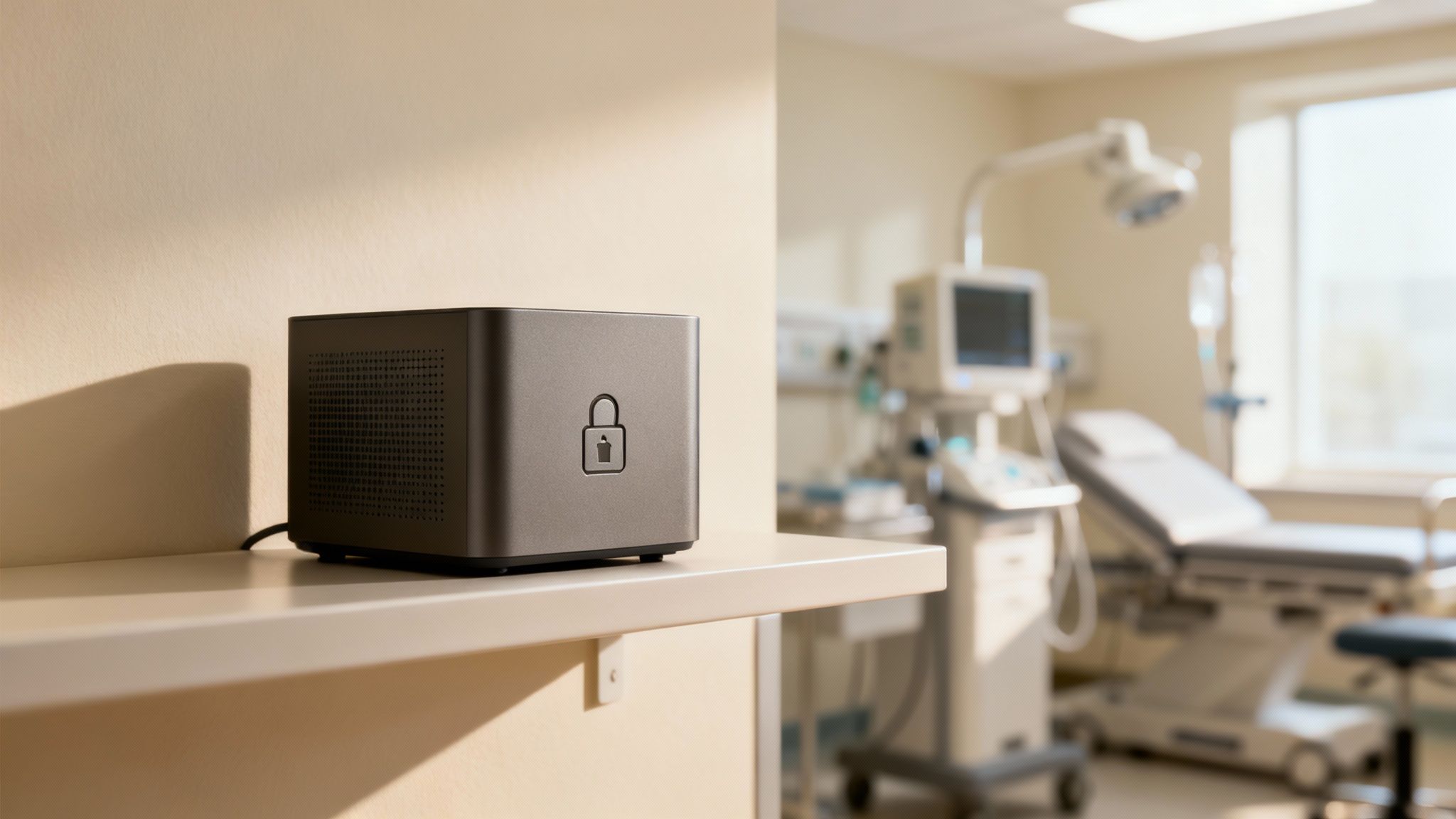
Keeping data local mitigates the risk of in-transit interception. It also simplifies compliance with data residency regulations like GDPR and HIPAA.
Impact and Enterprise Use-Cases
This localized security model is critical for industries handling confidential information.
- Healthcare: A European hospital can use edge devices to analyze patient monitoring data locally. This ensures compliance with GDPR by preventing sensitive health information from being transferred to non-EU cloud servers.
- Finance: Banks can deploy edge nodes in branch locations to process initial transaction data on-site. This satisfies data sovereignty requirements and reduces the risk of exposing financial data during transit.
- Government: Secure government facilities can process classified information on hardened edge servers. This ensures sensitive data never connects to an external network, eliminating the threat of remote exfiltration.
Implementation and Measurement
To implement a secure edge architecture, organizations must treat each edge node as a secure micro-perimeter.
- Actionable Tip: Implement a zero-trust security model across your edge infrastructure. Deploy end-to-end encryption from the sensor to the edge node and use hardware security modules (HSMs) to protect cryptographic keys. For more information, explore Third-Party Risk Management (TPRM) strategies for decentralized systems. You can learn more about how TPRM enhances security in distributed environments.
- Key Metric (KPI): Track the "Data Exposure Ratio." This measures the percentage of sensitive data transmitted beyond the secure edge. A successful deployment should aim for a ratio below 5%, meaning over 95% of critical data is processed and stored locally.
5. Scalability Without Proportional Cloud Infrastructure Growth
Edge computing enables operational scale without a proportional increase in centralized cloud costs. By distributing computation across a network of local edge nodes, the system scales horizontally. As data sources grow, new edge devices can be added to handle the increased load locally. This mitigates the need for costly upgrades to central data centers.
This decentralized architecture allows organizations to expand services more sustainably.
Impact and Enterprise Use-Cases
This model of distributed scalability is essential for global services and large-scale IoT deployments.
- Content Delivery Networks (CDNs): Companies like Netflix and Akamai place edge servers in regional data centers globally. This allows them to scale video streaming to millions of users by serving content from a nearby location, reducing the load on their central servers.
- Ride-Sharing Services: A service like Uber processes ride requests and GPS data at edge nodes within each city. This approach allows them to handle millions of simultaneous trips without funneling every real-time data point back to a single global cloud.
- Retail Operations: A large retail chain can process point-of-sale transactions at the store level. This allows the system to scale to thousands of locations without creating a bottleneck at the central corporate database.
Implementation and Measurement
To achieve this scalable architecture, organizations should design applications for a distributed environment.
- Actionable Tip: Deploy applications using lightweight containerization technologies like Docker and a streamlined orchestrator such as K3s. This creates a consistent runtime environment across all edge devices, simplifying management and enabling automated scaling. Discover more about efficient workload management with AI orchestration.
- Key Metric (KPI): Track "Cloud Ingress Cost per Terabyte." A successful edge scaling strategy should keep this metric flat or decrease it over time, even as the total volume of data generated by endpoints increases.
6. Lower Operational and Infrastructure Costs
Edge computing can reduce operational and infrastructure costs. By processing data locally, organizations can decrease their reliance on centralized cloud services. This shift avoids the costs of transferring massive volumes of raw data and paying for its storage and processing in the cloud.
Instead of a constant data flow to the cloud, only essential insights or summaries are transmitted. This filtered approach leads to a more cost-effective IT architecture.
Impact and Enterprise Use-Cases
Processing data at the edge can result in significant savings.
- Manufacturing (Synthetic Example): A smart factory can use edge gateways to analyze sensor data from its production lines locally. This can reduce its cloud data processing and storage costs from a baseline of $50,000 per month down to a projected $15,000 per month by sending only aggregated performance metrics to the cloud.
- Video Surveillance: A large-scale security operation with hundreds of cameras can cut cloud storage costs. Based on industry reports, savings can reach 70-80 percent. Edge devices analyze video streams in real time, uploading only clips that contain security alerts.
- Telecommunications: Telecom operators can process network traffic data at local edge sites instead of sending it all to a central data center. This can save millions annually in cloud egress fees.
Implementation and Measurement
To capitalize on these savings, organizations should analyze their data workflows.
- Actionable Tip: Audit your monthly cloud service bills. Identify the top three contributors to data transfer and storage costs. These high-volume data streams are good candidates for an edge-based processing model.
- Key Metric (KPI): Measure "Cloud Data Ingestion Volume" (in terabytes) and "Data Egress Costs" monthly. A successful edge deployment should aim to reduce these metrics by at least 60-75% compared to a fully cloud-dependent architecture.
7. Enhanced AI and Machine Learning Capabilities
Edge computing deploys machine learning (ML) models directly onto edge devices. This shifts AI inference from centralized cloud servers to the point of data generation. It enables intelligent, real-time decision-making without constant cloud connectivity.

This decentralization of AI unlocks autonomous operations and immediate, context-aware responses that cloud-based models cannot match.
Impact and Enterprise Use-Cases
Running algorithms locally creates value by enabling faster, more reliable automated systems.
- Retail Analytics (Synthetic Example): A smart retail shelf can use an edge-based vision model to monitor inventory levels in real time. It can instantly detect when stock is low, triggering an alert to staff. This can reduce out-of-stock instances by a projected 15-20 percent compared to periodic manual checks.
- Smart Home Devices: Modern smart speakers process voice commands like "set a timer" directly on the device. This on-device processing delivers a response time under 500 milliseconds and ensures private audio data does not leave the user's home.
- Agriculture: An autonomous drone with an edge AI system can analyze crop health from images during flight. It can identify areas affected by pests and trigger targeted spraying, which can reduce pesticide use by up to 30 percent, according to a 2022 study by Harper Adams University.
Implementation and Measurement
To use edge AI, organizations must optimize models for resource-constrained environments. Exploring options for AI model management on dsg.ai can provide a structured approach.
- Actionable Tip: Identify an AI-driven process currently limited by latency. Use model optimization techniques like quantization and pruning to reduce a model's size by up to 75%. This makes it suitable for deployment on hardware like a NVIDIA Jetson or Google Coral.
- Key Metric (KPI): Track "Inference Latency," the time it takes for the edge device to process input and generate an output. A successful edge AI deployment should achieve inference times under 100 milliseconds, a clear improvement over the 500ms+ round-trip time of some cloud-based AI services.
8. Better User Experience and Performance Optimization
Edge computing enhances application performance and user satisfaction by processing data closer to the end-user. Instead of routing all requests to a distant cloud, edge nodes handle computations locally. This proximity minimizes network latency, resulting in faster load times and a more responsive digital experience.
This architectural advantage is crucial for retaining users where performance affects engagement and revenue.
Impact and Enterprise Use-Cases
Improving application responsiveness has a direct impact on user behavior and business outcomes.
- Media and Streaming: A video streaming platform can use an edge network to cache 4K content near major population centers. Analysis by streaming industry experts indicates this can reduce buffering events by 60-80% and cut video start-up times in half.
- Online Gaming: For competitive gaming, actions must be processed with minimal delay. Edge servers process player inputs locally, reducing ping times to under 20 milliseconds, which is critical for preventing lag.
- E-commerce: An online retailer can deploy edge functions to personalize product recommendations. This can improve page load speeds by 30-50%, which Google's research correlates with higher conversion rates.
Implementation and Measurement
To use this benefit, organizations must identify where network distance creates a poor user experience.
- Actionable Tip: Start by implementing edge caching for your most frequently accessed static assets like images and videos. Platforms like Cloudflare and Fastly allow you to deploy these rules globally.
- Key Metric (KPI): Track "Time to First Byte (TTFB)" and "Largest Contentful Paint (LCP)." An effective edge strategy should reduce TTFB by over 75% and improve LCP scores to fall within Google's "Good" threshold (under 2.5 seconds) for a majority of users.
9. Environmental Sustainability and Energy Efficiency
Edge computing can improve environmental sustainability by optimizing energy consumption. By processing data locally on smaller devices, this architecture reduces reliance on large, power-intensive cloud data centers. This distributed model curtails the energy used for transmitting and processing vast datasets over long distances.
This shift also enables the use of low-power hardware, like ARM-based processors, designed for efficiency.
Impact and Enterprise Use-Cases
The energy savings from edge computing can impact both operational costs and environmental reporting.
- Smart Grid Management: Utility companies can deploy edge gateways to process energy consumption data locally. This enables real-time grid balancing and can reduce transmission line losses by an estimated 3-5 percent, according to Department of Energy reports.
- Precision Agriculture: IoT sensor networks can operate on battery or solar power for years. By processing sensor data at the edge, they transmit only critical alerts, cutting down on energy-intensive data transmissions.
- Retail Operations (Synthetic Example): A smart retail store can use edge devices to process video analytics. This avoids constantly streaming high-resolution video to the cloud, reducing the store's data-related energy consumption by a projected 15-20 percent.
Implementation and Measurement
To gain these green benefits, organizations must select hardware and optimize workloads.
- Actionable Tip: Prioritize energy-efficient hardware, such as systems built on ARM architecture. When designing your edge solution, use power-aware scheduling algorithms that place workloads on devices based on their current energy state.
- Key Metric (KPI): Track "Kilowatt-hours (kWh) per Processed Transaction." A successful edge implementation should demonstrate a 25-40% reduction in this metric when compared to the energy consumption of a fully cloud-based model for the same workload.
10. Localized Intelligence and Contextual Decision-Making
Edge computing enables adaptive decisions by processing data within its local context. Instead of relying on general logic from a central cloud, edge systems can analyze real-time environmental conditions and operational variables unique to a specific location.
This capability transforms services from reactive to proactive, tailoring actions to the immediate environment.
Impact and Enterprise Use-Cases
Context-aware decision-making drives operational improvements by adapting to local conditions.
- Smart Buildings: An edge-powered building management system analyzes local occupancy patterns and real-time weather data. It can then adjust HVAC and lighting in specific zones, reducing energy consumption by 15-20 percent compared to systems using predefined schedules, based on data from the U.S. General Services Administration.
- Precision Agriculture: In-field sensors with edge processing assess hyperlocal soil moisture and crop health. This allows for targeted irrigation, improving crop yields by up to 10 percent while minimizing resource waste.
- Retail Analytics: In-store cameras and sensors with edge AI can analyze local foot traffic. This enables dynamic pricing and personalized digital signage, which can increase customer engagement.
Implementation and Measurement
To implement localized intelligence, edge nodes must act autonomously based on local data.
- Actionable Tip: Start by deploying a pilot in a controlled environment, like a single retail store. Use telemetry to gather baseline data on local patterns. Create templates for common scenarios (e.g., "high-traffic morning") that balance central policies with local adaptations.
- Key Metric (KPI): Measure "Operational Efficiency Gain." This could be the percentage reduction in energy usage, the increase in crop yield per acre, or the conversion rate uplift. A successful deployment should show a measurable 5-15% improvement in the chosen KPI based on a 3-month pilot.
Edge Computing: 10-Benefit Comparison
| Benefit | Implementation complexity | Resource requirements | Expected outcomes | Ideal use cases | Key advantages |
|---|---|---|---|---|---|
| Reduced Latency and Real-Time Processing | High — distributed, real-time constraints | Low-latency edge servers, fast networking, local compute | Near-instant responses (ms→µs), real-time decisions | Autonomous vehicles, industrial robots, AR, medical devices | Safety-critical responsiveness; minimal jitter |
| Bandwidth Optimization and Reduced Network Costs | Medium — filtering and aggregation logic | Edge storage, compression, local analytics | Significant bandwidth reduction; lower transmission costs | Smart cities, agriculture IoT, remote sensors, mining | Lower egress/storage costs; efficient WAN usage |
| Improved Reliability and Offline Functionality | Medium–High — failover & sync complexity | Local storage, redundancy, orchestration tools | Continued operation during outages; high availability | Retail POS offline, healthcare monitoring, offshore rigs | Eliminates single points of failure; business continuity |
| Enhanced Security and Data Privacy | High — distributed security management | HSMs, device encryption, local access controls | Reduced data exposure; easier residency compliance | Healthcare, banking, government, sensitive data apps | Better privacy control; smaller attack surface |
| Scalability Without Proportional Cloud Growth | High — managing many distributed nodes | Large number of edge nodes, orchestration, monitoring | Horizontal scaling; modest central infra growth | CDN, ride-hailing, massive IoT, global services | Linear cost scaling; avoids cloud overprovisioning |
| Lower Operational and Infrastructure Costs | Medium — cost tracking and hybrid design | Capital edge hardware, maintenance, management staff | Reduced cloud/bandwidth bills; improved TCO | Telecom, manufacturing, video surveillance, retail | Significant cost savings; predictable OPEX/TCO |
| Enhanced AI and Machine Learning Capabilities | High — model optimization & lifecycle ops | ML accelerators, optimized frameworks, ML engineers | Faster on-device inference; privacy-preserving AI | On-device vision, real-time inference, autonomous systems | Instant AI decisions; lower latency and bandwidth |
| Better User Experience and Performance Optimization | Medium–High — caching and personalization sync | Edge caches, distributed nodes, monitoring tools | Faster responses; reduced buffering; personalized UX | Streaming, gaming, social media, e‑commerce | Improved responsiveness; fewer rebuffers/lag |
| Environmental Sustainability and Energy Efficiency | Medium — distributed power management | Energy-efficient processors, monitoring, renewables | Lower energy use and carbon footprint | Battery IoT, mobile processing, green edge sites | Energy savings; reduced data center impact |
| Localized Intelligence and Contextual Decision‑Making | High — diverse local logic management | Local sensors, compute, telemetry, config systems | Context-aware actions; improved local optimization | Smart buildings, traffic control, retail, agriculture | Hyperlocal adaptation; faster contextual decisions |
From Theory to Practice: Taking the Next Step in Your Edge Strategy
Processing data closer to its source addresses core operational challenges that technology leaders face. The ten benefits detailed here, from reduced latency to lower data transfer costs, are interconnected parts of a more resilient, efficient, and secure operational framework.
Real-time processing enables immediate quality control on a factory floor. Improved reliability ensures a remote mining operation continues functioning with intermittent connectivity. Enhanced data privacy helps healthcare providers meet HIPAA requirements by keeping patient data local. Bandwidth optimization makes deploying thousands of IoT sensors in agriculture economically viable.
The common thread is control. Edge computing returns control over data, performance, and cost to the enterprise. It mitigates the dependencies and vulnerabilities of a purely centralized cloud model.
Synthesizing the Gains: A Holistic View of Edge Computing Benefits
The true power of edge emerges when you combine these gains. For a Head of AI, deploying machine learning models at the edge (Benefit #7) is enabled by local processing power, which reduces the latency that would make a real-time task impossible (Benefit #1). This synergy creates a value proposition that is greater than individual metrics.
Consider the following takeaways:
- Operational Resilience: Edge builds a distributed, fault-tolerant system where local failures do not cause systemic outages. This shifts the focus from disaster recovery to continuous availability.
- Cost Optimization: Reducing cloud egress fees is a clear win (Benefit #6). The secondary cost savings can be more significant, including reduced waste from real-time quality control and minimized equipment downtime through predictive maintenance.
- Security and Compliance by Design: Edge architecture allows you to build security from the ground up (Benefit #4). By minimizing the attack surface and keeping sensitive data within a defined perimeter, you can more easily demonstrate compliance with regulations like GDPR and CCPA.
Your Actionable Path Forward
Moving from understanding the benefits to implementing a strategy requires a deliberate, architecture-first approach.
- Identify the Primary Business Driver: Start with the most pressing business problem. Is it the high cost of data backhaul from remote assets? The need for immediate decision-making in a manufacturing line? Or the requirement to process sensitive information without sending it to the cloud?
- Conduct a Pilot Project: Select a single, high-impact use case as a proof-of-concept. This allows your team to gain experience, measure baseline improvements (e.g., a 40% reduction in network traffic), and build a business case for broader adoption.
- Define Your Architectural Blueprint: A successful edge deployment requires a clear plan that defines data flows, processing logic, security protocols, and device management. This blueprint ensures scalability and maintainability.
Mastering an edge computing strategy prepares your organization for the future. It equips you to handle the growth of data from IoT and AI, turning that data from a logistical challenge into a strategic asset. By taking these next steps, you can move from theory to practice and begin unlocking these benefits.
A successful edge implementation begins with a robust and scalable architecture. DSG.AI specializes in designing and deploying enterprise-grade AI and data solutions with an architecture-first methodology, ensuring your strategy delivers quantifiable business outcomes without vendor lock-in. To see how our six-week process can accelerate your path from concept to a production-ready edge solution, we invite you to explore our work at DSG.AI.