Written by:
Editorial Team
Editorial Team
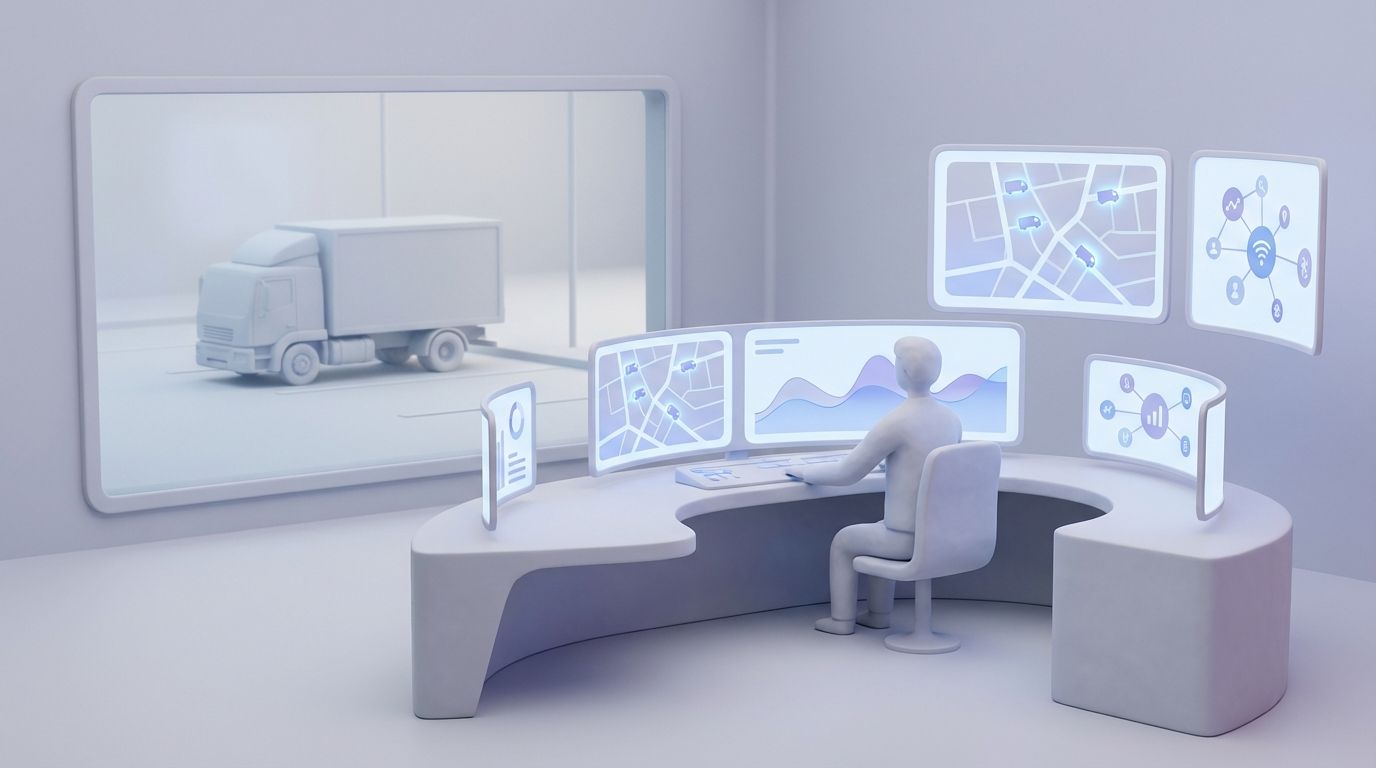
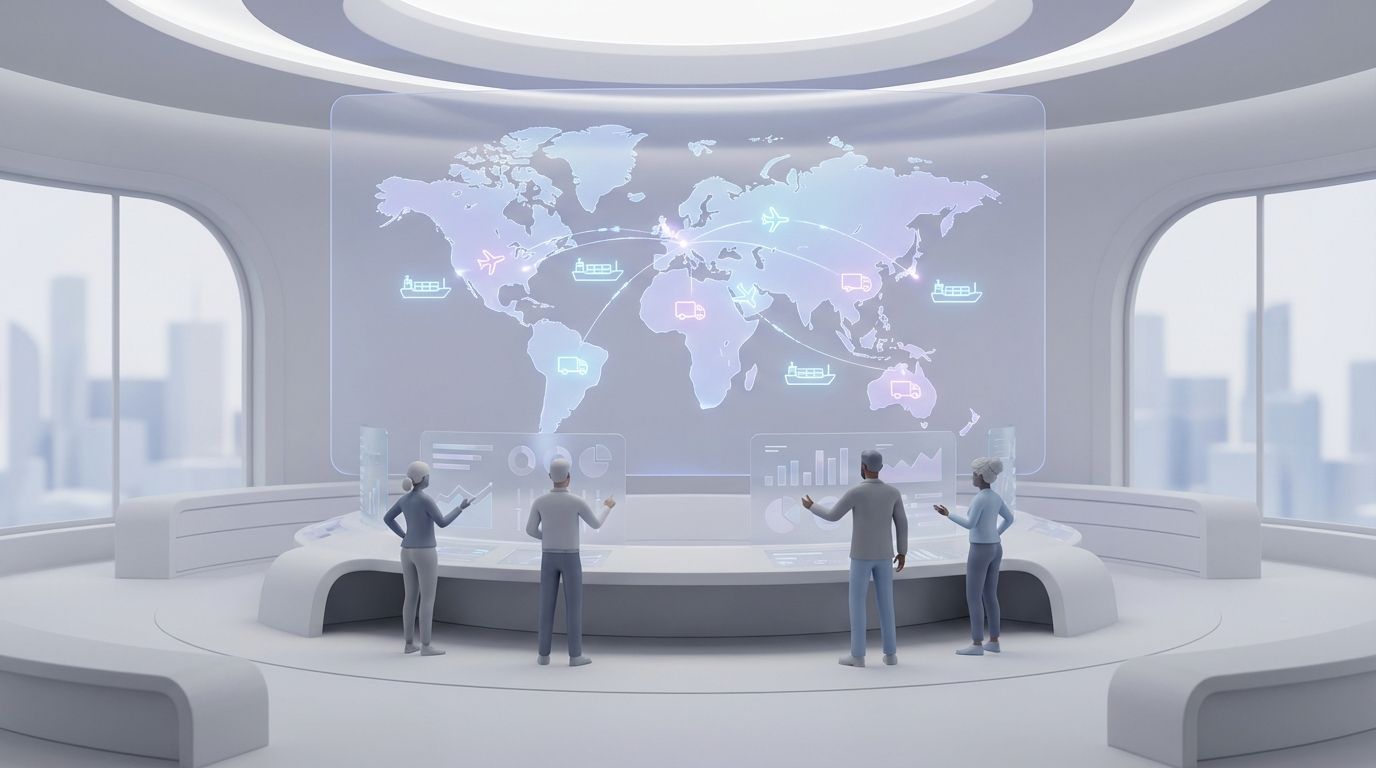
A supply chain control tower is a central hub that provides end-to-end visibility across your logistics network, from suppliers to end customers. It's not just a dashboard for viewing data. A control tower combines information from systems that were once disconnected to provide actionable insights. This helps logistics teams move from reacting to problems to proactively preventing them. The outcome is a more resilient supply chain that operates more smoothly and at a lower cost.
Moving Beyond Spreadsheets and Silos
Managing a supply chain with a mix of spreadsheets, legacy ERPs, and disconnected department systems leads to chaos. This fragmented approach creates blind spots that result in costly mistakes, like missed delivery dates and excess inventory costs.
A supply chain control tower acts as a central intelligence hub. It connects and harmonizes data from different sources. Like an air traffic control center that coordinates flights for safety and efficiency, a control tower monitors inventory levels, shipment statuses, and supplier performance from a single, unified dashboard.
The Real Cost of Incomplete Data
When teams make decisions using incomplete or outdated information, the consequences affect both the bottom line and customer relationships. These are measurable problems:
- Stockouts: Inability to accurately match inventory to demand leads to empty shelves. One food and beverage company found that stockouts on key product lines were reducing quarterly revenue by an estimated 2-4%.
- Delayed Shipments: Without real-time visibility into disruptions, a delay is often discovered only after it has impacted a production line or customer delivery.
- Reactive Firefighting: Teams spend their days expediting late orders and scrambling to find last-minute carriers instead of focusing on strategic improvements.
- Excess Inventory Costs: To buffer against uncertainty, companies often overstock. This can increase annual holding costs by 15% to 25% of the inventory's value, tying up working capital.
To move beyond the limitations of spreadsheets, businesses need a unified view of their data, including real-time shipment tracking for every shipment. The old methods are not sufficient for today's volatile global markets.
A control tower changes operational management from a fragmented, reactive process into a synchronized, proactive strategy. It provides the clarity needed to see disruptions coming and take action before they impact customers or profitability.
This shift is an operational upgrade and a competitive necessity. By creating a single source of truth, a control tower establishes the foundation for smarter, faster, and more efficient supply chain operations.
The Four Pillars of an Intelligent Control Tower
A modern supply chain control tower is more than a dashboard with charts. It is an intelligent system for your operations, built on four distinct pillars. These pillars work together to transform disconnected data into automated actions that protect profit margins and maintain customer satisfaction.
Without all four, you are left with a simple reporting tool, not a system for resilience.
The journey from operational disorder to clarity begins by acknowledging the risk in disconnected systems. When teams rely on spreadsheets and siloed software, they create operational inefficiencies.
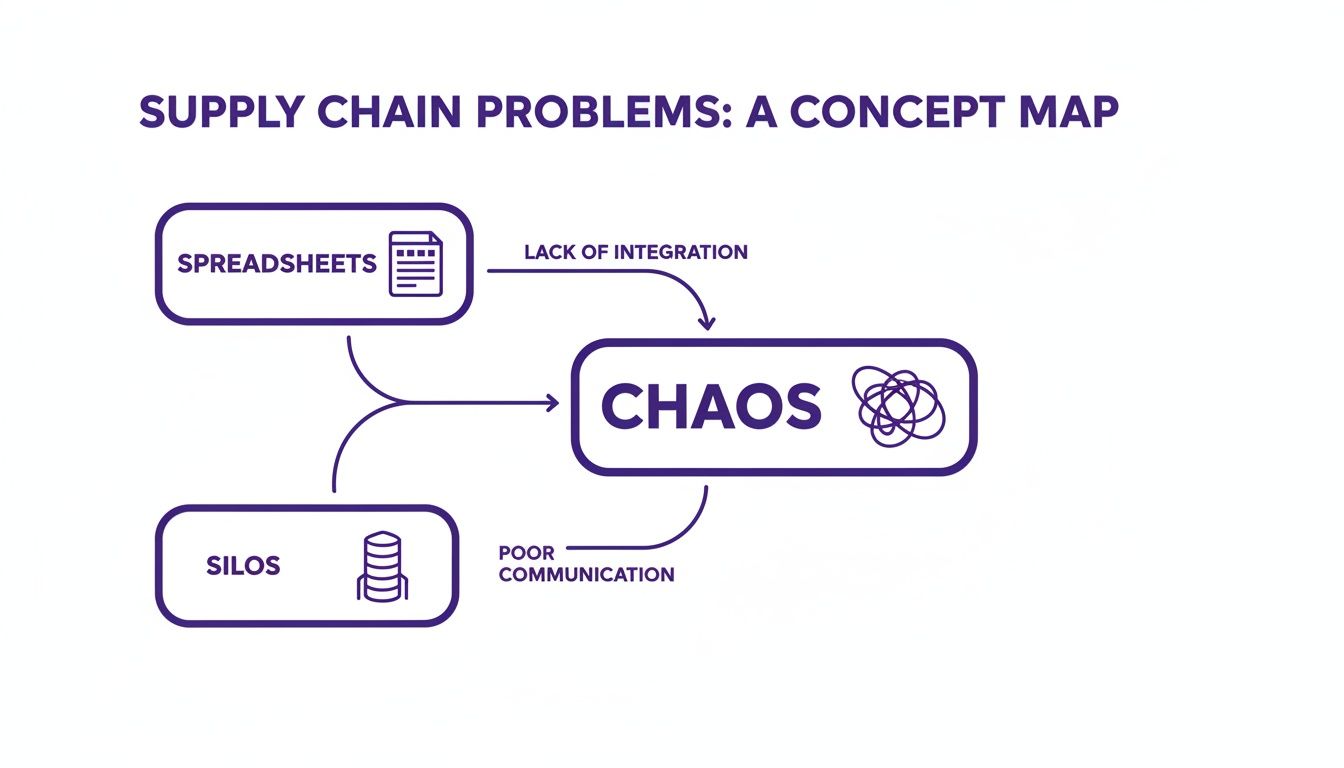
Manual processes are inadequate for a complex global network. A unified data strategy is the only way forward.
Pillar 1: Data Integration
The foundation of a control tower is Data Integration. This involves gathering, cleaning, and centralizing information from all parts of your network. The goal is to break down system silos to create a single, reliable source of truth.
An intelligent control tower integrates data from multiple sources, including:
- Internal Systems: ERP, Transportation Management System (TMS), and Warehouse Management System (WMS).
- Partner & Carrier Feeds: Updates from 3PLs, freight carriers, suppliers, and contract manufacturers.
- Real-Time Data Streams: Location and status from IoT sensors on containers and GPS trackers on trucks.
- External Factors: Weather forecasts, traffic data, and port congestion reports that can affect routes.
By combining these different data feeds, the control tower ensures every decision is based on complete and current information.
Pillar 2: End-to-End Visibility
Once data is integrated, the second pillar, End-to-End Visibility, makes it useful. This pillar transforms raw, aggregated data into a coherent, real-time map of your entire supply chain.
This unified view allows you to track shipments from the factory to the customer's door, monitor inventory levels across all warehouses, and oversee supplier performance in one place. You see more than just a single truck on a map; you see how its position affects a customer's order, a production schedule, and a delivery promise.
This clarity is the first step toward proactive management.
Pillar 3: Predictive Analytics
With a clear, real-time picture established, the third pillar, Predictive Analytics, adds foresight. AI and machine learning models analyze historical and live data to identify potential disruptions before they occur.
Instead of only alerting that a shipment is late, predictive analytics can identify the risk of a delay days in advance.
For example, an AI model might analyze a vessel's route, current ocean conditions, and historical port congestion data. Based on these inputs, it could predict a 75% probability of a two-day delay at the destination port. This early warning gives your team time to arrange alternative transport or notify the customer.
This capability shifts your team from reactive firefighting to strategic, forward-looking planning.
Pillar 4: Automated Orchestration
The final pillar is Automated Orchestration. This is where the control tower moves from showing you problems to helping solve them. It translates insights from the first three pillars into intelligent, automated actions.
Automated orchestration is the system’s ability to act on its own analysis. For a deeper dive, you can learn more about turning data into automated decisions in our guide on orchestration.
For instance, if predictive analytics flags that a weather system will likely cause a delay, the platform can automatically recommend a new route and show available capacity with an alternative carrier. This turns a control tower from a passive monitoring tool into an active, decision-making partner.
How AI-Powered Control Towers Outperform Traditional Systems
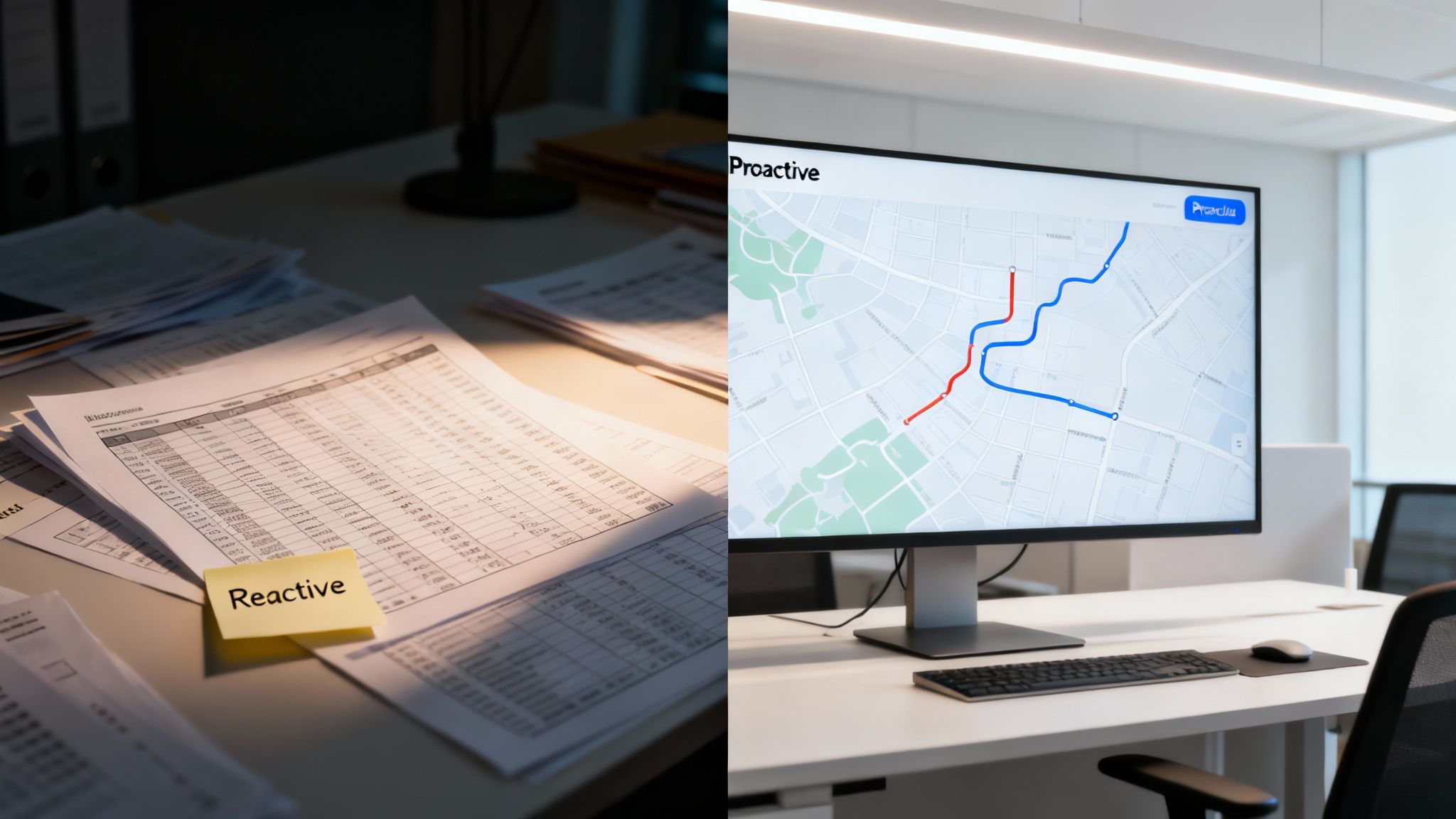
For years, traditional supply chain control towers provided basic visibility. They showed a problem after it had already occurred, but they could not help prevent it. This older model offered some visibility but was always a step behind.
An AI-powered control tower for supply chain management is different. It is like a GPS with live traffic updates and predictive routing. It analyzes current conditions, predicts future roadblocks, and proactively suggests better routes. This shift from reactive firefighting to proactive orchestration is what distinguishes a modern system.
This is a necessary evolution to manage today's global complexity. Gartner predicts that by 2025, 50% of large enterprises will use control towers for real-time visibility. This trend is driven by the growth of data from IoT sensors and rising carrier costs, making operational blind spots an unaffordable risk. Companies using real-time data in their control towers have seen logistics costs drop by an average of 15% compared to those using manual methods, according to the same report. You can find more supply chain insights in this comprehensive report.
From Manual Analysis to Automated Decisions
The main difference between old and new systems is how they handle data and decisions. Traditional systems were built for human analysis. They collected data, displayed it on a dashboard, and waited for a planner to identify an issue and decide on a course of action. This process is slow and prone to human error.
An AI-powered system automates this cycle. It processes millions of data points in real time, uses machine learning to identify patterns and predict future events, and can trigger corrective actions. This frees your team from constant firefighting, allowing them to focus on high-value strategic exceptions. You can explore our solutions for AI governance and monitoring to see how this works in practice.
A Clear Comparison
This table shows the capabilities of traditional and AI-powered control towers. The differences are significant.
Traditional vs AI-Powered Supply Chain Control Towers
This comparison illustrates how the technology has moved from simple data displays to intelligent, autonomous action.
| Capability | Traditional Control Tower | AI-Powered Control Tower |
|---|---|---|
| Data Analysis | Descriptive (What happened?) | Predictive & Prescriptive (What will happen & what should we do?) |
| Decision Support | Manual; relies on human interpretation. | Automated recommendations and decision execution. |
| Operational Focus | Reactive; responds to past disruptions. | Proactive; anticipates and mitigates future risks. |
| Scope | Often siloed to one function (e.g., transport). | End-to-end, connecting suppliers, logistics, and customers. |
| Alerts | Static thresholds (e.g., shipment is late). | Dynamic and predictive (e.g., shipment has a 90% chance of being late). |
A traditional tower shows you the score after the game is over. An AI-powered control tower acts as a coach on the field, calling plays in real time to ensure a win. It is the difference between reviewing history and actively shaping the future of your supply chain.
Driving Measurable Outcomes Across Industries
A control tower for supply chain operations must deliver measurable results. Business leaders need to see a clear connection between these systems and lower costs, better service, and improved resilience. Companies often use external expertise and solutions like Third Party Logistics (3PL) business storage to optimize specific parts of their supply chain.
The value of an AI-powered control tower is most evident when applied to specific industry problems that require precision and speed.
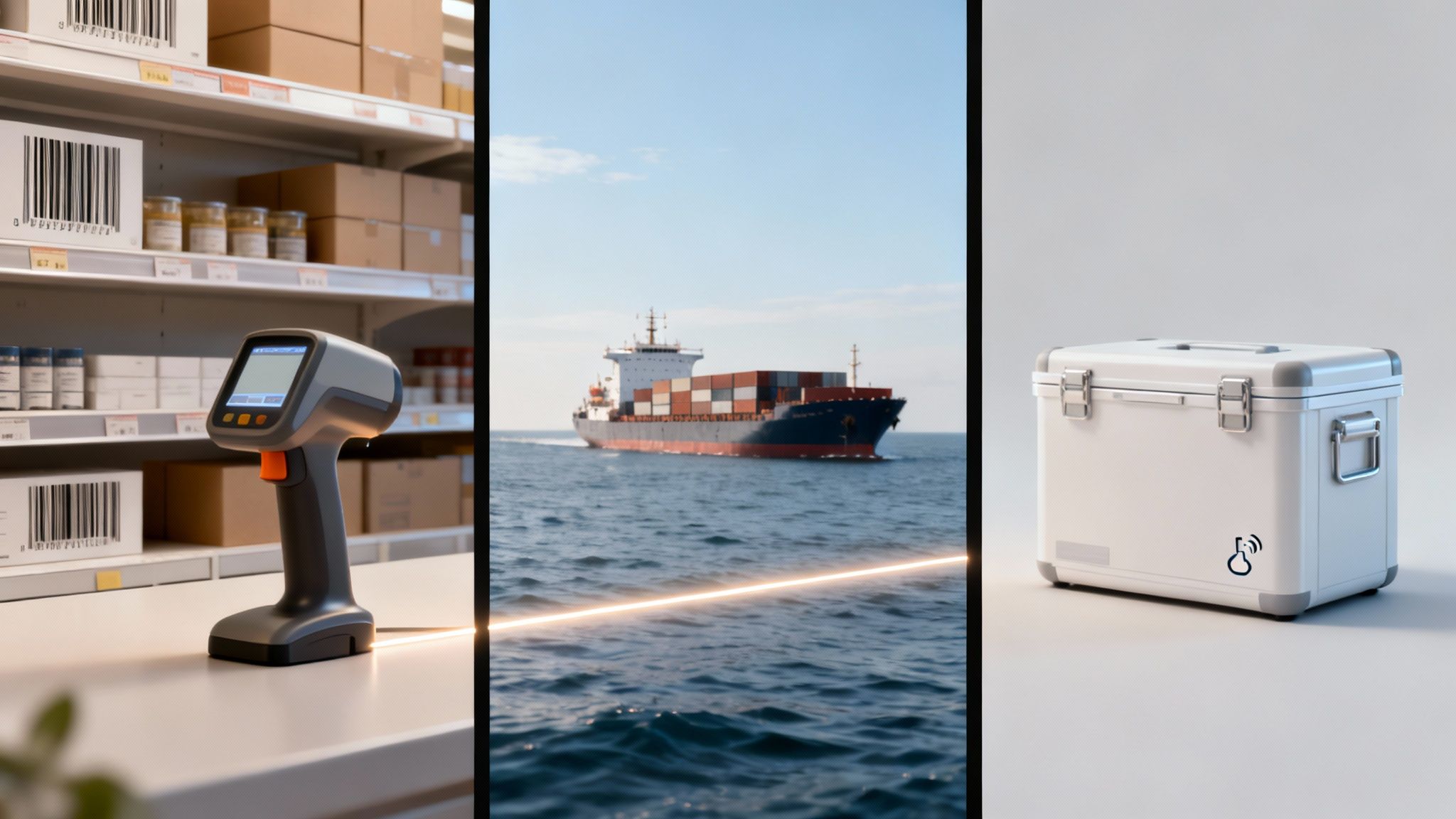
Here are a few synthetic examples of what this looks like in practice.
Global Retail Inventory Optimization
A multinational retailer faced a common problem: popular items were often out of stock, while other products sat on shelves and required heavy discounts to sell. Their forecasting relied on historical sales, a method that could not keep up with demand spikes from social media trends or local events.
- The Problem: Inaccurate forecasts led to having the wrong inventory in the wrong stores, which reduced both revenue and profit margins.
- AI Control Tower Solution: The control tower integrated point-of-sale data with external signals like weather forecasts, competitor promotions, and social media trends. This allowed its predictive models to forecast demand more accurately for each store.
- Quantified Outcome: The system automated inventory rebalancing suggestions. This led to a 20% reduction in stockouts and a 15% decrease in markdowns compared to the previous year.
Maritime Shipping Fuel Efficiency
For a global shipping company, fuel is a major operating expense. Traditional route planning was static and could not adapt to variables like ocean currents, weather, and port traffic that impact fuel consumption.
An AI-powered control tower moves beyond static route planning. It continuously analyzes real-time data to find efficiencies, turning small gains into significant savings.
- The Problem: Fixed routes resulted in excess fuel consumption, higher emissions, and unpredictable schedules.
- AI Control Tower Solution: The control tower integrated live weather data, ocean current maps, and real-time vessel performance metrics. Its AI simulated thousands of potential routes, constantly identifying and recommending the most fuel-efficient path for each ship.
- Quantified Outcome: The company achieved an 8 to 12 percent reduction in fuel consumption, saving millions of dollars annually and reducing its carbon footprint.
Pharmaceutical Cold Chain Integrity
A pharmaceutical firm dealing in temperature-sensitive biologics faced significant risk. If a single shipment deviated from its required temperature range during transit, a multi-million dollar batch of medicine could be lost.
Across logistics-heavy industries, we have seen AI-powered control towers reduce unplanned downtime by up to 20-30% by forecasting demand and simulating scenarios. Companies using these systems often report 15% logistics savings and faster response times to disruptions.
- The Problem: Spoilage events were usually discovered after delivery because there was no real-time monitoring or proactive alerting system.
- AI Control Tower Solution: The company implemented a control tower connected to IoT sensors inside its refrigerated containers. The system monitored temperature, humidity, and location in real time, using predictive models to flag any change that could lead to a future temperature breach.
- Quantified Outcome: Logistics teams and drivers received automated alerts, allowing them to take corrective action immediately. This proactive monitoring saved millions in potential product loss and helped them achieve 99.9% cold chain compliance.
A Phased Approach to Implementation
Implementing a full-scale control tower for supply chain overhaul at once is not advisable. A structured, phased approach is key to securing early wins, showing value quickly, and building momentum for a successful rollout. This involves breaking down the project into manageable steps.
This strategy is important. The supply chain control tower market is projected to reach USD 20 billion by 2030, according to some market analyses. This growth reflects the need for real-time visibility in an era of complex global networks. Siemens offers a useful perspective on why simple visibility is no longer enough.
Phase 1: Define Your Business Objectives
Before starting, you must define your "why." What specific business problem are you trying to solve? Vague goals like "improving visibility" are not sufficient. You need specific, measurable objectives tied to a bottom-line outcome.
Effective objectives look like this:
- Reduce late shipment penalties by 15% in the next two quarters.
- Decrease premium freight spend by 10% within six months.
- Improve on-time, in-full (OTIF) scores for our top 20 customers from 92% to 96%.
These clear targets guide the entire project, ensuring that every decision is focused on delivering tangible value.
Phase 2: Assess Data Readiness and Integration
A control tower's effectiveness depends on the quality of its data. This phase involves assessing your data landscape. You need to identify where critical information is located—whether in your ERP, TMS, WMS, or partner systems. Then you can map out how to bring it all together.
This is a foundational step. The goal is to create a single, reliable source of truth. Without clean, timely, and connected data, even the most advanced analytics will not be effective.
The initial data integration work is often the most challenging part of the implementation. Getting it right is essential for building a successful control tower.
Phase 3: Launch a Targeted Pilot Program
Start small with a focused pilot program. This approach minimizes risk and is the quickest way to demonstrate the concept's value. Choose one specific area of the business where you can make a significant, measurable impact quickly.
Good candidates for a pilot program include:
- A Single, High-Volume Shipping Lane: Focus on a route with frequent disruptions to demonstrate improved on-time performance.
- One Specific Product Line: Choose a product with complex logistics or high inventory costs to show potential savings.
- A Particular Geographic Region: Target an area with significant operational challenges or growth opportunities.
The pilot serves as a real-world test. It allows you to refine processes, gather feedback, and build a business case for a wider rollout, supported by ROI data.
Phase 4: Drive Change Management and Adoption
A control tower is not just software; it represents a new way of working. This final phase focuses on the people involved. Your teams need training on how to use the insights from the control tower to make better decisions.
Effective change management includes communicating the benefits, providing hands-on training, and integrating the control tower into daily workflows. When people see how the system makes their jobs less chaotic and more strategic, adoption will follow. This is how the technology becomes an essential part of your operation.
Building a Resilient and Future-Proof Supply Chain
A supply chain control tower should be the foundation of a resilient and adaptable enterprise. This involves building an intelligent system that becomes a core competitive asset, not just buying off-the-shelf software.
A custom, scalable AI system provides advantages that pre-packaged solutions cannot match. The most significant is full data ownership. Your operational data is a valuable asset, and maintaining control over it is crucial for long-term planning. This also prevents vendor lock-in, giving you the freedom to evolve your system as your business needs change.
Governance and Compliance in an Automated World
As AI is integrated into operations, governance becomes a primary concern. A purpose-built control tower must include a responsible AI framework from the start to ensure trust in automated decisions.
This ensures that every automated decision is transparent, fair, and compliant with regulations. For example, frameworks designed to meet standards like the EU AI Act provide the auditable trail needed to operate in complex global markets. You can learn more about these principles in our guide on Third-Party Risk Management (TPRM).
A future-proof supply chain requires a system that makes trustworthy, compliant, and intelligent decisions at scale. This transforms your control tower from a dashboard into a dependable operational co-pilot.
From Concept to Measurable Impact
The test of any technology investment is whether it delivers tangible business results quickly. The goal is to create a solution that targets your most pressing challenges, such as reducing logistics spend, improving on-time delivery rates, or decreasing inventory holding costs. A well-designed project should not take years to show value.
A purpose-built, AI-powered control tower is engineered to deliver measurable improvements within a single business quarter. By focusing on your unique operational needs, it ensures that every feature is aimed at a specific, quantifiable business goal. This is how you build a lasting competitive edge.
Frequently Asked Questions
When considering a major technology investment like a supply chain control tower, practical questions about ROI, timelines, and integration are common. Here are answers to the most frequent questions from enterprise leaders.
What Is the Typical ROI of a Supply Chain Control Tower?
The return on a control tower is measured in concrete operational gains. While results vary, most organizations see quantifiable improvements in several areas.
Here are typical results:
- Reduced Logistics Costs: A 10-15% reduction in total logistics and transportation spending is common. This comes from more efficient route planning, better shipment consolidation, and reduced premium freight usage.
- Improved On-Time Delivery: Proactive disruption management leads to more on-time deliveries. We often see a 5-10 percentage point improvement in OTIF metrics, which directly impacts customer satisfaction.
- Lower Inventory Carrying Costs: Better visibility into demand and inventory levels allows for leaner operations. This frees up working capital that was previously tied up in excess safety stock.
A control tower pays for itself by identifying and fixing operational inefficiencies, turning those fixes into savings and a stronger market position.
How Long Does Implementation Usually Take?
Modern, agile approaches have changed implementation timelines. A drawn-out, 18-month project is no longer the standard.
Our focus is on getting a functional pilot operational in under three months. We start by solving one specific, high-impact problem. By delivering value quickly, the project demonstrates its worth and builds momentum for a broader rollout.
Do We Need to Replace Our Existing ERP and TMS Systems?
No. An intelligent control tower is designed to work with your existing systems, not replace them.
It acts as an intelligence layer on top of your current technology stack. It connects to your ERP, Transportation Management System (TMS), Warehouse Management System (WMS), and other platforms. It pulls data from these sources to create a single, unified view of your operation. It enhances the value of your current technology investments by unlocking the data within them.
Ready to build a control tower that delivers measurable results in one business quarter? The expert team at DSG.AI designs and deploys enterprise-grade AI solutions tailored to your unique operational challenges. Explore our successful client projects.