Written by:
Editorial Team
Editorial Team
A supply chain control tower is a central hub that combines visibility with execution capabilities. It connects data from multiple systems to provide a single, real-time view of your entire logistics network. This is not a passive dashboard. It is a decision-making system designed to help managers anticipate disruptions and act on live information.
What Is a Supply Chain Control Tower
Operating a supply chain without a central command center is like trying to land multiple planes at a busy airport without air traffic control. Each pilot has a flight plan, but no one has a complete picture of runway availability, weather changes, or other aircraft. This leads to inefficient, reactive operations.
A supply chain control tower functions like an air traffic control center for products. It integrates siloed systems, including Enterprise Resource Planning (ERP), Warehouse Management Systems (WMS), and Transportation Management Systems (TMS). It also pulls data from suppliers and logistics partners to create a unified view of the entire supply chain.
From Reactive Dashboards to Proactive Command Centers
A control tower's primary function is to convert fragmented, often old, data into a real-time, comprehensive view of operations. This shifts teams from "firefighting"—solving problems after they occur—to proactive management.
With a control tower, leaders can:
- Anticipate Disruptions: Identify potential bottlenecks, material shortages, or shipping delays before they impact operations.
- Manage by Exception: Receive automated alerts for deviations from the plan, allowing teams to address issues before they escalate.
- Make Data-Driven Decisions: Use a single source of truth to protect service levels and profitability.
A McKinsey analysis found that companies using real-time data in logistics can reduce costs by up to 15%. This demonstrates the value of moving from static reports to a live, integrated operational view.
To understand this evolution, let's compare traditional dashboards with a modern control tower.
From Basic Dashboards to Intelligent Control Towers
This table outlines the differences between traditional visibility tools and an AI-powered control tower.
| Capability | Traditional Dashboards | Modern Control Tower |
|---|---|---|
| Data Scope | Siloed (ERP, WMS, or TMS only) | End-to-end (suppliers, logistics, customers) |
| Data Freshness | Historical (hours or days old) | Real-time (live updates) |
| Focus | Reactive (What happened?) | Proactive & Predictive (What is happening and what will happen?) |
| Decision Support | Manual analysis required | Automated alerts, prescriptive recommendations |
| Collaboration | Fragmented across teams | Centralized, cross-functional platform |
The shift is from reviewing past events to actively managing current and future operations. It moves from disconnected data points to connected intelligence.
The Growing Need for Centralized Visibility
Centralized command centers are becoming a business necessity. According to Precedence Research, the global control tower market was valued at USD 9.67 billion in 2022 and is projected to reach USD 32.14 billion by 2030, growing at a CAGR of 16.2% from 2023 to 2030. These figures show that companies increasingly see control towers as critical infrastructure.
Think of it as providing air traffic control for your warehouse, but scaled to cover the entire supply network. By connecting every node, from raw material suppliers to end customers, a control tower transforms data into a tool for building a more resilient business.
The Four Layers of a Supply Chain Control Tower's Architecture
A modern supply chain control tower is a multi-layered system designed to ingest, analyze, and act on large volumes of data. Understanding this architecture is the first step toward building a functional system.
The system has four distinct layers. Each layer builds on the one below it to turn raw data into coordinated, intelligent action.
Layer 1: The Data Aggregation Layer
This is the foundation. This layer connects to and pulls data from all parts of your supply chain, both internal and external. The quality of the control tower depends on the quality of its data.
It must integrate with a variety of sources:
- Internal Systems: ERP, Warehouse Management Systems (WMS), and Transportation Management Systems (TMS).
- Partner Systems: Data feeds from third-party logistics (3PL) providers, suppliers, and carriers.
- Live Data Streams: IoT sensors on containers, GPS data from fleets, weather alerts, and port congestion reports.
This layer cleans, standardizes, and structures this disconnected data into a unified format, creating the single source of truth for the entire system.
The diagram below shows how a control tower sits at the center, integrating data from core systems like your ERP, WMS, and TMS.
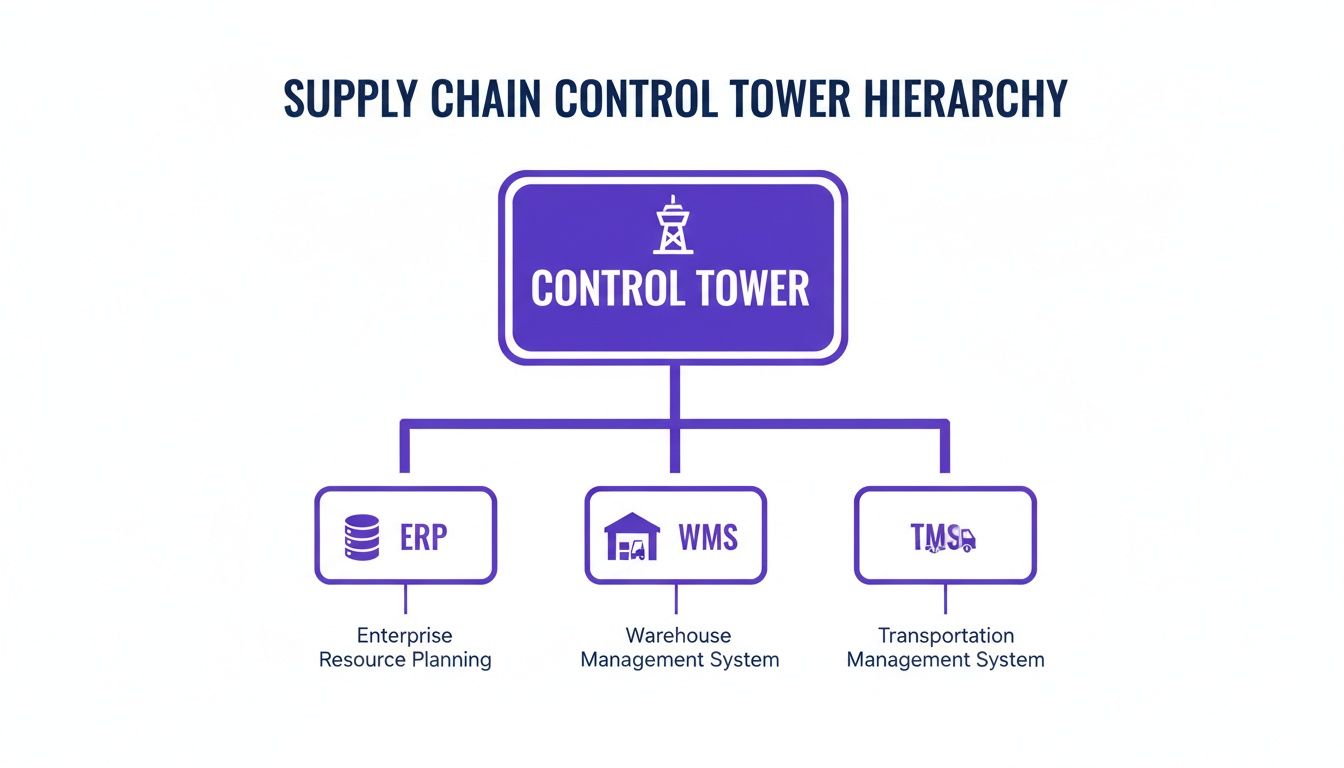
It acts as the central hub, breaking down data silos to create an end-to-end view.
Layer 2: The Analytics and Intelligence Engine
Once data is aggregated and organized, the analytics engine begins its work. This is where raw information becomes actionable intelligence. Using advanced analytics, machine learning (ML), and artificial intelligence (AI), this layer identifies patterns, predicts future events, and recommends actions.
This layer transforms the control tower from a passive reporting tool into a proactive command center. For example, instead of just showing a late shipment, it can predict the delay 24 hours in advance and suggest rerouting a truck to prevent a production line shutdown.
This engine enables exception management. It constantly scans for deviations from the plan and flags only the issues requiring human intervention. This frees your team from manually monitoring all operations.
Layer 3: The Visualization Layer
The visualization layer is the user interface. It presents complex analysis from the intelligence engine in an understandable format. The goal is to deliver the right information to the right person at the right time.
For example, a logistics coordinator might see a real-time map of all trucks, while a procurement manager sees a dashboard on supplier delivery performance.
This layer typically includes:
- Dashboards: At-a-glance views of key performance indicators (KPIs).
- Maps: Geographic tracking for assets, shipments, and inventory.
- Alerts and Notifications: Proactive warnings sent via email, SMS, or within the platform.
- Reports: Detailed analysis for performance trends and strategic planning.
This layer makes complex data clear, allowing for faster and better decisions.
Layer 4: The Collaboration and Execution Layer
The final layer turns insight into action. A control tower is not just for seeing problems; it is for solving them. This layer provides digital workflows and communication tools for teams and external partners to collaborate.
When an alert is triggered, this layer drives the response. It might automatically create a purchase order for a low-stock item or open a shared digital workspace for logistics and customer service teams to manage a critical shipment delay. This layer makes the intelligence from the analytics engine operational, ensuring decisions are executed quickly. This is the core of effective supply chain orchestration, bridging the gap between visibility and execution.
Turning Visibility into Real-World Business Value
Visibility alone does not improve the bottom line. A major technology investment must have a clear financial impact. A supply chain control tower is a value-generation engine designed to turn real-time data and predictive insights into measurable financial outcomes.
This is where the investment connects to the P&L statement. By shifting the supply chain from reactive to proactive, a control tower targets major cost centers and inefficiencies. It provides data to make smarter, faster decisions that protect margins and customer satisfaction.
Driving Measurable Cost Reductions
One of the first impacts is on the logistics budget. Without end-to-end visibility, companies often pay for premium freight to correct unforeseen delays or stock shortages. A control tower identifies potential disruptions early, providing time for proactive adjustments instead of expensive, last-minute fixes.
Synthetic Example: A control tower flags a production delay at a key supplier's factory. It assesses the downstream impact on shipments. Instead of discovering the problem when a truck fails to arrive, the system can suggest re-routing inventory from another distribution center days in advance. This avoids the need for expedited shipping, often leading to a 10-25% reduction in premium freight spend.
Better visibility also improves inventory management. A single, accurate view of stock levels across the network—from raw materials to finished goods—allows for optimized inventory holding. This can reduce safety stock buffers and minimize carrying costs, often resulting in a 15-30% decrease in overall inventory expenses.
Boosting Operational Efficiency and Resilience
Beyond direct cost savings, a control tower improves operational efficiency. It automates the manual work of tracking shipments and reduces the need for phone calls and emails to get status updates. This can shorten order-to-delivery cycles and free up teams to focus on strategic improvements instead of daily problem-solving.
An effective control tower provides insights to optimize all parts of the operation, including complex processes like mastering last mile delivery. By connecting all supply chain data, teams can coordinate better, solve problems faster, and improve key metrics like On-Time In-Full (OTIF) delivery.
The core value is the shift from reactive problem-solving to proactive exception management. A control tower doesn't just report that a container is stuck at a port; it alerts you to the risk of port congestion before the ship docks. This provides time to reroute and protect your production schedule.
This ability to anticipate and avoid disruptions builds a resilient supply chain. When unexpected events occur, organizations with a control tower can respond quickly, minimizing the impact on customers and revenue.
Real-World Value from Leading Enterprises
These benefits are not just theoretical. Leading enterprises have implemented control towers and are reporting measurable gains. Companies have achieved 25-40% reductions in lead times and 20-30% overall cost reductions.
Two examples:
- Unilever: Their control tower oversees 5.3 million annual shipments and reduced lead times from days to hours. (Source: MPO)
- Nestlé: By monitoring 1,000 global suppliers, their solution achieved a 20% reduction in lead times while managing raw material shortages. (Source: Capgemini)
These outcomes demonstrate the power of turning visibility into actionable, value-driven decisions.
Your Roadmap for Control Tower Implementation
Implementing a supply chain control tower is a strategic initiative, not just a technology installation. A successful plan ties the technology directly to business outcomes. The most effective projects use a phased rollout that delivers early wins, builds momentum, and justifies the investment.
This is a methodical process of building a new organizational capability. It starts with a focus on business goals and ends with a culture of data-driven decision-making.

Define Clear Business Objectives
Before evaluating any software, define what success looks like. A control tower has many capabilities, but trying to fix everything at once leads to failure. First, identify your main operational challenges and turn them into specific, measurable goals.
Synthetic Examples:
- Reduce Costs: Target a 10% reduction in premium freight spend by improving inbound logistics visibility within the next two quarters.
- Improve Service: Aim to increase the On-Time In-Full (OTIF) delivery rate by 5 percentage points within six months.
- Increase Efficiency: Cut inventory carrying costs by 15% by optimizing stock levels across the network.
These goals will guide every subsequent decision.
Establish Robust Data Governance
A control tower is only as effective as the data it uses. Inaccurate, incomplete, or siloed data will render the system useless. A strong data governance framework is non-negotiable.
Think of data governance as the foundation of your control tower. Without a solid, clean, and well-structured data foundation, any intelligence built on top will be unstable and untrustworthy.
This means defining data ownership, setting quality standards, and ensuring data consistency. It involves mapping all data sources—from ERPs and WMS to carrier feeds and IoT sensors—and creating a pipeline to ingest, clean, and harmonize it.
Select the Right Technology Stack
With objectives and a data strategy in place, it is time to choose the technology. A key decision is whether to build a custom solution or buy an existing platform. Building offers full control but usually involves long development cycles, high costs, and significant ongoing maintenance.
For most companies, partnering with a vendor that offers a flexible, configurable platform is a better path. This provides proven technology that can be adapted to specific needs. Modern, process-first approaches can also help connect data to decisions faster. You can learn more about this in our guide to Zero-Flow Orchestration.
Drive User Adoption Through Change Management
Technology is worthless if the team does not use it. A successful launch depends on people and processes as much as software. A proactive change management plan is needed to get your team on board and integrate the control tower into their daily workflow.
Your plan must include:
- Clear Communication: Explain why the change is happening and how it will improve their work.
- Role-Based Training: Provide hands-on practice with the specific dashboards and tools relevant to each role.
- Feedback Loops: Establish channels for users to ask questions and provide feedback. Show that you are listening.
Measure Success with the Right KPIs
To prove the project's value, track the right metrics. Your Key Performance Indicators (KPIs) should tie directly back to the business objectives set in the first step. By measuring performance before and after implementation, you can build a clear, data-backed case for the control tower's impact.
The table below provides examples of KPIs to track.
Measuring Control Tower Impact with Key Performance Indicators
| KPI Category | Metric | Baseline (Pre-Implementation) | Target (Post-Implementation) |
|---|---|---|---|
| Service Level | On-Time In-Full (OTIF) | 88% | 93% |
| Cost Efficiency | Premium Freight Spend | $1.2M / Quarter | $960K / Quarter (-20%) |
| Inventory | Inventory Turnover | 6.5 | 7.8 (+20%) |
| Forecasting | Forecast Accuracy (M-1) | 75% | 85% |
Following a structured roadmap like this one can turn the complex challenge of implementing a control tower in your supply chain into a manageable project that delivers a clear return on investment.
How to Choose the Right Implementation Partner
Selecting the right technology for your supply chain control tower is only half the process. Finding the right partner to build and implement it is equally important. Many vendors offer pre-packaged dashboards and solutions. However, an effective control tower is not an off-the-shelf product; it is a custom-built engine for your business.
Look for a team with strong engineering and data science capabilities. They should function as an extension of your own team, ready to handle data integration, AI model development, and scalable deployment.
Assessing Technical and Architectural Acumen
A top-tier partner will not start with a sales pitch for their platform. Instead, they will begin by discussing architecture. Their first goal should be to understand your business and design a system that fits your operational landscape.
This is especially critical when dealing with a complex mix of legacy systems like older ERPs and homegrown databases. A good partner will have a clear strategy for integrating these systems without requiring a costly "rip and replace" overhaul.
When vetting potential partners, ask specific questions:
- Data Integration: How will they connect to and process data from your ERPs, WMS, and third-party feeds? What is their process for data harmonization?
- Scalability and Reliability: What is their plan to ensure the system can handle data growth and maintain high availability?
- Avoiding Vendor Lock-In: Will you have full access to the source code and own the intellectual property at the end of the project? You should own your solution, not rent it.
A capable partner will provide confident, experience-backed answers. You can see what a transparent, architecture-first approach looks like in these real-world enterprise AI deployments.
Evaluating AI and Data Science Expertise
A modern control tower relies on AI and machine learning. Your partner needs a proven track record of building and deploying production-grade models, not just a theoretical understanding of data science.
MLOps (Machine Learning Operations) is the set of practices for reliably deploying, monitoring, and maintaining machine learning models in production. A partner without mature MLOps practices cannot guarantee that your AI will deliver consistent value long-term.
Their expertise in MLOps ensures that the AI models powering your control tower improve over time. Ask them to explain how they handle model performance monitoring, data drift, and algorithm retraining as your business changes.
Prioritizing Real-World Deployment Experience
Finally, look for a partner with a portfolio of successful, large-scale deployments. Ask for case studies and references, especially from companies with challenges similar to yours. An experienced partner has already navigated the unexpected roadblocks that can occur during a complex implementation.
The conversation should focus on business value, not just technical specifications. A good partner can connect technical capabilities to measurable outcomes, like a 15 percent reduction in carrying costs or a 10 percent improvement in forecast accuracy. They should be able to show you a clear path to ROI, turning your control tower from a technology project into a competitive advantage.
Frequently Asked Questions
Implementing a major initiative like a control tower in supply chain management will raise important questions. Here are answers to some of the most common ones.
Control Tower vs. Standard Dashboard
What is the difference between a control tower and a standard logistics dashboard? This distinction is critical.
A standard dashboard is like a rearview mirror. It shows what has already happened by visualizing historical data, typically from a single system. It is a passive reporting tool.
A control tower is a dynamic command center. It pulls real-time data from all sources, uses AI to predict future events, and suggests the best course of action. It is the difference between reviewing the past and actively managing the future.
Implementation Timeline
A large, multi-year IT project is a common concern. However, implementing a modern control tower does not have to be a long process. With a focused, agile approach, an initial version can be operational in as little as 8 to 16 weeks.
The key is to start with a high-impact, narrow use case, such as improving inbound logistics visibility. This allows you to prove the concept and show ROI quickly, building momentum for the next phase. You can then expand capabilities incrementally, letting early successes fund future development.
Integrating with Legacy Systems
A top concern for any CIO is how a new system will integrate with existing ones, especially with a mix of legacy ERPs, homegrown databases, and cloud applications.
A key feature of a modern control tower is its ability to connect these disparate systems.
A capable implementation partner will use a flexible data ingestion layer with robust APIs and connectors to unify information without requiring a disruptive 'rip and replace' of your current infrastructure. This integration flexibility is a critical factor when vetting potential vendors.
This provides the benefits of a unified view without replacing the systems you already rely on.
Understanding the Cost and ROI
What does a supply chain control tower cost? The price varies depending on the project's scope, the number of systems to connect, and data complexity. Pricing typically includes an initial implementation fee and an ongoing subscription.
This should be viewed as a strategic investment, not just a line-item expense. A solid business case will show that the financial benefits quickly outweigh the cost. We consistently see clients reduce premium freight spend, lower inventory carrying costs, and cut operational waste, leading to a full return on investment within 12 to 18 months.
Ready to build a supply chain control tower that delivers measurable business value? DSG.AI combines deep data science expertise with a proven, architecture-first approach to design, build, and deploy enterprise-grade AI solutions that you own completely. See how we turn complex data into competitive advantage by exploring our real-world AI projects.