
Written by:
Editorial Team
Editorial Team
Before shortlisting custom AI development companies, an internal review is necessary. Promising projects can fail when teams engage a partner without a clear definition of the business problem. This leads to wasted resources and a lack of valuable outcomes.
Successful AI projects begin with a precise definition of the business challenge, not a discussion about technology.
Defining Your AI Initiative Before Engaging Partners
Approaching vendors with a vague idea like "we need AI to improve efficiency" often leads to expensive misunderstandings. The first step is to translate an abstract concept into a concrete, quantifiable business case. This preparation is essential. It enables you to lead partnership discussions with a clear understanding of your needs, which is necessary to evaluate a potential partner effectively.
The market for specialized AI services is growing. The custom AI model development sector was valued at USD 87.79 billion in 2025 and is projected to grow at a compound annual rate of 25.4% through 2033. This growth reflects the recognition by enterprises that off-the-shelf solutions are insufficient for complex, unique business challenges. North America currently leads this market, indicating high demand for focused AI solutions in mature economies.
Frame the Business Problem First
An AI project should start by identifying a specific business problem limited by human capacity, data complexity, or process friction. This problem must be translated into a measurable outcome.
For example, a weak goal is: "We want to use AI to optimize our supply chain."
A strong, actionable goal is more specific: "We need to reduce logistics costs by 8% to 15% by building a predictive model that optimizes maritime fuel consumption. This model will use real-time weather patterns, historical vessel performance, and route data."
This level of clarity provides a benchmark for success. It requires any potential custom AI development company to address a specific business need, shifting the conversation from technology to results.
Assemble a Cross-Functional Team
Defining the problem and its metrics requires input from various business units. A successful AI initiative needs support and expertise from across the company to ensure the final solution is technically sound, operationally viable, and aligned with business goals.
The core team should include representatives from:
- Data Science: To assess data availability, quality, and project feasibility.
- Engineering: To plan integration with existing systems and infrastructure.
- Operations: To provide domain expertise and validate the solution's real-world utility.
- Finance: To build the business case and track the return on investment.
This team is responsible for establishing baseline metrics before development begins. For instance, if building a predictive maintenance model, the team must first document the current rate of unexpected equipment downtime, associated costs, and the Q2 baseline for maintenance expenses.
A well-defined problem, supported by a cross-functional team with clear baseline metrics, is a powerful tool. It allows you to control the narrative with potential partners, ensuring they build what you need, not just what they are capable of building.
A checklist can help structure this internal discovery process.
AI Initiative Scoping Checklist
Use this table to guide your internal team's discussions. It helps move from a high-level idea to a well-defined project scope to present to potential development partners.
| Scoping Area | Key Question to Answer | Example Metric (Maritime Fuel Optimization) |
|---|---|---|
| Business Problem | What specific operational pain point are we trying to solve? | High and unpredictable fuel costs are reducing profit margins. |
| Success Metric | How will we measure a successful outcome? What is the target? | Reduce fuel consumption per voyage by a minimum of 8%. |
| Data Availability | Do we have the necessary data? Is it accessible and clean? | We have 5 years of vessel telemetry, route data, and weather archives. |
| System Integration | Where will this model be implemented? How does it fit into our current workflow? | The model's output must integrate with our existing route planning software. |
| Operational Impact | Who will use this solution, and how will their job change? | Ship captains will receive optimized route suggestions on their bridge systems. |
| ROI Calculation | What is the financial justification for this project? | An 8% fuel reduction is estimated to save $4M annually. |
This checklist is an alignment tool that ensures all departments are in agreement before engaging an external firm.
The process of defining an initiative can be summarized in three steps.
This visual shows that a successful project starts with the problem, involves the right people, and is guided by data from the beginning. Once this internal alignment is complete, you are prepared to engage a custom AI development company and build a solution that delivers business value.
You can use a structured framework to assess your AI readiness.
Evaluating Partners Beyond Their Technical Claims
After completing internal preparations, the next step is vetting potential partners. This process requires a rigorous audit of a company's capabilities, not just a review of their sales materials. Many firms can build an AI model in a lab environment, but fewer can deploy and manage one in a real enterprise setting.
The evaluation should distinguish theoretical knowledge from proven, in-production experience. Enterprise spending on generative AI is projected to reach USD 37 billion in 2025, a 3.2x increase from 2024. As noted in the 2025 state of generative AI report, AI is becoming a mission-critical function that requires production-grade reliability.
Assess Production Deployment Experience
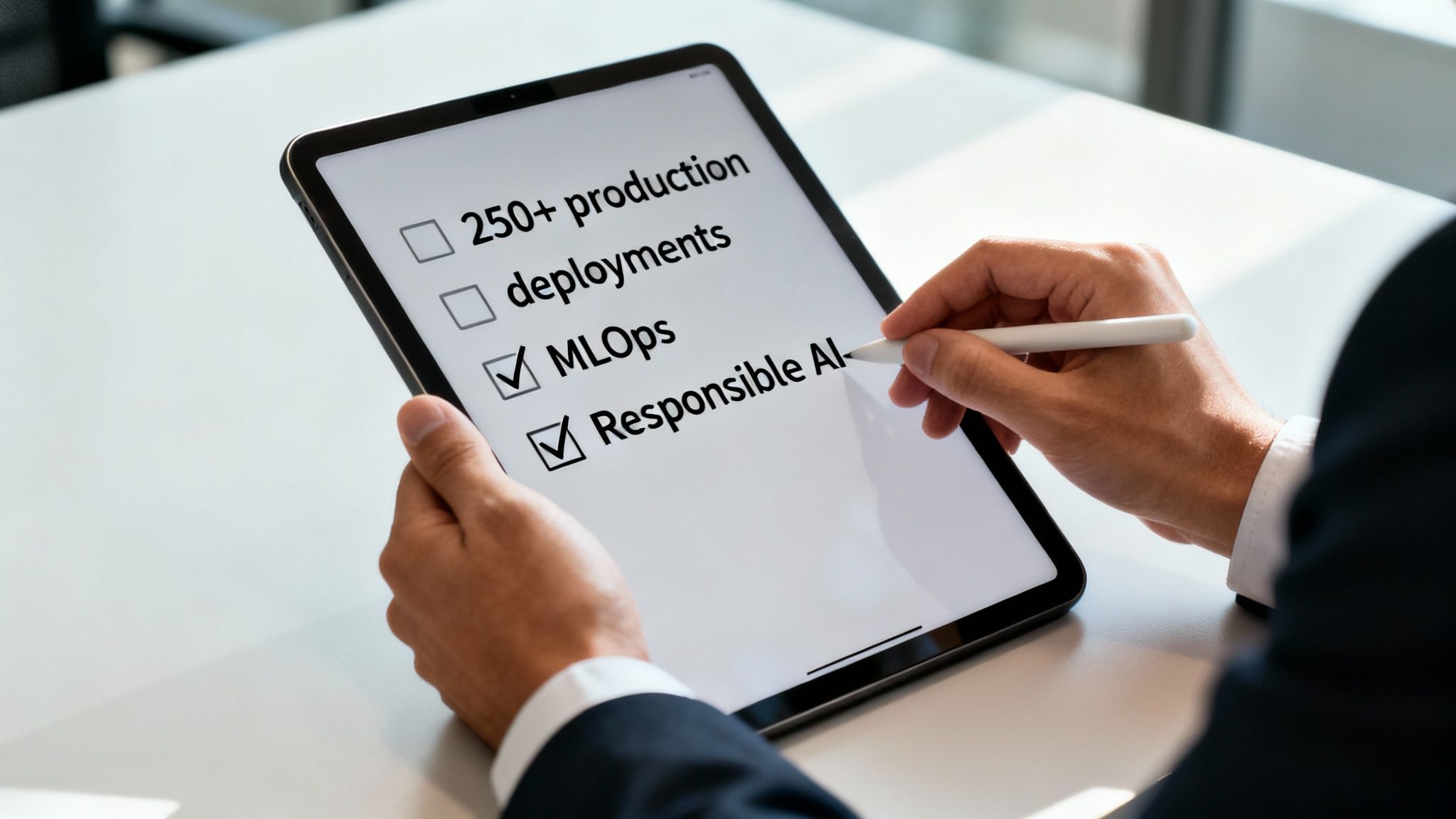
The most important differentiator for a custom ai development company is its record of deploying models into production. A proof-of-concept is different from an AI system operating 24/7, integrated with legacy systems, and handling real-world data.
Do not accept vague claims of "extensive deployment experience." Demand specific information.
- Ask for hard numbers: "How many distinct AI models has your team deployed into live production environments in the last 24 months?" A concrete number, such as over 250 deployments, indicates significant experience.
- Request relevant case studies: Look for examples similar to your industry. If their expertise is in retail but you are in maritime logistics, ask how their skills are transferable.
- Inquire about model longevity: "Describe a model that has been running in production for more than a year. What is your process for monitoring it, and how have you handled retraining?"
This line of questioning helps separate firms focused on experimentation from those that deliver sustainable, enterprise-grade AI.
A partner’s value is determined by the models they have successfully kept running in production, not just the models they can build. Focus your diligence on verifiable deployment history and long-term operational success.
Verify MLOps and Integration Expertise
An AI model is useless if it cannot be integrated into existing workflows. Machine Learning Operations (MLOps) is the discipline that combines machine learning with DevOps and data engineering to manage the entire AI lifecycle. A qualified partner should be able to discuss their MLOps framework in detail.
Probe their understanding of the practical challenges of operationalizing AI.
MLOps Questions to Ask:
- What is your standard framework for CI/CD for machine learning models?
- How do you version code, datasets, and models to ensure reproducibility?
- Describe your approach to automated monitoring. How do you detect performance degradation or data drift?
- What specific tools and platforms do you use to orchestrate your MLOps pipelines?
Their ability to work with your current tech stack is also crucial. Ask for a project example where they integrated an AI model with a legacy system, such as an old ERP or a custom database. Their answer will reveal their experience with real-world enterprise IT.
Evaluate Their Approach to Governance and Responsible AI
In the current regulatory environment, AI governance is a requirement. Overlooking fairness, transparency, and compliance can expose a business to legal and reputational risks, especially with regulations like the EU AI Act.
A top-tier custom ai development company should have a clear, documented methodology for Responsible AI.
Your questions should focus on their practical application of these principles:
- Bias Detection and Mitigation: How do you test for and mitigate algorithmic bias in training data and model outputs?
- Model Explainability: What techniques do you use to make a model's decisions understandable to business teams and auditors?
- Compliance Frameworks: Describe your experience building AI that meets specific regulatory standards, such as GDPR, HIPAA, or the EU AI Act.
This evaluation of governance is a key part of a secure partnership. You can learn more by exploring information on Third-Party Risk Management (TPRM). A partner that treats governance as a secondary concern is a liability. You need a team that builds AI that is effective, safe, fair, and compliant from the start.
Structuring The Engagement For Transparency And ROI
Once you have identified a promising partner, the next step is to structure the engagement. This involves creating a blueprint for success that protects your investment and ensures clear deliverables.
Poorly defined agreements can lead to scope creep, unexpected costs, and a final product that does not meet expectations. A detailed Statement of Work (SOW) is the most important tool for preventing these issues. It helps turn a significant expense into a strategic, ROI-driven investment.
Defining The Core Components Of Your SOW
A standard SOW is not sufficient for a complex AI project. The specifics of model development, data handling, and MLOps require a more detailed approach that leaves no room for interpretation.
Effective agreements should clearly define these four points:
- Service Level Agreements (SLAs): Specify performance metrics, such as 99.5% uptime for an inference API or a maximum prediction latency of 500 milliseconds. These are contractual obligations.
- Intellectual Property (IP) Ownership: The contract must state that your company retains 100% ownership of all IP, including the final model, source code, and related data.
- Source Code and Data Access: The SOW must grant you complete, unrestricted access to the source code repository (e.g., GitHub or GitLab) and all project data from the beginning.
- Exit Clause and Transition Plan: A clear exit strategy should detail the handover process, ensuring a smooth transfer of all assets and knowledge if the engagement ends.
Embracing Agile Implementation Models
AI development is iterative. The field changes too quickly for long, waterfall-style development cycles. An agile, flexible model allows for rapid results and adjustments.
A six-week implementation model is an effective approach. It is a focused sprint that forces both teams to prioritize and deliver a tangible result quickly.
A typical six-week cycle includes:
- Week 1 Discovery: Workshops to define the business problem, confirm data pipelines, and establish success metrics.
- Weeks 2-4 Iterative Development: Rapid prototyping and model building, with weekly demos for your team to provide feedback.
- Week 5 Deployment & Integration: The model is deployed to a staging environment and integrated with your existing tech stack for testing.
- Week 6 Handover & Training: The solution goes live in production. This week includes providing comprehensive documentation and training for your internal teams.
This compressed timeline creates urgency and accountability, keeping the project focused on delivering a working solution that solves the initial business problem.
The legal and commercial structure of your engagement is as important as the technology. A detailed SOW specifying IP ownership, SLAs, and an agile delivery framework protects your investment and orients the project toward ROI from the start.
The goal is to build a partnership where the custom AI development company acts as an extension of your team, operating within a clear framework where all actions are transparent, measurable, and tied to business value.
Diving Deep: Technical Due Diligence and Architecture Reviews
After initial conversations, your technical leadership should conduct a detailed review. Your CTO, Head of Engineering, and lead architects need to audit a potential partner’s technical capabilities beyond their sales presentation.
The objective is to confirm that the custom AI development company can engineer a robust, scalable AI system that will function effectively in your enterprise environment.
An impressive demo is different from an architecture that integrates with legacy systems, scales on demand, and performs reliably under pressure. This stage involves verifying that their solution can be operationalized for long-term use.
Do They Think Architecture-First?
A top-tier partner considers the system architecture from the beginning. They understand that the model is one part of a larger system. Your technical team must verify that their approach is designed for scalability, reliability, and integration with your existing tech stack.
Push for specific details.
- Wrangling Legacy Systems: Ask them to describe a past project where they integrated a new AI model with an on-premise ERP or a custom database. How did they handle data synchronization and API limitations?
- Scaling and Performance: Discuss their strategies for handling variable workloads. Do they prefer serverless for inference or container orchestration like Kubernetes? Ask for an example where they built a system to handle a 10x increase in prediction requests.
- The Right Tool for the Job: A technology-agnostic partner is often preferable. You need a team that selects tools based on your problem, not just their own preferences.
Their answers will indicate whether they have practical experience or only theoretical knowledge.
Probing Their MLOps and Model Monitoring Practices
Every machine learning model's performance degrades over time as real-world data deviates from its training data. A mature AI partner understands this and has a solid MLOps framework to manage the entire lifecycle.
Your due diligence must examine their ability to monitor, retrain, and redeploy models without disrupting business operations.
Ask pointed questions to assess their capabilities:
- Spotting Trouble: How do you detect model drift or performance dips? Ask what metrics they track beyond accuracy, such as prediction latency or shifts in data distribution.
- Automated Retraining: What triggers your automated retraining pipeline? Is it a fixed schedule, a performance threshold, or another factor? Can they describe the validation process before a new model is promoted to production?
- Keeping Data Clean: How do you ensure data quality and consistency across training and inference pipelines? Issues in this area are a common cause of failure for production AI systems.
A partner’s ability to describe a clear, automated process for monitoring and retraining is a positive indicator of their operational maturity. This is a core requirement for any serious enterprise AI project.
To structure your evaluation, you can use our AI audit and assessment framework as a checklist for this technical review.
Creating a Scorecard for Your Evaluation
Use a scorecard to compare potential partners objectively. This tool helps you focus on the capabilities most important to your project's success.
Technical Due Diligence Scorecard
| Capability | Vendor A Score (1-5) | Vendor B Score (1-5) | Evaluation Notes |
|---|---|---|---|
| Architecture Approach | Notes on legacy integration, scalability, tech choices. | ||
| MLOps Maturity | How robust are their monitoring and retraining pipelines? | ||
| Data Engineering | Expertise in data quality, pipeline management, security. | ||
| Security & Compliance | Knowledge of GDPR, CCPA, and industry-specific regulations. | ||
| DevOps & CI/CD | Code quality, testing automation, deployment frequency. | ||
| Technical Communication | Clarity, responsiveness, ability to explain complexity. |
This scorecard will provide a clearer picture of which partner has the technical depth and operational discipline to meet your needs.
Let's Use a Synthetic Example: A Logistics Email Classifier
Imagine you want to build an AI system to automatically classify thousands of incoming logistics emails—such as "shipment delayed," "customs issue," "invoice query"—to reduce manual processing time by 40%.
During the technical review, you would ask a potential partner:
- Handling the Morning Rush: "Our email volume increases significantly between 8 AM and 10 AM EST. How would you design the data ingestion pipeline to handle thousands of emails in real-time without loss?"
- Catching Costly Errors: "If the model misclassifies a 'customs issue' as an 'invoice query,' the delay could cost $50,000. What specific monitoring and alerting would you implement to detect such a critical failure immediately?"
- Adapting to the Unknown: "What happens when a new type of query appears? Describe your process for identifying these anomalies, collecting the necessary training data, and updating the model."
Their responses to these practical, scenario-based questions will demonstrate their ability to think through the entire operational lifecycle. It is also important to assess a partner’s expertise in specialized areas. For example, understanding their approach to agentic AI in cybersecurity and ensuring safe AI remediation can reveal their capacity for handling complex challenges.
From Deployment to Governance: Managing the Full AI Lifecycle
Deploying an AI model to production is the beginning, not the end. The work of governance, monitoring, and continuous improvement starts once the system is live. Without a solid post-deployment plan, an AI investment can become technical debt or a compliance issue.
A valuable partnership with a custom AI development company extends beyond the initial build. You need a clear strategy for the entire AI lifecycle to ensure your model adapts, improves, and continues to deliver value over time.
The MLOps Pipeline: Your AI's Operational Backbone
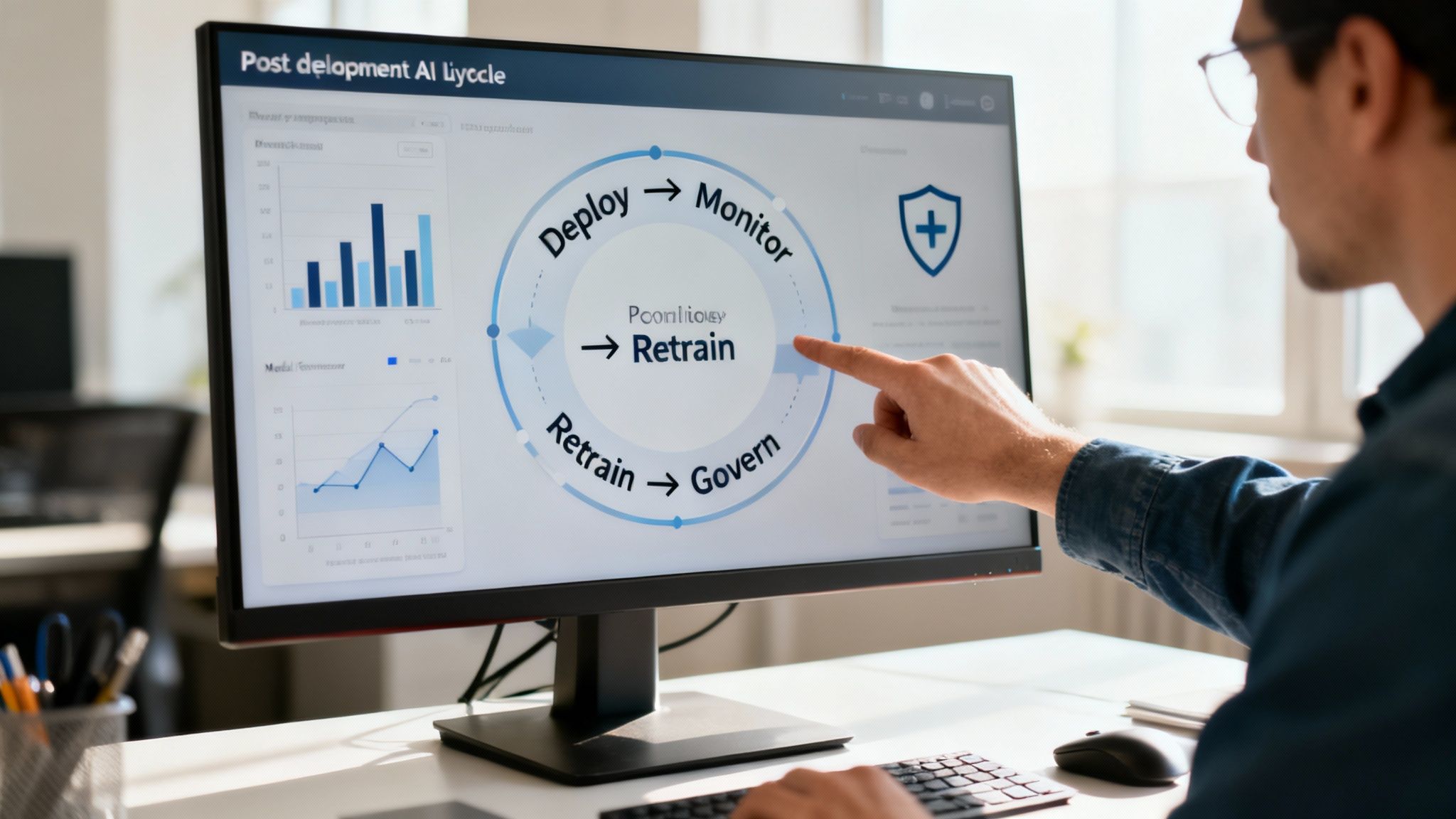
A mature Machine Learning Operations (MLOps) pipeline is central to any successful AI system. It is the operational framework that automates the monitoring, retraining, and redeployment of your models, keeping your AI effective as data and business needs change.
A skilled partner will have established the foundation for this pipeline during development. The focus then shifts to its ongoing operation.
A well-functioning MLOps pipeline should include:
- Continuous Monitoring: Track performance against original business goals, including metrics like prediction latency, data drift, and concept drift, to identify problems early.
- Automated Retraining: Establish clear triggers for the retraining process. For example, if a logistics classifier's accuracy decreases by 5% from its baseline over a 30-day period, the pipeline should automatically initiate a new training job with fresh data.
- Rock-Solid Version Control: Implement a rigorous system for versioning code, datasets, and models to ensure reproducibility and allow for easy rollbacks if a new model underperforms.
This structured approach transforms model management from a reactive task into a proactive, automated process.
Responsible AI and GRC: Don't Just Build It, Govern It
As AI becomes more integrated into your business, governance, risk, and compliance (GRC) are essential. A proactive governance plan is necessary to manage risk and ensure compliance with changing regulations. A partner's expertise in Responsible AI is valuable here.
Mastering AI regulatory compliance is critical, especially with new regulations like the EU AI Act imposing strict rules on high-risk systems.
Good governance is not just about avoiding penalties; it is about building trust. A transparent, fair, and explainable AI system is more likely to be adopted by your team and trusted by your customers, which drives business value.
Your governance framework must provide clear answers to key questions:
- How are we tracking model fairness? Are there dashboards monitoring performance across different customer segments to identify and correct biases?
- Who owns the model's decisions? Is there a clear line of accountability and an escalation path for when the AI makes an error?
- How are we documenting everything for compliance? Do you have an auditable trail of model versions, training data, and performance metrics for regulatory inquiries?
This focus on governance is a key factor in enterprise AI success. The artificial intelligence software market is projected to reach USD 174.1 billion in 2025 and USD 467 billion by 2030. This growth is driven by companies that understand that a competitive advantage comes from production-grade AI built on a solid governance foundation. You can read the full ABI Research report for more on these trends.
Choosing a custom AI development company that integrates governance into every step helps ensure your AI investment becomes a durable asset, not a compliance risk.
Your Questions Answered: What to Expect When Partnering with an AI Firm
Engaging a custom AI development partner is a strategic decision that raises practical questions. As an enterprise leader, you need to understand the engagement process, costs, and ownership terms.
Here are answers to common questions from CIOs, CTOs, and GRC leaders.
How Are AI Projects Typically Priced?
Experienced AI firms structure their pricing around fixed, outcome-based milestones rather than open-ended hourly billing. This approach aligns their success with yours.
A typical pricing model includes:
- Discovery & Scoping: A one-to-two-week engagement involving workshops, data feasibility analysis, and the creation of a project roadmap. This phase usually has a fixed fee, typically in the $25,000 to $50,000 range.
- Development Sprints: The main development work is divided into two-to-four-week sprints, each with a fixed cost and a specific deliverable, such as a working prototype or an integrated API.
- Production Deployment & Handover: This final phase covers deploying the model into your environment. This fixed-cost milestone includes comprehensive documentation and training for your internal team.
This milestone-driven approach reduces your investment risk by tying payments to tangible progress.
What Is a Realistic Project Timeline?
Be cautious of partners proposing long, "big bang" projects. The AI field moves too quickly. A focused, six-week implementation model is often more effective.
A six-week model promotes focus, not speed. The compressed timeline forces both teams to prioritize and make decisions quickly, preventing project drift and keeping it aligned with its core business objective.
This approach delivers a working solution in under two months, allowing you to gather feedback, demonstrate value, and iterate sooner.
Who Owns The Intellectual Property?
The answer to this question should be clear and absolute. When you engage a custom AI development company, the contract must state that your organization retains 100% ownership of all intellectual property.
This ownership must cover all project-related creations:
- The final, trained machine learning model
- All source code written during the project
- Proprietary data pipelines and unique algorithms
- All documentation and training materials
This point is non-negotiable. You are funding the creation of a strategic asset and must own it completely, with unrestricted rights to modify, extend, and deploy it without vendor lock-in.
At DSG.AI, we build enterprise-grade AI solutions based on trust. Our transparent engagement models guarantee you full IP ownership and a clear path to ROI. See how we have delivered measurable value for global leaders by exploring some of our client success stories.