
Written by:
Editorial Team
Editorial Team
A data governance consultant is an external expert who designs and implements a framework for managing a company's data. They develop the strategy, policies, and processes required to ensure data is accurate, accessible, and secure.
Their work aims to transform data from a potential liability into a strategic asset.
Why Companies Invest in Data Governance Consultants
Many companies collect data faster than they can use it. For a Chief Information Officer, this often results in data silos, inconsistent data quality, and pressure from new regulations. Without a clear data management plan, this information becomes a source of risk instead of a driver of growth.
A data governance consultant provides structure and direction to address these challenges.

From Data Chaos to a Strategic Blueprint
Building a data-driven business on disorganized data is like constructing a skyscraper without an architectural blueprint. The result is structural weakness, wasted resources, and significant risk.
A data governance consultant acts as the architect for a company's data infrastructure. They apply a structured methodology to solve complex data problems.
Here is how they address common challenges:
- Creating a Single Source of Truth: They dismantle data silos and resolve inconsistencies. This ensures teams across departments, from sales to finance, work from the same reliable data.
- Navigating Regulatory Requirements: They design frameworks for compliance with regulations like GDPR and the EU AI Act, helping companies avoid fines and reputational damage.
- Improving Decision-Making: By ensuring data quality and traceability, they provide executives with analytics that can be trusted for critical business decisions.
Quantifying the Need for Expert Guidance
The demand for data governance expertise is growing. The global data governance market is projected to reach $3.8 billion in 2025 and grow to $7.1 billion by 2033, according to Fortune Business Insights (2024). This growth is driven by the increasing volume of data and new, stricter regulations.
An effective consultant architects a system where high-quality, compliant data is a natural outcome of daily operations. They shift data governance from a reactive cleanup task to a proactive, value-creating function.
Hiring a data governance consultant is a strategic investment in building a more resilient and efficient company. The real cost of bad data quality highlights why robust governance is necessary. A consultant provides a roadmap to turn raw data into a valuable organizational asset.
What a Data Governance Consultant Actually Delivers
A data governance consultant delivers tangible outcomes that change how an organization manages its data. Their work involves building an operational system that converts disorganized data into a reliable asset.
A typical engagement includes four key functions.
Conducting a Comprehensive Data Health Diagnostic
Before creating a solution, a consultant must understand the current state of a company's data. This begins with a detailed diagnostic of the entire data environment to identify risks, gaps, and inefficiencies. This process assesses data quality, security vulnerabilities, workflow bottlenecks, and regulatory blind spots.
The output is a report that benchmarks the organization's data maturity. It provides an evidence-based answer to the question, "Where are we now?" This report helps secure leadership buy-in by quantifying the risks of inaction and identifying the most urgent issues.
Key Takeaway: A thorough diagnostic serves as a strategic map. It replaces assumptions with facts, allowing the consultant to design a governance framework that solves specific problems rather than applying generic practices.
Architecting a Scalable Governance Framework
Following the diagnosis, the consultant creates an architectural blueprint. This data governance framework is a customized plan that defines rules for data management, including data ownership and quality responsibility. The design is aligned with specific business goals, such as improving operational efficiency, enhancing analytics, or preparing for new regulations.
This framework is not a one-size-fits-all template. An experienced consultant designs it to be scalable, ensuring it can adapt as the company grows. The architecture establishes clear lines of data ownership and stewardship. You can evaluate your organization's current maturity with a free tool to assess AI and data maturity.
Implementing Policies and Tools
This phase brings the plan into action. The consultant guides the implementation of policies, standards, and technologies to make the new governance framework operational.
For example, a consultant working with a large retailer might identify inconsistent product data as the cause of shipping errors. The implementation phase could involve deploying a Master Data Management (MDM) platform.
This single project can deliver measurable value:
- It creates a single, authoritative record for each product.
- It ensures product information is consistent from the warehouse to the website.
- A synthetic example of an outcome could be a 10-15% reduction in data-related shipping errors within the first six months, based on the previous period's baseline.
The table below outlines common deliverables from a data governance engagement and their business impact.
Key Deliverables from a Data Governance Engagement
| Deliverable Category | Specific Output Example | Business Impact |
|---|---|---|
| Strategy & Roadmap | A multi-year data governance roadmap with prioritized initiatives and defined milestones. | Aligns data efforts with executive goals and ensures long-term, incremental value creation. |
| Framework & Policy | A documented Data Governance Framework with defined roles (e.g., Data Stewards, Owners). | Establishes clear accountability, reducing ambiguity and improving decision-making speed. |
| Technology & Tooling | A recommendation and implementation plan for a data catalog or MDM platform. | Increases data discovery, improves trust in data, and boosts operational efficiency. |
| Data Quality | Data quality dashboards with defined KPIs and a remediation workflow. | Reduces operational errors, enhances customer experience, and builds trust in analytics. |
| Change Management | Role-based training programs and communication plans for all affected teams. | Drives enterprise-wide adoption and ensures the long-term sustainability of the program. |
These deliverables work together to create a cohesive system for managing data as a core business asset.
Driving Enterprise-Wide Adoption and Training
A framework is ineffective if no one uses it. The final deliverable is driving adoption through training and change management. The consultant works with teams across the business—including IT, finance, sales, and marketing—to ensure everyone understands their role and the value of the new system.
This involves developing training materials, conducting workshops, and establishing communication channels. This focus on the human element is what differentiates successful governance programs. It is particularly important in regulated markets. North America currently leads the data governance market with a 43.50% global share, valued at $2.34 billion in 2025 according to Fortune Business Insights. This growth is driven by sectors like healthcare and finance that require strict data privacy. You can explore more on the global data governance market on fortunebusinessinsights.com.
Making Sense of Consultant Pricing and Engagement Models
Budgeting for a data governance consultant requires understanding how they work and charge. Engagements are customized based on a company's specific problems, timeline, and existing in-house skills.
Selecting the right engagement model from the start aligns expectations and helps avoid budget overruns. The three most common models are project-based, retainer-based, and staff augmentation.
This flowchart maps common data challenges to the appropriate type of engagement.
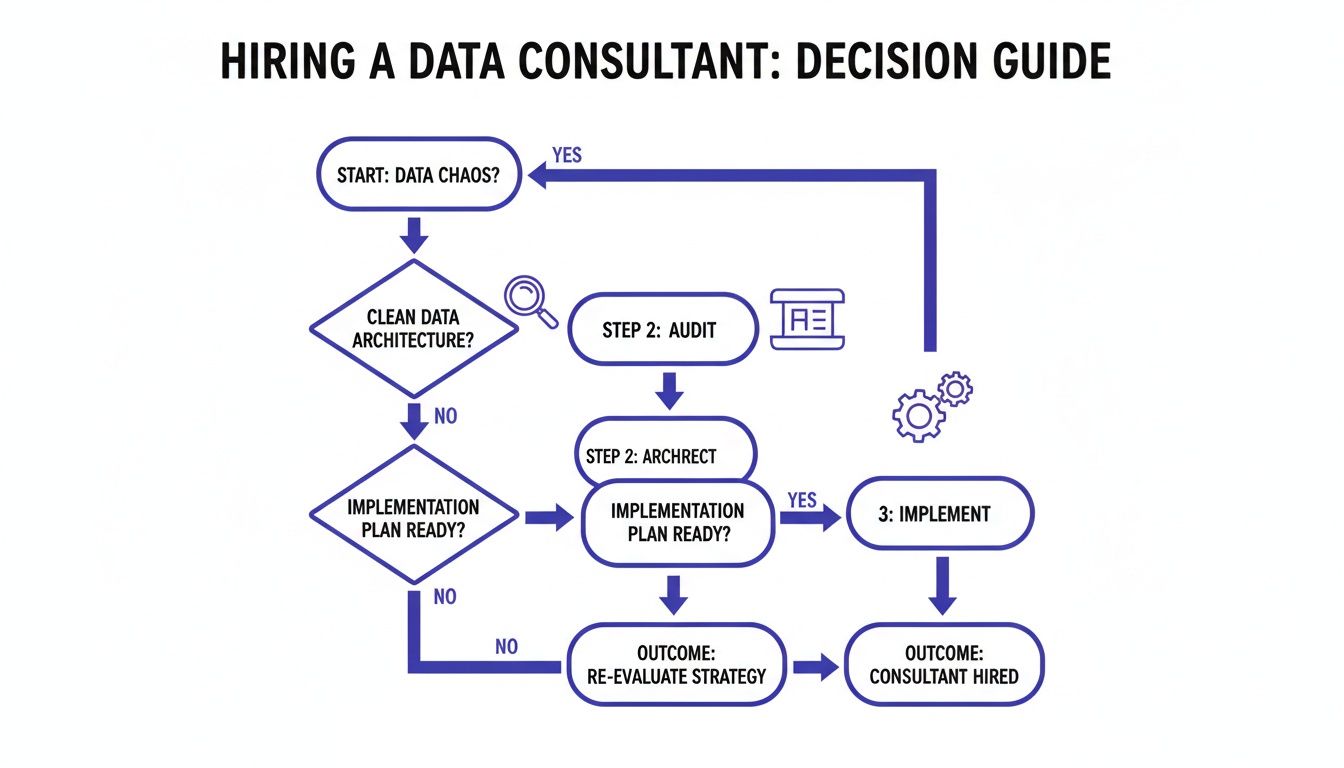
The best path depends on your starting point, whether it's a foundational audit, a new architectural design, or direct implementation.
Project-Based Engagements
The project-based model is suitable for companies with a specific, well-defined problem and a clear objective. The scope, timeline, and cost are agreed upon upfront, which simplifies financial planning.
Examples of project-based work include:
- GDPR or EU AI Act Readiness Audit: A consultant assesses current data practices against regulations and delivers a report on gaps with a remediation plan.
- Data Catalog Implementation: The project covers vendor selection, tool setup, initial metadata population, and team training.
- Master Data Management (MDM) Strategy: The consultant develops a complete strategy for a critical data domain like "Customer" or "Product," including a business case and an implementation roadmap.
Costs vary based on scope. A targeted assessment might cost $50,000, while a full framework implementation could exceed $500,000. This model is effective when a specific, measurable result is required.
Retainer-Based Advisory
The retainer-based model provides ongoing access to senior-level expertise. It is suitable for companies with a strong internal team that requires strategic guidance rather than hands-on implementation.
A retainer-based consultant acts as a strategic advisor. They offer an external perspective, help navigate internal politics, and ensure the governance program adapts to business changes and new regulations.
This model functions like a subscription for expert advice. A monthly fee, typically between $10,000 and $30,000, secures a set number of hours for strategy sessions or executive briefings. It is a cost-effective way to maintain the long-term direction of a program.
Staff Augmentation
The staff augmentation model is a tactical solution for a temporary skills gap. In this model, a consultant joins the team to fill a specific role for a set period, such as an interim Data Governance Lead or a specialist Data Steward.
This approach is useful when a program is already defined but lacks the specific skills or personnel to complete a key initiative. It provides immediate access to a qualified professional without the lengthy process of hiring a full-time employee.
Connecting Data Governance to AI and Regulatory Readiness
Data governance was once considered an IT housekeeping task. Today, it is the foundation for building trustworthy and compliant Artificial Intelligence. Companies adopting AI often face a common obstacle: the performance of an AI model depends entirely on the quality of the data it is trained on.
Without a solid governance framework, companies risk not only poor AI performance but also building systems that are biased, unreliable, and non-compliant.
A data governance consultant bridges the gap between raw data and AI ambitions. They ensure the foundation is solid before any AI models are deployed. Their role is to prepare the organization for the scrutiny that comes with AI and new regulations like the EU AI Act.

Building the Foundation for Trustworthy AI
Preparing data for AI is analogous to conducting a clinical trial. Incomplete, inconsistent, or unethically sourced patient data would never be used in a medical trial. The same principle applies to AI.
Data governance ensures that the datasets used for training AI are accurate, complete, and ethically sourced. AI governance then ensures the resulting AI model is fair, transparent, and effective.
A data governance consultant manages this process by focusing on three core pillars:
- Establishing Data Lineage: They map the entire data journey, from origin to use in an AI model. This traceability is essential for debugging algorithms and demonstrating compliance to regulators.
- Ensuring Data Quality: The consultant implements automated checks and standards to verify that data used in AI systems is accurate and fit for purpose. This helps avoid the "garbage in, garbage out" problem.
- Implementing Bias Detection: They help establish frameworks to identify and mitigate potential biases in datasets—related to gender, ethnicity, or geography—before they can affect AI models and lead to discriminatory outcomes.
This foundational work transforms a raw resource into a compliant, high-performing asset ready for AI.
Navigating the Regulatory Landscape
The growth of AI has led to new regulations designed to ensure responsible use. The EU AI Act, for example, sets strict rules for data quality, transparency, and risk management for AI systems used in Europe. Preparing for these regulations is a complex task that a data governance consultant is equipped to handle.
A consultant combines regulatory knowledge with practical data management expertise to create an end-to-end solution. This approach turns compliance from a burden into a competitive advantage and ensures data practices can withstand regulatory audits.
This proactive approach is becoming a business necessity. Regulatory pressure is a major factor driving the global data governance market, which is projected to grow from $3.566 billion in 2025 to $14.45 billion by 2035 at a 15.02% CAGR, according to a 2024 Market Research Future report. This shows how seriously organizations are investing in data protection. You can learn more about this expanding market on marketresearchfuture.com.
From Raw Data to Compliant AI Systems
A data governance consultant ensures that AI initiatives are built on a solid foundation. They implement the policies, tools, and processes needed to manage the entire data lifecycle with AI in mind. This includes data sourcing, labeling, model monitoring, and retirement. For more on this topic, explore our guide on EU AI Act readiness.
By integrating data governance into an AI strategy from the beginning, a consultant helps build systems that are powerful, fair, transparent, and compliant with emerging global standards.
How to Evaluate and Hire the Right Consultant for Your Team
Selecting a data governance consultant is a critical decision for your data strategy. The right partner can accelerate progress, help avoid costly mistakes, and ensure the program delivers business value. A poor fit can stall the initiative, deplete the budget, and erode trust with business leaders.
A structured evaluation process is necessary. It involves finding a partner with the right mix of technical expertise, industry knowledge, business acumen, and interpersonal skills to fit your company's culture.

The Four Pillars of a Great Consultant
A top-tier data governance consultant offers more than just technical skills. They must be able to communicate effectively with IT, business units, and the C-suite. Your evaluation should focus on these four essential pillars.
-
Deep Technical Expertise: A strong candidate must have hands-on experience with core disciplines like Master Data Management (MDM), metadata management, data quality frameworks, and data cataloging tools. They need to be able to discuss the pros and cons of different technologies and architectures with technical teams.
-
Relevant Industry Experience: Data governance is not one-size-fits-all. The challenges of a regulated bank differ from those of an e-commerce company. Look for a consultant with a proven track record in your sector. They will understand your industry’s specific data domains, regulatory issues, and operational challenges. You can see examples in various data strategy case studies.
-
Strategic Business Acumen: A good consultant connects governance work to business outcomes, such as increasing revenue, reducing operational costs, or mitigating compliance risk. They should be as comfortable discussing business strategy with the CFO as they are discussing data engineering with technical leads.
-
Proven Change Management Skills: Data governance implementation is a change management project. A brilliant framework is useless if people do not adopt it. The ideal consultant must be skilled in communication, stakeholder management, and training to gain buy-in and ensure new practices are sustained.
Key Takeaway: The ideal consultant combines the skills of a technologist, business strategist, and organizational diplomat. A weakness in any of these areas can put the project at risk.
This checklist can help you systematically vet potential partners and compare candidates.
Data Governance Consultant Evaluation Checklist
| Evaluation Criterion | What to Look For | Red Flags to Avoid |
|---|---|---|
| Industry & Domain Knowledge | Proven success in your specific industry (e.g., finance, healthcare). They should know your acronyms, regulations, and common data challenges. | Generic, one-size-fits-all case studies. Inability to discuss industry-specific compliance requirements (e.g., GDPR, CCPA). |
| Technical & Tooling Expertise | Hands-on experience with relevant tools (Collibra, Alation, etc.) and concepts (MDM, data lineage). Can they architect a solution? | Vague answers about technology. Over-reliance on a single tool vendor without justification. They seem more like a salesperson. |
| Business & Strategic Acumen | They ask about your business goals before talking about tech. Can they articulate the ROI of data governance in plain English? | Fixated on technical details without connecting them to business value. They can't explain how their work impacts the bottom line. |
| Change Management & People Skills | Stories of winning over skeptical stakeholders. A clear methodology for training and driving user adoption. | Downplaying the "people part" of the project. A history of failed projects blamed on "lack of buy-in" from others. |
| Project Methodology & Deliverables | A clear, phased approach. Examples of tangible deliverables like data dictionaries, policy documents, and RACI charts. | A fuzzy or non-existent plan. Unwillingness to commit to specific deliverables or timelines. |
| Cultural Fit | Their communication style matches your organization's. Do they seem like a collaborative partner or an outside dictator? | Arrogance or a "my way or the highway" attitude. Poor listening skills during the interview process. |
Using a checklist ensures your evaluation is consistent and helps you make a data-driven hiring decision.
Insightful Interview Questions to Ask
Once you have shortlisted candidates, you need to ask questions that reveal their problem-solving abilities. Situational and behavioral questions are more effective than standard interview questions.
Questions to Assess Strategic Thinking and Buy-In:
- Describe a time you gained executive buy-in for a data policy that required a significant operational change. What was the resistance, and how did you address it?
- How do you explain the ROI of a data governance program to a skeptical CFO? Provide a specific example.
- Tell me about a data governance project that did not succeed. What were the root causes, and what did you learn from the experience?
Questions to Assess Technical and Practical Acumen:
- You have identified a critical data quality issue in our customer master data. What are the first three steps you would take to diagnose the problem and develop a solution?
- We are considering implementing a data catalog. What are the top three criteria you would use to help us select the right tool?
- How do you approach assigning data ownership and stewardship roles in a highly decentralized company?
These questions require candidates to draw on their actual experience. Their answers will reveal their problem-solving style, their ability to navigate organizational politics, and their focus on delivering practical, business-focused results.
Ready to Get Started? Here’s What to Do Next
It is time to translate your data governance goals into action. This involves taking clear steps to build a more resilient and compliant organization that is prepared for AI.
This initial phase focuses on gathering facts. A small amount of focused internal work now will make future conversations with a data governance consultant more productive.
Take These Three Strategic Actions
First, conduct an internal readiness assessment. Assemble a cross-functional team from IT, sales, marketing, and operations to identify your most significant data-related problems. Examples might include inconsistent product data causing shipping errors or unreliable sales figures affecting forecasts. Attempt to quantify the impact of these issues.
Next, build a solid business case. Connect the governance program to measurable business outcomes. For example, frame your goals as "improving operational efficiency by 10-15%" or "reducing exposure to compliance risks." This document is key to securing executive buy-in.
Finally, use the evaluation checklist to shortlist two or three potential consulting partners. Approaching these conversations with a clear business case and a list of known issues will make the discussion more focused and valuable.
By taking these preparatory steps, you enter conversations with a data governance consultant from a position of knowledge. You will have a clear understanding of your problems, a vision for success, and a business case to justify the investment.
Once you have laid this groundwork, you are ready to build a data strategy that delivers results. If you need an experienced partner to help validate your findings and accelerate your journey from assessment to ROI, our team is available to help you execute that vision.
Frequently Asked Questions
Hiring a data governance consultant is a significant decision. Here are answers to some common questions.
What Is the Typical ROI on a Data Governance Engagement?
While every project is different, the financial returns are tangible. Some of our clients have seen a 15-25% reduction in operational costs by improving data quality and reducing errors. Analytics teams often report obtaining insights 20-30% faster because they can trust the data.
The most significant financial benefits often come from risk avoidance. A solid governance program helps prevent multi-million dollar fines for non-compliance with regulations like GDPR or the EU AI Act. A consultant should help you build a business case to track these metrics from the start.
How Long Does a Typical Data Governance Project Take?
The timeline depends on the project's scope. A foundational assessment to determine your current state and create a roadmap can typically be completed in 4 to 8 weeks.
A full implementation, including new tools, policies, and training, usually takes 6 to 12 months. However, many firms can fast-track a project focused on a critical area, such as preparing for new AI regulations, to deliver a quick win.
Key Insight: The goal is not a single, large-scale launch. It is about achieving early wins and building momentum. A good consultant will help you address the most urgent problems first to keep leadership invested.
Can We Handle Data Governance In-House Without a Consultant?
Some companies attempt a DIY approach, but it can be challenging. Internal teams are often busy with their daily responsibilities and may lack the dedicated time or specialized experience to launch a program successfully.
A consultant brings proven frameworks that have been tested across many projects. They can navigate political hurdles with an objective perspective, which accelerates the process. Their experience helps you avoid common mistakes and ensures the program is built correctly from the start.
Ready to turn your data from a liability into a strategic asset? DSG.AI delivers enterprise-grade AI and data solutions with measurable business value. Our architecture-first approach ensures your data strategy is scalable, reliable, and built for long-term success. Learn more about our past projects and client successes.