Written by:
Editorial Team
Editorial Team
Integrating data for enterprise AI is the architectural foundation for reliable, scalable artificial intelligence. Many organizations struggle with this step, leading to AI projects that fail to deliver a clear return on investment. The problem is rarely a lack of data, but a lack of a disciplined, strategic approach to integration. This disconnect creates a gap between AI potential and actual business outcomes.
Poor integration practices result in inconsistent data quality, brittle pipelines that break with minor system changes, and governance blind spots that expose the business to regulatory risk. For example, a logistics company may see a promising AI model for route optimization fail in production because its real-time vehicle telemetry data is unreliable. This shows a direct link between integration quality and operational ROI. Without robust data integration best practices, advanced algorithms will underperform, leading to costly re-works and a loss of competitive momentum.
This listicle provides 10 field-tested data integration best practices essential for building production-grade AI systems that deliver measurable business value. We will provide specific, actionable guidance on topics including API-first design, real-time quality monitoring, and event-driven architectures. The goal is to equip data leaders and their teams with the architectural patterns needed to move beyond common pitfalls and establish a data infrastructure that supports compliant, scalable, and impactful AI innovation.
1. Implement a Data Governance Framework Before Integration
Integrating data without a predefined governance framework creates risks related to data quality, security, and regulatory compliance that compound as the system scales. One of the most critical data integration best practices is to establish this governance foundation before moving any data. This ensures every subsequent step is built on a solid, reliable, and secure base.
This practice involves defining data ownership, establishing clear lineage tracking, creating a metadata management strategy, and implementing access controls. For example, a healthcare provider preparing to integrate patient data for a new AI-powered deterioration prediction model must first establish strict governance to comply with HIPAA. Similarly, a multinational retail organization needs a solid governance plan to support planogram optimization, ensuring data from thousands of stores is consistent and trustworthy.

Why It's a Best Practice
A proactive governance approach prevents costly rework and mitigates compliance risks. For organizations preparing for new regulations, such as the EU AI Act, a documented governance framework is essential. It provides the data provenance and usage records to support audit requirements and show a commitment to responsible AI. Organizations can use tools like DSG.AI's assessAI to evaluate their data governance maturity before an AI deployment, identifying gaps before they become critical failures. Learn how to prepare your organization for AI regulations to ensure your integration strategy is future-proof.
Actionable Implementation Steps
- Conduct a Data Audit: Identify and catalog all potential data sources to understand the scope before designing governance policies.
- Establish Clear Stewardship: Define and assign data stewardship roles early. Ensure every critical dataset has a designated owner accountable for its quality and usage.
- Automate Metadata Management: Use specialized tools to automate the capture and tracking of metadata. This reduces manual work and human error in documenting data lineage and definitions.
- Define Use-Case-Specific Quality Standards: Document precise data quality metrics (e.g., completeness, timeliness, accuracy) that are aligned with the requirements of your specific AI or analytics use case. For further details on how to unlock reliable insights, consider these data governance best practices.
2. Design Data Integration with API-First and Technology-Agnostic Approaches
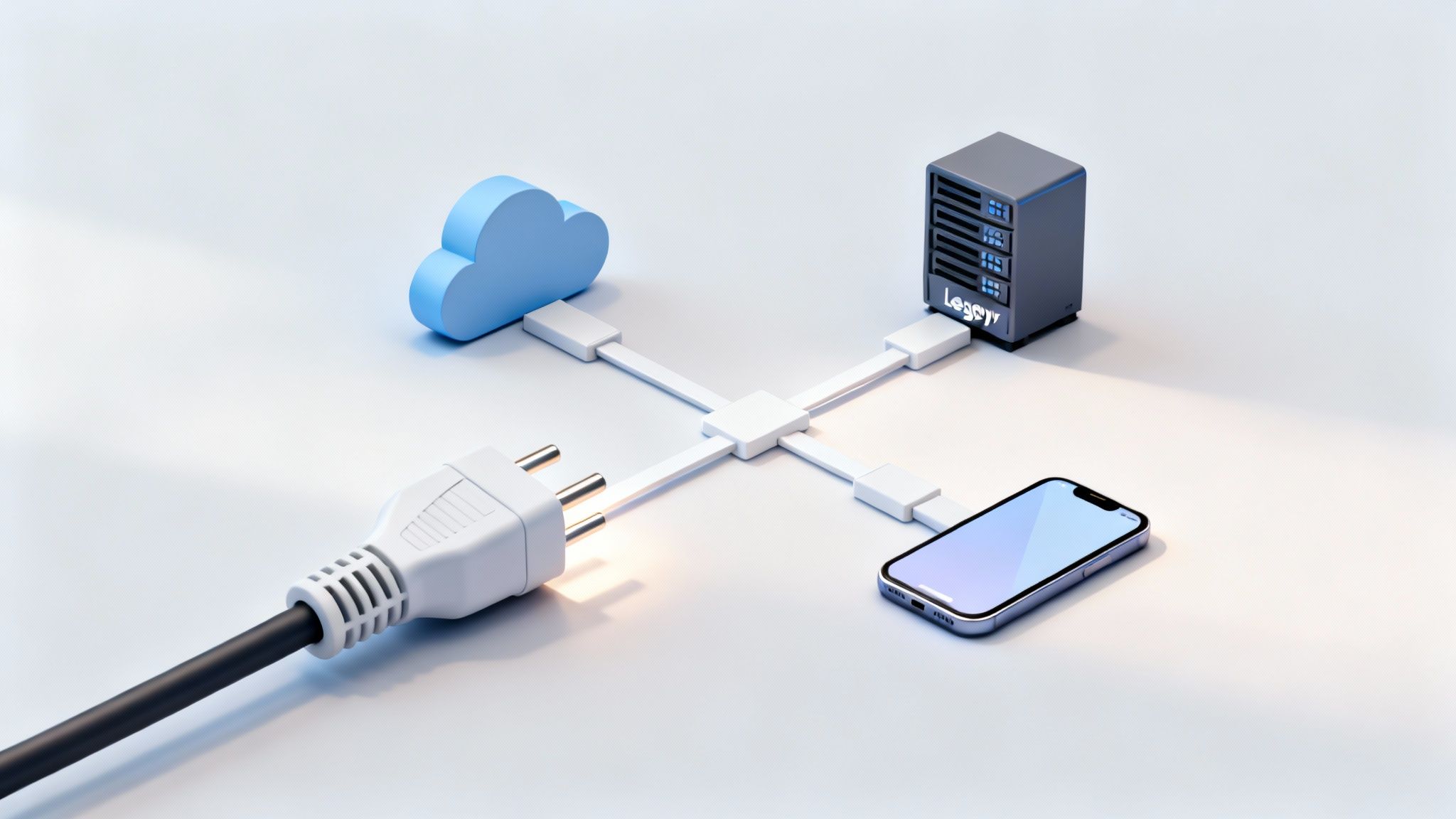
An API-first, technology-agnostic architecture insulates your data integration strategy from vendor lock-in and future technological shifts. This approach prioritizes creating standardized, well-documented interfaces (APIs) as the primary way to connect and exchange data. By abstracting the underlying technology, you create a modular framework where legacy mainframes, modern cloud services, and future platforms can all communicate seamlessly.
This methodology is useful for enterprises with diverse IT landscapes. For instance, a global logistics firm can use this approach to build an email classification system that integrates with Microsoft Exchange and Google Workspace using a single, unified API layer. Similarly, an agricultural forecasting platform can consume data from satellite feeds, on-farm IoT sensors, and weather services through a consistent set of APIs, simplifying development.
Why It's a Best Practice
An API-first design promotes reusability and agility. By decoupling data consumers from data producers, teams can independently update or replace individual systems without impacting the entire data ecosystem. For a Head of Data, this can mean a 20 to 30 percent reduction in development time for new integrations, based on DSG.AI's project experience from 2022-2024. Teams can reuse existing API contracts and adapters rather than starting from scratch.
Actionable Implementation Steps
- Define Clear API Contracts First: Use specifications like OpenAPI or GraphQL to define the structure, format, and protocols for data exchange before writing implementation code. This contract-first approach ensures alignment between teams.
- Implement an Adapter Pattern: Create middleware components or "adapters" that translate data from a source system's native format into the standardized model defined by your API contract.
- Use Containerization for Portability: Package integration services in containers (e.g., Docker) and manage them with an orchestrator like Kubernetes. This ensures your integration logic can be deployed consistently across any cloud or on-premises environment.
- Establish an API Versioning Strategy: Implement a clear versioning scheme (e.g.,
api/v1/data,api/v2/data) to introduce changes without breaking existing integrations. This ensures backward compatibility.
3. Establish Real-Time Data Quality Monitoring and Validation
Integrating data without continuous validation can lead to late discovery of problems. Real-time monitoring systems continuously validate data quality throughout the integration pipeline, identifying anomalies, schema violations, duplicates, and missing values as they occur. This proactive approach is a cornerstone of modern data integration best practices, as it prevents poor-quality data from corrupting downstream AI models.
This practice involves setting up automated checks and alerts that scrutinize data streams. For organizations deploying mission-critical AI, this is not optional. For instance, a mining operation must validate sensor data in real time to detect equipment issues before that data is fed into a predictive maintenance model. Likewise, a healthcare provider monitoring patient data feeds for a deterioration prediction model needs assurance of data completeness and accuracy at all times.

Why It's a Best Practice
Real-time validation shifts data quality management from a reactive, batch-based cleanup process to a proactive, continuous one. This prevents "data downtime," where AI models provide inaccurate results due to undetected data issues. By catching and flagging problems at the point of ingestion, organizations can maintain trust in their data assets and the AI systems that depend on them. This immediate feedback loop is critical for maintaining high performance standards.
Actionable Implementation Steps
- Start with Critical Dimensions: Focus initial monitoring on the most impactful data quality dimensions for your use case, such as completeness, accuracy, and consistency.
- Use Statistical Profiling: Establish baseline data quality patterns using statistical analysis of historical data. This allows for more effective anomaly detection when new data deviates from established norms.
- Implement Tiered Alerting: Create a multi-level alerting system that distinguishes between warnings (minor deviations) and critical alerts (significant quality failures). This helps teams prioritize responses.
- Automate Remediation Workflows: For common issues like duplicate records or formatting errors, build automated workflows to correct the data or quarantine it for manual review. Organizations can explore platforms like DSG.AI's assureIQ for these capabilities.
4. Implement Master Data Management (MDM) for a Single Source of Truth
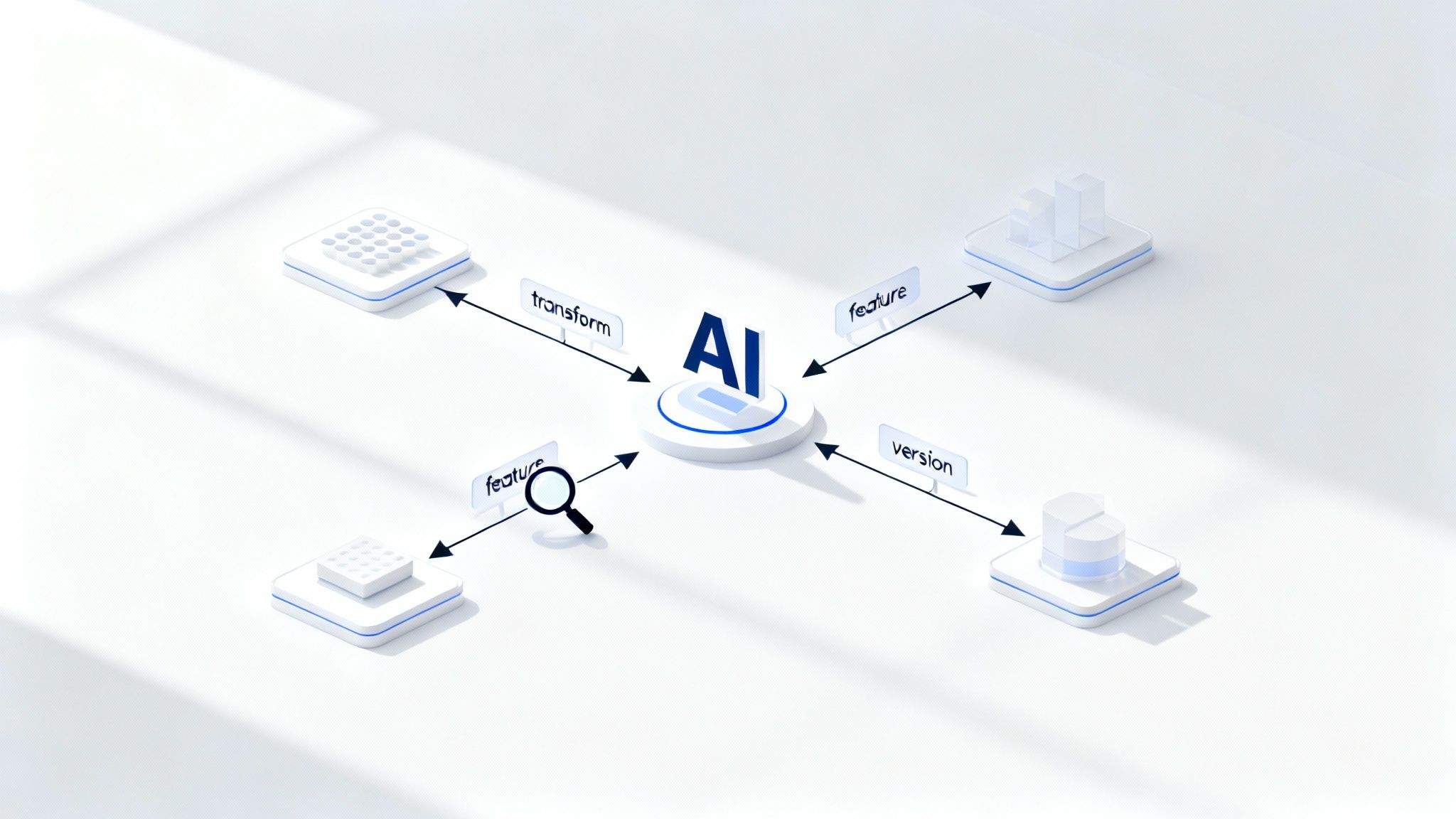
Integrating data from different sources often exposes multiple, conflicting versions of core business entities. Master Data Management (MDM) addresses this by creating a single, authoritative source for critical data like customers, products, and locations. This practice is essential for large-scale integration, as it eliminates data redundancy and inconsistency.
By establishing a "golden record" for each core entity, MDM prevents the "garbage in, garbage out" dilemma. For instance, a logistics firm can use MDM to consolidate customer and supplier data, improving the accuracy of AI-powered email classification and routing systems. Similarly, a global agricultural company can unify farm and equipment data to build consistent forecasting models across all its operational regions.
Why It's a Best Practice
MDM is a crucial element of data integration best practices because it establishes the semantic consistency needed for high-stakes business processes and AI. Without it, an organization might calculate customer lifetime value differently across its sales and marketing departments. By enforcing a single, enterprise-wide definition of a "customer," MDM ensures that all analytics, reports, and AI models operate from the same baseline reality.
Actionable Implementation Steps
- Prioritize High-Impact Domains: Begin your MDM initiative by focusing on the master data domains that deliver the most business value first, such as "customer" or "product."
- Use Probabilistic Matching: Implement matching algorithms that can identify and link related records across legacy systems even when data is incomplete or formatted differently (e.g., "John Smith" vs. "J. Smith").
- Establish Clear Stewardship: Assign formal data steward roles for each master data domain. These stewards are responsible for defining data quality rules, resolving conflicts, and governing changes to the master record.
- Create API-First Access: Design and publish APIs for consuming master data. This ensures that all systems can access the single source of truth in a consistent, controlled manner.
5. Design Event-Driven Architecture for Low-Latency Integration
Traditional batch-based data integration creates latency that is unacceptable for modern, real-time AI applications. Adopting an event-driven architecture is one of the most impactful data integration best practices for achieving low-latency responsiveness. Instead of periodically polling for changes, this model uses asynchronous message streams to propagate data events as they occur.
This architectural pattern is a strategic enabler for use cases where immediate action is critical. For instance, a mining operation can stream sensor data from heavy machinery to an anomaly detection model, triggering immediate maintenance alerts. Similarly, healthcare providers can use event streams to propagate vital sign updates from patient monitors, allowing a deterioration prediction model to issue real-time alerts. This approach decouples data producers from consumers, creating a more scalable and responsive data ecosystem.
Why It's a Best Practice
An event-driven approach shifts data integration from a scheduled process to a real-time flow. This minimizes data staleness and ensures AI models operate on the most current information. This is crucial for applications like fraud detection or dynamic pricing. By decoupling systems, it also improves fault tolerance; if a consuming service fails, events can be retained in a message queue and processed once the service recovers, preventing data loss.
Actionable Implementation Steps
- Choose an Appropriate Event Platform: Select a platform based on your needs. Use high-throughput systems like Apache Kafka for large-scale data streams or managed services like AWS SQS for use cases with lower volume.
- Design Immutable, Context-Rich Events: Structure each event as a complete, self-contained record of an occurrence. This immutability supports replayability, allowing you to reconstruct system state or retrain models, and provides a clear audit trail.
- Implement a Schema Registry: Use a schema registry (e.g., Confluent Schema Registry) to manage and enforce event data structures. This practice prevents downstream consumers from breaking when a data producer introduces changes.
- Monitor Consumer Lag: Actively monitor the time delay between when an event is produced and when it is processed. High consumer lag is an early indicator of a processing bottleneck.
6. Establish Data Catalog, Lineage, and Explainability Tracking
Integrating data without a clear map of its origin and transformations can slow down development and complicate audits. A critical data integration best practice is to combine a data catalog with end-to-end lineage and explainability tracking. This creates a unified system that makes data discoverable, traceable, and understandable.
This practice transforms data assets into a trusted resource. For example, a logistics company can catalog email, customer, and operational metadata, enabling analytics teams to discover relevant datasets for route optimization. Similarly, a healthcare provider building a patient deterioration model can use lineage tracking to document every data source and transformation, providing the evidence needed to build clinical trust.
Why It's a Best Practice
This combined approach supports responsible AI governance and operational efficiency. For organizations preparing for regulations like the EU AI Act, documented lineage is foundational to demonstrating compliance. It provides the audit trail needed to trace a model's prediction back to its source data. This visibility also accelerates onboarding for data scientists and analysts, who can discover trusted data assets on their own.
Actionable Implementation Steps
- Start Small and Expand: Begin by cataloging a few high-impact datasets tied to a critical business initiative. Demonstrate value, then gradually expand catalog coverage.
- Automate Lineage Capture: Implement automated lineage capture at the data platform level using modern tools. Manual documentation is error-prone and does not scale.
- Adopt Open Standards: Leverage open standards like OpenMetadata or Apache Atlas for metadata and lineage representation. This avoids vendor lock-in and promotes interoperability.
- Integrate the Catalog into Workflows: To drive adoption, integrate the data catalog directly into developer and analyst workflows through IDE plugins and API access.
7. Implement Scalable Data Pipelines with Separation of Concerns
A monolithic data pipeline, where ingestion, transformation, and consumption are tightly coupled, creates bottlenecks. A better approach, and a core data integration best practice, is to architect pipelines with a clear separation of concerns. This principle involves designing distinct, independently scalable layers for each stage of the data journey: ingestion, transformation, storage, and consumption.
This architectural pattern allows organizations to optimize each layer for its specific function. For example, a logistics platform can build a high-throughput ingestion layer for real-time tracking pings, a separate transformation layer to enrich this data, and multiple consumption layers feeding different AI models. Similarly, DSG.AI's maritime fuel optimization systems use this principle to separate high-frequency vessel sensor data ingestion from the complex computational models that correlate it with weather patterns.
Why It's a Best Practice
Separating concerns isolates failures, simplifies maintenance, and enables independent scaling. If the transformation layer experiences a slowdown, the ingestion layer can continue to receive data without interruption. This modularity also allows teams to upgrade or replace individual components without re-architecting the entire pipeline. For guidance on orchestrating robust, enterprise-grade data platforms, a production-ready guide to Databricks and Airflow integration offers valuable insights.
Actionable Implementation Steps
- Containerize Pipeline Stages: Use technologies like Docker and Kubernetes to encapsulate each pipeline stage into its own container. This makes them independently deployable, scalable, and portable.
- Choose Purpose-Built Storage: Select storage technologies aligned with each stage's needs. Use a data lake like Amazon S3 for raw data ingestion and a data warehouse like Snowflake for serving structured data.
- Implement Circuit Breaker Patterns: Programmatically isolate failures by implementing circuit breakers between stages. If a downstream service fails repeatedly, the circuit breaker trips, preventing cascading failures.
- Monitor Per-Stage Metrics: Track key performance indicators like latency, throughput, and error rates for each individual stage. This granular monitoring helps pinpoint bottlenecks. Discover how to effectively manage and automate these complex data workflows to improve reliability.
8. Implement Role-Based Access Control (RBAC) and Data Security
In a modern data ecosystem, security must be part of the integration process from the start. Leaving data unprotected during transit or at rest exposes an organization to severe risks. A fundamental data integration best practice is to implement a robust security framework, anchored by Role-Based Access Control (RBAC), to ensure that sensitive information is accessible only to authorized users and systems.
This practice involves a multi-layered security strategy, including data encryption, network segmentation, and enforcing permissions based on user roles. For instance, a financial services firm integrating transaction data for an AI-powered fraud detection system must use RBAC to prevent data scientists from accessing raw Personally Identifiable Information (PII), while still allowing the model to train on anonymized patterns.
Why It's a Best Practice
Implementing comprehensive security and RBAC is necessary for regulatory compliance. Mandates like GDPR and HIPAA require organizations to demonstrate strict control over how data is accessed and used. A well-defined RBAC system provides a clear, auditable trail of data access, simplifying compliance reporting. It moves security from a reactive model to a proactive, data-centric one.
Actionable Implementation Steps
- Layer Your RBAC Implementation: Apply RBAC at every level of the stack: the infrastructure layer (e.g., cloud IAM roles), the data platform layer (e.g., database permissions), and the application layer (e.g., BI tool access).
- Encrypt Data End-to-End: Ensure data is encrypted before it enters the integration pipeline and remains encrypted in transit (using protocols like TLS) and at rest (using standards like AES-256).
- Utilize Data Masking and Anonymization: For development and testing environments, use data masking or tokenization techniques. This allows teams to work with realistic data structures without exposing sensitive production data.
- Conduct Regular Access Audits: Routinely review access logs to identify suspicious activity or unused permissions. Automate alerts for anomalous access patterns.
9. Design for Idempotency and Fault Tolerance in Data Pipelines
Building a data pipeline without idempotency means that if a process fails midway, retrying it can create duplicate data. Designing for idempotency ensures that rerunning a process multiple times produces the same result as running it once successfully. This principle, combined with fault tolerance, is a cornerstone data integration best practice for creating resilient systems.
This approach is necessary for production AI systems where data consistency is paramount. For example, a logistics company processing shipping event emails must ensure that a temporary API failure doesn’t lead to duplicate shipment records when the process is retried. Similarly, a healthcare system reprocessing patient admission events after a network outage must do so without corrupting aggregated metrics.
Why It's a Best Practice
In any complex system, failures are inevitable. An idempotent and fault-tolerant architecture anticipates these failures—such as network issues or API rate limits—and builds in the logic to handle them. This prevents data loss or duplication, which can skew analytics. It directly supports operational reliability and reduces manual intervention from data engineering teams.
Actionable Implementation Steps
- Use Unique Idempotency Keys: Assign a unique identifier (e.g., a transaction ID) to each incoming record or batch. Before processing, the pipeline checks if this key has already been successfully processed, skipping duplicates.
- Design Stateless Transformations: Whenever possible, design your data transformation logic to be stateless. This means the output depends solely on the current input, not on any previously stored state, making retries safe.
- Implement Atomic Operations: Leverage transactional boundaries in databases and data warehouses to ensure that a series of operations either completes entirely or fails as a single unit. This prevents partial updates from corrupting data.
- Configure Intelligent Retry Logic: Implement retry mechanisms with exponential backoff for transient failures. This strategy avoids overwhelming a temporarily struggling system. Pair this with a dead-letter queue (DLQ) to isolate and analyze messages that repeatedly fail.
10. Implement Continuous Integration/Continuous Deployment (CI/CD) for Data Pipelines
Treating data pipelines as software products is essential for reliable AI. Applying Continuous Integration/Continuous Deployment (CI/CD) practices transforms data pipeline management from a manual process into an automated and auditable system. This is a cornerstone data integration best practice for organizations that need to iterate quickly and safely on their data transformations.
By integrating version control, automated testing, and staged deployments, CI/CD minimizes the risk of human error. For example, an agricultural technology company can use an automated pipeline to deploy seasonal updates to its crop yield forecasting models, ensuring each change is tested before it impacts farmer recommendations. Similarly, DSG.AI’s six-week methodology leverages CI/CD to accelerate model development and testing cycles.
Why It's a Best Practice
Adopting CI/CD for data pipelines improves reliability and development velocity. Instead of risky, monolithic deployments, teams can push smaller, incremental changes with confidence, knowing that automated checks will catch issues early. This practice enables data teams to respond faster to evolving business needs without introducing data quality regressions. It establishes a disciplined, repeatable process that builds trust in the data.
Actionable Implementation Steps
- Version Control Everything: Store all data pipeline artifacts, including transformation logic (e.g., SQL scripts), configuration files, and schema definitions, in a version control system like Git.
- Automate Testing at Every Stage: Implement a multi-layered testing strategy. Include unit tests for individual transformations, integration tests for pipeline segments, and data quality checks that run automatically on every code commit.
- Use Staged Environments: Create isolated development, staging, and production environments. Automate the promotion of pipeline changes through these stages, with mandatory approvals before code reaches production.
- Implement Feature Flags for Schema Changes: To de-risk major schema or logic updates, use feature flags to roll out changes to a small subset of users or systems first. This allows you to monitor the impact in a controlled manner before a full release.
10-Point Comparison: Data Integration Best Practices
| Practice | Implementation complexity | Resource requirements | Expected outcomes | Ideal use cases | Key advantages |
|---|---|---|---|---|---|
| Implement a Data Governance Framework Before Integration | High — extensive planning and cross-team alignment | Governance roles, metadata/lineage tools, time and budget | Improved data quality, compliance, auditability | Regulated enterprises, large-scale AI deployments, EU AI Act/GDPR readiness | Reduces quality issues, supports compliance, clarifies ownership |
| Design Data Integration with API-First and Technology-Agnostic Approaches | Medium–High — needs architectural design and standards | Skilled engineers, API tooling, container/orchestration infra | Modular, vendor-neutral integrations; easier future changes | Heterogeneous environments, modernization, multi-vendor integrations | Avoids vendor lock-in, enables rapid source addition, modularity |
| Establish Real-Time Data Quality Monitoring and Validation | High — real-time rules and streaming validation complexity | Monitoring infra, compute for streaming, data quality expertise | Early anomaly detection, maintained model reliability in production | Mission-critical systems (healthcare, mining), high-volume streams | Prevents bad data in production, enables rapid root cause analysis |
| Implement Master Data Management (MDM) for Single Source of Truth | High — complex deduplication, governance and change mgmt | MDM platforms, stewardship, integration and reconciliation effort | Consistent, authoritative entity data across systems | Multi-system enterprises needing consistent customer/product data | Eliminates duplicates, improves model training accuracy and KPIs |
| Design Event-Driven Architecture for Low-Latency Integration | Medium–High — shift from batch to streaming patterns | Event streaming platform, stream processing expertise, schema registry | Near-real-time data propagation, decoupled scalable services | Real-time alerts, IoT, time-sensitive analytics and model updates | Low-latency updates, horizontal scalability, event replayability |
| Establish Data Catalog, Lineage, and Explainability Tracking | Medium–High — metadata coverage and ongoing maintenance | Catalog/lineage tools, automation for capture, stewardship | Faster discovery, traceability, audit and explainability support | Responsible AI, regulatory audits, cross-team analytics onboarding | Improves discoverability, supports explainability and audits |
| Implement Scalable Data Pipelines with Separation of Concerns | Medium — requires careful design to avoid new bottlenecks | Orchestration, storage/compute tiers, engineering for modularization | Maintainable pipelines with independent scaling per layer | Diverse data sources feeding multiple models, high-throughput ETL | Independent scaling, easier testing, targeted optimization |
| Implement Role-Based Access Control (RBAC) and Data Security | Medium — ongoing policy and role management | Security tooling, encryption, auth systems, audits, expertise | Protected sensitive data, regulatory compliance and audit trails | Healthcare, finance, any environment handling regulated PII/PHI | Reduces breach risk, enforces least privilege, supports compliance |
| Design for Idempotency and Fault Tolerance in Data Pipelines | Medium–High — careful deterministic design and error handling | Checkpointing, dead-letter queues, idempotency keys, monitoring | Reliable retries, consistent results, reduced data duplication/loss | Distributed systems, retry-prone integrations, critical pipelines | Prevents duplication/loss, simplifies recovery, increases availability |
| Implement CI/CD for Data Pipelines | Medium — requires testing discipline and deployment pipelines | CI tools, test infra (unit/integration/schema), DevOps skills | Safer rapid iterations, versioned deployments, rollback capability | Fast-iteration AI projects, frequent schema or transform changes | Faster delivery with safety, reproducibility, automated testing |
Building Your AI Foundation with an Architecture-First Approach
The journey from siloed data to production-grade AI is an architectural marathon. Navigating this landscape requires a disciplined commitment to the foundational principles of data integration. The ten best practices we have explored—from establishing a governance framework to implementing CI/CD—are not just checklist items. They represent the pillars of a resilient, scalable, and trustworthy AI ecosystem.
Adopting these data integration best practices transforms your data infrastructure from fragmented projects into a cohesive, strategic asset. This architectural discipline is the critical differentiator between AI initiatives that stall in proof-of-concept stages and those that deliver sustained, measurable business value. By prioritizing an API-first design, you ensure interoperability and future-proof your systems. By embedding real-time data quality monitoring and master data management, you build confidence in the data that fuels your critical algorithms.
From Technical Hurdles to Strategic Enablers
Mastering these concepts shifts the organizational perspective on data integration. It becomes a core strategic enabler for innovation. An architecture built on these principles provides the stability needed for deploying high-stakes AI applications in operational settings, from optimizing logistics routes to predicting equipment failure.
Consider the compounding benefits:
- Governance and Security: A foundation of clear governance, coupled with robust RBAC and security protocols, de-risks AI adoption and ensures compliance with regulations like the EU AI Act.
- Operational Excellence: Event-driven architectures, idempotent pipelines, and comprehensive monitoring reduce latency, minimize failures, and accelerate incident resolution.
- Trust and Transparency: A commitment to data lineage, cataloging, and explainability builds essential trust among business stakeholders, operators, and regulatory bodies.
Effective data integration is a continuous discipline, not a one-time project. It requires a cultural shift towards valuing data as a product and treating the pipelines that move it with the same rigor as production application code. This commitment ensures that as your business needs evolve, your data infrastructure can scale without collapsing. This architecture-first approach is the only sustainable path to building AI solutions that not only work but also last.
Ready to move from theory to a production-ready AI system with full IP ownership? The principles discussed here are embedded in the architecture-first, six-week implementation methodology at DSG.AI. We partner with enterprise teams to build, deploy, and hand over scalable AI solutions, ensuring your data integration foundation is built for long-term success. Explore our approach and past projects at DSG.AI.