
Written by:
Editorial Team
Editorial Team
What is a data steward? A data steward is a subject-matter expert responsible for the day-to-day management of a company's data assets within a specific domain, such as "customer" or "product" data. They are the operational link between high-level data governance policies and the practical reality of how data is used.
They are not just gatekeepers. They are enablers who ensure data is high-quality, documented, compliant, and trusted by the people who use it.
What Is a Data Steward?
A data steward acts like a specialized librarian for a company's information. While a data owner might own the "library" (the data domain), the steward is an expert on its contents. They catalog assets, ensure information is accurate, and help people find and use it responsibly. This function is the operational backbone of analytics and AI initiatives.
The need for data stewards grew with the volume of data in the early 2010s and became critical with regulations like GDPR. The impact is measurable. For example, a 2019 study by a data management firm found that companies with mature stewardship programs reported a 35% higher data accuracy rate compared to those without.
This is why the role is central—it connects stewardship, quality, documentation, and trust.
As shown, the steward’s work creates a foundation of trustworthy data that the business can build on.
The Business Case for Data Stewards
Without clear data stewardship, a business operates with unreliable data. In an environment that relies on data-intensive applications and AI, a lack of stewardship leads to inconsistent reports, failed projects, and compliance risks. Stewards prevent these problems by turning data strategy into action.
A data steward's primary goal is to ensure data is fit for its intended purpose. They translate high-level governance rules into tangible actions that improve data quality, usability, and security.
To understand the steward's function, it helps to see the larger picture. Learning What is Information Governance provides that context. Data stewards execute the principles of information governance within specific data domains.
Their work ensures that when someone pulls a sales report or an AI model makes a prediction, the underlying data is sound. For a CIO or Head of Data, investing in stewardship is a fundamental step toward building a data program that is scalable, compliant, and drives business value.
Data Steward vs. Data Owner vs. Data Custodian: Role Clarity
The lines between a data steward, owner, and custodian can be unclear. All three are essential for data governance, but they have distinct responsibilities. This table clarifies the differences.
| Role | Primary Responsibility | Scope of Work |
|---|---|---|
| Data Steward | Day-to-day management of data quality, metadata, and data access rules within a specific domain. | Operational & Tactical: Enforces data definitions, resolves quality issues, and documents data lineage. The "how." |
| Data Owner | Overall accountability for a specific data domain, including its quality, security, and business value. | Strategic: Makes high-level decisions on data usage, access rights, and classification. The "what" and "why." |
| Data Custodian | Technical implementation and management of the infrastructure that stores and secures the data. | Technical: Manages databases, access controls, and backups. Usually an IT role focused on the "where." |
In short, the Owner sets the rules from a business perspective, the Steward implements those rules daily, and the Custodian manages the technical systems that hold the data.
The Core Responsibilities of a Data Steward
What does a data steward do? The role is a function defined by action. Data stewards have an operational commitment to the health, quality, and integrity of specific data domains, like "customer," "product," or "financial" data.
They are the first line of defense against data inconsistencies that can derail analytics projects and erode business trust.

This is not a passive role. Stewards actively engage with the data, applying governance policies to real-world scenarios and ensuring the information under their care is fit for purpose. They are the bridge between high-level data governance strategy and its day-to-day execution.
Managing Data Quality and Consistency
A data steward’s primary job is to ensure data quality. This means they are responsible for the accuracy, completeness, and consistency of the data in their domain. They identify and work to fix problems at the source.
Here is what that looks like in practice:
- Defining Business Rules: The steward works with business teams to establish clear rules for data. For example, they define what constitutes a "valid customer address" and then implement checks to enforce that standard.
- Investigating Discrepancies: When reports show conflicting sales figures from marketing and finance, the steward investigates the root cause, documents the issue, and coordinates the fix.
- Monitoring Data Health: They use data profiling tools and dashboards to monitor key quality metrics. This allows them to spot trends or dips in accuracy before they become major business problems.
Synthetic Example: A retail data steward for the "Product Information" domain notices that 15% of new product listings are missing weight and dimension data. By implementing a mandatory field in the product setup workflow, they reduce the error rate to less than 1% within one quarter. As a result, shipping errors fall by 8% against the previous quarter's baseline.
Overseeing Metadata and Documentation
If data is the "what," then metadata is the "who, when, where, and why." A data steward is responsible for creating and maintaining this context. Without good metadata, data assets become unusable.
Key metadata activities include:
- Documenting Definitions: The steward ensures every important data element has a clear, agreed-upon business definition. For instance, they clarify whether "revenue" means gross or net and if it includes taxes.
- Tracking Data Lineage: They document the data's journey from its origin to its use in reports and AI models. This transparency is essential for audits and troubleshooting.
- Classifying Data: Stewards classify data based on its sensitivity (e.g., Public, Internal, Confidential), which informs access and security controls.
This documentation makes data discoverable, understandable, and trustworthy for business analysts and AI engineers.
Implementing Policies and Resolving Issues
Data stewards are the operational arm of a data governance program. They translate high-level policies into concrete actions and serve as the go-to experts for their data domain.
This work impacts business outcomes and reduces organizational risk. Data from a 2021 industry survey showed that companies with active data stewards report 52% fewer data discrepancies, which can improve the ROI of analytics initiatives by up to 28%.
In sectors like logistics, effective stewards have been shown to reduce data breach risks by up to 40% by enforcing proper data classification and retention rules. You can read the full research on data steward responsibilities to see how they mitigate these issues.
This makes the data steward a direct contributor to business efficiency, compliance, and strategic success.
The Skills That Define a Great Data Steward
Identifying a great data steward requires looking beyond a typical job description. The role is a hybrid, demanding someone who understands the business and possesses analytical skills. A successful candidate can navigate organizational politics to become a champion for data quality.

This blend of abilities elevates a data steward from a gatekeeper to a strategic asset. They must speak the language of both business teams and the IT department, acting as a translator to align everyone on what data means and why it matters.
Deep Domain and Business Expertise
Deep domain expertise is a non-negotiable skill. A data steward for customer data must understand the entire customer journey, from marketing touchpoints to support. A steward for supply chain data needs expertise in logistics, inventory, and vendor management.
This business context allows a steward to:
- Identify incorrect data: They can recognize an anomalous "customer lifetime value" figure because they understand underlying business patterns.
- Create relevant rules: Their data quality rules are based on operational needs, not abstract technical ideals.
- Understand the ripple effect: They can predict how a data quality problem in one area will affect financial reporting or sales forecasts.
Without this business knowledge, a steward can only follow a script. They cannot effectively validate, define, or protect the data they are responsible for.
Strong Analytical and Technical Skills
While business knowledge is primary, a great data steward also needs a strong analytical mind. They must be comfortable working directly with data, using tools to analyze datasets, and identifying patterns that signal quality issues. They should be technical enough to trace problems to their source and understand data flows.
A significant part of this is implementing essential metadata management best practices so that everyone can find, trust, and understand the data.
A data steward does not need to be a database administrator or a software engineer. However, they must be technically literate enough to profile data, understand data lineage, and collaborate effectively with IT on remediation efforts.
Excellent Communication and Collaboration
Finally, a data steward must be an exceptional communicator. Much of their day is spent mediating conversations between different departments, each with its own perspective on data.
Consider the communication skills they use daily:
- Translating technical concepts: They explain complex data problems to non-technical leaders in plain English.
- Building consensus: They negotiate an agreement when marketing and sales have conflicting definitions for a "lead."
- Championing governance: They must advocate for data policies, explaining why they are essential for the business.
Their ability to build bridges and foster a shared sense of ownership makes change stick. They guide the organization toward a culture where data is valued.
How to Structure Stewardship in Your Organization
Where does a data steward fit on the org chart? The answer depends on your company's size, data maturity, and culture. There is no single correct way.
Choosing the right model is a strategic decision that determines whether your data governance policies will be adopted or ignored. A poor setup creates bottlenecks. The right one creates clear ownership, encourages collaboration, and scales with the business.
Let’s review the three most common ways companies structure their data stewardship programs.
The Centralized Model
In a centralized model, all data stewards belong to a single, dedicated team, often a Data Governance Office. This group sets and enforces data standards uniformly across the organization.
Stewards in this setup typically report to a Chief Data Officer, ensuring a consistent vision is applied everywhere. This top-down approach is common in highly regulated fields like finance or healthcare, where consistency is a legal requirement.
The trade-off is that a central team can become disconnected from the daily realities of the business units. They might create policies that are technically sound but operationally inefficient, creating a bottleneck for data requests.
The Decentralized Model
The decentralized model is the opposite approach. Instead of a central team, data stewards are embedded directly within business departments like marketing, sales, or operations. They are subject matter experts who understand their department's data and report to their respective business leaders.
This model places responsibility with the people closest to the data. A steward in the finance department knows what a "valid transaction" is and can create relevant quality rules. This leads to faster problem-solving.
The biggest risk is inconsistency. Without central oversight, each department can create its own rules and definitions. Marketing's definition of a "customer" might differ from sales', making enterprise-wide reporting inaccurate.
The Federated Model
The federated model is a hybrid approach. It combines the strengths of the other two models while minimizing their weaknesses. Here, stewards remain embedded in their business domains but also belong to a central data governance council.
This "hub-and-spoke" structure allows for both localized expertise and enterprise-wide consistency. Stewards handle day-to-day data management within their departments, while the central council provides oversight, sets standards, and facilitates cross-functional collaboration.
This model is popular because it works for most complex organizations. It avoids the bureaucracy of a purely centralized system and prevents the inconsistencies of a decentralized one. The federated model balances control and business agility. It is a structure that supports complex, large-scale initiatives through better data orchestration and governance.
Comparing Data Stewardship Organizational Models
Picking the right structure means weighing these trade-offs. The table below outlines the key differences to help you decide which model aligns best with your organization's goals.
This table evaluates three common models for structuring data stewardship programs, highlighting their advantages and disadvantages.
| Model | Key Characteristics | Best For | Potential Challenges |
|---|---|---|---|
| Centralized | A single, corporate team of data stewards manages data for the entire organization. | Companies in highly regulated industries or those with low data maturity needing strong, consistent control. | Can be slow, bureaucratic, and lack specific business context, creating bottlenecks. |
| Decentralized | Data stewards are embedded within business units and report to departmental leadership. | Agile, fast-moving organizations where business units have unique and specialized data needs. | High risk of inconsistent standards and data silos, making enterprise-wide reporting difficult. |
| Federated | Stewards are embedded in business units but are part of a central data governance council for oversight. | Most large enterprises, especially those with diverse business units seeking both agility and consistency. | Requires strong communication and a clear charter to balance central authority and local autonomy. |
The best model fits your reality. The goal is to empower people with the right context and authority to make data an asset, not to force a rigid structure where it does not fit.
The Steward’s Role in Modern AI Governance
The rise of enterprise AI has reshaped the data steward's job. The role is no longer limited to cleaning data for dashboards. Today, stewards are on the front lines, acting as guardians of responsible AI and influencing the success, safety, and compliance of machine learning models.
For any CIO or executive in Governance, Risk, and Compliance (GRC), this is a critical shift. Investing in a strong data stewardship program is a direct investment in trustworthy AI that can be deployed without creating business or legal risks.
Mitigating Risk in AI Training Data
An AI model is only as good as its training data. When that data is flawed, the consequences can include biased decisions and inaccurate predictions. Data stewards work at the source of this problem, ensuring the data fed into models is fit for purpose.
Here is what that looks like in practice:
- Verifying Accuracy and Completeness: They identify errors and inconsistencies in training datasets that could teach an AI model the wrong lessons.
- Identifying and Flagging Bias: Stewards who know their business domain can spot historical biases in the data—like skewed demographic information in customer files—before it is incorporated into an algorithm.
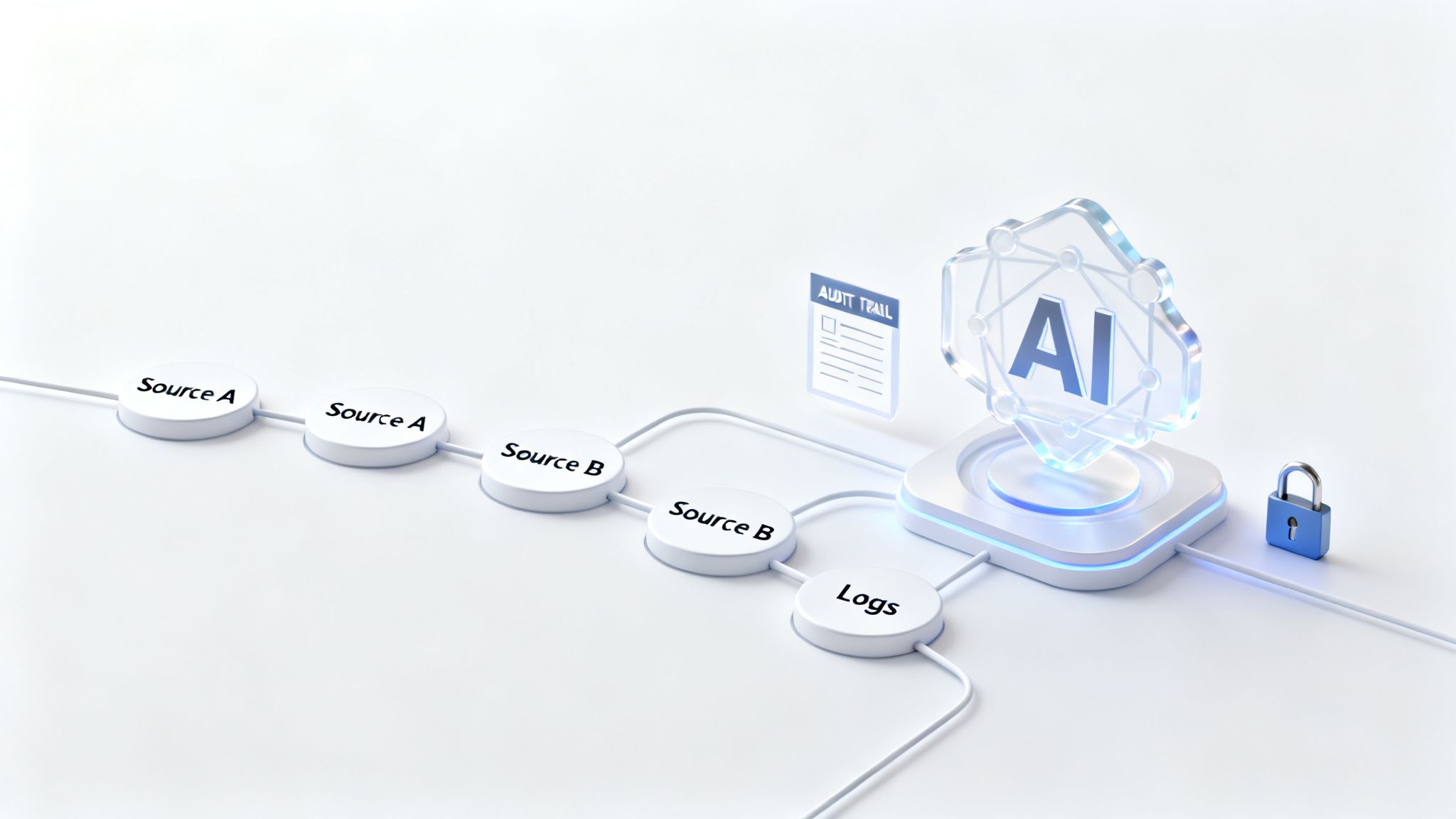
- Ensuring Transparent Sourcing: They document data lineage, creating an auditable trail that shows where every piece of data originated. This is a legal necessity.
This hands-on work turns AI governance from a theoretical policy into practical, everyday controls. Stewards apply principles of fairness and transparency long before a model makes a production decision.
Building an Auditable Trail for Compliance
New regulations like the EU AI Act require companies to prove how their AI systems work and what data they use. The documentation managed by a data steward becomes a lifeline. Their focus on metadata management and data lineage creates the auditable evidence that regulators demand.
As companies scale their AI initiatives, the steward’s role in compliance grows. An IDC report surveying 400 enterprises found that organizations with dedicated business data stewards improved their decision-making speed by 33%. Following the EU AI Act proposal, many GRC leaders began prioritizing stewards for data lineage tracking to avoid audit failures. For more on this, you can see how data stewards drive business value on ataccama.com.
Connecting Stewardship to Business Value
The data steward's role in AI governance gives the business confidence to innovate. When data is properly managed, AI models are more reliable, produce better results, and are less likely to cause financial or reputational damage.
This foundation of trust allows an organization to move its AI projects from the lab into high-impact applications. The data steward enables business value by ensuring that investments in AI are built on a solid foundation of high-quality, compliant, and well-understood data. Without them, even sophisticated AI systems are potential liabilities. For organizations looking to meet emerging standards, you can read our guide on achieving readiness for the EU AI Act.
Measuring the Impact of Your Data Stewards
Investing in a data stewardship program is a commitment of time and resources. To secure leadership buy-in, you must demonstrate tangible value. Anecdotes about "cleaner data" are not enough.
This means measuring and reporting on the impact your stewards have on the business. This involves connecting their daily tasks to improvements in operations and financial results. The right Key Performance Indicators (KPIs) elevate the data steward from a theoretical role to a quantifiable business asset.
To do this, you need a framework that links what your stewards do to the metrics the business cares about.
Defining Your Key Performance Indicators
Good KPIs for data stewards fall into three categories: data quality, operational efficiency, and risk reduction. Vague goals like "improve data quality" are not useful. You need specific, measurable targets anchored to a starting point.
Before a steward begins work on a dataset, you must establish a baseline. For example, if you are addressing incomplete customer records, your baseline might be that 75% of them have a valid phone number. With that number, you can set a tangible goal: increase that figure to 90% within six months.
Here are a few practical examples of KPIs:
- Data Quality Metrics: "Achieve a 20% decrease in duplicate customer records in Q2 compared to the Q1 baseline."
- Operational Efficiency Metrics: "Reduce the time to resolve data-related support tickets by 30% from the prior six-month average."
- Compliance and Risk Metrics: "Reduce data access policy violations found in internal audits by 15% year-over-year."
A crucial first step is to establish a clear baseline for each KPI. Without a starting point, you cannot credibly demonstrate improvement or calculate the ROI of your stewardship efforts.
Setting Targets and Reporting on Progress
Once your KPIs and baselines are set, establish realistic targets. They should be challenging but achievable. This gives your stewards a clear goal. Regular reporting is equally important to maintain momentum and communicate wins to stakeholders.
Consider creating a simple dashboard to visualize progress. It is a powerful tool for transparency and helps you tell a compelling story about the program's success. This is essential for any Head of Data who needs to justify their team's budget. A professional data governance audit can provide a comprehensive framework for measurement and reporting.
Below is a synthetic example of a KPI tracking table a Head of Data could share with leadership.
| KPI Category | Metric | Q1 Baseline | Q2 Target | Q2 Actual |
|---|---|---|---|---|
| Data Quality | Incomplete Product SKUs | 18% | < 12% | 11.5% |
| Efficiency | Avg. Time to Resolve Data Issues | 4.5 hours | < 3 hours | 2.8 hours |
| Risk Reduction | Data Access Policy Violations | 12 | < 5 | 4 |
This kind of hard data shifts the conversation from cost to value. It proves that data stewards are a strategic investment that boosts business performance, reduces risk, and improves organizational efficiency.
Getting Started: Common Questions About Data Stewardship
As you plan a data stewardship program, practical questions will arise. Answering them early helps build momentum. Let’s address some of the most common ones.
Answering these questions helps you get past the initial hurdles of defining roles and structuring your team for success.
What Is the Difference Between a Data Steward and a Data Owner?
This is the most common point of confusion. Getting the distinction right is crucial for clear accountability.
A Data Owner is a senior leader, such as a VP or Director, who has ultimate responsibility for a major data domain, like "customer data." They focus on the big picture: setting access rules, defining security policies, and ensuring the data serves its strategic purpose. They own the "what" and the "why."
A Data Steward is the subject matter expert responsible for the day-to-day management and execution of the owner's strategy. They handle the "how"—defining business terms, monitoring quality, and ensuring the data is fit for purpose. They make the owner's strategic vision a reality.
How Do We Start a Data Stewardship Program?
Do not try to address everything at once. The most successful programs start small, prove their value quickly, and then expand.
Here is a four-step approach:
- Select a High-Value Pilot: Pick a single data domain where a clear business problem exists. A good starting point could be cleaning product data to reduce shipping errors or refining customer data to improve marketing campaigns.
- Secure an Executive Sponsor: You need a champion in a leadership position who supports the initiative and can help clear roadblocks.
- Appoint Your First Steward: Find someone within that business area who is an expert on the data. Give them a clear charter that outlines their authority and responsibilities.
- Track and Broadcast Wins: Define a few simple metrics, like the reduction in data errors. When you hit a milestone, share the success widely to build the case for expansion.
Can One Person Be a Steward for Multiple Data Domains?
Yes, this is common, especially in smaller companies or new programs. Someone could steward both "sales data" and "customer data" if the business contexts overlap.
The key is to ensure the steward is not stretched too thin and has deep expertise in the domains they manage. For massive, complex, or highly regulated data—such as patient health records or financial transaction data—a dedicated steward is almost always the right choice to avoid bottlenecks.
At DSG.AI, we help enterprises design, build, and operationalize AI systems built on a foundation of trustworthy, well-governed data. Our architecture-first approach ensures your AI solutions are scalable, reliable, and deliver measurable business value from day one. Learn more about how we turn data into a competitive advantage by exploring our production AI projects.