
Written by:
Editorial Team
Editorial Team
Reader Persona: Sarah, a Director of Retail Operations at a large, multi-channel retailer. Problem: Sarah's team relies on manual, spreadsheet-based pricing, which is slow and reactive. This leads to shrinking margins from competitor price wars and lost revenue from inefficient inventory clearance. Goal: To educate retail leaders like Sarah on how to implement an AI-driven dynamic pricing system to automate pricing decisions, protect margins, and improve inventory efficiency. Funnel Stage: Consideration
Dynamic pricing is more than adjusting numbers on a price tag. It is a core business capability that allows you to react to the market in real-time. It acts as a control system for your product catalog, constantly monitoring competitor prices, customer demand, and inventory levels to make intelligent adjustments.
From Simple Rules to AI-Driven Strategy
Dynamic pricing first appeared in industries like airlines and hotels, where the value of a seat or a room changes by the minute. Early retail adoption was often limited to simple rules, such as matching a competitor's price on a few popular items. This manual, one-to-one logic cannot scale with a modern retail operation managing thousands of SKUs and dozens of market signals.
Today, the approach is different. For technology leaders and CIOs, this represents a strategic shift from manual decisions to a predictive, AI-powered capability. This system does not just react to the market; it anticipates it to achieve specific business goals.
The Business Case for Intelligent Pricing
Adopting dynamic pricing solves critical operational and strategic challenges that large-scale retailers face. For a deeper look at the strategy, see this complete guide to dynamic pricing in retail.
The table below outlines the key business drivers and the outcomes that leaders should expect from a well-executed dynamic pricing strategy.
Key Business Drivers for Adopting Dynamic Pricing
| Business Driver | Description | Expected Outcome |
|---|---|---|
| Margin Optimization | Adjusting prices based on real-time costs, demand elasticity, and competitive positioning to protect profitability. | Increased gross margin; reduced profit erosion; better alignment between price and perceived value. |
| Revenue Growth | Capturing the optimal price a customer is willing to pay at any given moment to maximize sales volume and value. | Higher gross merchandise value (GMV); increased average order value; improved market share. |
| Inventory Efficiency | Using pricing to accelerate sales of slow-moving or perishable goods before they lose value. | Lower carrying costs; minimized stockouts on popular items; a 15% to 30% reduction in end-of-season markdowns. |
| Competitive Agility | Responding instantly to competitor price changes or market trends without requiring manual intervention from pricing teams. | Faster reaction to market shifts; maintained price competitiveness; pricing teams freed for strategic work. |
The global dynamic pricing market has reached a valuation of USD 5.2 billion, indicating its rapid adoption. A case study of a major Asian e-commerce firm showed a 10% increase in gross margins and a 3% lift in gross merchandise value (GMV) after implementing its models. For enterprise leaders, this is a scalable AI solution that integrates into existing workflows and delivers measurable results.
A modern dynamic pricing system is an automated decision-making engine. It connects disparate data sources to execute a coherent pricing strategy aligned with high-level business goals, such as market share growth or profit maximization.
Understanding the AI Models Driving Dynamic Pricing
At the heart of any modern dynamic pricing system is an engine that processes a constant stream of data to make decisions. The sophistication of that engine separates a basic, reactive system from one that can drive growth.
In 2021, 17% of e-commerce companies across North America and Europe reported plans to adopt dynamic pricing. By 2023, a study confirmed this trend, revealing that 55% of executives now see digital pricing as a high-impact priority. They are moving past simple rules and into sophisticated models. You can review more of this data on the growth of dynamic pricing strategies at Statista.com.
Let's break down the different types of engines that power these systems.
The Limits of Simple Rule-Based Systems
The entry point for many retailers is a rule-based system. This is a straightforward form of automation operating on "if-then" logic.
A synthetic example of a rule might be, "If Competitor A drops their price on Product X, match it," or "Increase prices by 5% on all swimwear during July."
While these systems are easy to set up, they are rigid and show limitations in a fast-moving market. They are reactive, not predictive, and cannot process the multiple variables that influence demand. The price-matching rule, for instance, could lead to a race to the bottom, reducing margins without considering current stock levels, brand value, or price elasticity.
Supervised Machine Learning for Demand Forecasting
Supervised machine learning learns from historical data to predict future outcomes. It analyzes past data—sales figures, promotions, inventory counts, seasons, competitor prices—to find patterns and relationships.
The goal is to build a predictive model that answers the question: "If we price this SKU at $49.99, how many units will we sell next week?" By forecasting demand at different price points, the system can recommend the optimal price to meet a specific business goal, whether maximizing revenue, moving aging inventory, or protecting profit margins.
Here is a synthetic example:
- Input Data: A retailer feeds the model two years of sales data for a specific brand of running shoes. This includes daily prices, units sold, promotional periods, and competitor pricing.
- Training: The model learns that a 10% discount on Fridays typically increases sales by 30%, but only if a key competitor's price remains stable. It also finds that demand for these shoes drops by 15% in the winter, regardless of price.
- Prediction: The system can now forecast sales for the upcoming weekend at various price points, giving the pricing team data for an informed decision.
Reinforcement Learning for Policy Optimization
Reinforcement learning (RL) learns by actively testing pricing strategies in a simulated or live environment. The AI model tests different pricing actions, observes the result (the "reward," such as an increase in profit), and refines its strategy. Through this trial-and-error process, the model can uncover pricing moves that a human or a supervised model might miss.
Reinforcement learning understands the ripple effects of pricing. It can learn how reducing the price of a popular brand of coffee might increase sales of coffee filters (a halo effect) or decrease sales of a competing coffee brand (cannibalization).
This ability to optimize an entire pricing policy—not just individual prices—makes RL powerful. It shifts the focus from predicting demand to finding the best sequence of pricing actions to maximize long-term business outcomes. It continuously adapts as the market changes.
Comparison of Dynamic Pricing AI Models
The right model for your business depends on your goals, data maturity, and technical resources.
| AI Model | How It Works | Pros | Cons | Best For |
|---|---|---|---|---|
| Rule-Based | Executes pricing actions based on pre-defined "if-then" logic. | Simple to implement; low data requirements; predictable behavior. | Inflexible; cannot adapt to new market dynamics; risks price wars and margin erosion. | Retailers new to automation or for simple, stable product categories. |
| Supervised ML | Learns from historical data (sales, prices, promotions) to forecast demand at different price points. | Accurate for prediction; considers multiple demand drivers; optimizes for specific goals (e.g., revenue). | Requires large, clean historical datasets; can be slow to adapt to sudden market shifts. | Businesses with robust historical data aiming to optimize pricing for revenue or profit on a per-product basis. |
| Reinforcement Learning (RL) | Learns through trial-and-error by testing pricing actions in a simulated or live environment to maximize a long-term reward (e.g., profit). | Highly adaptive; optimizes for long-term goals; can uncover system-wide strategies (halo/cannibalization). | Complex to build and train; requires a sophisticated simulation environment; can be unpredictable during learning. | Large, mature enterprises aiming to optimize pricing across their entire catalog and account for complex product interdependencies. |
The journey from rule-based systems to reinforcement learning mirrors a retailer's evolution from basic automation to strategic intelligence.
Designing a Scalable Data and MLOps Architecture
An AI model is ineffective without the technical architecture to support it. A dynamic pricing retail system requires a scalable architecture that can handle large amounts of data in near real-time and maintain model performance in a production environment.
The system's performance depends on the quality and speed of its data. These data pipelines must be fast and reliable, as the retail industry generates approximately four petabytes of data every hour, according to IBM research.
Core Data Sources for Pricing Models
A pricing model needs data from both internal and external sources to get a complete view of the market.
Typical data sources include:
- Internal Data: Transaction logs (what sold, when, where, and for how much), real-time inventory levels for every SKU, product details from your ERP, and historical promotion data.
- External Data: Competitor pricing data scraped from their sites, broad market trends such as consumer spending habits, and other signals like weather forecasts or local event calendars that might affect demand.
This flowchart shows how different AI models rely on these data streams.
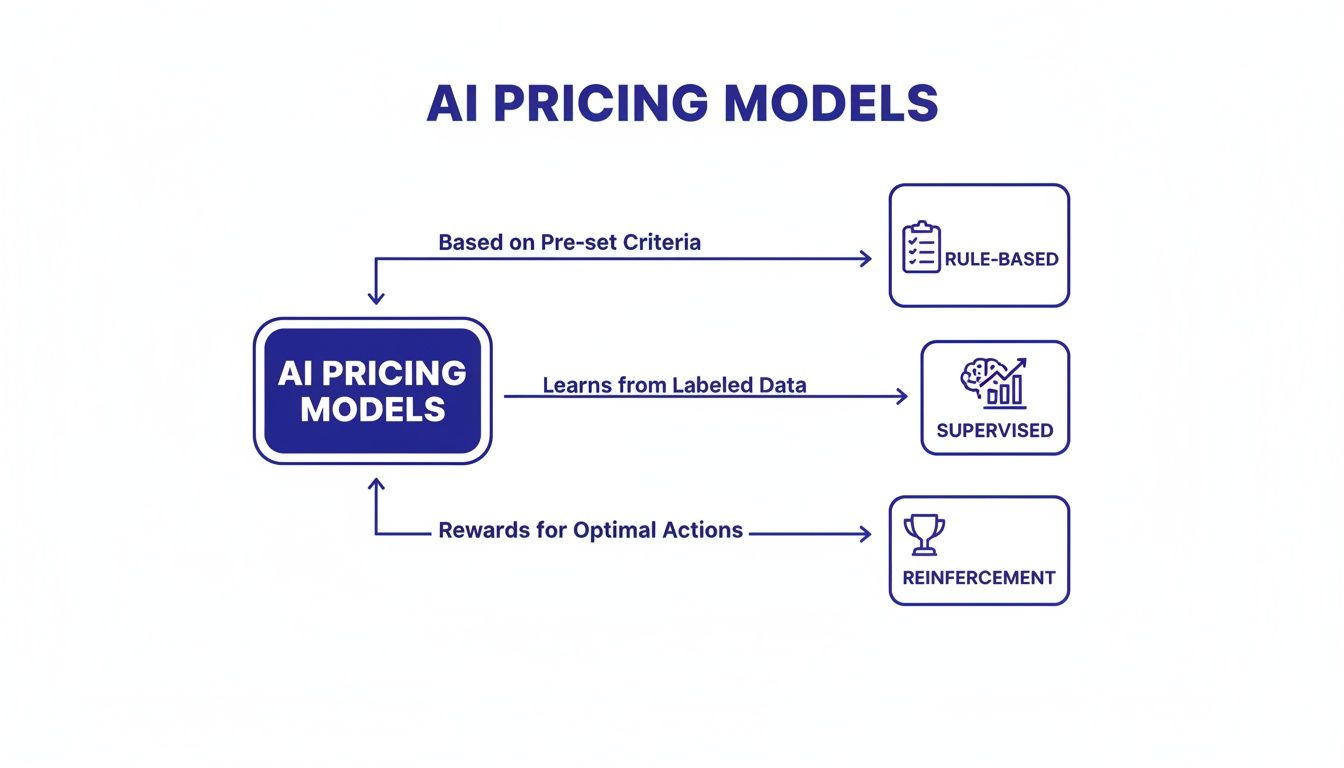
The progression from rule-based pricing to reinforcement learning models requires an increasingly sophisticated and integrated data architecture.
The Role of MLOps and Feature Stores
MLOps (Machine Learning Operations) is a framework that automates the machine learning model lifecycle, from data preparation and training to deployment and monitoring.
MLOps applies the discipline of DevOps to machine learning. It ensures dynamic pricing models are continuously monitored, retrained, and improved, which is critical for preventing performance decay, or "model drift."
A core component of a modern MLOps stack is the feature store. A feature store is a central repository for the curated data points ("features") used to train models. It ensures the data used for training is identical to the data used for live predictions, preventing a class of errors that can lead to inaccurate pricing. To learn more about managing complex AI workflows, you can explore the principles of AI system orchestration.
Blueprint for a Production-Grade System
Building a system that can scale across millions of products requires a clear architectural blueprint.
A high-level architecture should include these five key areas:
- Data Ingestion Layer: Connectors and APIs to pull data from all sources into a central data lake or warehouse.
- Feature Engineering & Store: An automated pipeline that transforms raw data into clean, model-ready features stored in a central feature store.
- Model Training & Validation: An automated environment for training new models, testing their performance against business goals, and versioning them.
- Inference & Deployment: A scalable serving layer that delivers real-time price recommendations via API to your e-commerce site, point-of-sale systems, or digital shelf labels.
- Monitoring & Governance: Dashboards and alerts to track model performance, data quality, and business impact, with guardrails to prevent poor pricing decisions.
This end-to-end approach ensures your dynamic pricing system is stable, scalable, and integrated into your retail operations.
Measuring Success with the Right Business KPIs
To measure the return on a dynamic pricing system, you must focus on key performance indicators (KPIs) that demonstrate business impact. Proving ROI requires a disciplined approach that isolates the algorithm’s impact from other market factors.
The most effective method is A/B testing, or randomized controlled trials. You divide products or stores into two groups: a test group using the new dynamic pricing and a control group using the old strategy. This setup allows you to attribute any performance difference directly to the new pricing logic.
Core Financial and Commercial KPIs
Begin by evaluating core financial metrics.
-
Gross Margin: This is the primary test of profitability. A successful model should increase the average margin per product.
-
Gross Merchandise Value (GMV): This is the total value of goods sold in a period. An increase indicates that price adjustments are driving higher total sales value.
-
Conversion Rate: This is the percentage of visitors who make a purchase. Effective dynamic pricing should increase this number by presenting the right price at the right time.
These three KPIs should be tracked together to get a balanced view of performance. A model might increase GMV by cutting prices, but if gross margin or conversion rate decline, it is not a success.
A successful outcome is not just changing prices faster; it's controlling pricing with transparency, automation, and intelligence. The goal is a system that balances competing objectives to achieve holistic growth.
Essential Operational KPIs
A dynamic pricing system should also improve operational efficiency. These operational KPIs are early indicators of long-term financial health.
Monitor these key operational metrics:
-
Inventory Turnover: This measures how quickly stock is sold. If dynamically priced items sell faster, the model is successfully stimulating demand for slow-moving products.
-
Markdown Frequency and Depth: The system should reduce the need for deep, end-of-season clearance sales. Smaller, frequent price adjustments can help sell products at a better average price over their lifecycle.
-
Stockout Rate: The model must be intelligent enough to raise prices when inventory is low. This manages demand, prevents stockouts, and protects both sales and the customer experience.
Balancing Trade-Offs with a Portfolio View
A key challenge in dynamic pricing retail is managing competing goals across a large product catalog. For example, maximizing profit on a bestseller might inadvertently reduce sales of a related, high-margin accessory (cannibalization). Conversely, pricing a "loss leader" strategically might boost sales across an entire category (a halo effect).
Product-level KPIs cannot capture these complex relationships. A holistic portfolio view is necessary. You cannot judge success on an item-by-item basis. What matters is the net impact across an entire product category or the business as a whole. This perspective transforms the pricing engine from an optimization tool into a growth engine.
Navigating Business and Regulatory Compliance Risks
Automated pricing introduces business and regulatory risks that require careful management. Implementing a dynamic pricing retail strategy is a governance challenge that affects brand reputation and legal standing.

On the business side, an algorithm programmed to aggressively undercut competitors can trigger a price war, reducing margins. If prices fluctuate in ways that seem random to customers, it can damage trust and the long-term customer relationship.
The Challenge of Fairness and Price Discrimination
Dynamic pricing enters a complex ethical and regulatory area, specifically the potential for unfair price discrimination. While pricing differently for customer segments (e.g., student discounts) is not new, AI can personalize pricing at a scale that may create biased outcomes.
For example, an algorithm trained on historical data containing societal biases might learn to offer higher prices to people in specific neighborhoods. While unintentional, the result is discriminatory. This can lead to customer dissatisfaction and regulatory scrutiny.
The goal is not just to change prices faster; it's to control pricing with transparency, automation, and intelligence. Without clear guardrails and a commitment to fairness, the speed of AI can amplify reputational and compliance risks as easily as it can amplify profits.
Establishing Responsible AI Controls for Compliance
Managing these risks requires a proactive stance built around Responsible AI. This is becoming a legal requirement. You need to build controls into your system to ensure fairness and transparency in every AI-driven pricing decision.
Essential controls for a compliant dynamic pricing system include:
- Model Explainability: You must be able to explain why the AI set a specific price. Tools that show the primary factors behind a pricing decision are crucial for internal audits and justifying logic to regulators.
- Fairness Audits: Before deployment, models must be tested for demographic bias. This involves running simulations to confirm they do not systematically offer different prices to protected groups without a valid, non-discriminatory reason.
- Human-in-the-Loop Governance: The system must have "guardrails"—business rules that prevent prices from falling below a margin floor or rising above a ceiling. For critical products, a final human approval step provides necessary oversight.
These controls are becoming mandatory. With new regulations like the EU AI Act, companies will be legally required to prove their AI systems are fair, transparent, and safe. For more information, you can explore the key steps toward achieving AI Act readiness. Building these governance frameworks from the start protects customer trust and ensures your AI-powered pricing strategy is sustainable.
Your Enterprise Implementation Roadmap: A Phased Approach
Implementing a dynamic pricing system across a large enterprise is a strategic initiative. A phased roadmap minimizes risk, delivers value early, and ensures the final system is aligned with your business. Breaking the project into manageable stages builds momentum and stakeholder support.
A broader practical AI implementation roadmap can provide additional context.
Here is a four-phase plan to take you from concept to a fully operational system.
Phase 1: Discovery and Strategy
This is a two-week sprint to establish the project's foundation. The goal is to define the problem and confirm you have the necessary resources.
Activities in this phase:
- Define the Objective: Secure stakeholder agreement on the primary goal. Are you focused on increasing margins, driving revenue, or clearing inventory? The answer will shape the project.
- Data Audit: Identify and assess the quality of crucial data sources like transaction histories, real-time inventory levels, and competitor price feeds.
- Establish Success Metrics: Define the key performance indicators (KPIs) and establish a baseline to measure performance against.
Phase 2: Pilot and MVP
Over four to six weeks, you will build a Minimum Viable Product (MVP) to prove the concept on a small scale. This step aims to achieve a quick win to build confidence and justify further investment.
You will select a limited, high-impact scope, such as a single product category or a few key SKUs. The model will test your core assumptions and provide the first real data on the strategy's effectiveness for your business.
A successful pilot does more than test an algorithm. It validates the entire workflow, including data pipelines, the MLOps framework, and the team's ability to act on the model’s outputs in a controlled setting.
Phase 3: Scaled Rollout
With a successful pilot, it is time to expand. This phase, typically lasting three to six months, focuses on scaling the solution from a targeted experiment to a broad, operational system. You will methodically roll out the dynamic pricing model across more product lines and markets.
The focus shifts to engineering. You will strengthen the MLOps infrastructure to ensure it can reliably handle thousands of price updates. This stage also involves deeper integration with core commerce and ERP systems, transforming the MVP into an enterprise-grade tool.
Phase 4: Continuous Optimization
A dynamic pricing system is never "finished." This final, ongoing phase is about continuous improvement. Your models will be constantly monitored for performance drift and retrained with new data to adapt to changing market dynamics.
You can later explore more sophisticated models, like reinforcement learning, to address complex problems like product cannibalization. This is also where you will face the "build vs. buy" decision. Building your own system provides full control and valuable intellectual property, which can be a significant long-term advantage.
You can see examples of our approach to these projects in our portfolio of https://dsg.ai/projects.
Common Questions About Dynamic Pricing
Switching to a dynamic pricing model is a significant change, and it is important to ask practical questions about cost, timeline, and potential issues.
How Long Until We See a Return on Our Investment?
While results vary, a well-executed pilot program can show a positive ROI within 3-6 months. The pilot itself can often be completed in 4-6 weeks.
The purpose of the pilot is to quickly demonstrate the concept's value. By focusing on a small set of high-impact products, you can get a clear, data-driven view of the potential increase in margin or revenue, providing a solid business case for a full-scale rollout.
Can This Integrate With Our Existing Systems?
Yes. A modern dynamic pricing engine is designed with an API-first approach to connect with the tools you already use, such as major ERP and e-commerce platforms like SAP, Oracle, Shopify Plus, and Adobe Commerce.
Smooth integration requires mapping all data flows from the beginning. You need to ensure that inventory levels, sales data, product catalogs, and promotional details are communicated seamlessly between the pricing engine and your core systems.
A good system acts as an intelligent layer over your current tech stack. It does not replace what you have; it enhances it with automated decisions.
What Happens If the AI Makes a Bad Call on a Price?
This is managed through a combination of MLOps and human oversight. A system should never operate without guardrails.
A well-designed system includes multiple safety layers:
- Automated Monitoring: The platform should constantly monitor for unusual pricing behavior or outputs that deviate from historical performance.
- Business Guardrails: Your team can set hard rules, such as minimum margin thresholds or limits on price increases. These safety nets prevent the AI from violating fundamental business rules.
- Human Approval Workflows: For high-stakes product lines, you can require a manager's approval before a price change is implemented. This maintains strategic control.
How Much Historical Data Do We Really Need to Start?
Ideally, 1-2 years of clean, detailed transaction data provides a rich history for the model to learn from.
However, you do not need a perfect, massive dataset to begin. We can start with less history, especially when supplemented with external data. By combining your internal sales data with market signals—like competitor actions or consumer demand trends—the AI can build a comprehensive view of the landscape more quickly. This allows you to start realizing value even if your internal data is not perfectly curated.
At DSG.AI, we help large companies design, build, and operate AI systems that deliver measurable results. Our architecture-first methodology ensures your dynamic pricing solution is scalable, integrates with your existing workflows, and provides you with full IP ownership without vendor lock-in.
See how we translate complex data into a competitive advantage by reviewing our enterprise AI projects.