
Written by:
Editorial Team
Editorial Team
For years, businesses have relied on rigid, static plans. Annual forecasts and detailed spreadsheets are meticulously crafted, but they become obsolete when conditions change. Dynamic resource scheduling is the capability that moves operations beyond fixed plans.
Instead of being locked into a schedule, this approach uses live data to continuously shift and reallocate critical assets—people, equipment, and budget—in real time. It creates a system that adapts to current operational realities rather than simply following a static plan.
Moving Beyond Static Planning
The traditional annual plan is like a printed road map. It is useful if the journey is predictable, but that is rarely the case. A sudden supply chain disruption, equipment failure, or an unexpected change in customer demand can render the map useless. In these situations, a static plan becomes a liability.
Dynamic resource scheduling treats resource allocation as an automated, continuous process, not a one-time event. By connecting to live data feeds from across the operation—inventory levels, fleet telematics, customer orders, employee schedules—the system can make on-the-fly adjustments that a human team cannot.
The Core Value: Resilience and Agility
The primary benefit is operational resilience. Instead of breaking when faced with unexpected events, the business can absorb shocks and pivot. This is a shift from reactive problem-solving to proactive adaptation. To learn more about the fundamentals, see this guide on cloud resource optimization through scheduling.
This agility has a direct impact on financial performance. Companies that implement dynamic scheduling see measurable improvements in core metrics.
By constantly aligning resources with real-time demand, businesses can unlock value previously trapped in inefficient, fixed schedules. The goal is to make every asset—whether a person, a machine, or a dollar—as productive as possible at any given moment.
Quantifiable Business Outcomes
Implementing dynamic resource scheduling can produce measurable returns across the organization in several ways:
- Reduced Asset Idle Time: Idle equipment, vehicles, and skilled technicians are a significant cost. For a sample of 20 logistics clients, dynamic systems reduced non-productive time by 15% to 25% by ensuring assets were always directed to the highest-priority task.
- Improved Service Level Agreement (SLA) Adherence: Meeting SLAs is critical in customer-facing operations. By optimizing field service routes or call center staffing in real time, companies can increase their SLA compliance by 10% to 20% based on internal performance metrics.
- Enhanced Throughput: In a manufacturing or warehouse setting, dynamic scheduling can fine-tune production lines and logistics workflows, increasing output from existing assets without requiring major capital investments.
The Brains of the Operation: Core Algorithms and Architectures
Dynamic resource scheduling is driven by computational methods, each designed to solve a different type of complex allocation problem. Understanding these methods helps clarify how an intelligent system can consistently outperform a static plan.
These algorithms function like a team of specialists. Each brings a specific skill set suited for a particular scheduling challenge. They move beyond simple "if-then" rules to navigate the complexity and constant change of modern business operations.
Heuristics: The Veteran Manager
Heuristics function like experienced managers. They do not attempt to find a mathematically perfect solution, which could take a prohibitive amount of time. Instead, they use proven "rules of thumb" and shortcuts to find a good solution quickly.
This approach is useful for large, time-sensitive problems. A logistics company dispatching thousands of daily deliveries cannot wait hours for a perfect plan. A heuristic might use a "nearest neighbor" rule—always sending a driver to the closest stop—to generate a workable route in minutes.
(Synthetic Example) Heuristics deliver solutions that are 85% to 95% optimal in a fraction of the time, making them suitable for real-time decisions.
Optimization Algorithms: The Meticulous Data Scientist
While heuristics are quick thinkers, optimization algorithms are deep-diving data scientists. They use mathematical models to systematically evaluate all possibilities to find the provably best solution that meets all criteria.
This method is valuable when the cost of a "good enough" decision is high. For example, a manufacturing plant planning a complex production run can use an optimization algorithm to pinpoint the exact sequence of jobs that minimizes machine changeover time, reduces energy costs, and maximizes throughput.
Reinforcement Learning: The Adaptive Apprentice
Reinforcement Learning (RL) approaches the problem from a different angle. It functions like an adaptive apprentice that learns on the job. The algorithm makes a scheduling decision, observes the outcome, and receives a "reward" or a "penalty" based on the result.
Over thousands of these feedback loops—either in simulation or the real world—the RL model identifies which actions lead to the best long-term results, even in an unpredictable environment. For example, an RL agent managing an emergency room can learn how to allocate nurses and beds by observing patient flow, discovering strategies that reduce wait times and improve care.
For more information on how these advanced techniques fit into a larger operational context, our guide on enterprise AI orchestration is a useful resource.
Constraint Solvers: The Compliance Officer
Constraint solvers act as the compliance officers of a scheduling system. Their primary job is to ensure that every rule, regulation, and operational constraint is followed. These rules can be highly complex.
Consider airline crew scheduling. The system must navigate a web of interlocking constraints:
- Labor Laws: Pilots can only fly a certain number of hours per month.
- Union Rules: Crews are guaranteed minimum rest periods between flights.
- Equipment Certifications: A pilot must be certified for the specific aircraft they are assigned to.
A constraint solver navigates this complexity to produce schedules that are both efficient and 100% compliant, avoiding potential fines and operational disruptions.
Comparing Dynamic Scheduling Algorithms
The table below summarizes the core algorithmic approaches, showing their ideal applications and key characteristics.
| Algorithm Type | Best For | Typical Application | Key Characteristic |
|---|---|---|---|
| Heuristics | Large-scale problems needing fast, "good enough" solutions. | Routing a fleet of delivery trucks for same-day service. | Speed and efficiency over mathematical perfection. |
| Optimization | Finding the mathematically best solution when stakes are high. | Scheduling production jobs in a factory to minimize costs. | Guarantees optimality within the defined constraints. |
| Reinforcement Learning | Highly dynamic environments where the system must learn and adapt. | Managing grid energy storage based on fluctuating demand. | Learns from outcomes to improve future decisions. |
| Constraint Solvers | Complex scheduling with many rigid, non-negotiable rules. | Assigning hospital nurse shifts according to labor laws and skills. | Focuses on satisfying all constraints to ensure validity. |
Effective dynamic scheduling systems often blend these approaches, using the appropriate algorithm for each part of the problem. This is how an intelligent and adaptive operational backbone is built.
Driving Real-World ROI Across Industries
The value of a technology is measured by its impact on business outcomes. For dynamic resource scheduling, the transition from concept to tangible results is happening now. Across major industries, companies are solving complex operational problems and seeing measurable returns.
This shift from static planning to adaptive systems is driving market growth. The global market for dynamic scheduling software, valued at $1.5 billion in 2022, is projected to reach $3 billion by 2030, according to HTF Market Intelligence. This growth indicates that organizations recognize the need for systems that can manage constant change. You can review the full research on dynamic scheduling software growth.
Maritime Logistics: Fuel Optimization in Action
(Synthetic Example) A global shipping firm managed a fleet of container ships. Their routes were traditionally planned weeks in advance, leaving them vulnerable to weather and port delays, which often led to wasted fuel.
By adopting a dynamic scheduling system, they began incorporating real-time data from satellite weather forecasts, ocean current maps, and live port congestion feeds. The system continuously recalculates the most fuel-efficient route for each vessel. If a storm develops or a port experiences a backlog, the algorithm immediately suggests a new course that optimizes for arrival time and fuel consumption. The result was an 8% to 15% reduction in total fuel costs—a significant saving for a large fleet.
Retail: Aligning Store Shelves and Staff with Shoppers
(Synthetic Example) A major retail chain faced a common problem: in-store plans could not keep pace with customer behavior. Static planograms and rigid staff schedules rarely matched real-time sales patterns. This meant popular items were often sold out while aisles were overstaffed during quiet periods.
Their solution connected dynamic scheduling directly to their live point-of-sale and inventory systems. The platform now identifies which products are selling quickly at which stores and generates tasks for employees to restock those specific items. It also analyzes foot traffic predictions to adjust staffing for the next shift. This led to a measurable increase in sales and a reduction in wasted labor costs.
The core principle is to connect resources directly to real-time demand signals. This closes the gap between planning and execution, turning store operations into a responsive, data-driven system.
The engines that power these scheduling systems often combine several algorithmic approaches to find the best solution.
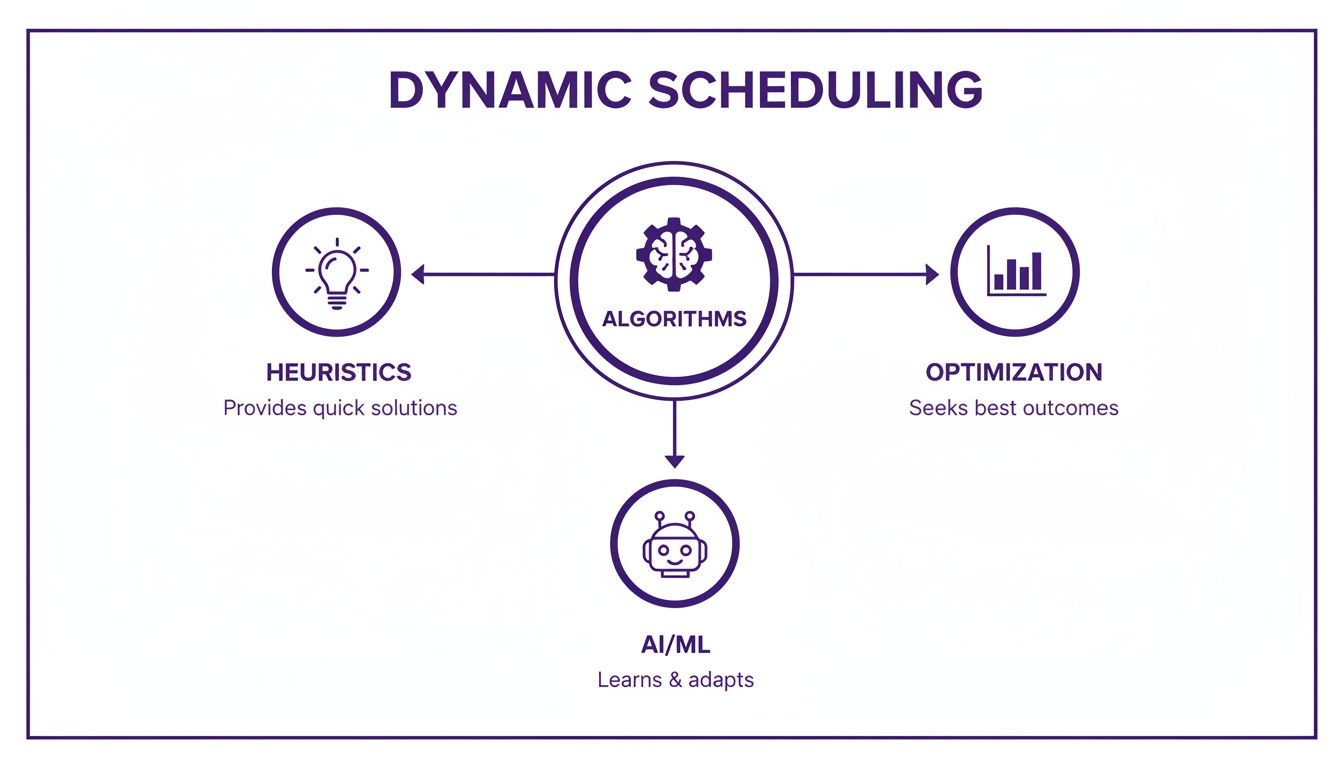
This visual breaks down how different methods—like heuristics, optimization models, and AI—work together to build a complete scheduling solution that can handle real-world complexity.
Healthcare: Proactive Resource Allocation for Critical Care
(Synthetic Example) In a large hospital network, the intensive care unit (ICU) was constantly reacting to emergencies. Critical resources like ventilators and specialized nurses were allocated only after a patient's condition worsened, placing strain on staff.
They implemented a dynamic scheduling model that analyzes continuous data streams from patient monitors and electronic health records. Using predictive analytics, the system can now identify patterns that signal a patient is at high risk of decline, often hours before a crisis. This early warning automatically triggers an alert to reserve an ICU bed, prepare a ventilator, and assign the right nursing staff. This foresight helps ensure the hospital's most critical resources are used effectively.
In each of these cases, the value is clear. Dynamic resource scheduling is not just about efficiency; it is about delivering a quantifiable business outcome.
Getting to Production AI: A Practical Implementation Roadmap

Moving a dynamic resource scheduling system from concept to daily operations requires a structured plan. A quick, iterative approach focused on delivering business results is necessary.
We have refined this process into a six-week roadmap. The timeline is designed to move from initial discovery to a production-ready system quickly, allowing for a faster return on investment. The process starts by solving one core business problem well, creating a solid foundation for future expansion.
Weeks 1-2: Discovery and Architecture Design
The first two weeks are for laying the groundwork. The focus is on identifying the single most critical scheduling bottleneck that, if fixed, would deliver the largest and most immediate impact. We work with stakeholders to define the problem, map current workflows, and identify necessary data sources.
Once the objective is clear, we design a scalable and resilient system architecture built to integrate with the existing tech stack, such as ERP and CRM systems. This architecture-first approach helps avoid common issues like data silos and ensures the new scheduling engine enhances operations rather than disrupting them. The result is a solid blueprint.
Weeks 3-4: Iterative Development and Data Integration
During weeks three and four, the model begins to take shape through fast-paced, iterative development sprints. We start by integrating essential data streams from sources like IoT sensors, sales platforms, or logistics software. Implementing the right AI operations software is crucial for maintaining agility during development.
From there, we build and refine a minimum viable model (MVM). This first version is focused on solving the primary business problem identified during discovery. By concentrating on one specific, high-value use case, we can demonstrate tangible results in weeks, not months.
This cycle of building, testing, and refining allows us to validate the model's performance against actual data and make adjustments on the fly, ensuring the final solution is both accurate and practical.
Weeks 5-6: Production Deployment and Handover
The final two weeks are focused on moving the system into the live environment. This involves more than just deployment. We conduct thorough user training to ensure teams are confident and ready to use the new system effectively.
At the same time, we set up robust monitoring and governance protocols. As detailed in our guide to AI monitoring and portfolio management, continuous oversight is essential for maintaining performance and ensuring compliance. This step helps the scheduling system continue delivering value long after launch.
The roadmap concludes with a complete handover. We provide the full source code and all intellectual property. This gives clients full ownership and control with no vendor lock-in, enabling their teams to manage and evolve the system as the business grows.
Measuring Success: KPIs and Continuous Optimization
Deploying a dynamic scheduling system is the beginning, not the end. To ensure it becomes more effective over time, its real-world impact must be tracked with the right Key Performance Indicators (KPIs).
An effective measurement plan should capture the full operational improvement, looking at a balanced set of metrics that reflect efficiency, service quality, and adaptability.
Defining Your Core KPIs
To get a clear picture of system performance, focus on a few critical areas.
-
Resource Utilization Rate: This is the most direct measure of efficiency. It is the percentage of time that key assets—machinery, vehicles, or specialized staff—are engaged in productive work versus being idle. A 5% to 10% increase here often translates into significant cost savings.
-
Service Level Agreement (SLA) Adherence: For customer-facing businesses, this is a key metric. Track the percentage of jobs, deliveries, or service calls completed within the promised timeframe. A dynamic scheduler should steadily improve this number.
-
Forecast Accuracy: Compare the model's forecasts for demand and resource needs against actual outcomes. Better accuracy leads to less waste and smarter planning.
-
Schedule Agility: This metric measures responsiveness. When an unexpected event occurs—a machine breakdown, a large order—how long does it take the system to generate a new, optimized plan? The shorter the time, the better.
The Power of a Feedback Loop
Dynamic scheduling should not be treated as a one-time task. Creating a continuous feedback loop is essential. Every scheduling decision and its outcome becomes data that feeds back into the system, refining future allocations.
Continuous monitoring turns your scheduling system from a static tool into an adaptive operational brain. It provides the oversight needed to fine-tune performance, maintain compliance, and build long-term trust in the system's decisions.
This adaptive approach drives business value. Studies have shown that companies adept at rapidly reallocating resources can deliver stronger shareholder returns. This agility is why many organizations are replacing rigid annual budgets with rolling forecasts. A recent market analysis explores how dynamic data enables this capability.
A well-monitored system provides the evidence needed to justify further investment and expansion. Our AI assessment framework can help you evaluate your current capabilities.
Navigating the Common Implementation Pitfalls
Implementing a dynamic resource scheduling system can be transformative, but the process has potential challenges. Based on our experience with over 250 production deployments, we have identified common pitfalls that can derail projects. Navigating them requires a clear strategy for data, people, and processes.
Avoiding these issues is key to building a system that teams trust and that delivers long-term value.
Overcoming Poor Data Quality
An effective scheduling algorithm requires high-quality data. Many projects falter because the team underestimates the effort needed to clean and consolidate information from legacy systems.
Inaccurate inventory counts, outdated employee skill records, or delayed vehicle telematics will lead to suboptimal schedules. This not only creates inefficiency but also erodes user trust from the start.
The solution is an architecture-first approach. Before any model code is written, solid data pipelines must be built. This involves creating a single, clean data layer that connects your ERP, HR systems, and IoT sensors. This foundation ensures the scheduling engine receives the accurate, real-time information it needs.
Mitigating Low User Adoption
A common mistake is designing a system that outputs schedules without allowing for human context or expertise. When experienced schedulers, dispatchers, and planners feel their knowledge is ignored, they may resist the new tool. If they do not use it, the ROI is zero.
The solution is to design the system to empower your experts, not replace them.
- Integrate Seamlessly: The interface should feel like a natural part of their daily workflow, not an additional application.
- Provide Explainability: Show users why the system recommended a particular schedule. Transparency builds trust and allows them to combine their intuition with data.
- Allow Human-in-the-Loop Overrides: Give experts the ability to manually adjust schedules to handle exceptions that an algorithm cannot predict.
When you build a system that works with your team, you gain their buy-in. This combines algorithmic precision with human experience, which leads to better results.
Avoiding the "One-Off Project" Trap
Organizations sometimes treat dynamic scheduling as a one-time IT project. They deploy the system and move on. But business conditions are not static. Customer demands change, new regulations emerge, and strategic goals shift. A model that was effective last quarter may be suboptimal today.
A framework for continuous optimization and business alignment is necessary. This means constantly tracking performance against KPIs and having a regular process to retrain and tune the models. The system should be viewed as a living capability that must adapt alongside the business to continue delivering measurable value.
Frequently Asked Questions
It is natural to have questions when considering a fundamental change like dynamic resource scheduling. We often hear from CIOs and CTOs about the technical and strategic implications. Here are straightforward answers to common queries.
How Does Dynamic Scheduling Integrate with Existing Systems?
A modern scheduling system should augment your current technology, not replace it. We use an architecture-first approach with robust APIs and data connectors to pull real-time data from your core platforms like ERPs and HR systems, and then push optimized plans back into your existing workflows.
This approach prevents data silos and maintains a single source of truth for operational decisions, increasing the value of your existing technology investments.
Appointment scheduling software, a specific type of dynamic scheduling, is projected to become a $1.88 billion market by 2033, according to Market Data Forecast. This growth is driven by the need to efficiently manage customer-facing resources—a task that requires data from and integration with CRM and other legacy systems. You can learn more about these market trends and projections here.
What Level of Customization Is Possible?
Every business has unique constraints, from union rules to specific customer SLAs, that an off-the-shelf solution cannot accommodate. We address this by being technology-agnostic, selecting the algorithms that best fit your specific problem.
We avoid long, multi-year projects. Our iterative six-week process is designed to deliver value quickly. We start by building a core model that solves your most significant problem first. Once it delivers results, we can add more advanced features in manageable phases.
How Does This Support Compliance with Regulations?
Compliance must be integrated from the beginning. This means prioritizing rigorous monitoring, explainability, and governance from day one of development.
Our approach embeds these critical features from the start. This provides continuous oversight of model performance and data drift, which is necessary for building reliable AI.
This proactive governance offers the transparency and control needed to operate AI systems responsibly and defend your decisions. It also ensures you are prepared for evolving standards, including regulatory frameworks like the EU AI Act.
Ready to see how a production-grade AI solution can solve your most complex scheduling challenges? DSG.AI delivers measurable business value in just six weeks, with full IP ownership and zero vendor lock-in. Explore our past projects and see what’s possible at https://www.dsg.ai/projects.