
Written by:
Editorial Team
Editorial Team
Enterprise AI solutions are engineered for scalability, reliability, and security. These are production-grade systems designed to integrate into core business operations and deliver measurable results.
Unlike an experimental pilot, a true enterprise solution is built to solve a specific business problem. It might reduce supply chain inefficiencies or predict customer churn with a quantifiable impact on the P&L. It transforms artificial intelligence from a research concept into a core business asset.
What Enterprise AI Solutions Are and Why They Matter Now
Many companies have tested AI through small-scale pilot projects. These experiments are useful for learning but rarely affect key business metrics. A pilot project is like a prototype engine on a test bench—it proves the concept, but you wouldn't use it to power a commercial vehicle.
Enterprise AI is the production-ready engine, installed in the vehicle and moving freight. It’s architected for industrial-strength performance. This means it is built to process large volumes of data, integrate with existing ERP and CRM systems, and operate with high availability. The focus shifts from "can this technology work?" to "how do we deploy this asset to improve a specific business outcome?"
From Experimental Pilots to Production Systems
Moving from a pilot to a production solution is a significant step. A pilot might show that a machine learning model can identify a product defect from an image. An enterprise AI solution integrates that model into the production line, where it processes thousands of images per hour in real-time, automatically sends alerts to quality control teams, and logs data for continuous process improvement.
This is a strategic shift. AI moves from an R&D project to a component of business infrastructure that can generate a return on investment. The development of large language models (LLMs) has accelerated this shift, opening new applications in automation and operational efficiency.
The table below outlines the differences between these two approaches.
Comparing AI Pilots vs. Enterprise AI Solutions
| Attribute | AI Pilot Project | Enterprise AI Solution |
|---|---|---|
| Objective | Prove a concept; test a hypothesis. | Solve a core business problem at scale. |
| Scope | Narrow and isolated; often uses sample data. | Integrated with business processes; uses live production data. |
| Scale | Limited users and data volume. | Designed for thousands of users and terabytes of data. |
| Integration | Minimal or no integration with core systems. | Integrated with ERP, CRM, and other operational platforms. |
| Reliability | Not built for high availability; downtime is acceptable. | Engineered for 99.9%+ uptime and fault tolerance. |
| Security | Basic security measures; not production-hardened. | Enterprise-grade security, access controls, and compliance. |
| Outcome | A report or presentation on findings. | Measurable ROI through efficiency, revenue, or cost savings. |
| Ownership | R&D or an innovation team. | Business units and IT operations. |
A successful pilot is a prerequisite. The business value is realized when the technology is deployed as a reliable solution within daily operations.
The Urgency of Adopting Enterprise AI
The enterprise AI market is growing quickly. Projections show an expansion from $20.93 billion in 2025 to $560.74 billion by 2034, representing a compound annual growth rate of 44.10%.
Large corporations currently hold a 64% revenue share, but smaller companies are adopting these tools at a rapid pace. This data suggests that delaying implementation creates a competitive disadvantage. You can review the full research on the enterprise artificial intelligence market for more detail.
An enterprise AI solution is defined by its ability to reliably execute a business process at scale. It moves AI from the lab into the core operational fabric of the company, where it can directly influence key metrics like cost reduction, efficiency gains, and revenue growth.
This growth is fueled by tangible results. Industry leaders are moving beyond isolated proofs-of-concept to build systems that deliver a clear, measurable return on investment. The question for CIOs is no longer if they should adopt enterprise AI, but how to make it a driver of operational excellence and strategic advantage.
Designing a Scalable Architecture for Enterprise AI
Building an enterprise AI solution begins with architecture, not algorithms. A well-designed technical foundation separates a temporary proof-of-concept from a business asset that delivers long-term value.
This is like designing a factory. You would first design the assembly line—planning how raw materials (data) arrive, where they're processed (model training), and how finished goods are inspected and shipped (inference). This blueprint ensures all components work together and allows for future upgrades without redesigning the entire system.
The same logic applies to AI. A well-designed architecture handles growing data volumes and integrates with existing tools like ERP and CRM systems. It prevents vendor lock-in and ensures the system can evolve with the business.
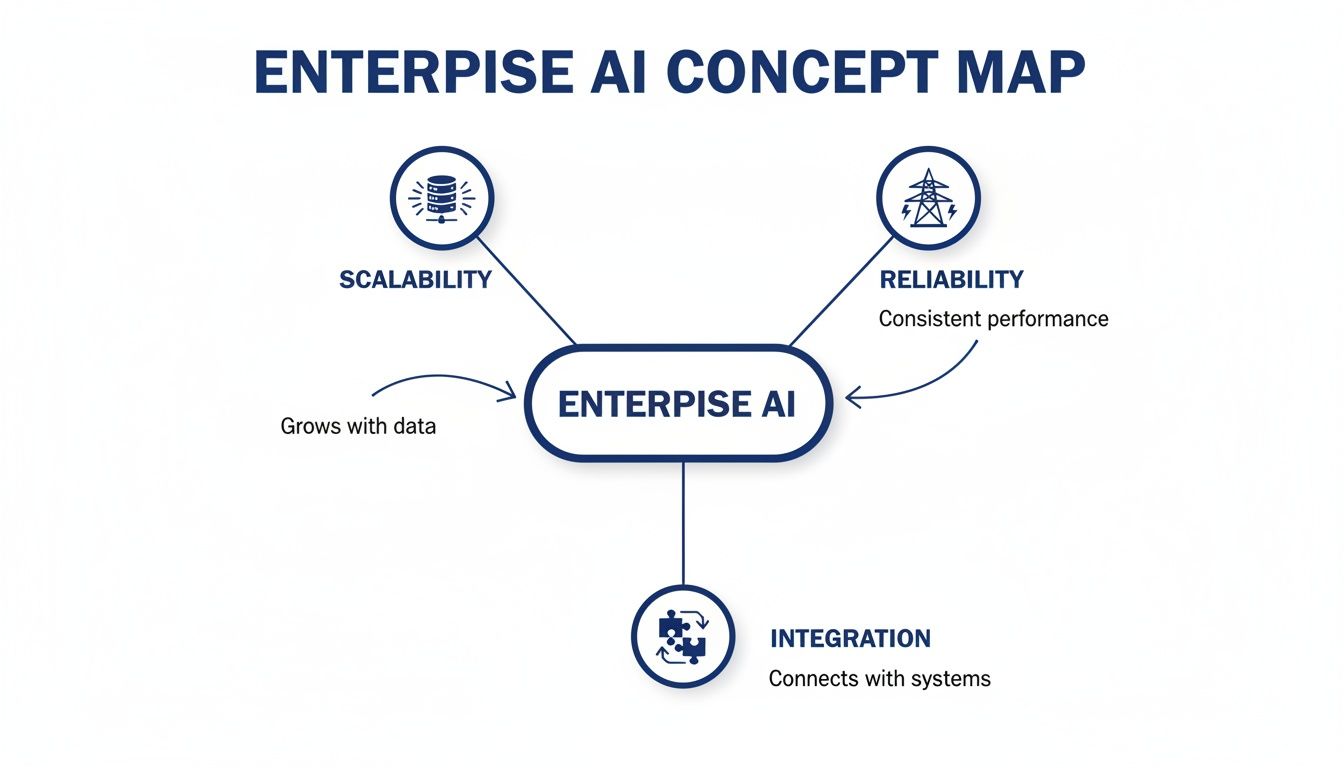
As the visual shows, enterprise AI requires a balance between scalability, reliability for critical operations, and deep integration with the existing technology stack.
Core Architectural Components
Any scalable AI system is built from a few fundamental components. Understanding these functional roles is the first step toward building a durable solution.
- Data Ingestion Pipelines: These channels feed data into the AI system from sources like internal databases, real-time streams, or third-party APIs. They must handle high volumes while cleaning and preparing the data for use.
- Model Training Environments: This is where AI models learn from data. These environments require significant computational power and must be configured to retrain models automatically as new data becomes available to prevent performance degradation.
- Inference Engines: The inference engine applies the trained model to live data, generating predictions or decisions in real-time. These outputs are then served to users or other business systems.
- Monitoring and Management Systems: This component tracks model performance, system uptime, and data drift that could affect accuracy. Continuous oversight ensures the solution remains reliable and effective.
For a modern AI architecture dealing with unstructured data, an understanding of the underlying data infrastructure is important. For instance, knowing what a vector database is is becoming necessary for managing complex data relationships at an enterprise scale.
From Brittle to Resilient: A Synthetic Scenario
Let's consider a synthetic example. A logistics company needs an AI system to classify 100,000 incoming emails per day and route them to the correct department—billing, tracking, or support. The system must maintain 99.9% uptime.
A monolithic application would create a single point of failure. If the connection to the email server fails or the model crashes, the entire system stops. Updating such a system without causing downtime is difficult.
A resilient, microservices-based architecture breaks the problem into smaller, independent services. One service fetches emails, another classifies them using an AI model, and a third routes them. If the classification service needs an update, the other services continue running, creating a highly available and easily maintainable system.
This modular design is a characteristic of modern enterprise AI. It helps achieve the required 99.9% uptime and allows individual components to be scaled or improved independently. If email volume increases, only the email-fetching service needs to be scaled.
This architectural approach elevates an AI project from a fragile experiment to a production-grade asset.
The Six-Week Roadmap to AI Implementation
Deploying a new enterprise AI solution does not require a multi-year project. With a focused, time-boxed approach, a business concept can become an operational asset in six weeks. This roadmap provides a structured framework for getting an AI solution into production quickly.
This methodology helps close the gap between AI adoption and operationalization. While 93% of companies use AI in some capacity, only 34% are using it to reinvent business processes, according to a 2024 Vention report. A larger group, 37%, is still in the early stages of exploration. You can read the full report on the state of AI in the enterprise. A rapid, results-driven implementation can help an organization advance its AI maturity.

The process depends on clear deliverables, consistent communication, and a focus on solving one specific, high-value business problem at a time.
Week 1: Discovery and Scoping
The first week establishes the foundation for the project. The goal is to define a precise, measurable business objective.
Key activities for this week include:
- Problem Definition Workshop: Involve stakeholders to identify the exact operational bottleneck the AI will solve.
- KPI Alignment: Define the single metric that will measure success. Move from general goals like "improve efficiency" to specific targets.
- Data Assessment: Identify and evaluate necessary data sources for accessibility, quality, and volume.
Synthetic Example: A maritime shipping company wants to reduce operational costs. After the discovery week, their objective is: "Achieve an 8 to 12 percent reduction in maritime fuel consumption versus the Q3 baseline by optimizing vessel routes based on real-time weather and cargo data."
Weeks 2-3: Iterative Development
With a clear target, the next two weeks focus on building the AI model through rapid, iterative sprints. This is not a "black box" process. The goal is to build a working prototype quickly and refine it based on continuous feedback from the business team.
This agile approach keeps the solution aligned with business needs. The business team works with the development partner, providing visibility into the process. This collaboration ensures the model is trained to solve real-world operational complexities.
Week 4: Integration and Testing
An AI model is only valuable when integrated into business workflows. Week four is dedicated to integrating the solution with core systems—ERP, CRM, or other operational platforms—and conducting thorough testing.
This stage involves:
- API Development: Build the interfaces that allow the AI to exchange data with other software.
- End-to-End Testing: Run simulations of real-world scenarios to ensure the entire system functions correctly.
- User Acceptance Testing (UAT): Involve frontline users to confirm the tool is practical and effective for their daily work.
Weeks 5-6: Deployment and Optimization
In week five, the solution goes live. The deployment is managed to avoid disrupting daily operations. This includes a formal handover, where the internal team is trained on how to use and manage the new system. A good partnership ensures the client receives the full source code and retains 100% of the intellectual property.
The final week is for monitoring the live solution and making initial optimizations. We track the KPIs against the baseline established in week one. This period confirms the solution is delivering the expected business value and sets the stage for continuous improvement.
Navigating AI Governance and Regulatory Compliance
Integrating AI into the enterprise introduces new responsibilities. A poorly governed AI system can create reputational, operational, and legal risks. A governance framework is the foundation for building trust and ensuring the long-term viability of AI initiatives.
The cornerstone of modern AI governance is Responsible AI. This is a business discipline built on three pillars. For an AI solution to deliver sustainable value, it must be engineered with these principles.

The Core Pillars of Responsible AI
Responsible AI is a proactive approach to risk management. It involves designing systems that operate safely and reflect company values.
- Fairness: The system's outputs must be free from discrimination. This requires actively identifying and mitigating biases in training data and model logic that could disadvantage any group.
- Transparency: You must be able to explain how the AI reaches its conclusions. This concept, known as explainability, requires clear documentation and the ability to articulate the reasoning behind an outcome.
- Accountability: Clear lines of responsibility must be established for the AI's performance and behavior throughout its lifecycle, from development to decommissioning.
These principles provide the "why" of AI governance. The "how" is increasingly defined by global regulations that are turning these best practices into legal requirements.
Cracking the Code of the EU AI Act
The EU AI Act is a significant regulation setting a global benchmark for AI management. The Act uses a risk-based approach: the higher the potential for harm, the stricter the rules.
The EU AI Act may apply to companies outside of Europe. If your company provides or uses AI that affects anyone in the EU, the regulation is relevant. Understanding its risk tiers is a critical task for any global enterprise.
For a detailed breakdown of the steps required for compliance, our guide on preparing for the EU AI Act is a useful resource.
How the Risk Tiers Play Out in the Real World
The EU AI Act’s risk-based approach categorizes AI systems to determine the required level of scrutiny. This framework helps enterprises focus governance efforts where they are most needed.
| EU AI Act Risk Tiers and Enterprise Implications | ||
|---|---|---|
| Risk Level | Example Use Case | Key Compliance Requirement |
| Unacceptable Risk | Government-run social scoring, real-time biometric surveillance in public spaces. | Banned. These systems are prohibited in the EU with very few exceptions. |
| High Risk | AI in critical infrastructure, credit scoring, hiring, and medical device diagnostics. | Strict Obligations. Requires rigorous data governance, conformity assessments, human oversight, and detailed technical documentation. |
| Limited Risk | Chatbots, AI-generated content (deepfakes). | Transparency Obligations. Users must be clearly informed that they are interacting with an AI system or that content is AI-generated. |
| Minimal Risk | AI-enabled video games, spam filters. | No specific obligations. These systems are considered low-impact, though voluntary codes of conduct are encouraged. |
This tiered system provides a clear roadmap for compliance, allowing for innovation while managing regulatory exposure.
High-Risk AI: A Practical Example
Let's consider a bank that implements an AI system to make instant decisions on loan applications. Under the EU AI Act, this is a 'high-risk' system because its decisions can significantly affect an individual's financial situation.
To comply, the bank must:
- Implement Strong Data Governance: The data used to train the model must be meticulously documented, checked for bias, and verified as high-quality and relevant.
- Maintain Comprehensive Technical Documentation: The bank must keep detailed records of how the system was built, its operational logic, and its known limitations for regulatory review.
- Ensure Mandatory Human Oversight: The AI cannot operate with total autonomy. A clear process must exist for a human to review the AI's decisions and override them when necessary, particularly for appeals or borderline cases.
To manage compliance across multiple AI models, enterprises are adopting Governance, Risk, and Compliance (GRC) platforms. These systems help automate compliance checks, monitor for model drift or bias, and provide a central dashboard for overseeing AI risk.
Choosing the Right Partner for Your AI Initiative
Selecting an AI partner is a critical decision. It is not just about buying software; it is about finding a collaborator who can support innovation, manage costs, and maintain your company's independence.
Many providers can create a compelling demo, but it is important to look for a documented history of deploying complex AI systems into production. Vague promises are a red flag. Look for concrete proof, such as a portfolio of over 250+ production deployments, which demonstrates experience with the practical challenges of integration, scale, and long-term support.
Key Evaluation Criteria
When vetting potential partners, focus on three core areas. These questions address their business model and technical philosophy.
- Real-World Experience: Have they deployed solutions at an enterprise scale in your industry or a similar one? Ask for case studies with specific numbers and measurable results.
- Technological Philosophy: Are they selling a proprietary, all-in-one platform, or are they technology-agnostic? An agnostic partner will select the right tools for your specific problem, not just the ones they offer.
- Business Model: Is their primary goal to license a black-box product or to build a custom solution with your team? A partnership model focuses on transferring knowledge and building capabilities within your organization.
Why IP Ownership Is Non-Negotiable
One of the most important contract terms is intellectual property (IP) ownership. For long-term flexibility and cost control, you must insist on 100% ownership of the IP and the complete source code from the project's start.
Without full ownership, you are effectively renting a core business capability. This creates vendor lock-in, limiting your ability to modify, enhance, or move the solution to a different provider without incurring significant costs or starting over.
This is a fundamental economic decision. When you own the code, you control the asset. You can bring maintenance in-house, switch cloud providers, or hire a different firm for future upgrades without being dependent on the original developer.
Questions to Ask Potential Partners
Before signing a contract, ask direct questions. Their answers will reveal their transparency and intentions.
- IP and Source Code: Will we receive 100% of the intellectual property and all source code at the end of the project, with no licensing fees?
- Pricing Model: Can you provide a transparent breakdown of all costs—development, integration, and ongoing support? Are there any hidden fees or variable costs tied to data volume or usage?
- Model Use Restrictions: Are there any contractual limits on how we can use, modify, or retrain the models you develop for us?
- Exit Strategy: What is the process if we decide to manage this system internally or move to another partner? What support will you provide during that transition?
Be aware of red flags like opaque pricing, restrictions on model use, or reluctance to hand over full IP ownership. The objective is to find a partner who will build a solution that you own completely.
Measuring the True ROI of Your Enterprise AI
To maintain executive support and secure future funding, every AI solution must demonstrate its financial value. Measuring the return on investment (ROI) is about quantifying business impact in a disciplined way.
The method involves defining and tracking key performance indicators (KPIs) that connect directly to business operations. This requires specific, measurable targets. Without this clarity, building a strong business case and proving the investment's value is not possible.
Establishing the Pre-AI Baseline
The most important step in measuring ROI occurs before the project begins: establishing a baseline. You cannot demonstrate improvement without a precise measurement of the starting point. This baseline is the standard against which all future performance is measured.
For example, if the goal is to reduce waste in manufacturing, you need the exact scrap rate from the previous quarter. If the goal is to improve agricultural forecasts, you must document the accuracy of existing models.
This pre-implementation data is essential. A clear baseline—such as "Our Q2 scrap rate was 11.4%" or "Last year's forecast accuracy was 78%"—is the only way to prove that the AI solution delivered a tangible improvement, like an 8 to 15 percent reduction in scrap.
Defining Financial and Operational KPIs
A comprehensive ROI calculation considers both direct financial gains and operational improvements. The two are often linked; increased efficiency usually leads to cost savings.
Financial Metrics (Direct ROI):
- Cost Savings: Calculate the reduction in operational spending in dollars. This could include lower fuel consumption, less material waste, or fewer hours spent on manual data entry.
- Revenue Lift: Identify the increase in top-line revenue generated by the AI. For example, improved sales forecasting leading to better inventory management and fewer stockouts.
Operational Metrics (Indirect ROI):
- Process Efficiency: Track improvements such as shorter cycle times, faster email triage and classification, or higher production output per hour.
- Error Rate Reduction: Monitor the decrease in human errors, product defects, or compliance issues.
This focus on measurable results is driving growth in the market. The enterprise AI platform market, valued at $13 billion, is projected to reach $50.3 billion by 2030, with a 27.7% CAGR, according to a 2024 Verdantix report. This growth is occurring because 63% of organizations report benefits like cost reductions and revenue growth from their AI projects. You can find more data on the growth of the enterprise AI platform market.
By concentrating on these hard numbers, the conversation shifts from technology to business outcomes. To identify high-impact opportunities in your operations, you can get started with an AI assessment to pinpoint where to begin. This methodical approach ensures your enterprise AI solutions deliver and prove their value.
Common Questions from the Field
A few key questions often arise during the decision-making process. Here are some of the most common ones from technology leaders.
How Do We Get an AI Solution to Talk to Our Legacy Systems?
The goal is to avoid a major, disruptive overhaul. An architecture-first approach using APIs and microservices is effective. The AI solution is a collection of smaller, specialized components, not a single monolithic application.
These components connect to existing ERP, CRM, and data warehouses through well-defined interfaces. This allows for a phased rollout. You can connect the AI to a single data source first, demonstrate a quick win, and then expand its integration without altering core infrastructure.
What’s the Biggest “Hidden Cost” We Should Plan For?
Ongoing data management and model maintenance are the most significant hidden costs. Building the solution is the first step; keeping it performing optimally is the long-term work. This requires budgeting for data pipeline maintenance, model retraining as conditions change, and continuous accuracy monitoring.
A good partner will include this "Total Cost of Ownership" in the initial plan, providing a realistic budget for maintaining the solution's value over time.
Can We Dip Our Toes in the Water, or Do We Need to Go All-In from the Start?
You can start small. The strategy is to select a single, high-impact business problem with a clear, measurable return and solve it quickly. A focused project, like the six-week roadmap outlined earlier, is ideal for building confidence and demonstrating value promptly.
This approach provides a tangible win and proves the concept in a real-world setting. That success makes it easier to gain the buy-in needed for more ambitious AI projects in the future.
Ready to put this theory into practice? The team at DSG.AI specializes in building production-grade AI solutions that deliver measurable business value in weeks, not years. See our work.