
Written by:
Editorial Team
Editorial Team
To automate business processes effectively, you must see it as a core business strategy, not just a cost-cutting tactic. The process involves identifying high-impact opportunities, selecting the right tools—whether RPA, BPM, or AI—and building an architecture that can scale. This is how automation builds genuine resilience and a competitive edge, rather than just small, tactical efficiencies.
Why Business Process Automation Is a Strategic Imperative

For enterprise leaders, business process automation is no longer an item on the IT department's project list. We have moved past viewing it as a simple tool for reducing operational expenses. It is now a fundamental strategy for building a more durable and competitive company.
The entire conversation has changed. Businesses are dealing with market volatility, unstable supply chains, and high customer expectations. Manual processes cannot keep up. Automation allows a business to react to these pressures with speed and precision.
From Tactical Fixes to Foundational Strategy
If you still think of automation as a series of one-off fixes, such as automating a single data entry task, you are missing the larger opportunity. The strategic value emerges when you take an architecture-first approach. This means designing automation not as a collection of isolated bots, but as integrated parts of a larger, intelligent system.
A well-designed automation architecture acts as a force multiplier. It is the difference between automating one repetitive task and orchestrating complex, end-to-end workflows that span multiple departments and systems. That is how you create durable value that compounds over time.
This foundational thinking prevents you from creating a patchwork of brittle, siloed automations that are difficult to maintain and impossible to scale. For a closer look at this concept, exploring the strategic impact of Artificial Intelligence on business transformation offers relevant context. It ensures every new automation project builds on the last, strengthening a cohesive and adaptable operational backbone for your organization.
The Growing Momentum Behind Automation
The strategic importance of automation is evident in its market growth and adoption rates. The global business process automation market reached approximately USD 10.09 billion in 2023 and is projected to reach USD 23.9 billion by 2029. With nearly six in ten companies already implementing some form of automation, the message for leaders is clear: adopt automation or fall behind.
This is not just about keeping pace; it is about setting the pace. The enterprises that implement automation correctly are seeing significant, measurable results:
- Increased Operational Agility: They can adapt workflows quickly to shifting market conditions without needing a massive manual overhaul.
- Enhanced Decision-Making: When your experts are freed from repetitive tasks, they can focus their skills on high-value analysis and strategic planning.
- Improved Compliance and Reduced Risk: Automated processes are consistent. They follow regulatory standards every time and leave a clear audit trail.
Ultimately, learning how to automate business processes is less about the technology and more about building an organization that can thrive in a world of constant change.
How to Identify High-Impact Automation Opportunities
Figuring out where to start with automation can be overwhelming. The key is to avoid pursuing low-impact projects that become expensive experiments. Your goal should not be just to automate something; it is to automate the right thing. This requires a practical, structured method to identify and prioritize the processes that will deliver the most significant return.
Without a disciplined approach, many companies fall into the trap of selecting scattered, one-off opportunities. A better method is to build a data-driven roadmap that starts by examining your current operations to find the processes most suitable for change.
Building Your Prioritization Matrix
A simple prioritization matrix is an effective tool for this task. It removes guesswork and requires you to score potential projects against a consistent set of criteria, moving you from subjective feelings to objective analysis.
The idea is to score each potential automation candidate on a simple scale (e.g., 1 to 5) across a few critical dimensions. I recommend starting with these four:
- Manual Effort: How many hours are people spending on this process each week or month? Processes that consume a significant amount of manual hours are often prime targets.
- Error Frequency: How often do mistakes occur? If human error causes rework, customer complaints, or compliance issues, automation's consistency can deliver a quick win.
- Strategic Value: Does this process directly impact revenue, customer satisfaction, or a competitive advantage? Automating these processes amplifies their positive business impact.
- Implementation Complexity: What is the technical effort, cost, and time required to complete this? A lower complexity score is beneficial for an initial project to build momentum.
By scoring each process, you will create a ranked list that clearly indicates where your team should focus first. This makes building the business case and aligning stakeholders much easier.
From Theory to Real-World Application
When you apply this matrix, you will uncover opportunities in unexpected areas. Let's examine a couple of common scenarios to see how this works.
Synthetic Example 1: A Logistics Company with High Email Volume Imagine a global logistics firm where a team of ten coordinators spends their entire day manually reading, sorting, and routing thousands of inbound emails for quotes, tracking, and customs documents.
- Manual Effort: Extremely high. This accounts for 300-400 person-hours each week just to manage an inbox.
- Error Frequency: Moderate, but impactful. A misrouted email leads to an average delay of 4-6 hours, which directly affects customer satisfaction.
- Strategic Value: High. In logistics, faster response times are a significant competitive differentiator.
- Implementation Complexity: Low-to-moderate. An AI agent can be trained relatively quickly to classify email intent and extract key data.
This process scores very high on all important metrics. It is an ideal candidate for automation.
The most successful automation roadmaps are built with deep input from the people who perform these processes daily. They understand the pain points that a spreadsheet cannot capture.
Engaging Business Stakeholders for Deeper Insights
While a data-driven matrix provides a good starting point, the numbers alone are not enough. You must talk to department heads and the front-line employees doing the work. These conversations will uncover nuances, hidden frustrations, and the team's readiness for change. To ensure you are asking the right questions, you may want to review our guide to help you assess AI readiness and organizational maturity.
Set up workshops with the process owners and have them walk you through their workflows, step by step. Ask direct questions to get to the core of the issue:
- Which tasks are the most tedious or frustrating for your team?
- Where are the biggest bottlenecks?
- If you had an extra 10 hours a week, what high-value work would you be able to do?
These discussions ensure that the chosen processes are not only technically sound but are also ones the business is eager to improve. For example, you might discover that while finance has a high-volume manual process, they are also in the middle of an ERP upgrade and cannot take on another project. Instead, operations might be struggling with inefficient vendor management best practices and be ready for a solution.
This holistic view, combining hard data with human experience, is the most reliable way to build an automation roadmap that delivers real, lasting value.
Choosing the Right Automation Technology
Once you have identified your top automation opportunities, you must select the right tools. The market is filled with acronyms—RPA, BPM, AI—and making the wrong choice can stall a project, reduce its value, or result in a brittle solution that is difficult to maintain.
The solution is not to find one "best" technology. It is about building a blended, problem-focused strategy. You must understand what each tool was designed for and match it to the specific process you are trying to improve. Think of it like a mechanic's toolbox; you would not use a wrench when you need a screwdriver.
To find high-impact opportunities, it is useful to score them based on the manual effort they require, their frequency, and their strategic value.
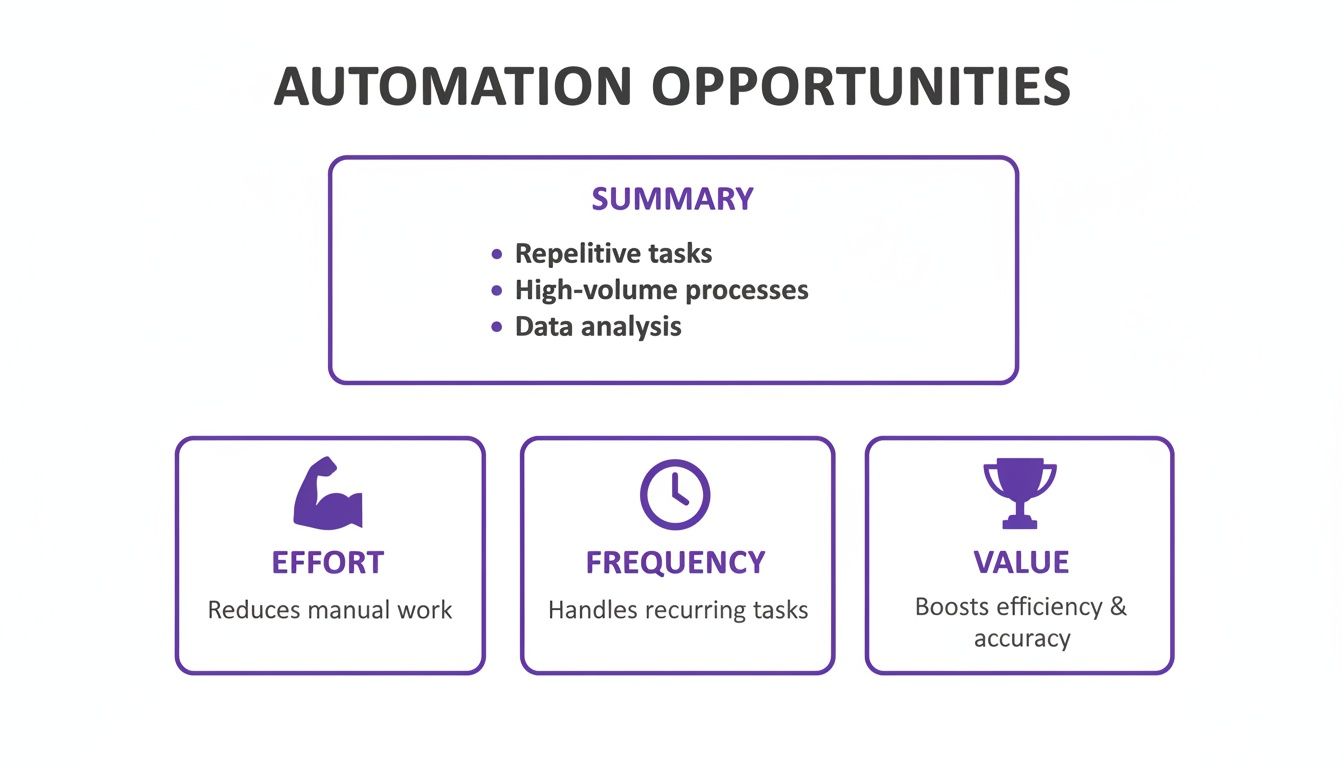
This visual shows that the best candidates for automation are not just the tedious ones, but those that are frequent, time-consuming, and strategically important.
Robotic Process Automation for Repetitive Tasks
Robotic Process Automation (RPA) is a digital workhorse. It is ideal for high-volume, rules-based tasks that do not require human thinking. Essentially, it is software that mimics what a person does on a computer—clicking, copying, and pasting data between systems.
A classic use case is integrating with legacy systems. Imagine you have an old mainframe with no API. An RPA bot can log in, scrape data from the screen, and input it into a modern web application. It is a fast, pragmatic way to bridge technology gaps without starting a massive development project.
However, RPA has a significant weakness: its reliance on stable user interfaces. If a developer moves a button on a website or renames a field, the bot will break. It requires maintenance to keep up with changes.
Business Process Management for Complex Workflows
While RPA handles a single task, Business Process Management (BPM) software orchestrates entire, end-to-end workflows. These are the complex processes that cross multiple departments and systems, like employee onboarding or insurance claims processing.
BPM platforms provide tools to visually map a process, set business rules, assign tasks to people, and connect with different applications. They give you a high-level view of the entire workflow, making it easy to spot bottlenecks and ensure everything happens in the correct order. To see how this fits into a larger strategy, you can explore the principles of enterprise AI orchestration.
The key difference is scope. RPA is about doing a specific task faster. BPM is about ensuring an entire multi-step process runs smoothly and efficiently from start to finish.
AI Agents for Cognitive Work
This is where automation becomes intelligent. AI-powered agents use machine learning (ML) and natural language processing (NLP) to perform tasks that require cognitive skills—such as understanding context, making judgments, and learning from new information.
An RPA bot follows rigid rules, but an AI agent can read an unstructured email from a customer, determine their intent and sentiment, and decide whether to route it to sales, support, or billing. This type of judgment is beyond what a rules-based system can do.
The growth in this area is significant. According to a 2023 Grand View Research report, the machine learning segment of the intelligent automation market is projected to grow at a 22.6% compound annual growth rate through 2030. This reflects a real shift, with a 2022 IBM survey finding that 56% of businesses were already using AI to improve their operations.
A Practical Comparison for Leaders
Deciding between these technologies depends on the problem you are trying to solve. The most effective enterprise strategies often use all three together. For example, an RPA bot could pull data from an invoice PDF, an AI agent could validate it against a purchase order and flag discrepancies, and a BPM platform could manage the approval workflow for any exceptions.
This quick comparison guide can help clarify the decision.
Automation Technology Comparison for Enterprise Leaders
This table compares the primary use cases, complexity, and strategic value of RPA, BPM, and AI-powered agents to help leaders select the right technology for their business needs.
| Technology | Primary Use Case | Best For | Implementation Complexity | Scalability |
|---|---|---|---|---|
| RPA | Automating discrete, repetitive tasks | High-volume, structured data entry; legacy system integration | Low to Moderate | Task-level; can be brittle if UI changes |
| BPM | Orchestrating complex, multi-step business processes | End-to-end workflows like claims processing or onboarding | Moderate to High | Process-level; highly scalable for core operations |
| AI Agents | Handling tasks that require judgment and interpretation | Unstructured data analysis; customer service routing; decision support | High | Function-level; scales by learning and improving over time |
A technology-agnostic approach that starts with the business problem will consistently deliver the best results. By understanding the distinct strengths of RPA, BPM, and AI, you can build a powerful, scalable automation engine that delivers a measurable return on investment.
Designing a Scalable Automation Architecture

Many automation programs stall in "pilot purgatory" because they were built as isolated experiments, not as foundational components of a larger strategy. To achieve enterprise-wide scale, you must start with the architecture. This means designing the blueprint for growth before you write any automation code.
Without this plan, you create a collection of brittle, siloed bots. These one-off solutions quickly become a source of technical debt. They are difficult to maintain and do not integrate with other systems. A scalable architecture ensures your automated processes can adapt and grow with your business.
Core Principles for Scalable Automation
A robust architecture is built on a few key principles that promote flexibility and resilience. Establishing these from the start prevents future limitations. Think of them as the structural beams that support long-term, enterprise-wide automation.
- Modularity: Design your automations as independent, reusable components. Instead of building one large, monolithic process, create smaller modules that each handle a specific job, like an "extract invoice data" module or a "verify customer address" service.
- API-Led Integration: Make Application Programming Interfaces (APIs) the standard for how your automations communicate with other systems. This creates a clean, documented, and secure way to exchange data that is far more reliable than fragile methods like screen scraping.
- Loose Coupling: Ensure your automated components are not tightly dependent on each other. A loosely coupled system allows you to update or replace one part of a process—say, upgrading your CRM—without breaking the entire workflow.
When you adhere to these principles, you can add, remove, or modify automated processes with minimal disruption. It is the difference between a rigid structure that breaks under pressure and a flexible one that adapts.
An architecture-first approach is about future-proofing your investment. You are not just solving today's problem; you are building the capacity to solve tomorrow's problems more efficiently. This mindset separates isolated wins from systemic business improvement.
Building a Phased Implementation Roadmap
Once you have a solid architectural foundation, the next step is to map out a realistic implementation plan. Start small, prove value quickly, and then scale out methodically. This approach builds momentum and gains stakeholder support at each stage.
A common and effective path looks like this:
- Develop a Minimum Viable Product (MVP): Select one high-impact, relatively low-complexity process from your priority list. The goal is to achieve a tangible win within 60 to 90 days. This proves the technology works and demonstrates real-world business value.
- Refine and Expand: Use the learnings from the MVP to improve the initial automation. Then, identify adjacent processes that can connect to it. This is where modularity pays off; you can plug in new components that build on the first one.
- Establish a Center of Excellence (CoE): As your program grows, formalize your approach by creating a CoE. This cross-functional team will set standards, develop reusable assets, and provide the governance needed to ensure consistency and quality across all automation projects.
- Scale Across the Enterprise: With a series of proven successes, a solid architecture, and established governance, you are ready to scale. You can now confidently roll out automation across different departments and business units, reimagining core operational workflows.
This phased approach significantly lowers risk while building confidence. Each successful phase provides the business case—and the technical foundation—for the next level of investment.
A Synthetic Example From Logistics
Let's illustrate how this works with a synthetic example from a logistics company. Their most immediate problem is a team spending 400 person-hours a week manually classifying inbound emails.
An architecture-first roadmap for how to automate this business process would look like this:
- Phase 1 (MVP): Build a modular AI agent that performs one task: classify incoming emails into categories like "Quote Request," "Shipment Status," or "Customs Inquiry." This agent connects to the email server through an API. The immediate ROI is a 75-85% reduction in manual sorting time, freeing up the team for higher-value customer conversations.
- Phase 2 (Expansion): Next, add a second module that extracts key data (like tracking numbers or customer IDs) from those classified emails. This data is then passed via an API to the company's Transportation Management System (TMS), automatically creating or updating records. This eliminates copy-pasting.
- Phase 3 (Scaling): With email and data entry handled, the architecture can be extended further. New modules are built to automate quote generation, proactively send shipment status updates, and flag customs documents that require urgent human attention.
What started as a simple email classifier has now become the foundation for a comprehensive, automated supply chain communications platform. This demonstrates the power of designing for scale from day one. It turns a tactical fix into a strategic asset that delivers compounding value.
Implementing Strong Governance and Measuring Real-World ROI
Starting automation without a clear governance framework can lead to problems. It is like building a high-speed factory with no safety protocols. The initial momentum is positive, but the risk of errors, compliance issues, and operational chaos increases with every new bot deployed. To move beyond a few isolated wins and build a sustainable, enterprise-wide program, you need solid guardrails and a method for measuring what matters.
This is not just about avoiding mistakes. It is about building trust in the technology and proving the long-term value of your investment. Good governance delivers consistency and security, while a mature approach to Return on Investment (ROI) captures the full business impact, justifying the resources needed to scale.
The Case for an Automation Center of Excellence
Once your automation footprint expands beyond a few pilot projects, a centralized Center of Excellence (CoE) is essential. A CoE acts as the cross-functional control center for your entire automation program. This team is responsible for setting the standards, policies, and best practices that guide all automation efforts. Their main job is to ensure every project is built securely, efficiently, and in alignment with business objectives.
An effective CoE handles several critical functions:
- Defining Roles and Responsibilities: It clarifies who owns the automation strategy, who builds the solutions, and which business leaders are accountable for process outcomes.
- Managing the Automation Pipeline: It acts as a gatekeeper, vetting and prioritizing new automation ideas based on the strategic matrix discussed earlier.
- Developing Reusable Assets: The CoE builds a library of common automation components, code snippets, and templates. This accelerates future development and prevents teams from duplicating efforts.
- Overseeing Change Management: They work directly with business units to prepare teams for new automated workflows, addressing concerns and ensuring a smooth transition.
A well-run CoE is the best defense against the chaotic, unmanaged spread of "shadow automation" projects. It provides the structure needed to scale responsibly.
Responsible AI and GRC in the Automation Era
When AI and machine learning are involved, the need for governance becomes even more critical. AI models are not static code; they can drift, develop biases, or make unanticipated decisions. This introduces a new layer of risk that requires a dedicated Governance, Risk, and Compliance (GRC) framework specifically for AI.
Your Responsible AI GRC program should cover a few key areas:
- Continuous Model Monitoring: You must actively watch how your AI models perform in the real world to detect performance decay or data drift. For instance, a model trained to classify logistics emails might see its accuracy drop from 95% to 70% if a new type of customer inquiry becomes common.
- Fairness and Bias Audits: Regularly test your models to ensure they are not producing discriminatory outcomes. This involves analyzing model decisions across different customer segments or demographics to identify and fix unintended biases.
- Regulatory Preparedness: Keeping up with new regulations is essential. With new rules on the horizon, understanding your obligations is critical. For a detailed guide, our article offers key insights on how to achieve EU AI Act readiness.
Strong AI governance is not just a compliance exercise for the legal team. It is about preserving the integrity and trustworthiness of your automated decisions, which is fundamental to protecting your brand and maintaining customer confidence.
Measuring the Total Return on Investment
To maintain momentum, you must measure ROI in a way that captures the attention of the C-suite. A common mistake is focusing only on direct cost savings from reduced headcount. While that is part of the story, it is a narrow view that misses the broader impact.
A holistic ROI calculation for business process automation should also quantify the "soft" benefits that are strategically vital.
| Metric Category | Example Metric | Measurement Method |
|---|---|---|
| Operational Efficiency | Reduction in invoice processing time | Baseline: 4.5 days. Post-automation: 1.2 days. Result: 73% improvement. |
| Customer Satisfaction | Improvement in Net Promoter Score (NPS) | Pre-automation NPS: 35. Post-automation NPS: 42. Correlate with faster issue resolution. |
| Compliance & Risk | Reduction in audit exceptions | Baseline: 8-10 exceptions per quarter. Post-automation: 1-2 exceptions. |
| Employee Engagement | Decrease in employee turnover for affected roles | Survey data showing a 15% increase in satisfaction for roles augmented by automation. |
When you can build a business case that includes stronger customer loyalty, lower compliance risk, and better employee retention, you are presenting the full picture of automation's strategic value. This is the comprehensive story you need to tell to manage, optimize, and scale your initiatives for long-term success.
Common Questions About Business Process Automation (and Straightforward Answers)
As you move from strategy to implementation, practical questions will arise. Knowing how to automate processes effectively means anticipating common roadblocks and understanding how to navigate them. Here are some of the most frequent questions from enterprise leaders and direct answers based on practical experience.
How Do We Pick the Right First Process to Automate?
Start with a process that is high-volume, repetitive, and strictly follows a set of rules. These are the tasks that consume your team's time and are prone to human error, making them ideal candidates for a quick, visible win.
Look for opportunities in departments like finance (invoice processing), HR (employee onboarding), or operations (data entry). Your first project should be something you can launch that delivers a clear, measurable result within 90 days. This is how you build momentum and get the business excited about the possibilities.
To remove guesswork, create a simple scoring model. Weigh factors like the potential ROI, implementation complexity, and its direct business impact. This approach shifts the decision from intuition to data-backed analysis.
What’s the Real Difference Between Automation and AI?
These terms are often used interchangeably, but they are fundamentally different—though they are powerful when combined.
Automation is about execution. It follows a pre-defined script to complete a task. An example is an RPA bot that copies data from a spreadsheet and pastes it into a CRM. It does exactly what it is told, every time.
AI, on the other hand, is about judgment. Machine learning models can learn from historical data to make predictions or decisions. An example is an AI agent that can read a customer support email, understand the sentiment and intent, and then decide which department should handle it.
In short, automation does what you tell it to do. AI decides what to do based on what it has learned. The most sophisticated solutions use AI for the "thinking" and automation for the "doing."
How Do We Keep Our Automation Projects From Getting Stuck in Pilot Purgatory?
To avoid "pilot purgatory," treat your first project as a business initiative, not just a tech experiment. The single most important step is to secure an executive sponsor from the start. Their involvement signals that this is a priority.
Next, define success metrics that matter to the business, not just the IT team. Instead of a vague goal like "deploy the bot by Q3," aim for something tangible like, "cut invoice processing time by 40%."
Finally, think about architecture from day one. Do not build a throwaway proof-of-concept. Design your initial solution with the understanding that it will eventually need to scale and integrate with broader systems. This requires more upfront work but prevents significant problems later.
What Kind of Team Do I Actually Need to Make This Happen?
You cannot just delegate this to the IT department. A successful automation program needs a cross-functional team that combines deep business knowledge with technical expertise.
Your core team should include:
- A Business Analyst who can map out how processes currently work.
- An Automation Developer or ML Engineer to build the solution.
- An IT Infrastructure Specialist to handle the environment and integrations.
- A Project Manager to keep the roadmap on track.
The most critical role is the business process owner from the relevant department. This person is your subject matter expert and the champion who ensures the final solution solves a real-world problem for their team. Without their involvement, you are building in a vacuum.
At DSG.AI, we help enterprises design, build, and operationalize AI systems that deliver measurable value from day one. Our architecture-first approach ensures your automation initiatives are scalable, reliable, and seamlessly integrated into your core workflows. Learn how we turn data into a competitive advantage by exploring our enterprise AI projects.