
Written by:
Editorial Team
Editorial Team
Enterprise inventory management has evolved from periodic counts and reactive ordering into a continuous, data-driven discipline. Holding excess inventory erodes margins through increased carrying costs, while stockouts damage customer trust and cede market share. A 2024 analysis by the Supply Chain Council found that top-quartile companies maintain 25% to 40% less inventory than their peers while achieving similar or better service levels. This performance gap shows that optimizing inventory requires advanced analytics and AI to navigate volatility.
This article outlines 10 actionable inventory management best practices for enterprise-scale operations. It provides a roadmap for achieving quantifiable improvements in cost, service, and resilience. The focus is on measurable outcomes and technology integration. For businesses ready to move beyond outdated methods, a comprehensive guide to Odoo Inventory Management can serve as the central system for stock, integrating many of the principles discussed here.
From AI-powered demand sensing to multi-echelon network optimization, each section offers specific strategies. This article explains how to build a robust and efficient inventory system that directly contributes to bottom-line results. We will cover tactics like Just-In-Time (JIT) optimization, ABC analysis, and demand-driven safety stock calculations to provide a complete framework.
1. Real-Time Inventory Visibility with AI and IoT-Powered Monitoring
Traditional inventory management relies on periodic manual counts and lagging data from enterprise resource planning (ERP) systems. This practice creates a distorted view of stock levels and is no longer sufficient in a dynamic supply chain. A key inventory management best practice is to shift from periodic snapshots to continuous operations using Artificial Intelligence (AI) and the Internet of Things (IoT).
This approach embeds intelligence directly into physical inventory. IoT sensors, such as RFID tags or GPS trackers, are attached to assets or pallets. These sensors continuously transmit data on location and movement. AI algorithms then analyze this real-time data to provide visibility and predictive insights. To achieve real-time visibility, it is useful to understand the transformative impact of IoT on business and how it powers monitoring solutions.

Synthetic Example: Cold Chain Logistics
A pharmaceutical distributor uses temperature sensors on vaccine shipments. The system provides real-time alerts if a container deviates from its required temperature range of 2°C to 8°C. This prevents spoilage and ensures regulatory compliance. Based on pilot programs in similar industries, this method can reduce product loss by 10% to 18%.
Actionable Implementation Steps
Start by identifying a high-impact use case, such as tracking high-value assets, to demonstrate a clear return on investment. Before a full-scale deployment, establish data governance standards for tagging and security to ensure data integrity. Finally, integrate the IoT data stream with your existing demand forecasting models and Warehouse Management System (WMS) to create a unified view of your supply chain.
2. Just-In-Time (JIT) Inventory Optimization with Predictive Analytics
The traditional Just-In-Time (JIT) model aims to minimize holding costs by receiving goods only as they are needed. This model is often seen as high-risk in volatile markets. However, integrating JIT with predictive analytics transforms it into a dynamic and resilient strategy. This modern inventory management best practice uses AI to forecast demand and supplier lead-time variability with high precision.
Instead of relying on historical averages, predictive models analyze real-time sales data and market trends. These systems identify potential demand surges or supplier delays before they occur, automatically adjusting reorder points. The result is a lean inventory system that minimizes capital tied up in stock while buffering against disruptions.
Synthetic Example: Automotive Manufacturing
An assembly plant uses predictive analytics to forecast the need for specific components on the production line. The system coordinates with suppliers to ensure parts are delivered within a precise four-hour window. This reduces on-site storage needs by 35% to 45% and minimizes line stoppages, based on outcomes from similar JIT implementations.
Actionable Implementation Steps
Start with a group of stable, predictable SKUs to pilot the JIT model before expanding to more volatile products. Establish partnerships with key suppliers by sharing demand forecasts to create a collaborative supply chain. Continuously monitor supplier performance metrics, such as on-time delivery rates. Finally, build redundancy with qualified backup suppliers to mitigate the risks of a lean inventory system.
3. ABC Analysis for Inventory Prioritization and Resource Allocation
Not all inventory holds equal value, yet many organizations apply a uniform control strategy. This approach consumes resources managing low-impact items. An effective inventory management best practice is to implement ABC analysis, a method that segments items based on their strategic importance. This technique applies the Pareto principle, categorizing inventory into three tiers: A (high-value products), B (moderate value), and C (low-value, high-frequency items).
This stratification allows for proportional allocation of resources. Managers can focus intensive control on the "A" items that contribute most to revenue. The "C" items can be managed with simpler controls, optimizing labor and capital. When combined with AI forecasting, ABC analysis becomes dynamic, automatically reclassifying items as demand shifts.

Synthetic Example: Healthcare Systems
A hospital network classifies critical medications as "A" items. These are subject to daily cycle counts and automated reordering. Routine consumables like bandages are "C" items, managed with a simpler two-bin system. This reduces administrative overhead by up to 30% while ensuring 99.9% availability for critical supplies, an outcome observed in similar healthcare settings.
Actionable Implementation Steps
Define a value metric that aligns with your goals, such as annual consumption value or profit margin. Run a pilot analysis on a single product category to validate classification thresholds (e.g., A items represent the top 20% of value). Implement distinct inventory control policies for each tier, such as weekly cycle counts for "A" items and quarterly for "C." Schedule a formal review of your ABC classifications each quarter to adapt to market changes.
4. Demand-Driven Material Requirements Planning (DDMRP) with AI Forecasting
Traditional Material Requirements Planning (MRP) systems operate on error-prone forecasts. This often creates a "bullwhip effect" that distorts inventory levels. Demand-Driven Material Requirements Planning (DDMRP) shifts from a forecast-push model to a consumption-pull model. This inventory management best practice uses strategically placed inventory buffers to protect material flow.
The core of DDMRP is positioning these "decoupling point" buffers at key nodes in the supply chain to absorb variability. The system monitors the actual consumption of these buffers to generate replenishment signals. When AI-powered forecasting is added, the system gains a predictive edge. AI can analyze real-time signals from Point-of-Sale (POS) systems to detect market shifts earlier than traditional methods, allowing for dynamic adjustment of buffer sizes.
Synthetic Example: Manufacturing Networks
An automotive supplier uses DDMRP to manage sub-component inventories for a JIT assembly line. By placing buffers at key work-in-progress stages and using real-time consumption data, they cut lead times by 30% and reduced stockouts of critical parts by 98%. These figures are based on a 2023 case study of an electronics manufacturer using DDMRP.
Actionable Implementation Steps
Identify the strategic decoupling points in your supply chain where buffers will provide the most benefit. Establish real-time data feeds from consumption points to accurately monitor buffer levels. Pilot DDMRP with a single product family to refine the process before scaling. Continuously monitor the accuracy of your AI demand-sensing models to ensure buffer calculations remain optimized.
5. Inventory Accuracy and Cycle Counting with Automated Quality Assurance
Inventory record accuracy (IRA) is the foundation of a resilient supply chain. Traditional annual physical counts are inefficient and often too late to prevent errors. A better inventory management best practice is to implement a continuous cycle counting program enhanced by automated quality assurance. This shifts inventory verification from a single event to an ongoing process.
This approach uses data analytics and AI to guide counting. Anomaly detection algorithms analyze variance patterns and transaction histories to identify error-prone SKUs or systemic process flaws. Instead of random schedules, cycle counts become targeted interventions, focusing resources where they can have the greatest impact on accuracy.
Synthetic Example: Retail Distribution
A retailer's distribution center uses AI to schedule daily cycle counts for high-value electronics. The system flags SKUs with recent high return rates, allowing teams to verify stock and address potential process errors. This approach helps maintain an IRA of 99.5%, a common target for high-performing distribution centers.
Actionable Implementation Steps
Establish clear IRA metrics, tiered by item value (e.g., A, B, C items). Systematically investigate all significant count variances to find and fix root causes, such as procedural gaps. Use mobile devices with barcode scanning to minimize manual data entry errors and integrate the counting workflow directly into your WMS. You can assess your readiness for AI-driven inventory management to identify key areas for improvement.
6. Supplier-Managed Inventory (SMI) and Vendor-Controlled Replenishment
Traditional procurement places the burden of inventory monitoring on the buyer. This leads to administrative overhead and potential stockouts. An effective inventory management best practice is shifting this responsibility through Supplier-Managed Inventory (SMI). In this model, the supplier monitors a customer's inventory levels and executes replenishments within pre-agreed parameters.
This approach transforms the supplier into a proactive partner. By providing suppliers with access to demand data, you empower them to manage stock more effectively. This alignment reduces coordination costs, minimizes safety stock requirements, and improves supply reliability.
Synthetic Example: Retail Consumables
A national grocery chain grants a beverage supplier access to real-time sales data. The supplier's system automatically schedules replenishment orders when stock falls below a set threshold. This model can reduce stockouts by up to 15%, according to industry benchmarks for VMI programs.
Actionable Implementation Steps
Start with a pilot focused on low-risk, high-volume commodity items. Establish a clear Service Level Agreement (SLA) that defines replenishment frequency and order accuracy targets. Share your demand forecasts 4 to 6 weeks in advance, using a platform like DSG.AI's demand forecasting to provide accurate predictions. Implement a supplier scorecard system that tracks key performance indicators like on-time delivery and forecast accuracy.
7. Inventory Obsolescence Management and Lifecycle Tracking
Ignoring the product lifecycle leads to diminished margins and costly write-offs. Proactive inventory obsolescence management is a critical inventory management best practice that shifts focus from disposal to strategic value recovery.
This practice involves establishing data-driven triggers to identify at-risk inventory. By defining thresholds based on age and demand velocity, businesses can act preemptively. AI and predictive analytics are central to this approach. They analyze historical sales data and market trends to forecast which products are entering a decline phase. This allows for early, targeted interventions that maximize sell-through.
Synthetic Example: Retail Apparel
A fashion retailer uses AI to monitor seasonal collections. The system flags items with slowing sales six weeks before the season's end, automatically initiating targeted promotions. Based on data from similar retail analytics projects, this can reduce end-of-season write-downs by up to 15%.
Actionable Implementation Steps
Segment inventory and establish unique obsolescence thresholds (e.g., 90 days for seasonal items, 18 months for core components). Implement automated aging reports in your inventory system that flag stock approaching these thresholds. Develop a tiered clearance strategy, where actions from promotional bundling to liquidation are tied to the level of obsolescence risk. Integrate these insights with your demand forecasting models to ensure purchasing decisions reflect a product’s current lifecycle stage.
8. Multi-Echelon Inventory Optimization Across Supply Chain Networks
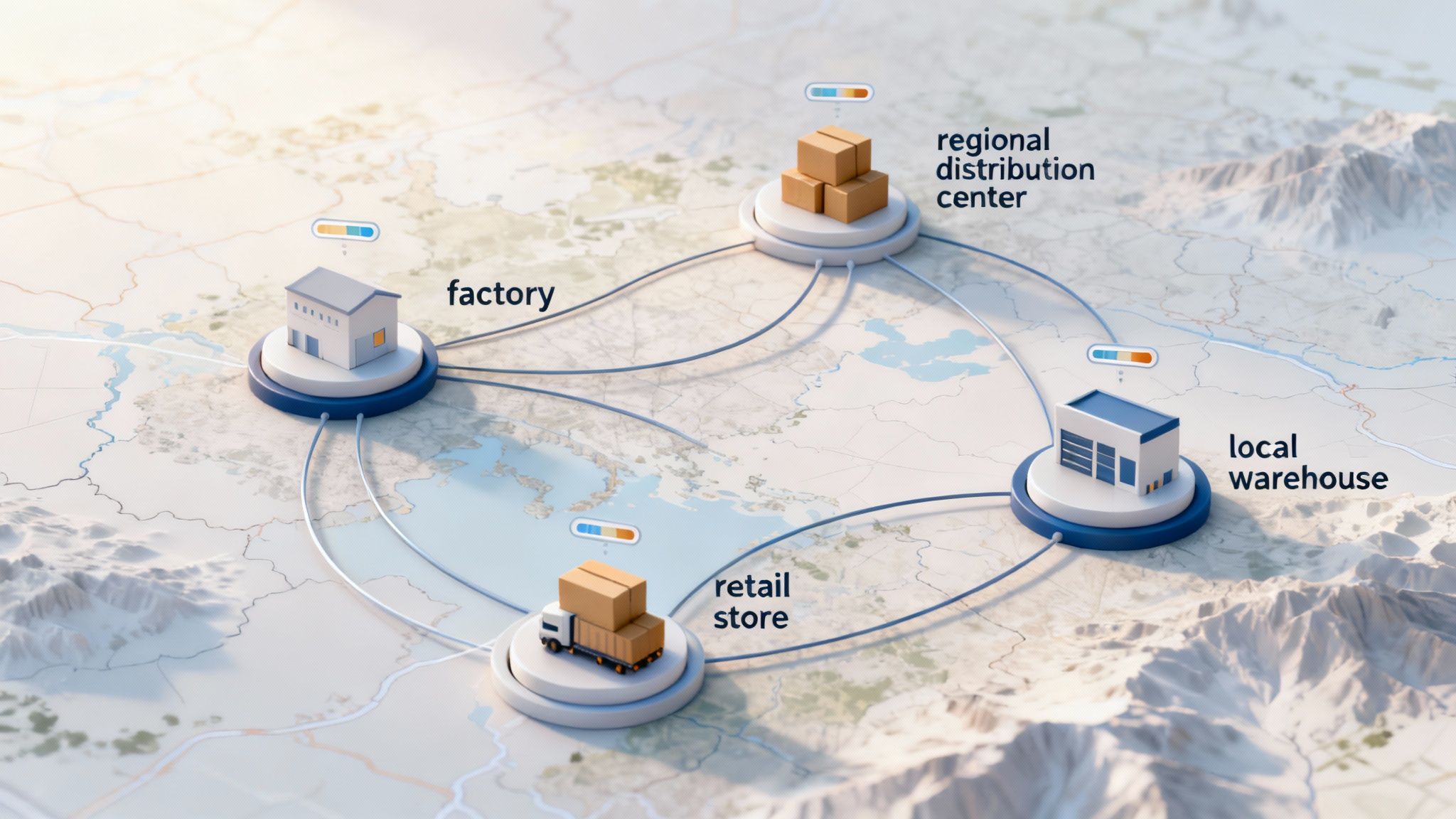
Traditional inventory planning often treats each stage of the supply chain as an independent silo. This leads to inefficiencies like the "bullwhip effect," where demand fluctuations upstream cause amplified inventory swings downstream. A strategic inventory management best practice is implementing multi-echelon inventory optimization (MEIO), a method that balances stock levels across the entire network.
MEIO uses advanced algorithms and AI to determine the optimal quantity and location of inventory at every node in the supply chain. Instead of each location managing its own safety stock, the system calculates interdependent stock levels that minimize total network-wide costs. Organizations can achieve this level of coordination through modern supply chain orchestration platforms that integrate data into a unified optimization engine.
Synthetic Example: Global Retail
A multinational retailer uses MEIO to optimize inventory for a key product category across its distribution centers and stores. The model dynamically adjusts stock policies. According to academic research on MEIO, this can lead to a 10% to 20% reduction in total system inventory while improving in-store availability by 2% to 5%.
Actionable Implementation Steps
Begin with a targeted scope, such as a single high-value product category, to prove the concept and demonstrate a clear ROI. Establish quantifiable objectives upfront, such as specific cost reduction targets. Ensure your optimization models are fed with high-quality, real-time demand signals. Establish a regular cadence for re-optimization, as demand patterns and lead times evolve.
9. Demand-Driven Safety Stock Optimization with Volatility Analysis
Traditional safety stock calculations often rely on static formulas that treat demand as predictable. This leads to either excess inventory or frequent stockouts. A modern inventory management best practice is to adopt a dynamic, demand-driven approach that uses volatility analysis to set safety stock levels based on real-world uncertainty.
This method uses AI-driven analysis of demand variability and supplier reliability. By quantifying the volatility of both demand and supply for each SKU, the system can allocate safety stock more intelligently. It strategically builds buffers for unpredictable items while reducing stock for stable products. This approach can reduce overall safety stock requirements by 15% to 30% while maintaining or improving customer service levels.
Synthetic Example: Manufacturing
A component manufacturer analyzes the historical on-time delivery performance of its suppliers. It increases safety stock for components from a supplier with a 12% lead-time variability rate while reducing buffers for a reliable supplier with only 2% variability. This method prevents line-down situations caused by supply disruptions.
Actionable Implementation Steps
Start by establishing clear service level targets (e.g., a 95% fill rate for A-items). Use inventory management software to calculate safety stock by separately analyzing demand and supply variability. Create a regular cadence, such as a monthly review, to dynamically adjust these safety stock levels as market conditions change.
10. Continuous Improvement and Governance of Inventory Management Processes
Achieving inventory excellence is a continuous cycle of optimization. Static processes degrade over time as market conditions change. A critical inventory management best practice is establishing a robust framework for continuous improvement and governance to ensure performance is consistently measured and enhanced.
This approach transforms inventory management into a strategic, data-driven function. It involves defining clear Key Performance Indicators (KPIs), establishing regular reviews, and using root cause analysis to address performance gaps. Modern governance is amplified by AI, which automates anomaly detection and proactively identifies optimization opportunities.
Synthetic Example: Manufacturing Operations
A global manufacturer conducts weekly inventory variance reviews. Discrepancies trigger a root cause analysis process. This analysis identified that 12% of errors were due to incorrect unit-of-measure conversions at receiving. Corrective actions led to a 9 percentage point improvement in inventory record accuracy within one quarter.
Actionable Implementation Steps
Establish clear KPIs like Inventory Turnover, Days of Supply, and Carrying Costs. Implement a disciplined cadence of weekly metric reviews with formal action tracking. Create and train teams on root cause analysis templates to standardize investigations. Schedule quarterly strategic reviews to assess the effectiveness of your inventory program and adjust your strategy.
10-Point Inventory Best Practices Comparison
| Solution | Implementation complexity | Resource requirements | Expected outcomes | Ideal use cases | Key advantages |
|---|---|---|---|---|---|
| Real-Time Inventory Visibility with AI and IoT-Powered Monitoring | High — sensor deployment, integration and continuous data flows | Significant capital for sensors, RTLS, connectivity, integration and ongoing maintenance | Continuous visibility, fewer stockouts, predictive alerts, reduced carrying costs | Cold chain, high-value assets, e‑commerce fulfillment, retail planogram compliance | Real-time location & condition monitoring; anomaly detection; automation |
| Just-In-Time (JIT) Inventory Optimization with Predictive Analytics | Medium‑High — process change, supplier coordination and reliable forecasting | Forecasting models, supplier integration, accurate lead‑time data and strong supplier relationships | Lower inventory levels, improved cash flow, less waste, greater agility | Automotive assembly, stable SKUs, coordinated production schedules | Minimizes holding costs; reduces obsolescence; lean operations |
| ABC Analysis for Inventory Prioritization and Resource Allocation | Low‑Medium — data classification and governance | Accurate cost/usage data, reporting tools and periodic review processes | Focused controls on high‑impact SKUs, simpler management, better audit accuracy | Retail, healthcare, manufacturing, e‑commerce SKU prioritization | Simple prioritization; targeted auditing; better capital allocation |
| Demand-Driven MRP (DDMRP) with AI Forecasting | Medium‑High — redesign planning logic and buffer strategy | Real‑time consumption feeds, buffer modeling, integration with production and suppliers | Lower inventory with improved resilience; faster response to demand shifts | Manufacturing networks, distribution centers, pharma, automotive suppliers | Consumption‑based reordering; strategic buffers; improved responsiveness |
| Inventory Accuracy & Cycle Counting with Automated QA | Medium — workflow changes, cycle count automation and AI models | Mobile scanners, WMS integration, historical variance data and staff training | Higher record accuracy, fewer full physical inventories, early loss detection | Retail DCs, healthcare pharmacies, e‑commerce fulfillment centers | Continuous accuracy improvement; reduced labor; faster reconciliation |
| Supplier‑Managed Inventory (SMI) & Vendor‑Controlled Replenishment | Medium — contractual setup, data sharing and governance | Supplier integrations, SLAs, forecast sharing and performance monitoring | Reduced internal management burden, coordinated replenishment, lower total cost | Commodity fast‑moving items, hospitals, QSRs, packaging components | Outsources replenishment; improves supplier efficiency; frees resources |
| Inventory Obsolescence Management & Lifecycle Tracking | Medium — lifecycle models, aging reports and clearance workflows | Demand history, ML obsolescence models, clearance channels and policies | Fewer write‑offs, faster clearance, improved cash recovery and sustainability | Apparel seasonality, electronics, pharma expiry, evolving manufacturing parts | Early obsolescence detection; value recovery; waste reduction |
| Multi‑Echelon Inventory Optimization Across Networks | High — complex network modeling and cross‑partner coordination | Extensive multi‑tier data, advanced optimization compute, cross‑organizational alignment | Minimized system inventory, improved service levels, lower transport cost | Global retail, automotive OEMs, pharma distributors, large e‑commerce networks | System‑optimal inventory distribution; coordinated cost/service trade‑offs |
| Demand‑Driven Safety Stock Optimization with Volatility Analysis | Medium — volatility modeling and frequent recalibration | Granular demand & lead‑time data, AI models, monitoring and calibration processes | 15–30% safety stock reduction while maintaining/improving service | Retail with mixed volatility, manufacturing with variable suppliers, seasonal pharma | Targets protection where variability is greatest; lowers carrying costs |
| Continuous Improvement & Governance of Inventory Processes | Medium — governance design, KPI cadence and review workflows | KPI dashboards, monitoring tools, analytics and organizational commitment | Sustained performance gains, faster issue detection and institutionalized best practices | Any organization seeking inventory excellence; regulated industries | Proactive governance; continuous visibility; accountability and remediation |
From Best Practices to Business Value: Your Implementation Roadmap
Navigating modern supply chains requires a strategic, integrated approach. The inventory management best practices in this article, from AI-powered JIT to multi-echelon optimization, are not isolated strategies. They are interconnected components of an operational framework designed to build resilience and drive profitability. The common thread is the critical role of real-time data and the power of artificial intelligence to translate that data into action.
Mastering these concepts moves an organization from a reactive to a proactive stance. Instead of relying on historical averages, you can use predictive analytics to anticipate demand shifts. Rather than applying a uniform safety stock policy, you can use volatility analysis to set dynamic levels that protect service while minimizing capital investment. This transition is fundamental to building a supply chain that accelerates growth.
Synthesizing Strategy into Action
A successful implementation hinges on a phased, methodical approach. Attempting to deploy an AI-driven forecasting model without first establishing robust data governance is ineffective.
Consider this strategic implementation sequence:
- Phase 1: Establish the Data Foundation. Begin with Real-Time Visibility (Practice #1) and Inventory Accuracy (Practice #5). Implement IoT sensors and automate cycle counting to create a single source of truth.
- Phase 2: Segment and Prioritize. Apply ABC Analysis (Practice #3) to segment your inventory. This allows you to focus resources on the items with the most significant impact.
- Phase 3: Deploy Predictive Analytics. With a clean data foundation, implement AI-powered Demand Forecasting (Practice #4) and Demand-Driven Safety Stock Optimization (Practice #9). Start with pilot programs for your "A" items.
- Phase 4: Expand and Integrate. Extend your strategy to partners through Supplier-Managed Inventory (SMI) (Practice #6). Adopt a holistic view with Multi-Echelon Inventory Optimization (Practice #8).
- Phase 5: Embed Continuous Improvement. Formalize your Governance and Continuous Improvement processes (Practice #10). Establish KPIs and conduct regular performance reviews.
This phased roadmap de-risks the transformation and accelerates the time to value. The goal is to turn inventory into a strategic asset that fuels a competitive advantage.
Ready to move from theory to implementation? The team at DSG.AI specializes in designing and deploying custom AI solutions that bring these inventory management best practices to life. We help enterprises build and own their intelligent inventory systems, delivering measurable ROI. Explore our tailored AI projects and see how we can help you build your competitive edge.