
Written by:
Editorial Team
Editorial Team
Persona: Alex, a Chief Technology Officer (CTO) at an established enterprise in a regulated industry like finance or logistics.
Problem: Alex's company relies on stable but aging legacy systems. These systems create a bottleneck, preventing her teams from developing and deploying AI-driven features that are necessary to compete. She needs a clear, low-risk, and pragmatic plan to modernize these core systems without causing major business disruption.
Goal: To educate technology leaders on specific, actionable strategies for modernizing legacy systems to enable AI, positioning them to consider specialized implementation partners.
Funnel Stage: Consideration
In enterprise technology, "legacy" often means stability bought with the loss of agility. While reliable, these core systems can block innovation, especially for companies aiming to integrate production-level Artificial Intelligence. Outdated architecture, monolithic codebases, and siloed data prevent the adoption of machine learning models and advanced analytics. The challenge is not just updating technology; it is strategically re-architecting the enterprise foundation to support a future where AI is a core operational component.
This article outlines ten distinct legacy system modernization strategies, each designed to address specific technical debt while creating pathways for AI integration. This guide focuses on practical patterns that embed AI and data-centric capabilities from the start.
Readers will find a breakdown of approaches, from a complete AI-First Architecture overhaul to the incremental Strangler Fig Pattern enhanced with ML services. We will explore:
- Decision criteria for selecting the right strategy based on risk, budget, and business objectives.
- Implementation steps for each pattern, including governance and risk controls.
- Integration models for connecting modernized systems with AI and data platforms.
The goal is to equip CIOs, CTOs, and engineering leads with a guide to transforming legacy liabilities into strategic, AI-enabled assets.
1. AI-First Architecture Modernization
AI-First Architecture Modernization is a strategy that re-engineers legacy systems by placing artificial intelligence capabilities at the core of the new design. Instead of adding AI as a feature, this approach rebuilds the system's foundation to prioritize data pipelines, model serving infrastructure, and real-time decision-making.
This pattern is effective for businesses whose core operations can be significantly improved by predictive analytics. For example, a maritime shipping company might replace a logistics system with an AI-first platform that optimizes fuel consumption based on real-time weather and vessel data. A synthetic example of such a project could target a 5 to 9 percent reduction in fuel costs against a prior-year baseline. A healthcare provider could layer a patient deterioration prediction model onto an Electronic Health Record (EHR) system to enable proactive clinical interventions.

Implementation Roadmap
This strategy begins with a comprehensive assessment of existing data sources and their quality. Successful projects use a structured path:
- Architecture-First Assessment: Map data flows, identify integration points with legacy systems, and design the target AI-native architecture. Determine the feasibility and potential ROI of the AI initiative with a structured assessment.
- Iterative Development: Structure the project in focused 6-week sprint cycles. Each cycle should deliver a clear, measurable business outcome or ROI milestone.
- Proactive Governance: Embed data governance, model monitoring, and risk management frameworks into the design phase, not as a post-deployment task.
- Full IP Ownership: Ensure the plan includes provisions for complete ownership of all intellectual property, including source code, models, and data pipelines.
2. Strangler Fig Pattern with AI Enhancement
The Strangler Fig Pattern is a modernization strategy that gradually replaces a legacy system. New, AI-enabled services are built alongside the old system, intercepting and handling specific pieces of functionality. Over time, these new services grow and "strangle" the legacy system, which is eventually decommissioned. This approach avoids the high risk of a single, large-scale migration.
This pattern is effective for modernizing complex systems where downtime is unacceptable. For example, a global logistics firm could deploy an AI model to handle inbound email classifications for a single, high-volume trade lane. The new model would process requests, with the legacy rules-based system acting as a fallback. This allows for performance comparison and a gradual, controlled rollout. An insurer could introduce an AI-powered fraud detection service to analyze a subset of claims, slowly expanding its scope as it proves its accuracy against older manual review workflows.

Implementation Roadmap
This strategy requires careful planning of the interface between the new and old systems, often called a facade. This facade routes traffic and ensures seamless operation during the migration.
A phased approach includes these steps:
- Identify Low-Risk Seams: Start by identifying high-volume, low-risk functionalities that can be cleanly separated from the legacy core. This creates an ideal pilot for the new AI service.
- Establish Performance Baselines: Implement monitoring to track the performance, accuracy, and cost of the new AI service against the legacy system. Define clear success metrics for each phase.
- Controlled Traffic Migration: Use tools like feature flags or a proxy layer to control the rate of traffic migration. Start with a small percentage (e.g., 1-5% of traffic) and increase it as confidence in the new service grows.
- Plan Data Synchronization: Address data synchronization between the legacy and new systems early. An event sourcing architecture can help maintain data consistency during the transition.
3. API-Led Modernization with Machine Learning Services
API-Led Modernization is a strategy that decouples legacy system functionality from the user interface by exposing data and business logic through modern APIs. This approach wraps the legacy core, avoiding a high-risk replacement. It then enhances this accessible data by deploying containerized machine learning models as distinct microservices. These ML services can be called via APIs by any modern application.
This pattern is effective for organizations that need to introduce intelligent features without disrupting stable backend systems. For instance, a mining company can expose its legacy SCADA system data via an API. This data can feed a real-time AI recommendation engine to optimize mineral processing, potentially leading to a 3 to 6 percent increase in yield based on historical performance. A media company could develop a content moderation API that provides consistent, AI-driven content scoring, which can then be integrated into multiple frontend applications.
Implementation Roadmap
This strategy centers on disciplined API design and a robust microservices architecture for the ML components. The initial focus is on identifying high-value data trapped in legacy systems and designing a secure API layer to unlock it.
A structured implementation path includes:
- API Design and Gateway Setup: Start by defining a clear API contract and implementing an API gateway for security, rate limiting, and traffic management.
- Containerize ML Services: Package machine learning models into lightweight containers (e.g., Docker) and deploy them using an orchestrator like Kubernetes for scalability.
- Implement Governance and Monitoring: Use API versioning to allow for updates and the gradual deprecation of legacy endpoints. Establish monitoring for the reliability and latency of each AI service.
- Build a Developer Portal: Create comprehensive API documentation and a developer portal to encourage adoption by internal and external development teams.
4. Event-Driven Architecture with Intelligent Stream Processing
Event-Driven Architecture is a strategy that decouples legacy system components and transforms them from slow, batch-oriented processes into a real-time ecosystem. Instead of polling databases, this approach uses a message bus (like Apache Kafka) to broadcast business events as they happen. AI models subscribe to these data streams, processing information in-motion to deliver low-latency predictions and automated decisions.
This pattern is useful for businesses that need to react instantly to changing conditions. For example, a retail company can stream point-of-sale transaction events to an AI model that dynamically updates inventory forecasts. A synthetic project goal could be to reduce stockouts by 10 to 18 percent compared to the previous quarter's baseline. In agriculture, real-time weather and soil sensor events can be fed into predictive models to optimize irrigation schedules.
Implementation Roadmap
Adopting this strategy requires a shift from a request-response model to a publish-subscribe model. It involves treating events as primary data sources and building resilient pipelines.
A successful implementation path includes:
- Define Event Schemas: Establish a clear, versioned schema for every business event. A schema registry prevents data quality issues and ensures models receive consistent inputs.
- Establish a Resilient Broker: Implement a robust event broker and configure dead-letter queues to handle processing failures without data loss.
- Implement Stream Processing: Use stream processing frameworks to build AI-powered services that consume and analyze event streams. Ensure services can handle spikes in event volume.
- Monitor End-to-End Latency: Measure and monitor the time from event creation to the final AI-driven action. This is a key performance indicator for real-time systems.
5. Data Lake to Data Mesh Modernization
Data Lake to Data Mesh Modernization is a strategy that dismantles the centralized data lake and distributes data ownership to domain-specific teams. Instead of one team managing all data, this approach treats data as a product. Each business domain (e.g., finance, logistics) is responsible for owning, cleaning, and serving its own data sets. It applies principles of domain-driven design and federated governance.
This pattern is effective for large enterprises where centralized data teams become bottlenecks. For example, a global financial services firm can implement a data mesh to empower its fraud detection and wealth management domains to independently develop AI models using trusted data they own. This decentralized model can accelerate time-to-market for data-driven products.
Implementation Roadmap
A data mesh transformation requires a shift in both technology and organizational culture. The process prioritizes establishing clear governance and tooling before migrating data sources.
A structured implementation follows this path:
- Pilot Domain Selection: Start small with two or three high-impact business domains that are ready for data ownership. Use these pilots to prove the model's value.
- Establish Federated Governance: Define universal standards for data product schemas, access controls, and quality metrics. Use a central data cataloging tool to ensure data products are discoverable.
- Invest in a Self-Serve Platform: Build or procure a common data infrastructure platform that provides domain teams with tools to build and manage their own data products.
- Link to Business Outcomes: Tie every data product to a specific business or AI use case. This ensures the initiative delivers tangible value, such as a 10 to 15 percent improvement in supply chain forecast accuracy.
6. Containerization and Kubernetes-Based Modernization
Containerization and Kubernetes-Based Modernization is a strategy that encapsulates legacy applications and their dependencies into portable containers. These containers are then deployed and managed on a Kubernetes platform, enabling consistent environments and dynamic scaling without immediate code changes. This approach decouples the application from the underlying infrastructure.
This pattern is effective for organizations needing to improve the operational efficiency and scalability of existing applications. For example, a retail organization can containerize its legacy Point of Sale (POS) system and deploy it alongside modern AI-powered recommendation engines on the same Kubernetes cluster. A logistics company could containerize its core route optimization code, allowing it to scale compute resources dynamically while integrating with new ML-based demand forecasting models.
Implementation Roadmap
This strategy requires a methodical approach that prioritizes stability. It begins by identifying application components for containerization and establishing a CI/CD pipeline.
Successful projects follow a structured path:
- Phased Containerization: Start by containerizing stateless services or smaller components of the legacy system to build experience. This minimizes risk before tackling more complex parts of the monolith.
- Establish a CI/CD Pipeline: Implement automated build, test, and deployment pipelines to manage container images. This ensures consistency across all environments.
- Implement Robust Observability: Deploy comprehensive logging, monitoring, and alerting using tools like Prometheus and Grafana. This provides visibility into the health of containerized applications.
- Plan for Data and State: Develop a clear strategy for managing persistent data. Evaluate solutions for databases and stateful services, such as using Kubernetes StatefulSets or managed cloud databases.
7. Responsible AI and Governance Integration During Modernization
Responsible AI and Governance Integration is a modernization strategy that embeds ethical principles, compliance, and governance frameworks into the system architecture from the outset. It ensures that as legacy systems are updated with AI, they are designed to be transparent, auditable, and aligned with legal and ethical standards.
This strategy is critical for organizations in regulated industries or those deploying AI in high-stakes environments. For instance, a financial institution can modernize its legacy loan origination system by integrating an AI model with built-in bias monitoring to ensure fair lending practices. In healthcare, a patient deterioration prediction model must include explainability features (XAI) that allow clinicians to understand the factors driving a specific risk score. Understanding how to prepare for emerging regulations is essential; you can find more information on achieving compliance with new AI regulations.
Implementation Roadmap
This strategy requires collaboration between technical, legal, and business teams before development begins.
A structured implementation path includes:
- Establish Governance First: Before writing code, define clear governance requirements. This includes fairness constraints, data privacy rules, and criteria for model explainability.
- Integrate Explainability Early: Implement tools like SHAP or LIME during model development, not after. This ensures the ability to interpret model decisions is a native feature.
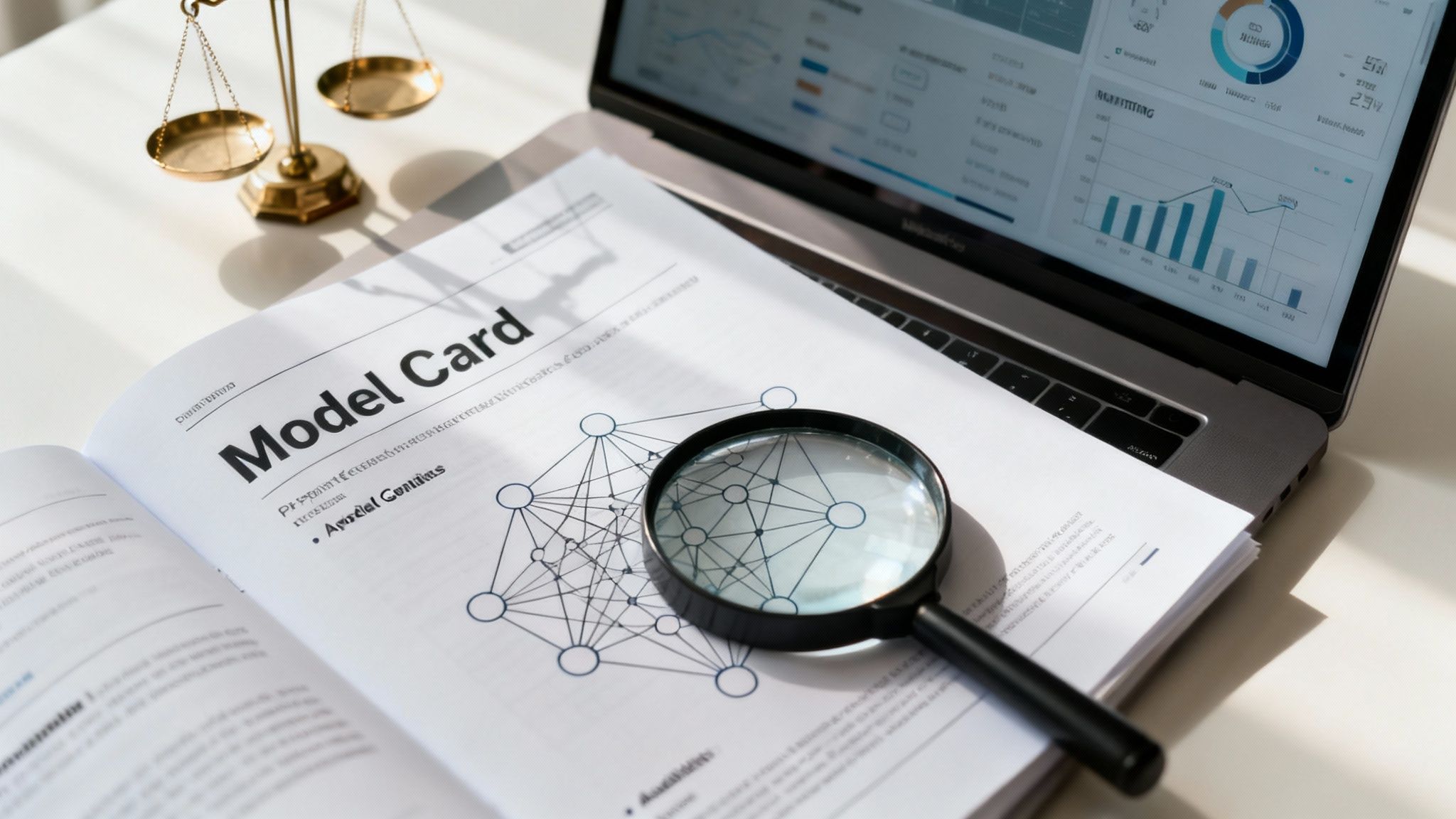
- Document with Model Cards: Create comprehensive "model cards" for each AI component. These documents detail the model's intended use, performance metrics, limitations, and fairness evaluations.
- Build for Continuous Monitoring: Design and deploy dashboards to continuously track for data drift, prediction drift, and performance degradation. Implement regular, automated bias audits.
8. Incremental Refactoring with Continuous Delivery
Incremental Refactoring with Continuous Delivery is a modernization strategy that avoids a "big bang" rewrite by making small, continuous improvements to legacy code. This approach leverages a robust CI/CD pipeline, automated testing, and feature flags to safely reduce technical debt while maintaining system stability.
This pattern is ideal for mission-critical systems where downtime is unacceptable. For example, a telecommunications provider could use this strategy to incrementally refactor its legacy billing system, introducing a real-time, AI-driven fraud detection model one component at a time. An insurance company might slowly modernize its policy management system, adding AI-powered claims analysis features behind feature flags before a full rollout.
Implementation Roadmap
This strategy demands an engineering-focused approach centered on safety and frequency. Success hinges on building a strong foundation of automation before making code changes.
Successful projects follow a structured path:
- Establish a Testing Safety Net: Before refactoring, develop a comprehensive suite of automated tests (unit, integration, end-to-end) to create a baseline and catch regressions.
- Implement a CI/CD Pipeline: Automate the build, test, and deployment process to enable frequent, small releases. The ability to deploy multiple times per day is a key enabler.
- Use Abstraction and Feature Flags: Employ techniques like the "branch by abstraction" pattern to safely replace components over time. Use feature flags to roll out new functionality to specific user segments.
- Prioritize with Observability: Use monitoring and observability data to identify the most problematic areas of the codebase to refactor first, ensuring effort has the most impact.
9. Cloud-Native Migration with AI/ML Services
Cloud-Native Migration with AI/ML Services is a strategy that moves legacy applications to a cloud-native architecture while integrating managed AI platforms. This approach transforms monolithic systems into scalable services that leverage platforms like AWS SageMaker, Google Vertex AI, or Azure Machine Learning. The objective is to reduce infrastructure management and accelerate the deployment of intelligent features.
This pattern is ideal for organizations seeking to escape the costs of self-hosting their applications and MLOps infrastructure. For example, a financial services firm could migrate its on-premise fraud detection system to a containerized application that calls a managed anomaly detection model. According to industry analysis from firms like Gartner, such a move can reduce infrastructure maintenance costs by an estimated 18 to 25 percent. An e-commerce retailer might migrate its product catalog to a cloud database and use SageMaker to power a new product recommendation engine.
Implementation Roadmap
A successful cloud-native migration requires a phased approach that prioritizes stability and cost control. It starts with an analysis of application dependencies and the total cost of ownership (TCO) in the cloud.
This strategy involves a multi-stage process:
- TCO and Platform Analysis: Begin with a TCO analysis comparing current on-premise costs to projected cloud spending. Evaluate managed vs. self-hosted ML platforms.
- Phased Migration: Start with a "lift-and-shift" for stable legacy workloads to exit the data center, then refactor applications for the cloud-native environment in subsequent phases.
- Infrastructure as Code (IaC): Use tools like Terraform or CloudFormation to define and manage cloud infrastructure. This ensures reproducible deployments.
- Proactive Cost Governance: Implement cost monitoring, budget alerts, and resource tagging from the beginning. Plan for data egress costs, as they can become a significant expense.
10. Synthetic Data and AI Model Augmentation Strategy
Synthetic Data and AI Model Augmentation is a modernization strategy that addresses data scarcity, privacy, and quality issues. It involves creating high-fidelity, artificially generated data that mirrors the statistical properties of real-world datasets. This approach allows organizations to train and validate AI models even when historical data is limited or restricted by privacy regulations like HIPAA or GDPR.
This strategy is valuable in regulated industries or for scenarios involving rare events. For instance, a financial institution can generate millions of synthetic transaction records, including fraudulent patterns, to train a fraud detection model without using sensitive customer data. Case studies from firms like Gretel.ai show this can improve model accuracy by 10 to 18 percent over models trained only on limited, real fraud examples. A manufacturing firm can simulate equipment failure scenarios to build a predictive maintenance model.
Implementation Roadmap
This strategy requires a focus on data quality and validation to ensure the synthetic data accurately represents reality. It augments real data rather than replacing it entirely.
Successful implementation follows a structured methodology:
- Statistical Property Validation: Profile the real dataset to establish a baseline. Validate that the generated synthetic data matches the real data’s key statistical distributions and correlations.
- Blended Training Approach: Use a combination of real and synthetic data during model training. This often improves model generalization, especially for underrepresented cases.
- Bias and Fairness Audits: Conduct bias audits on both the source data and the synthetic data. This ensures the generation process does not amplify existing biases.
- Iterative Refinement: Treat the synthetic data generation model as a product. Continuously test models trained on this data against real-world performance benchmarks and refine the generation process.
10-Point Legacy Modernization Strategy Comparison
| Strategy | Implementation complexity | Resource requirements | Expected outcomes | Ideal use cases | Key advantages |
|---|---|---|---|---|---|
| AI-First Architecture Modernization | High — major upfront assessment and redesign | High — ML engineers, data engineers, infra, governance | Rapid AI capabilities, reduced technical debt, scalable ML ops | Enterprises needing end-to-end AI transformation (healthcare, maritime, agriculture) | Real-time ML by design, compliance-ready, scalable, tech-agnostic |
| Strangler Fig Pattern with AI Enhancement | Moderate — incremental replacement with coordination overhead | Moderate — integration, dual-run ops, monitoring | Low-disruption migration, phased replacement of legacy functions | Systems that must remain live during modernization; pilotable workflows | Minimal downtime, lower risk, enables A/B testing and gradual learning |
| API-Led Modernization with ML Services | Medium — API design and versioning are critical | Medium — API gateways, containerized models, security | Reusable AI services, faster frontend innovation, decoupled systems | Multi-application integrations, mobile and third-party clients | Decoupling, reusability, backward compatibility, easy integration |
| Event-Driven Architecture with Intelligent Stream Processing | High — requires stream-processing and distributed-systems expertise | High — streaming platforms, SREs, real-time inference infra | Low-latency predictions, real-time automation, full event history | IoT, sensor-heavy environments, real-time transaction processing | True real-time ML, replayable histories, scalable decoupling |
| Data Lake to Data Mesh Modernization | High — significant organizational and technical change | High — data platform tooling, data engineers, governance teams | Improved data quality/discoverability, faster AI project delivery | Large enterprises with domain silos, regulated industries | Domain ownership, federated governance, scalable data products |
| Containerization and Kubernetes-Based Modernization | Medium–High — container and orchestration learning curve | Medium — platform engineers, CI/CD, observability tools | Consistent deployments, elastic scaling of AI services, portability | Teams modernizing deployments or decomposing monoliths | Portability, efficient scaling, CI/CD integration, hybrid cloud support |
| Responsible AI and Governance Integration During Modernization | Medium — governance embedded across lifecycle | Medium–High — explainability tools, monitoring, compliance experts | Reduced regulatory risk, explainability, fairness, auditability | Regulated/high-stakes domains (finance, healthcare), public-facing AI | Compliance-ready, bias monitoring, audit trails, increased stakeholder trust |
| Incremental Refactoring with Continuous Delivery | Low–Medium — disciplined, iterative process | Medium — CI/CD, automated tests, feature-flagging | Continuous, low-risk delivery of improvements and AI features | Teams favoring low-risk, steady modernization of legacy code | Small reversible changes, rapid feedback, preserves system stability |
| Cloud-Native Migration with AI/ML Services | Medium — cloud migration planning and optimization needed | Medium–High — managed ML platforms, cloud engineers, cost controls | Reduced ops burden, faster experimentation, auto-scaling ML workloads | Organizations adopting managed AI services (SageMaker, Vertex AI) | Managed tooling, scalability, faster time-to-market, reduced infra ops |
| Synthetic Data and AI Model Augmentation Strategy | Medium — generative modeling and validation effort | Medium — compute for generation, domain experts, validation tooling | Faster model development, mitigates data scarcity and privacy risks | Regulated or sparse-data domains (healthcare, finance), imbalance cases | Enables safe training data, edge-case testing, privacy-preserving augmentation |
Final Thoughts
Modernizing a legacy system is a strategic requirement for growth in an AI-driven economy. The ten legacy system modernization strategies in this article are not just theoretical. They are a practical playbook for transforming brittle systems into agile, intelligent platforms. Modernization is not about replacing old technology; it is about re-architecting your enterprise for a future where data and AI drive value.
Recapping the Core Modernization Imperatives
Successful modernization projects are incremental, risk-managed, and aligned with business outcomes.
Here are the key takeaways:
- AI is a Modernization Accelerator: AI capabilities should be woven into modernization from day one. This ensures new systems are built to leverage predictive insights, which can drive efficiency gains of 10-18% in areas like resource allocation.
- Incremental Progress Mitigates Risk: The Strangler Fig and Incremental Refactoring patterns offer a pragmatic path. They allow organizations to de-risk massive projects by delivering value in stages and minimizing operational disruption.
- Data Architecture is Paramount: The transition from a centralized Data Lake to a decentralized Data Mesh is pivotal. This shift empowers domain teams, improves data quality, and creates the scalable infrastructure necessary for AI applications.
- Governance is Non-Negotiable: As highlighted by the Responsible AI strategy, compliance and ethical considerations must be embedded into the modernization lifecycle. Proactive governance avoids costly rework and builds trust.
Your Path Forward: From Strategy to Execution
The journey from legacy to modern is unique for every organization, but the principles for success are universal. It demands a clear vision, executive sponsorship, and a culture that embraces iterative change.
Begin by assessing your current state, not just technologically, but also in terms of business process bottlenecks and data accessibility. Use this baseline to prioritize which systems offer the highest ROI for modernization. For instance, a system where enhanced data processing could reduce supply chain delays by 8-12 hours presents a stronger business case than one with less tangible impact.
The goal is to build a resilient and intelligent enterprise architecture. This allows you to adapt to market changes and deliver superior customer experiences powered by data and AI.
The experts at DSG.AI specialize in implementing advanced legacy system modernization strategies that deliver measurable business outcomes. Explore our past projects to see how we have helped organizations turn technical debt into a competitive advantage: DSG.AI.