
Written by:
Editorial Team
DSG.AI
Imagine a seasoned mechanic who can listen to an engine and tell you a specific part will fail in about two weeks. Predictive maintenance software does something similar, but for your entire operation—and with much more data. It uses live information from sensors, like vibration and temperature, to monitor equipment health.
This shifts your maintenance strategy from a reactive, "fix-it-when-it-breaks" approach to a proactive, data-driven plan. The results are measurable: companies using this approach often report a reduction in unplanned downtime and a 15-30% cut in overall maintenance costs, according to industry benchmarks.
What Is Predictive Maintenance Software
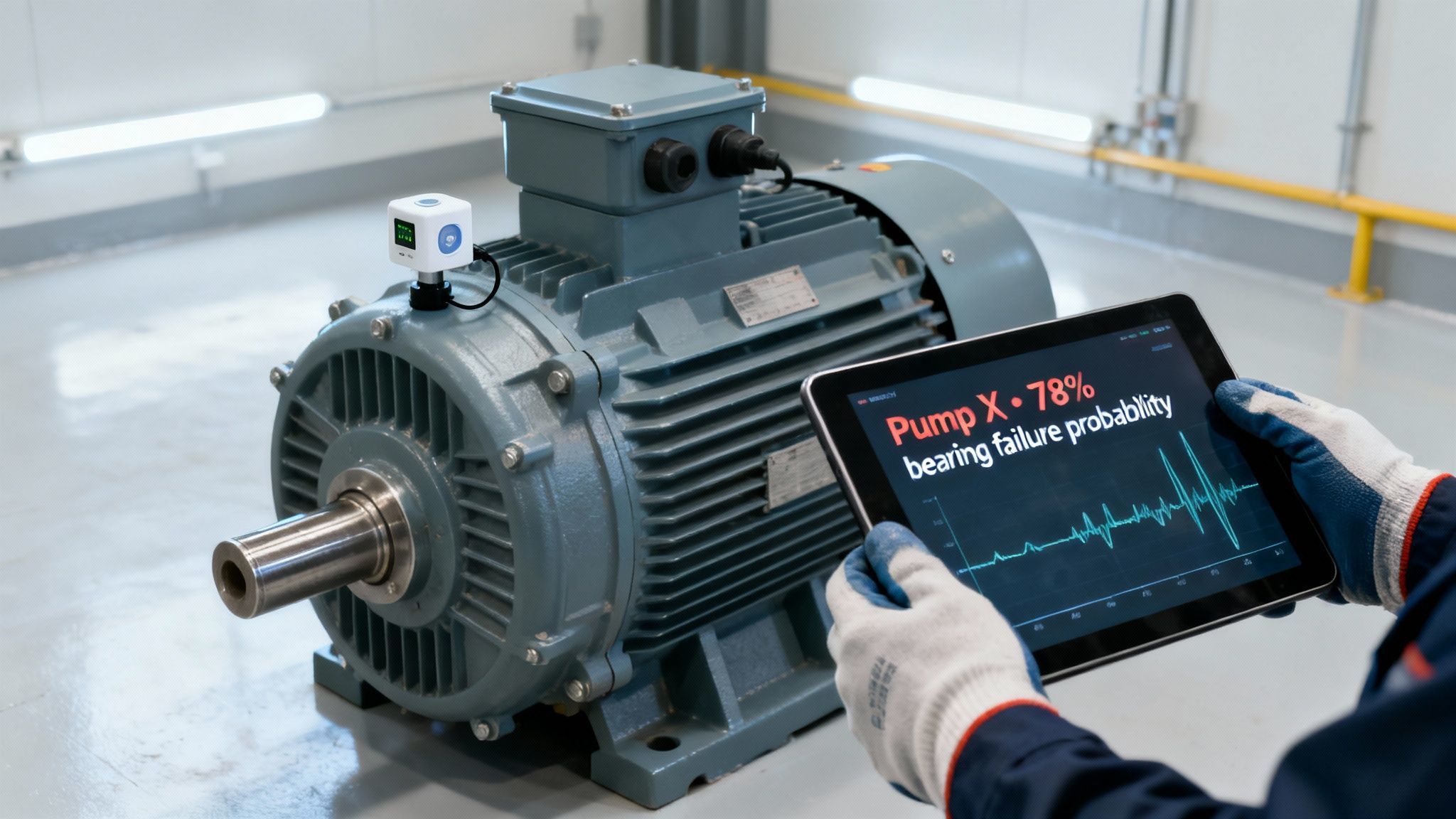
Predictive maintenance (PdM) software is a system that monitors the condition of equipment to forecast when a failure is likely to happen. Instead of using a fixed calendar, it uses real-time data from sensors to spot subtle patterns and anomalies that indicate a pending breakdown.
This allows your maintenance team to intervene at the optimal moment—not too early, which is wasteful, and not too late, which can be costly.
For example, changing your car's oil every 5,000 miles is preventive. Changing it only when a sensor indicates the oil has lost its viscosity is predictive. The second method is more efficient and cost-effective.
This process is built on the principles of predictive modeling. To understand the technical side, this guide on understanding predictive modeling is a useful resource. By using data, maintenance becomes a strategic advantage that boosts reliability and profitability.
Shifting From Reactive To Proactive Maintenance
For decades, the standard approach to maintenance has been reactive. A machine breaks, production stops, and a team scrambles to fix it. This creates a high-cost, high-stress cycle of emergency repairs.
Let's look at how the strategies compare.
A Practical Comparison of Maintenance Strategies
This table highlights the differences between the three main maintenance philosophies.
| Maintenance Type | Trigger | Cost Profile | Equipment Downtime |
|---|---|---|---|
| Reactive | Equipment Failure | High (unplanned) | Unplanned & Significant |
| Preventive | Fixed Schedule/Time | Moderate (planned) | Planned & Scheduled |
| Predictive | Real-Time Condition Data | Low (optimized) | Minimized & Planned |
Predictive maintenance software moves your operation from the left side of this table to the right. It analyzes operational data to generate specific, actionable alerts. Instead of a vague warning, you receive a clear directive. For example: "Pump X shows a 78% probability of bearing failure within the next 200 hours." This gives your team a precise window to schedule repairs without disrupting the entire production line.
This shift is a significant industry movement. The global predictive maintenance market was valued at USD 10.93 billion in 2023 and is projected to reach USD 70.73 billion by 2032, growing at a compound annual rate of 26.5%, according to a recent market analysis. This growth is driven by AI, machine learning, and IoT sensors that enable real-time monitoring and analysis.
The Core Benefits For Your Operation
Implementing a predictive maintenance platform delivers tangible results by changing how you manage assets over their lifecycle. Businesses that adopt this technology typically see improvements in several key areas.
These gains create a positive ripple effect. Better reliability leads to more predictable production schedules, reducing the need for large spare parts inventories. It also helps create a safer environment for your team.
The goal is to build a more resilient and efficient operation. By removing the guesswork from maintenance, you can extend the life of critical assets and make data-backed decisions that impact the bottom line.
How a Predictive Maintenance System Actually Works
A predictive maintenance platform functions like an intelligence system for your equipment. Its mission is to gather raw data, process it into a usable format, analyze it for threats, and deliver clear, actionable information to your team. The operation can be broken down into a four-layer system that transforms a subtle sensor reading into a major failure averted.
The process from a sensor signal to a scheduled maintenance task is designed to be seamless. The goal is not just to collect data, but to turn that data into a specific action that protects critical assets.
Layer 1: The Data Acquisition Foundation
It all starts with data. This is the foundation of the entire system, where the raw material for insights is gathered. Without a steady stream of high-quality data, the algorithms are ineffective.
This process begins by placing IoT (Internet of Things) sensors on critical machinery. These sensors act as the system's monitoring devices, capturing a constant flow of operational data.
Key data they typically gather includes:
- Vibration analysis to detect imbalances or bearing wear in rotating equipment.
- Thermal imaging to spot hot spots caused by friction or electrical resistance.
- Acoustic analysis to listen for sound changes that might signal stress or cracks.
- Oil analysis to check for contaminants or particles that point to internal wear.
Consider this layer your surveillance team, gathering raw feeds 24/7. Their job is to capture every change in your equipment's behavior.
Layer 2: Processing and Storing Raw Data
Once collected, the raw data is often noisy, unstructured, and voluminous. This second layer acts as a central hub where all this information is sent to be cleaned, organized, and securely stored for analysis.
The raw data is transmitted to a central platform, usually in the cloud. Here, the data is filtered to remove noise, normalized for consistency, and structured so machine learning models can process it.
This step is critical. The quality of the prediction depends on the quality of the data fed into the system. A system fed with inconsistent data will produce unreliable alerts.
This cleaned data is then archived in a database, building a historical record of each asset's operational life. This historical context teaches the software what "normal" behavior looks like.
Layer 3: Analytics and Predictive Modeling
This is the analytical core of the operation. In the Analytics and Modeling layer, machine learning algorithms analyze the stored data to find patterns that precede a failure.
The system analyzes trends and connects data points over time. For instance, a synthetic example shows it might learn from past events that a slight increase in vibration, combined with a fractional rise in temperature, has preceded a specific type of motor failure 92% of the time.
These algorithms are trained on your historical data, so they learn the unique operational signature of each piece of equipment. When the software spots a deviation from that baseline, it flags it as an anomaly. This is pattern recognition on a large scale.
Layer 4: Visualization and Taking Action
The final layer translates complex analytical findings into simple, direct instructions for your maintenance crew. This is where the platform delivers its real-world value.
This usually takes the form of a dashboard that presents key information visually. Instead of raw data streams, your team sees:
- Asset Health Scores: A simple score, such as 0-100, showing the current condition of a machine.
- Trend Lines: Visual graphs that illustrate how an asset's health is changing over time.
- Actionable Alerts: Clear notifications like, "Pump B-12 shows a 90% probability of bearing failure in the next 150 operating hours."
This clear communication allows maintenance planners to shift from reactive firefighting to proactive, scheduled repairs, preventing downtime before it happens.
Integrating PdM Software with Your Existing Systems
A predictive maintenance tool is most effective when integrated with your existing enterprise systems. This creates a connected workflow that automates the maintenance response. Without these links, a failure prediction is just an alert waiting for action.
This integration turns a warning into a fully-resourced maintenance plan. The entire process follows a logical four-step flow, moving from data to action.
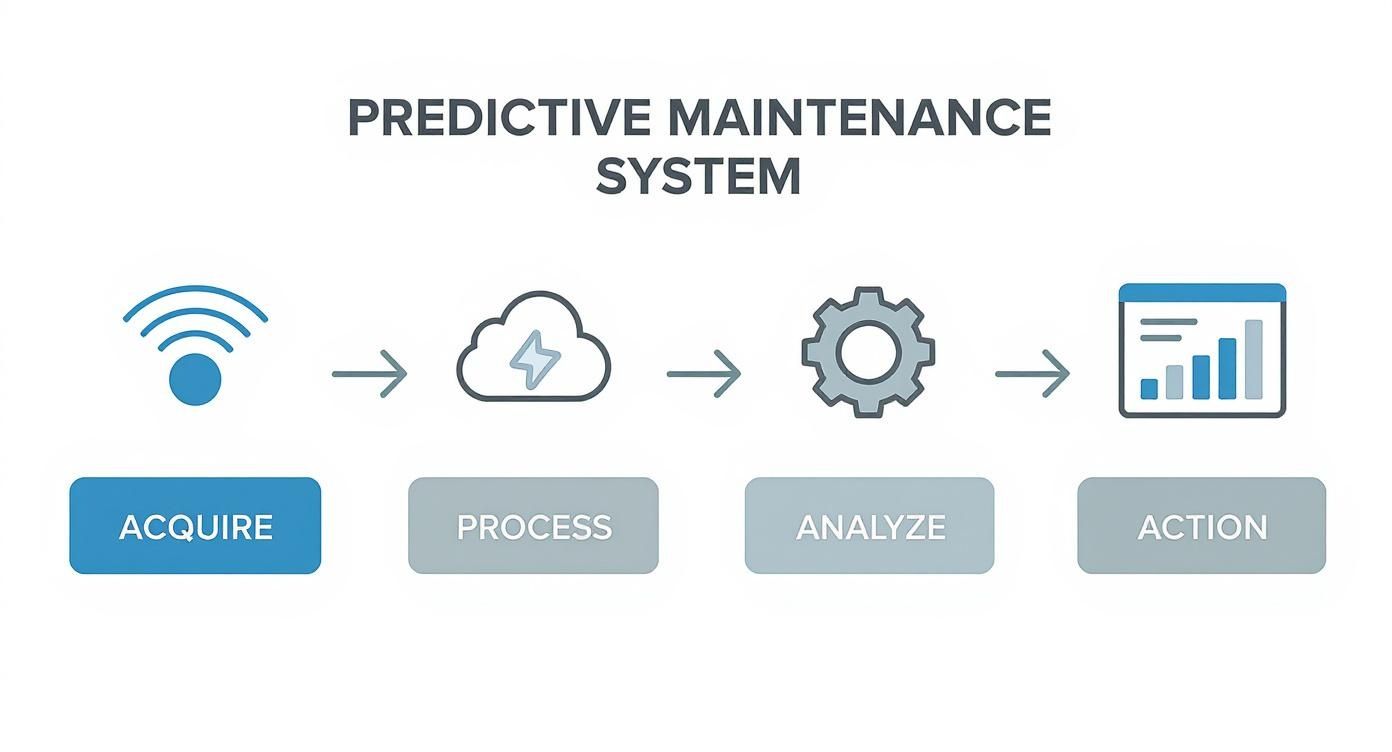
The diagram shows how data is acquired, processed, and analyzed. The "Action" step becomes powerful when tied directly into your core business platforms.
Connecting to Your CMMS and ERP
The most vital connection is between your predictive maintenance software and your Computerized Maintenance Management System (CMMS). This link closes the loop between predicting a problem and fixing it. When the PdM software flags a potential failure, it can automatically generate a detailed work order inside the CMMS.
That automated work order can be pre-loaded with necessary information:
- The specific asset ID and its location.
- A description of the predicted issue (e.g., bearing wear).
- A list of parts needed for the repair.
- The urgency level and a suggested timeframe for the work.
Your Enterprise Resource Planning (ERP) system is the next integration point. This connection places maintenance activities within the larger business context, tying them to inventory levels and production schedules. For instance, before creating a work order, the system can check the ERP to ensure the needed spare parts are in stock.
This check can prevent a technician from showing up to a job without the necessary parts, a common issue that can result in 10% to 30% in wasted labor time, according to industry studies.
By linking PdM software to the ERP, you can align maintenance schedules with production demands. This ensures repairs happen during planned downtime instead of stopping a critical manufacturing line. It’s about creating an intelligent, resource-aware maintenance response.
The Role of APIs in System Integration
This communication happens through an Application Programming Interface (API). An API acts as a universal translator, allowing your PdM software, CMMS, and ERP to exchange information automatically. A well-designed API ensures data flows smoothly and securely between systems, eliminating the need for manual data entry.
When evaluating predictive maintenance software, consider the quality and flexibility of its APIs as well as its algorithms. A robust API library provides your IT team with the tools to build custom workflows. For organizations managing multiple AI platforms, a clear governance strategy is important. You can learn more about overseeing these systems by exploring how to manage your AI portfolio effectively. This oversight ensures all intelligent systems work together to achieve business goals.
Choosing the Right Predictive Maintenance Software for Your Team
Selecting the right predictive maintenance software is about finding a solution that aligns with your operational goals. A flashy demo is meaningless if the solution cannot scale with your facility or integrate with your team's existing systems. By focusing on a few key criteria, you can find a platform that delivers results.
The first step is to assess your current situation and future goals. Are you starting with a pilot program on 50 critical assets? Or do you plan to monitor 500 machines across multiple sites within the next year? The right software should handle both scenarios without requiring a costly overhaul later.
Evaluate Scalability and Deployment Models
First, look at how the software scales. You need a platform that can handle more assets, more users, and increasing data volumes without performance issues. Ask potential vendors for evidence of their system's performance under load. Get specific metrics on data ingestion rates and processing speed for a large fleet of assets.
Next, decide on the deployment model that fits your IT infrastructure and budget.
- Cloud-Based (SaaS): These options typically have a lower upfront cost, faster implementation, and shift the maintenance burden from your internal IT team. They are usually priced as a subscription, making costs predictable.
- On-Premise: This model provides full control over your data and security but requires a significant initial investment in hardware. You will also need to dedicate internal staff for maintenance and updates.
The industry is shifting toward cloud-based solutions. Software is the fastest-growing segment of the market. A subscription-based tool can lead to a 30–50% reduction in the total cost of ownership compared to a traditional on-premise setup, based on common TCO models. You can find more details on the predictive maintenance market on MordorIntelligence.com.
Analyze Model Suitability and Integration Depth
Not all predictive models are the same. A platform's value depends on whether its algorithms are a good match for your specific equipment. A model designed for a conveyor belt may not be suitable for tracking the high-frequency vibrations of a CNC machine spindle.
When vetting a solution, ask specific questions about its analytical models. Does it include pre-built models for common equipment like pumps and motors, or will you need to invest in custom development? A good vendor should be able to explain why their algorithms are appropriate for your machinery.
Equally critical is how well the software integrates with other systems. A standalone system that does not communicate with your core platforms can create data silos and manual work. Ask for proof of how the software connects with your specific CMMS and ERP. A seamless API that automatically generates work orders is a key requirement for efficiency.
Vet Vendor Expertise and Support
Finally, evaluate the vendor. A true partner provides more than a license key; they bring industry knowledge and support your success. Do they understand the challenges of your sector, whether it's manufacturing, energy, or logistics?
A vendor with experience in your industry can be valuable for tasks like fine-tuning models and making continuous improvements. They should also provide training to help your team trust and act on the system's insights. You are investing in a relationship as much as a platform. Before committing, it is wise to determine your organization's AI readiness. You can assess your AI maturity and identify gaps with our assessment tool.
Measuring Success and Proving the ROI of Your PdM Program
To secure investment in predictive maintenance software, you need to build a solid business case based on data. This requires proving the return on investment (ROI), a process that starts before the new system is implemented.
You need a clear "before" picture. By establishing a data baseline of your current operations, you create a benchmark for measuring future performance. A well-executed program will show measurable improvements in key metrics.
Establishing Your Key Performance Indicators
Before implementation, identify the metrics that define success for your maintenance operations. These Key Performance Indicators (KPIs) translate technical achievements into business value.
You should benchmark and track metrics like these:
- Mean Time Between Failures (MTBF): The average time a machine runs before it fails. A rising MTBF indicates that your predictive strategy is preventing failures.
- Overall Equipment Effectiveness (OEE): A standard measure for manufacturing productivity. It combines availability (uptime), performance (speed), and quality (good parts) into a single score.
- Direct Maintenance Costs: The total spending on labor, replacement parts, and outside contractors. A successful PdM program should reduce this number.
- Spare Parts Inventory: By anticipating needs more accurately, you can reduce the amount of capital tied up in spare parts. It is common to see a 10-20% reduction in this area.
This focus on metrics changes the conversation. You stop saying, "I think this is helping," and start reporting, "We've increased MTBF by 22% and reduced emergency work orders by 41% since Q2." This is how you build a strong business case.
Tracking these metrics is fundamental to demonstrating the value of your predictive maintenance initiative. The table below outlines some of the most critical KPIs to monitor.
| Key Performance Indicators for Predictive Maintenance | ||
|---|---|---|
| KPI | Definition | Example Goal |
| Mean Time Between Failures (MTBF) | The average operational time between one asset failure and the next. | Increase by 25% within the first year. |
| Maintenance Cost per Asset | Total maintenance costs (labor, parts, contractors) divided by the number of assets. | Reduce by 15% for critical machinery. |
| Overall Equipment Effectiveness (OEE) | A composite score measuring asset availability, performance, and quality of output. | Improve OEE score from 70% to 80%. |
| Unplanned Downtime | The total time equipment is non-operational due to unexpected failures. | Decrease unplanned downtime by 50%. |
| Spare Parts Inventory Value | The total monetary value of spare parts held in inventory. | Reduce inventory carrying costs by 20%. |
By consistently measuring these KPIs, you create a clear narrative of improvement that links your PdM program to financial and operational gains.
Calculating a Clear Return on Investment
Once your KPIs are established, calculating the ROI is a straightforward process. The logic is simple: compare the total cost of your PdM system to the financial benefits it creates, which come from avoided costs and new efficiencies.
Here is a practical, synthetic example.
ROI Example: Manufacturing Plant
A mid-sized plant invests $150,000 to deploy a predictive maintenance solution on its most critical production line.
- Investment Cost: $150,000 covers the software subscription, new sensor hardware, and initial team training.
- Cost Avoidance: Over the first year, the system prevents four major equipment failures. Based on historical data, each failure typically costs the company $60,000 in lost production, overtime for emergency repairs, and wasted raw materials.
- Total Savings: 4 prevented failures x $60,000 per failure = $240,000 in avoided costs.
- Net Return: $240,000 (Savings) - $150,000 (Investment) = $90,000 in net savings.
- First-Year ROI: ($90,000 / $150,000) * 100 = a 60% ROI.
This type of analysis demonstrates that a predictive maintenance program is a strategic investment that pays for itself. As these systems become more central to operations, platforms that can assure AI quality and performance are becoming important for maintaining trust in the results and validating the ROI.
Predictive Maintenance Software in the Real World
Theory is useful, but results on the shop floor and bottom line are what matter. It’s one thing to discuss what predictive maintenance could do; it’s another to see how it performs in high-stakes environments. Across industries, companies are turning data into financial and operational gains.
Let’s look at two industries to see this in practice.

These are not isolated successes. They are part of a shift in how asset-heavy industries approach reliability, risk, and performance.
Manufacturing Success with CNC Machines
In manufacturing, unplanned downtime reduces profitability. A major automotive supplier faced this issue with its fleet of CNC machines. Unexpected spindle failures frequently halted production lines.
They installed vibration sensors on their most critical machines. The new predictive maintenance software began analyzing the data and learning the operational signature of a healthy machine.
Within a few months, the system flagged subtle, high-frequency vibrations that were undetectable by human operators. It recognized these patterns as an early sign of a future spindle bearing failure.
With this warning, the maintenance team could schedule repairs during planned shutdowns, avoiding emergency breakdowns. The result was a documented 18% reduction in unplanned downtime and a 12% decrease in scrap material caused by machine faults over a six-month period.
This is an example of turning a reactive process into a controlled, proactive one. The financial return was immediate and measurable.
Energy Sector Wins in Wind Turbine Operations
In the energy sector, equipment failures can be very expensive. For a wind farm, a gearbox failure in a turbine is a worst-case scenario. It requires large, costly cranes and results in lost revenue for every hour the turbine is offline.
One operator implemented a predictive analytics program to monitor their turbine gearboxes remotely. Their software continuously analyzed data from two sources:
- Vibration Patterns: Sensors picked up on small changes in the machinery's mechanical signature.
- Oil Particle Data: The software analyzed lubricant samples, automatically detecting microscopic metal fragments that signal internal wear.
By combining these two data streams, their system can now predict gearbox faults up to six months in advance. This lead time is a significant advantage. It gives the operations team ample time to schedule crane rentals and part deliveries efficiently, often bundling maintenance tasks to reduce costs.
The foresight from their software has helped them avoid millions in emergency repair costs and lost production. This trend is accelerating globally, with the Asia Pacific region emerging as a major growth area. Driven by rapid industrialization, the APAC market for this software is projected to grow at a CAGR of 37.4% through 2025, according to some forecasts. You can find more details on these global predictive maintenance market trends from Cognitive Market Research.
Common Questions About Predictive Maintenance Software
Practical questions often arise when considering a new technology like this. Let's address some of the most common ones.
How Much Historical Data Do I Need to Get Started?
This depends on your equipment and what you’re trying to predict. As a general rule, 6 to 12 months of clean operational data is a good starting point. This provides the models with enough history to learn from, including sensor readings and records of past failures.
However, you don't always have to wait that long. Some newer PdM systems can start delivering value sooner. They use anomaly detection algorithms that first learn what "normal" looks like for a piece of equipment and then flag any deviation from that baseline. In this case, the focus shifts from having large amounts of data to having high-quality data.
Can This Software Work on Our Older Equipment?
Yes. This is one of its most powerful applications. You can modernize legacy assets by retrofitting them with inexpensive IoT sensors.
Low-cost, wireless sensors can track metrics like vibration, temperature, and electrical current. They can often be installed without major modifications to the machinery. This is a way to extend the life and improve the reliability of older equipment without the capital expense of a full replacement.
What Are the Biggest Implementation Hurdles We'll Face?
The biggest challenges are often related to people, not technology. The technical aspects are often more straightforward than preparing the organization for the change.
Here are common hurdles:
- Poor Data Quality: If the system is fed messy, unstructured data, it will produce unreliable insights. This "garbage in, garbage out" problem can hinder a project's success.
- Skills Gaps: Your team may not have the data science expertise to manage and interpret the analytical models. This is a new skillset that may need to be developed or acquired.
- Resistance to Change: Maintenance crews who have relied on experience and a calendar can be skeptical. Gaining their trust in a predictive alert over their own judgment takes time and demonstrated success.
Overcoming these obstacles requires a solid plan. A phased rollout, buy-in from leadership, and a thorough training program are essential. Empowering your team to trust the data is as important as the technology itself.
Ready to turn data into a competitive advantage? The world-class team of AI researchers and ML engineers at DSG.AI can design, build, and operationalize a predictive maintenance solution that delivers measurable business value from day one. See how we turn data into a competitive advantage at global scale. Explore DSG.AI projects