Written by:
Editorial Team
DSG.AI
A supply chain control tower is a central hub that uses real-time data to provide end-to-end visibility across your entire logistics network. This centralized view allows your teams to see, understand, and act on potential disruptions before they impact operations or customers. The goal is to shift from reactive problem-solving to proactive management of goods in motion.
Why Supply Chain Visibility Is a Requirement
Operating a modern supply chain with disconnected spreadsheets and siloed data systems creates significant operational risk. Many operations leaders find themselves in a constant state of reaction, discovering problems only after they have caused expensive delays or customer dissatisfaction. This approach is inefficient and exposes the business to unnecessary risk.
A supply chain control tower changes this dynamic. It is a strategic, central hub for an entire operation. It integrates visibility, data, and collaborative tools to help you anticipate disruptions and make data-informed decisions.
The Shift from Reactive to Proactive Management
The primary function of a control tower is to move an organization from a reactive to a proactive operational posture. This shift is necessary for building a resilient and competitive supply chain.
Consider a common scenario without a control tower: you might not learn a critical shipment is delayed until the truck fails to arrive at the distribution center. This triggers a scramble to track the shipment, inform the customer of the delay, and arrange costly expedited freight to resolve the issue.
A control tower with an automated alert system could flag the potential delay days in advance, using GPS data and real-time traffic analysis. This early warning enables your team to reroute the shipment or adjust inventory at the destination. A potential crisis is managed as a standard operational adjustment.
The Business Case for Centralized Oversight
This shift from firefighting to forward-planning produces measurable results. Companies that implement a supply chain control tower report improvements in both efficiency and profitability. According to Emergen Research, the global Supply Chain Control Tower (SCCT) market is projected to grow from approximately $6.7 billion to $93.8 billion over the next decade.
The benefits include:
- Reduced Operational Costs: Proactively rerouting shipments and optimizing inventory can reduce logistics costs by up to 15%. This reduces spending on last-minute expedited shipping and lowers the cost of carrying excess inventory.
- Improved Service Levels: Complete visibility leads to more accurate delivery estimates and fewer stockouts, which directly impacts customer satisfaction and retention.
- Enhanced Resilience: Early identification of potential bottlenecks—such as port congestion, a supplier issue, or a geopolitical event—allows for quick adjustments to minimize impact.
This level of oversight is a modern operational necessity. For more context on this topic, see this external a guide to real-time supply chain visibility. Visibility is the foundation of any modern, profitable, and resilient operation.
How a Supply Chain Control Tower Works
A supply chain control tower functions like an air traffic control center for your products. It doesn't just display data; it helps manage the entire network of suppliers, orders, and shipments to ensure smooth operations.
It is an intelligent system built on interconnected layers that work together to provide command over your operations, shifting your entire posture from reactive to proactive.
The control tower sits at the top of an evolutionary path from simply reacting to problems to actively orchestrating your entire supply chain.
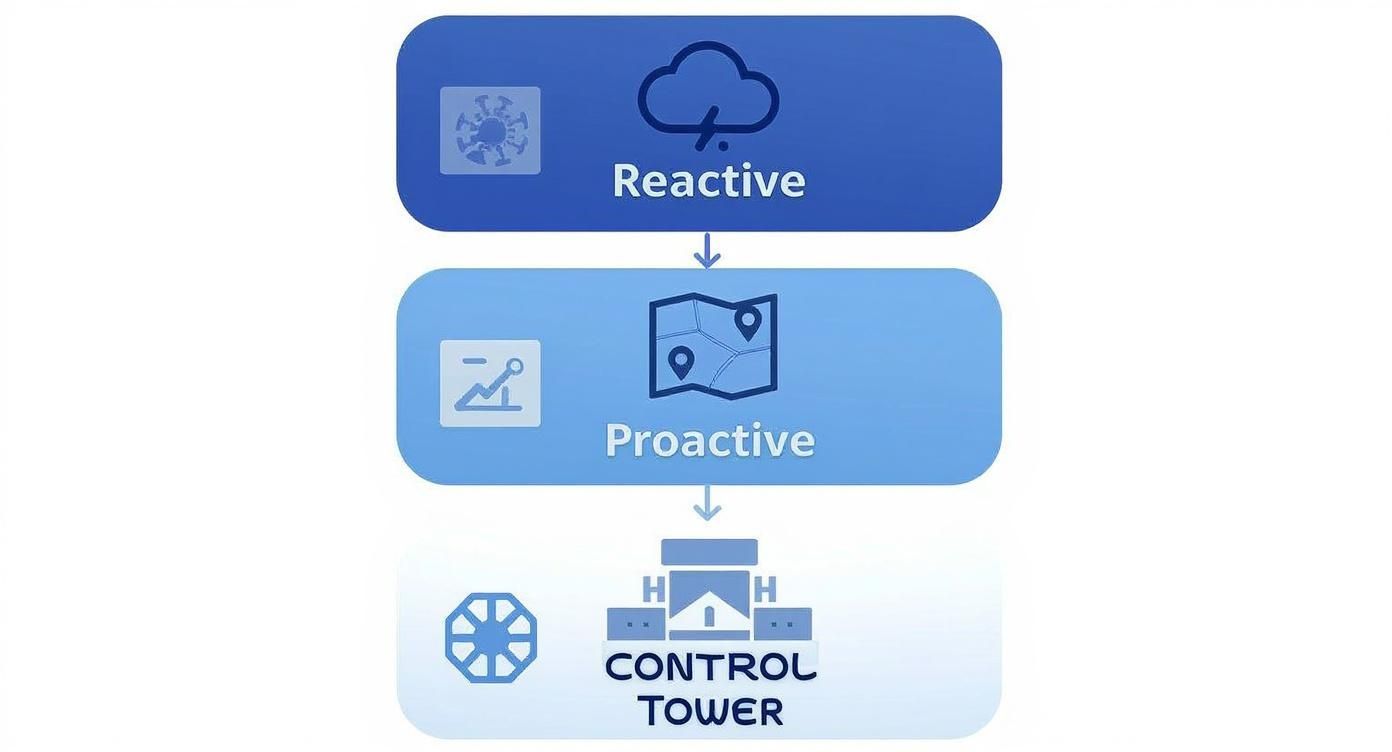
A mature control tower provides the tools to shape outcomes, not just predict them. To achieve this, it uses a multi-layered architecture.
The Foundation: The Visibility Layer
You cannot manage what you cannot see. The foundational layer of any control tower is Visibility. Most supply chain data is distributed across systems that do not communicate with each other, creating data silos.
The Visibility Layer breaks down these silos. It acts as a central data hub, integrating real-time information from across your operation to create a single source of truth.
- Transportation Management Systems (TMS): Provide live shipment locations and carrier performance data.
- Warehouse Management Systems (WMS): Offer up-to-the-minute inventory levels and order fulfillment status.
- Enterprise Resource Planning (ERP): Supply master data on orders, products, customers, and financials.
- External Sources: Integrate contextual data from IoT sensors, GPS trackers, and third-party feeds on weather, traffic, and port congestion.
By integrating this data, the Visibility Layer eliminates blind spots that can lead to costly disruptions. All stakeholders, from procurement to logistics, work from the same information.
The Brain: The Analytics Layer
With a clear, real-time view of your supply chain, the next step is to interpret the data. This is the role of the Analytics Layer—the brain of the operation.
Here, artificial intelligence and machine learning algorithms analyze large volumes of data to identify meaningful patterns. A control tower without analytics is a reporting tool; with analytics, it becomes an intelligent command center.
A McKinsey study found that companies using real-time data analysis reduced logistics costs by 15%. The Analytics Layer enables these savings by helping you move from seeing what happened to predicting what will happen next.
This layer identifies patterns and risks that a human might miss. For example, it could flag that a key supplier's on-time delivery rate has decreased by 8% over the past quarter, indicating a potential future stockout. It also allows for "what-if" scenario modeling, letting you simulate the cost and service impact of changing production or rerouting shipments before making a decision.
The Hands: The Action Layer
Insights are only useful if they lead to action. The final component is the Action and Collaboration Layer, which provides your team with the tools to make and execute decisions quickly.
When the Analytics Layer flags a probable disruption—for example, a 48-hour container delay at a port—the Action Layer triggers an automated alert.
This is more than a simple notification. It includes context and prescriptive recommendations, such as suggesting a specific downstream truck shipment be rerouted or inventory be reallocated from a nearby distribution center. This is the core of effective supply chain orchestration, a topic you can explore further in this guide on supply chain orchestration and its benefits.
This layer also includes collaboration tools, so cross-functional teams can connect on the platform, evaluate options, and implement a coordinated response without relying on email chains or phone calls. Together, these layers provide end-to-end control, giving you the foresight and agility to manage your supply chain with precision.
The Role of AI in Your Control Tower
A control tower without artificial intelligence is a basic monitoring tool. Infusing the tower with AI and machine learning upgrades it to a predictive system. It transforms your control tower from a reactive dashboard into the intelligent nerve center of your operation.
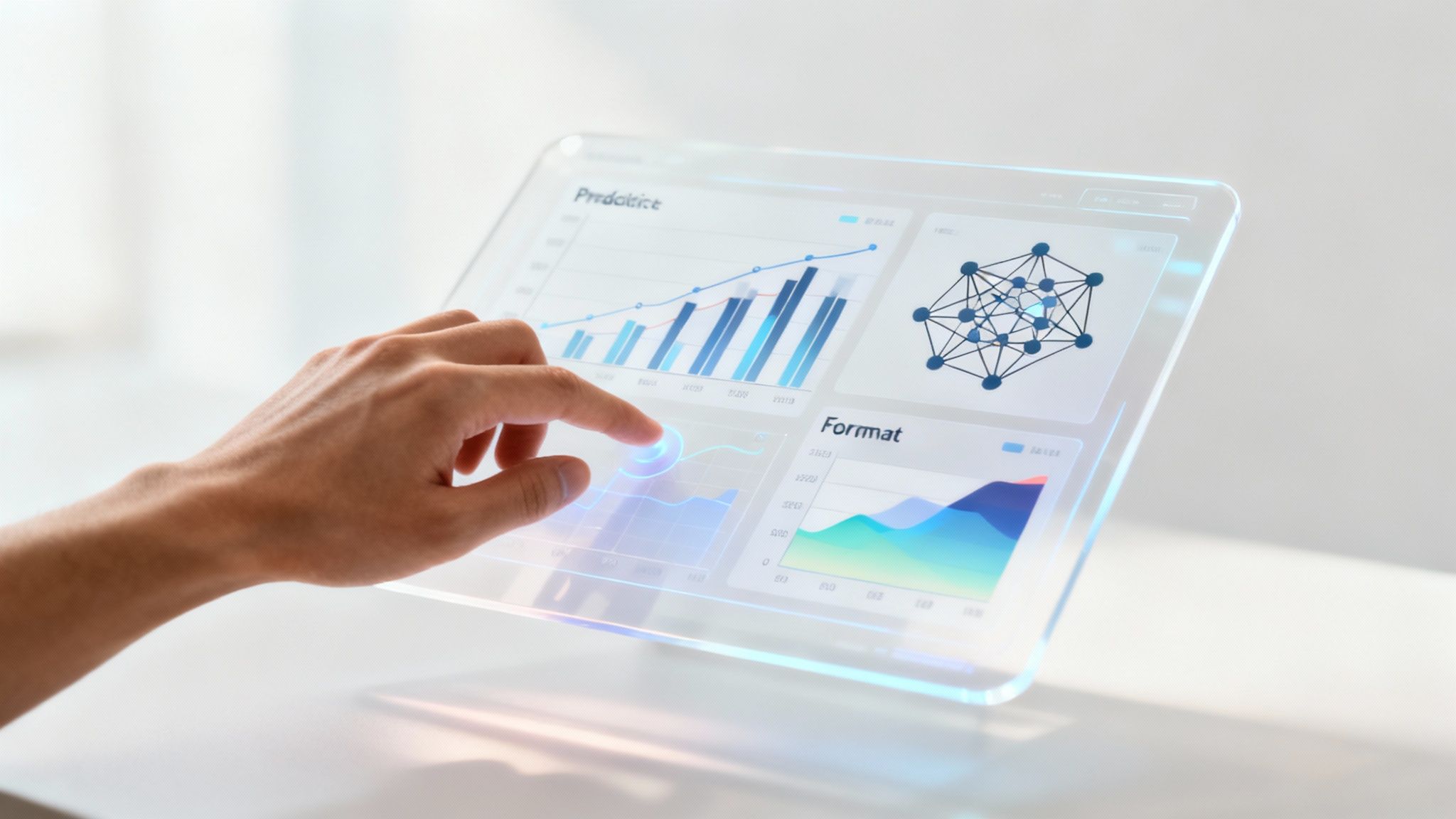
Your supply chain generates a large amount of data every second from ERPs, warehouse systems, and external sources. AI algorithms are designed to analyze this information, identifying subtle patterns and connections that a human team could not. This enables a fundamental shift from reacting to problems to proactively preventing them.
From Predictive Insights to Prescriptive Actions
Knowing a problem is likely to occur is one thing; knowing what to do about it is another. AI in a control tower doesn't just raise an alert; it provides a data-backed recommendation for how to respond. It turns a large volume of data into clear, actionable intelligence.
Here are a few examples:
- Supplier Risk Prediction: An AI model could analyze a key supplier's on-time delivery record, cross-reference it with regional weather patterns and local labor issues, and alert you to a 75% probability of a production delay—three weeks before it happens.
- Dynamic Route Optimization: Instead of using fixed routes, an AI-powered tower can reroute shipments in real time to avoid sudden port congestion or a major highway accident, saving time and fuel.
- Intelligent Inventory Management: Machine learning can analyze historical demand, incorporate upcoming marketing promotions, and consider social media trends to adjust inventory levels. This can reduce capital tied up in safety stock by 8% to 15% while still protecting against stockouts.
The application of this intelligence is growing, which is visible in how advanced technologies like AI are shaping operational fields across different industries.
The goal is to create a self-improving system. With every decision and outcome, the machine learning algorithms learn, continuously refining their forecasts and recommendations to become more accurate over time.
This combination of AI, machine learning, and cloud-based IoT is driving the rapid adoption of control towers. AI-driven analytics give teams the ability to forecast demand swings, identify supplier risks before they halt production, and optimize inventory with a new level of precision.
The Governance of AI-Powered Decisions
As AI transitions from an advisory role to an active participant in decision-making, governance becomes critical. It is not enough for an AI to produce a recommendation. Your team must understand why the model is suggesting a specific course of action. This is where concepts like model explainability and data lineage are important.
A properly governed AI control tower is not a black box. It provides transparency into its reasoning, allowing operators to trust its suggestions and know when to override them. This is the basis of responsible AI.
Ensuring this level of trust requires dedicated oversight. If you are exploring this topic, you may be interested in solutions for managing and monitoring AI models for enterprise governance. A well-governed system ensures your AI is a transparent and trusted partner in your operations.
Real-World Applications and Proven Business Value
A supply chain control tower proves its worth by delivering measurable, bottom-line results. It becomes the central nervous system of daily operations, turning predictive insights into cost savings and improved customer satisfaction. This is where the return on investment becomes clear.
The business case is built on quantifiable outcomes. For example, a global consumer packaged goods (CPG) company can use its control tower to manage promotional event performance. By connecting demand forecasts with real-time data from warehouses and transportation, they can prevent stockouts that undermine marketing campaigns.
A high-tech manufacturer dealing with frequent disruptions can use its control tower to get ahead of costly problems. When a major port becomes congested, the system identifies every shipment at risk and simulates the best alternative routes.
Driving Quantifiable Improvements
This ability to act before a problem escalates is what separates high-performing organizations. The logistics team can reroute cargo before it gets stuck in a bottleneck, saving weeks of delays and avoiding high expedited freight costs. These are strategic moves that protect profit margins and customer relationships. The impact is visible across key performance indicators.
- Reduced Expedited Freight Costs: By receiving early warnings on port delays and carrier issues, one electronics manufacturer used its control tower to proactively reroute shipments. As a result, they cut emergency freight spending by 20% compared to their Q2 baseline.
- Leaner Inventory: A pharmaceutical company used predictive analytics to adjust its safety stock levels across its network. They reduced excess inventory by 12% while maintaining a 99.5% service level for critical medicines.
- Higher On-Time, In-Full (OTIF) Rates: A major retailer increased its OTIF delivery performance from 88% to 94% in six months. The improvement was driven by real-time visibility into supplier performance and transport delays, allowing for early intervention.
The core value is the shift from reactive firefighting to proactive exception management. Instead of learning about a problem from a customer, the control tower flags a potential issue days or weeks in advance. This gives your teams the time and data needed to find a cost-effective solution.
This proactive stance provides a competitive advantage. Large retailers like Walmart and Amazon use control tower platforms. Walmart’s AI-powered tower helps it prevent empty shelves during peak seasons, while Amazon's system is the backbone for managing its complex fulfillment network. You can find more research on how market leaders are using this technology from Emergen Research on the SCCT market.
Synthetic Use Case: A Global CPG Company
Here is a practical, synthetic example. A global CPG company is launching a major summer beverage promotion. In the past, these events resulted in regional stockouts, leading to lost sales and dissatisfied retailers.
This time, they use a control tower. The planning team integrates marketing forecasts with live data from their warehouse and transportation systems. Two weeks before the launch, the tower's AI model identifies a problem. A key bottling plant in the Southeast is showing a 10% decrease in output due to unexpected equipment maintenance.
Simultaneously, the system analyzes point-of-sale data and sees a heatwave is driving demand 15% higher than forecasted for that region. The control tower automatically alerts the logistics team and recommends reallocating inventory from a Midwest distribution center that has a surplus. The team acts on the recommendation, the transfer is executed, and the stockout is avoided. The promotion achieves a 15% sales lift compared to the previous year.
This example shows how a supply chain control tower connects different data points to create a clear path to action. It is not just about seeing what is happening; it is about making intelligent, data-driven decisions that directly impact revenue. This also highlights the importance of data quality and governance. The integrity of these decisions depends on trustworthy data. To learn how to ensure the reliability of these complex systems, see our solutions for AI governance and assurance.
Your Roadmap to a Successful Implementation
Implementing a supply chain control tower is a strategic initiative, not just an IT project. It requires a thoughtful, phased approach that aligns technology with clear business goals. A solid implementation roadmap is often the difference between a valuable tool and an expensive, underused one.
The journey begins with a clear definition of success for your organization. Before evaluating vendors, you must establish the core business objectives you aim to achieve.

First, establish your "North Star" metrics. Are you focused on cutting costs, such as a 10-15% reduction in expedited freight spend? Or is the primary goal to improve customer satisfaction by achieving higher on-time, in-full (OTIF) delivery rates? Perhaps the main driver is managing risk and building a more resilient supply chain.
Clarity on these goals is essential. This clarity will guide every subsequent decision, from which data sources to prioritize to how you scope your pilot program.
Phase 1: Define Objectives and Assess Readiness
Once your primary goals are set, you need to assess your organization's readiness across data, processes, and people. A control tower relies on data, so understanding your data ecosystem is the first step.
This assessment should answer a few key questions:
- Data Accessibility: Can you access real-time data from core systems like your ERP, TMS, and WMS? Or is it isolated in silos?
- Data Quality: Is your data accurate, complete, and consistent? Identifying and fixing data gaps now is less costly than addressing them mid-project.
- Process Maturity: Are your supply chain processes standardized and documented? Or are they mostly ad-hoc and dependent on a few individuals?
An honest data readiness assessment is one of the most valuable early steps. It not only prepares the groundwork for the control tower but also often reveals immediate process improvements that can deliver value before the main system is implemented.
Phase 2: Plan the Pilot Program
Do not attempt a "big bang" rollout across the entire enterprise. This approach often leads to failure. The most effective implementations begin with a focused pilot program designed to achieve quick wins and build momentum.
This pilot should target a specific, high-impact pain point that aligns with your main business objectives.
For instance, if reducing freight costs is the goal, the pilot could focus on gaining visibility into a single, high-volume shipping lane known for delays and detention fees. The aim is to prove the concept and show a clear return on investment in a controlled environment, typically within 3-6 months.
A successful pilot accomplishes two things. First, it validates the technology and your implementation strategy on a manageable scale. Second, it creates internal advocates who can support a broader rollout based on tangible results.
Phase 3: Navigate the Build Versus Buy Decision
As the pilot plan develops, you will face the "build vs. buy" decision.
Building a custom control tower offers maximum flexibility but requires significant in-house expertise, a long timeline, and a large capital investment. This path is typically for large enterprises with unique needs and mature data science teams.
For most companies, partnering with a specialized vendor is the faster and more practical path to value. A good vendor provides a proven platform, pre-built data connectors, and industry best practices. The key is to find a partner who understands your industry and can configure their platform to meet your specific goals, rather than forcing you into a rigid model.
Regardless of the path you choose, securing buy-in across the organization is essential. A supply chain control tower impacts not just the logistics team but also procurement, finance, sales, and customer service. Effective change management, clear communication, and involvement from stakeholders in every affected department from the beginning are necessary. This ensures the project is viewed as a strategic business enabler, not just another piece of software.
Your Questions, Answered
Here are answers to some of the most common questions from leaders considering a supply chain control tower.
What’s the Difference Between a Control Tower and a TMS or WMS?
Think of it as a team of specialists versus a general manager.
Your Transportation Management System (TMS) specializes in optimizing shipping. Your Warehouse Management System (WMS) focuses on efficiency within your distribution center. Both are essential, but they operate in specific domains.
A supply chain control tower is the general manager. It does not replace these systems; it connects them. It integrates data from your TMS, WMS, ERP, and other sources to provide a single, holistic view of the entire operation. This allows you to make strategic decisions based on the complete picture.
How Long Does a Control Tower Implementation Take?
The timeline depends on the scope. A "big bang" approach is not recommended. Instead, a phased rollout is a better strategy.
A focused pilot project—for example, gaining real-time visibility into one critical shipping lane—can start delivering results in just 3 to 6 months. This demonstrates value quickly and builds support for the next phase.
A full, enterprise-wide deployment is a larger effort, often taking between 12 and 18 months. The key is to secure an early win, prove the ROI, and then expand from a solid foundation.
Do We Need Perfect Data to Get Started?
No, you do not need perfect data. But you do need a smart data strategy from the beginning.
One of the initial benefits of a control tower project is that it highlights existing data issues. The process of centralizing information from different systems exposes gaps, inconsistencies, and inaccuracies. This creates a business case for improving data governance and quality over time. You start with the data you have and build from there.
At DSG.AI, we design and operationalize enterprise AI systems that create business impact. Our architecture-first approach ensures your control tower is built to be scalable, reliable, and aligned with your operational reality. We help you turn data into a competitive asset.
See how we help organizations build their next AI-powered systems by exploring our work at https://www.dsg.ai/projects.