
Written by:
Editorial Team
DSG.AI
An Enterprise Data Architect acts as the master planner for a company's data ecosystem. They don't build a single database; they design the entire data infrastructure that connects departments like finance, marketing, and operations.
This blueprint ensures all data systems work together on a unified, scalable foundation. The architect’s work prevents data silos, which occurs when different departments use conflicting data. This strategic oversight allows company leaders to make decisions based on a single, reliable source of information.
What an Enterprise Data Architect Really Does

Imagine a company where the sales team reports 10,000 active customers, but the marketing team reports 12,500. This discrepancy happens when data systems are built without a central plan, leading to operational inefficiencies.
The architect’s job is to prevent this digital chaos. They design the entire data infrastructure. This includes creating data governance policies (the "zoning laws"), defining data integration pathways (the "interstate highways"), and selecting shared technology platforms (the "utility grids") that all departments use.
Their primary function is to translate high-level business goals into a practical, technical data strategy that the entire organization can build upon.
The Vision Beyond a Single Project
The enterprise-wide perspective distinguishes the Enterprise Data Architect. A data engineer, for instance, focuses on building a specific pipeline to move data from point A to point B. A solutions architect designs the system for a single application.
The Enterprise Data Architect operates at a higher level, answering foundational questions:
- How do we establish a single source of truth for customer data that sales, marketing, and support can all use?
- What technology standards will allow our platforms to scale by 200% over the next three years without system failures?
- How can our data architecture support future AI models while remaining compliant with GDPR?
By answering these questions, they build a resilient foundation that supports other technical roles. According to a 2023 report from Allied Market Research, the global enterprise data management market is projected to reach USD 266.8 billion by 2035, growing at a CAGR of 8.4% from 2025. This growth is driven by the need to solve data integration and governance problems, which are the core responsibilities of an Enterprise Data Architect.
An Enterprise Data Architect transforms a company from a collection of isolated data projects into a cohesive, managed ecosystem. Their work creates valuable, actionable intelligence from raw data.
Comparing an Enterprise Data Architect to Related Roles
The focus and deliverables of these roles are distinct. This table clarifies the differences.
| Role | Primary Focus | Scope | Key Deliverables |
|---|---|---|---|
| Enterprise Data Architect | Strategic design and governance | Entire organization's data ecosystem | Master data blueprint, technology standards, governance frameworks, long-term data strategy. |
| Data Engineer | Building and maintaining data pipelines | Specific data flows and systems | ETL/ELT pipelines, data warehouses, production-ready data models, data quality checks. |
| Solutions Architect | Designing systems for specific business problems | A single application or project | Application architecture diagrams, technology stack selection, integration plans for one solution. |
A Data Engineer builds data systems, and a Solutions Architect designs a specific application. The Enterprise Data Architect ensures all systems work together cohesively.
Tying the Architect's Work to Real-World Business Value
An enterprise data architect's impact is measured by business outcomes, not just technical diagrams. Their decisions are intended to turn data architecture from an IT expense into a strategic asset that increases efficiency, drives revenue, and ensures regulatory compliance.
Without a solid plan, a company experiences data-related inefficiencies. A skilled architect prevents this by creating a well-managed ecosystem where information flows smoothly and reliably.
Building a Single Source of Truth
One of the architect’s most important jobs is to create a unified data model for the organization. Instead of marketing and sales having different definitions of a "customer," the architect establishes one authoritative definition that everyone uses.
This action reduces data redundancy. By establishing a single source of truth, an architect can help an organization reduce its duplicate data. Based on synthetic project estimates, this can lead to a 15-20 percent reduction in the first year, resulting in direct savings on storage costs.
Choosing the Right Tools for the Job
The architect evaluates and selects technology to support the company's long-term vision. The goal is to build a technology stack that is cost-effective, scalable, and avoids vendor lock-in.
Strategic technology choices can deliver significant returns.
- Reduce Costs: Decommissioning redundant legacy systems and consolidating data on a modern platform can reduce annual operational costs. A synthetic example shows a potential reduction of 10-25 percent.
- Improve Performance: Well-designed data pipelines provide analytics teams with information in minutes instead of hours, accelerating the pace of business decisions.
The measure of an enterprise data architect is the efficiency they bring to the business. Their work allows employees to stop searching for data and start using it.
Navigating the Maze of Compliance and Risk
With data privacy laws like GDPR and CCPA, a well-architected system is a primary line of defense. The data architect integrates governance and security into the data infrastructure's foundation. This makes compliance an automated, systematic process rather than a manual checklist.
For example, by designing clear data lineage and strict access controls from the start, the architect ensures sensitive customer data is handled properly. This proactive approach reduces the risk of a data breach or a fine from regulators.
Fueling Revenue Growth and Innovation
A primary business goal is to use data for a competitive advantage. The architect enables this by designing systems that provide clean, reliable data to business analysts, data scientists, and product developers.
When teams can access trusted, integrated data, they can identify trends and uncover insights that lead to new products or services. For example, a retail company with a unified customer view can launch personalized marketing campaigns. A synthetic projection suggests this could increase sales conversion rates by 5-10 percent. The enterprise data architect builds the data backbone that makes this possible.
The Modern Data Architect Skill Set
An effective Enterprise Data Architect combines technical engineering skills with business strategy. Their value lies in this blend of technical knowledge and strategic vision, which allows them to translate a complex business goal into a functional, scalable data blueprint.
An architect who only understands technology may build systems that do not solve business problems. A strategist without technical skills lacks credibility with engineering teams. The most effective architects are fluent in both business and technical domains and can bridge the gap between the server room and the boardroom.
Core Technical Competencies
An architect's credibility is built on technical expertise. This requires hands-on experience and a practical understanding of architectural trade-offs. A firm grasp of fundamental technical system design principles is necessary to build large-scale systems.
Here are specific technical skills required:
- Database Systems Mastery: Proficiency with both SQL databases (like PostgreSQL) and NoSQL databases (like MongoDB or Cassandra) is required. The architect must know when to use a relational model versus a flexible key-value store.
- Modern Data Warehousing Platforms: Deep, practical knowledge of cloud-native platforms like Snowflake, Google BigQuery, or Amazon Redshift is essential. This includes understanding their internal architectures, cost models, and performance optimization.
- Data Modeling Techniques: An architect must be an expert in different data modeling approaches, such as Kimball's dimensional modeling and Inmon's normalized model. Their job is to choose the model that best serves the company’s long-term analytical goals.
According to a 2024 report by Grand View Research, the global enterprise architecture tools market is projected to reach USD 1.74 billion by 2032. Data modeling and asset management tools account for over 62% of that revenue.
Strategic and Business Acumen
Technical skills alone are not sufficient for success. The architect’s role is about aligning the technical data infrastructure with the company's strategic goals. This requires a set of non-technical skills.
The most difficult part of the job is not designing the architecture but gaining consensus from stakeholders with competing priorities. An architect's primary skill is building consensus around a unified vision.
These strategic abilities are what distinguish a highly effective architect:
- Executive Communication: They must be able to explain the business case for a multi-million dollar data platform to a non-technical audience. This involves translating a technical concept like "data mesh" into a business outcome, such as "a 15% reduction in time-to-market for new products."
- Stakeholder Management: Architects navigate the competing priorities of different departments. They must act as diplomats to find common ground between teams with different needs and technology preferences.
- Long-Term Strategic Thinking: They design systems that can adapt to business needs three to five years in the future. They anticipate future growth, new regulations, and emerging technologies like AI.
If you are planning your AI strategy, our AI readiness assessment can help you evaluate your current capabilities.
Choosing the Right Data Architecture Pattern
Selecting the right data architecture is one of the most critical decisions an enterprise data architect makes. This involves creating the right blueprint for a company’s specific needs.
An incorrect choice can lead to years of technical debt, increased costs, and systems that fail to deliver business value. The right choice creates a scalable, efficient foundation that supports analytics, accelerates AI projects, and can evolve with the business.
The diagram below shows how an architect operates at the intersection of technical knowledge and business strategy.
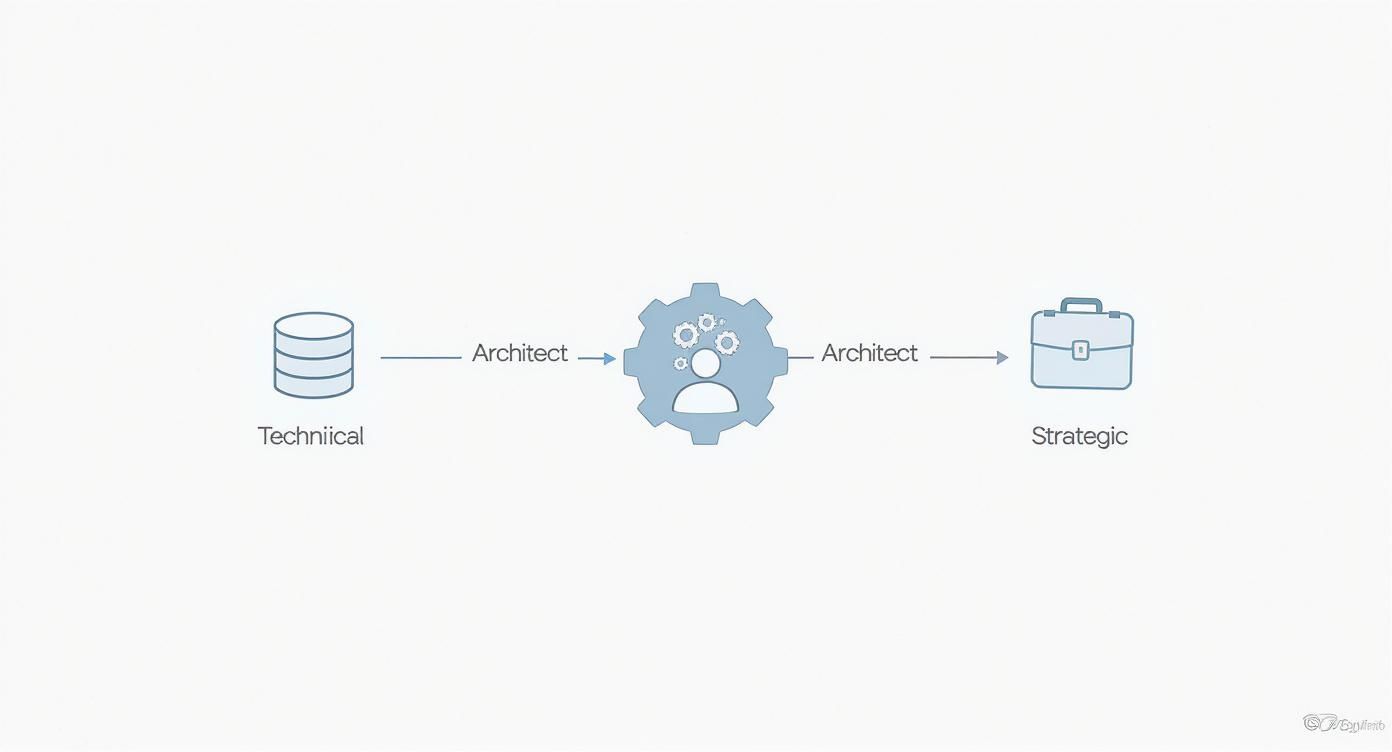
This balance is essential when choosing from the major architectural patterns available.
A Quick Tour of Modern Data Architectures
To make an informed choice, it is important to understand the philosophy behind each major pattern: the Data Warehouse, Data Lake, Data Mesh, and Data Fabric. Each has strengths and is designed for different problems.
This table breaks down the core concepts, ideal use cases, and governance models for each.
| Pattern | Core Principle | Ideal Use Case | Data Governance Model |
|---|---|---|---|
| Data Warehouse | Centralized, highly structured data for reporting. | Enterprise-wide Business Intelligence (BI) and historical analysis. | Centralized and strict. Data is cleaned and modeled before loading. |
| Data Lake | Store all data (structured and unstructured) in its raw format. | Data science, machine learning, and exploratory analytics. | Centralized but flexible. "Schema-on-read" requires strong cataloging. |
| Data Mesh | Decentralized data ownership by business domain. | Large, federated organizations needing scalability and domain autonomy. | Decentralized, federated. Domain teams own data quality and access. |
| Data Fabric | A virtualized data layer that connects disparate data sources. | Hybrid and multi-cloud environments needing unified data access. | Hybrid. Centralized policies with distributed enforcement. |
There is no single "best" option. The right choice depends on the organization’s scale, maturity, and strategic goals.
When to Use Each Pattern
A traditional Data Warehouse is like a library. Data from across the business is cleaned, structured, and cataloged before use. This ensures that when a business user accesses a report, the information is reliable and consistent. It is ideal for answering known business questions with structured historical data. Its main drawback is its rigidity and slow adaptation to change.
A Data Lake is like a reservoir. It stores large quantities of raw data in its native format. The approach is to store everything now and determine its use later. This offers flexibility for data scientists and ML engineers who need raw data to discover new patterns. The risk is that without strong governance, it can become a "data swamp."
The Data Mesh is a decentralized approach. Instead of a central team managing all data, each business domain (like marketing or finance) owns its own "data products." They are responsible for the quality and accessibility of their data. This model is suitable for large organizations that want to avoid central bottlenecks and promote data ownership. It requires a significant cultural shift to succeed.
The core idea behind a Data Mesh is to move data responsibility from a central IT team to the business domains that understand the data best. This decentralization helps data management scale as the organization grows.
These patterns typically use cloud infrastructure, which means a solid understanding of cloud computing fundamentals is necessary. According to a 2023 report from MarketsandMarkets, the global data fabric market is expected to reach USD 8.2 billion by 2030, reflecting the enterprise need for agility and connected data across hybrid environments.
Driving Collaboration and Data Governance
An Enterprise Data Architect’s technical blueprints are successful only if they facilitate collaboration between teams. Success is measured by the seamless collaboration that turns an architectural vision into a functional, governed data ecosystem. The architect is the central hub, translating business needs into technical requirements and vice versa.

This role is inherently collaborative. The architect ensures that data strategy is a shared responsibility integrated into product development, machine learning, and corporate governance.
The Architect and ML Engineering: A Symbiotic Relationship
The relationship between the enterprise data architect and Machine Learning (ML) engineers is a critical feedback loop. The architect provides a stable, governed, and accessible data platform. This involves engineering pipelines that deliver clean, reliable data that ML models can use.
In return, ML engineers are the power users of this infrastructure. Their experience provides insights for identifying bottlenecks, spotting quality issues, and improving the system.
- What the Architect Provides: A governed data platform with standardized access patterns, clear data lineage, and well-documented datasets. A synthetic project model suggests this foundation can reduce the time ML engineers spend on data preparation by 20-30 percent.
- What the ML Engineer Provides: Feedback on data quality, latency, and the need for new data sources. This feedback helps the architect refine the enterprise data model to better support advanced analytics.
Aligning Data Strategy with the Product Roadmap
For Product Managers, the data architect is a key strategic partner who ensures the data strategy enables the product roadmap. A new product feature, like a real-time recommendation engine, is a data architecture challenge.
The architect works with product teams to answer foundational questions: What data is needed? How will we collect, store, and serve it? How does this new data flow fit into our enterprise ecosystem without creating another silo? This proactive alignment prevents costly rework and ensures new products are built on a scalable data foundation.
The most effective architects anticipate future needs rather than just reacting to requests from product teams. They build the data infrastructure for the product the company will want to launch 18 months from now.
Embedding Governance with GRC Teams
Collaboration with Governance, Risk, and Compliance (GRC) teams is non-negotiable. A core part of the architect’s job is designing systems where compliance is a built-in feature. This means integrating security, privacy, and regulatory requirements into the data architecture from the beginning.
With regulations like the EU AI Act on the horizon, this partnership is critical. The architect translates legal requirements into technical controls, such as data access policies, encryption standards, and auditable data lineage. You can learn more about how to prepare for these new rules in our guide to AI Act readiness.
This approach transforms compliance from a manual audit process into an automated function of the data platform.
How to Hire and Measure a Great Data Architect
Hiring an enterprise data architect involves finding a candidate with a specific blend of skills. You are looking for someone with deep technical knowledge, strategic foresight, and the communication skills to drive projects across the organization.
Measuring their success is not about counting completed projects but about tracking tangible business results. A great architect operates at the intersection of technology, business strategy, and people, and your hiring and performance tracking should reflect this.
The Hiring Checklist
When interviewing candidates, look for evidence of both technical mastery and strategic influence. An enterprise data architect can design a system, communicate the vision, and navigate organizational politics to implement it.
- Proven Stakeholder Management: Ask for specific examples of working with stakeholders. A strong candidate will have experience mediating between a security team demanding total lockdown and a data science team needing broad access.
- Technical Justification Skills: The best architects translate technology choices into business value. Probe their experience building a business case for a large investment, such as moving from a legacy on-premise data warehouse to a cloud platform like Snowflake or Databricks.
- Architectural Fluency: They should be able to discuss the pros and cons of different architectural patterns. Can they explain why a data mesh might be right for one company but a centralized data lake is better for another, connecting it to the business context?
Key Interview Questions to Ask
Go beyond standard technical questions. Your goal is to simulate real-world problems.
- “Walk me through designing a data architecture for a company moving from on-premise to a hybrid cloud environment. What are the key risks you'd identify?”
- “Describe a time you justified a major technology investment to a non-technical executive. How did you frame the ROI?”
- “Tell me about a data governance policy you implemented. What was the business problem, and how did you get teams to adopt it?”
Measuring the Impact of Your Data Architect
An architect's performance should be tied directly to business outcomes, not just technical milestones. These KPIs connect their architectural decisions to measurable improvements.
The value of an enterprise data architect is not in the diagrams they create, but in the efficiency, cost savings, and opportunities those diagrams enable for the business. Their performance should be measured in reduced operational friction and accelerated insight.
- Reduction in Time-to-Insight: How long does it take for an analyst to access a new dataset and generate insights? An architect's work should reduce this cycle. A synthetic model shows a potential 15-25 percent improvement within their first year.
- Decrease in Data Storage and Processing Costs: By optimizing data pipelines and systems, they should deliver a measurable reduction in infrastructure spending. A reasonable target for cost savings, based on synthetic examples, is in the 10-20 percent range.
- Improvement in Data Quality Scores: Implement automated quality checks for critical data. The architect’s governance work should lead to a quantifiable increase in these scores over a six-month baseline.
Frequently Asked Questions
Here are answers to common questions about the enterprise data architect role.
How Does This Role Enable AI and Machine Learning?
An enterprise data architect is foundational to any AI or machine learning program. The architect designs and builds the data infrastructure that AI models rely on.
They are responsible for creating a governed, scalable, and accessible data infrastructure. This work ensures that data scientists and ML engineers work with clean, consistent, and trusted data.
This foundational work directly reduces the time spent on data preparation. According to a 2020 report from Anaconda, data scientists spend a significant portion of their time on data preparation.
The architect:
- Designs efficient data pipelines that feed models with high-quality data.
- Establishes a single source of truth, which is critical for preventing model drift caused by inconsistent data inputs.
- Implements governance standards to ensure every AI system is built on a foundation of compliant and secure data.
What Is the Typical Career Path to This Role?
Becoming an enterprise data architect requires technical expertise and business acumen; it is not an entry-level position. The path typically starts in hands-on technical roles.
Common stepping-stone roles include:
- Data Engineer: Builds and manages data pipelines.
- Solutions Architect: Designs technical solutions for specific business problems, often in a cloud environment.
- Senior Database Administrator: Manages and tunes large-scale, mission-critical database systems.
To advance, a professional must develop a strategic mindset, learn to translate technical ideas for executives, navigate stakeholder demands, and connect technology roadmaps to business goals.
How Can We Justify the Cost of Hiring an Architect?
Hiring a senior enterprise data architect is a significant investment. The return on investment appears in improved efficiency, lower risk, and new revenue opportunities. The architect’s value lies in preventing the costly data chaos that affects many large organizations.
An effective enterprise data architect unlocks the economic value of data. They transform an expensive data landscape into a streamlined asset that contributes to the bottom line.
The business case for this role is based on three pillars of ROI:
- Improved Operational Efficiency: By consolidating redundant systems and standardizing data models, they can reduce data storage and processing costs. A synthetic estimate suggests a 10-20 percent reduction is possible.
- Reduced Operational Risk: They design architectures with built-in governance and security, which lowers the risk of a costly data breach or a fine for non-compliance.
- Enablement of New Revenue: By providing clean, accessible data, they act as a force multiplier for analytics and AI teams. This allows them to build new data-driven products and services.
At DSG.AI, we specialize in designing and building enterprise-grade AI solutions with a clear focus on measurable ROI. Our architecture-first approach ensures your systems are scalable, reliable, and built for your unique business needs, giving you full IP ownership without vendor lock-in.
Discover how we turn complex data challenges into competitive advantages. Learn more about our production-grade AI projects.