
Written by:
Editorial Team
DSG.AI
Data quality software is a set of tools designed to find, fix, and manage the health of data across a company's systems. Its function is to convert raw, inconsistent information into a reliable asset for analytics, operations, and strategic decisions.
Why Data Quality Is a Strategic Investment
Reader Persona: Director of Data Analytics at an enterprise. Problem: Business intelligence reports are generating conflicting metrics, and AI models are underperforming. There is a strong suspicion that unreliable source data is the cause, leading to flawed business decisions.
For data leaders, the daily challenge is converting a chaotic flood of information into something trustworthy. In many companies, up to 30% of core data is inaccurate, according to market analyses. This directly undermines analytics and operational efficiency. This is where data quality software demonstrates its strategic value.
Without a systematic method for managing data quality, the costs accumulate. The symptoms appear as operational errors, unreliable business intelligence reports, and increasing compliance risks. Investing in a solution addresses these issues proactively.
The Hidden Costs of Inaction
Delaying a data quality initiative has direct financial consequences that compound over time. The problems become more difficult and more expensive to fix later. To build a foundation for any data-driven project, a leader must first understand how to solve data integrity problems and why the right software is essential.
Here are areas where poor data quality reduces business value:
- Operational Inefficiency: Incorrect inventory or customer records lead to supply chain disruptions and poor service experiences. A global logistics company, in a synthetic example, found it was losing thousands of staff hours each quarter manually correcting shipping address errors that originated in their CRM.
- Flawed Analytics and AI: Predictive models and AI systems are only as reliable as their training data. For example, a business might project 15% growth for a product line, only to discover it was declining because of skewed sales data from duplicate transaction records.
- Increased Compliance Risk: Regulations like GDPR and CCPA require accurate customer data. Incomplete or duplicated records can prevent a company from properly responding to data access requests, creating exposure to potential fines.
A principle in data management is the "1-10-100 Rule." This states it costs $1 to validate a record at the point of entry, $10 to cleanse it later in a batch process, and $100 per record if no action is taken, accounting for the downstream costs of the error.
Investing in data quality software allows a shift from reactive data cleanup to a proactive data governance strategy. The software functions like a refinery, turning crude data into a predictable, high-value asset. With reliable data, analytics, AI, and operational systems can run at peak performance.
Diving Into the Core Capabilities of Data Quality Platforms
Modern data quality software is an integrated system. Each capability is designed to address a specific business problem by improving data reliability. Understanding these core functions is the first step toward building a resilient data foundation.

These capabilities are the building blocks of a data management strategy. A clear understanding is necessary for anyone learning how to improve data quality across an organization. It supports a move from just spotting problems to actively fixing them before they cause damage.
Data Profiling: The Diagnostic Report
Before fixing a data issue, you must understand its scope. Data profiling is the diagnostic step. The software automatically scans data sources to analyze their structure, content, and relationships.
It answers specific questions:
- What percentage of records in the "State" column are null?
- Does the "Phone Number" field consistently adhere to a 10-digit format?
- How many unique values exist in the "Product Category" column?
By generating this statistical summary, profiling highlights hidden issues before they corrupt analytics. This initial analysis provides the baseline needed to create effective rules for cleansing and standardization.
Data Cleansing and Standardization: The Fix-It Crew
Once profiling identifies problems, data cleansing and standardization tools begin corrective work. This is the phase where errors are fixed, inconsistencies are resolved, and data is aligned with a universal standard.
Cleansing involves correcting or removing inaccurate, incomplete, or corrupted data. Standardization ensures that values are represented consistently. For example, it converts "USA," "U.S.A.," and "United States" into a single, standard format. This process makes the data reliable for analysis.
By standardizing data at the point of entry and across existing systems, organizations can prevent the compounding effect of small errors. This proactive correction is fundamental to building trust in downstream business intelligence and reporting.
Data Matching and Deduplication: Creating a Single Source of Truth
Duplicate records scattered across different systems are a common challenge. Data matching and deduplication tools are designed to find and merge these redundant records, creating a single, authoritative source of truth.
For instance, a single customer might exist in a CRM, a billing system, and a marketing platform with slight variations like "Jon Smith," "Jonathan Smith," and "J. Smith" at the same address. Data quality software uses matching algorithms to identify these as the same entity.
Synthetic Example A B2C retail company analyzed its e-commerce and loyalty program databases and found over 250,000 duplicate customer records. After implementing an automated deduplication process, the company measured the following outcomes:
- An 8% reduction in marketing mailer costs within one quarter by eliminating multiple mailings to the same household.
- A 12% improvement in customer satisfaction scores over six months, attributed to more personalized and consistent communication.
This cleanup is essential for creating a 360-degree view of customers, products, or suppliers, which improves operational efficiency and the customer experience. Platforms like DSG.AI's assureIQ provide tools to manage and govern these data-matching processes.
Data Monitoring: The Proactive Guardian
Data quality is not a one-time project; it requires continuous oversight. Data monitoring acts as a guardian for the data ecosystem. It continuously tracks data against defined business rules and quality metrics, automatically flagging new issues as they appear.
This feature can alert teams to data quality degradation in near real-time, such as a sudden spike in null values from a key data source. By catching these problems early, monitoring prevents them from escalating into widespread issues that could affect business decisions. It shifts data quality from a reactive cleanup task to a sustained, forward-looking process.
Core Capabilities of Data Quality Software
These core functions work together to build and maintain data integrity. Each plays a distinct role, from initial diagnosis to ongoing maintenance.
| Capability | Primary Function | Business Impact Example |
|---|---|---|
| Data Profiling | Scans and analyzes data to discover its condition, structure, and content. | Uncovers that 30% of customer phone numbers in a specific database are in an invalid format before a marketing campaign launch. |
| Data Cleansing | Corrects, amends, or removes inaccurate, incomplete, or erroneous data. | Fixes misspelled city names and incorrect postal codes, improving logistics and delivery accuracy by a measured 4% in Q3. |
| Data Matching | Identifies and links related records that represent the same entity. | Consolidates multiple customer profiles into a single master record, enabling a 360-degree view for customer service agents. |
| Data Monitoring | Continuously tracks data against predefined rules to detect new quality issues. | Sends an alert when a data feed starts delivering records with missing invoice amounts, preventing financial reporting errors. |
A comprehensive data quality platform integrates these capabilities, providing a unified approach to transforming raw data into a reliable enterprise asset.
How to Evaluate Data Quality Software for Your Enterprise
Selecting the right data quality software is a strategic decision. The platform will affect financial and operational outcomes for years. For enterprise leaders, the evaluation must go beyond a feature checklist.
A practical evaluation judges these tools based on how they will perform within your specific environment. This means focusing on architectural requirements, long-term costs, and the vendor's ability to support governance goals. A rushed decision can lead to a tool that fails to scale, integrate, or solve the intended problem.
Assess Scalability and Performance
Enterprise data volumes are large and growing. A platform that performs well on a small dataset may not handle petabyte-scale streams from ERP systems, IoT devices, and customer applications. The first task is to test any vendor's claims about scale.
Ask specific questions:
- What is the measured processing throughput for cleansing 10 million records of our customer data?
- How does performance change when running deduplication rules across a 500-million-row table?
- Can the platform handle both large batch jobs and real-time quality checks on streaming data without introducing significant latency?
A vendor should provide clear performance benchmarks or allow a proof-of-concept (POC) with your own data. This is the only way to confirm the software can handle your current and future data loads without becoming a bottleneck.
Prioritize Integration and Architectural Fit
A data quality tool is ineffective if it cannot connect to existing systems. Seamless integration is a core requirement. Your evaluation must confirm the platform will fit into your technology stack.
Consider how it interacts with key parts of your architecture:
- Cloud Data Warehouses: Does it have native, high-performance connectors for platforms like Snowflake, Databricks, BigQuery, or Redshift?
- Legacy and On-Premise Systems: How does it connect to older databases and mainframe systems that run critical business functions?
- API and Extensibility: Is there a well-documented API that allows developers to automate data quality jobs and build custom integrations?
The goal is to find a solution that embeds quality checks directly into your data pipelines. This avoids the inefficient and less secure process of exporting, cleaning, and re-importing data. Quality should be managed where the data resides.
Scrutinize Security and Compliance Features
For any large organization, especially in regulated industries like finance or healthcare, security is a primary concern. A data quality tool will access sensitive information, so its security must be robust.
A data breach originating from a third-party tool can cause significant financial and reputational damage. Vetting a vendor’s security posture is a critical due diligence step that protects the entire business.
Your evaluation must include a deep review of security and compliance. Request documentation and proof of:
- Data Encryption: Is data encrypted both in transit (over the network) and at rest (on disk)?
- Access Controls: Does it offer role-based access control (RBAC) and integrate with your corporate identity provider (like Active Directory or Okta)?
- Compliance Certifications: Can the vendor provide current certifications relevant to your industry, such as SOC 2, HIPAA, or ISO 27001?
These are fundamental requirements for protecting your data and maintaining compliance with regulations like GDPR and CCPA.
Analyze the Total Cost of Ownership
It is important to look beyond the initial purchase price and understand the Total Cost of Ownership (TCO). The license fee is often only one component of the total expense.
To calculate the TCO, factor in all associated costs:
- Licensing and Subscription Fees: The direct cost of the software.
- Implementation and Integration: The cost of professional services or the hours your internal team will spend on setup.
- Training and Onboarding: The resources required to enable your team to use the platform effectively.
- Ongoing Maintenance and Support: Annual support contracts and the personnel needed to operate and maintain the tool.
A thorough TCO analysis provides a realistic picture of the long-term financial commitment. This allows you to make an investment that aligns with your budget and delivers clear, defensible value.
Fueling Your AI and Analytics with Trusted Data
The principle "garbage in, garbage out" is especially relevant in the era of AI and advanced analytics. AI initiatives are like high-performance engines; their output depends on the quality of the fuel. Poor data can lead to inaccurate results and undermine strategic projects.
Flawed models, wasted resources, and missed opportunities are direct consequences of poor data quality. Data quality software acts as the filtration system for your data pipelines, ensuring that advanced systems are fed clean, consistent, and reliable information. Without it, data scientists often spend the majority of their time cleaning data instead of building models that create business value.

The Direct Impact on Model Performance
The link between data quality and AI performance is direct and measurable. Small, hidden errors in a dataset can degrade a predictive model's accuracy. This is a practical problem with financial implications.
Consider a common scenario. An e-commerce company builds an AI model to predict customer churn. The model is trained on customer data that contains a 10% error rate from duplicate accounts and outdated addresses. The outcomes are:
- The model's predictions are 15-20% less accurate compared to a model trained on clean data, based on backtesting.
- It fails to identify key signals from high-risk customers, resulting in preventable revenue loss.
- The marketing team allocates budget to retain customers who are duplicates or have already churned.
This example illustrates that data quality is a critical component of an AI strategy. Effective data quality tools can prevent these costly mistakes. Once data integrity is established, the next step is to manage your AI model portfolio to ensure ongoing performance and governance.
Accelerating Time-to-Value for Data Science Teams
Automating data quality can significantly increase the productivity of technical teams. Data scientists report spending up to 80% of their time preparing data—cleansing, validating, and transforming it. This is a bottleneck that slows innovation.
By implementing automated data cleansing and enrichment, organizations can reduce the manual data preparation work for data science teams by up to 50%, based on common project outcomes. This change allows new AI and analytics projects to deliver value more quickly.
Data quality software becomes an investment in business agility. This realization is driving market growth. The global market for data quality tools, valued at USD 2.3 billion, is projected to exceed USD 8 billion by 2033, largely due to the expansion of AI and machine learning. You can read more about data quality market forecasts for more detail on this trend.
When data scientists can focus on analysis and model building, the entire organization benefits from faster, more reliable insights.
Building the Business Case and Measuring ROI
To secure executive approval for new data quality software, the case must be presented in financial terms. It is not sufficient to discuss "cleaner data." You must connect data quality improvements to a clear Return on Investment (ROI) that aligns with executive priorities.
A strong business case reframes data quality from an IT expense into a driver of business performance. It builds a framework that shows how better data impacts the bottom line, shifting the conversation from concepts to numbers that justify the investment.
The Four Pillars of Data Quality ROI
To build a financial model, focus on improvements across four areas. Each represents a way that high-quality data generates tangible business value.
- Cost Reduction: This often provides the most immediate returns. Cleaning data eliminates direct waste. For example, deduplicating customer records reduces spending on redundant marketing campaigns.
- Risk Mitigation: Poor data quality can be a liability, creating exposure to compliance and legal issues. This can be quantified by estimating the potential cost of fines for violating regulations like GDPR or CCPA. Accurate, governed data is a key defense.
- Productivity Gains: Data scientists and analysts may be spending significant time manually cleaning data. Automating this work allows them to focus on high-impact analysis, increasing their output without increasing headcount.
- Revenue Growth: A single, trustworthy view of each customer is foundational for effective cross-selling and up-selling. It also improves the accuracy of sales forecasts and personalization engines, which can increase revenue.
The most effective business cases combine metrics from all four pillars. For example, you can show how a 10% reduction in duplicate customer records leads directly to a 5% decrease in marketing costs, while also making revenue forecasts more reliable.
Quantifying the Financial Impact
To make your case persuasive, use specific metrics. Connect your data quality initiatives to the Key Performance Indicators (KPIs) that the business already uses.
Here is a practical breakdown of metrics for each ROI pillar:
| ROI Pillar | Key Metric to Measure | A Realistic Example of Impact |
|---|---|---|
| Cost Reduction | Decrease in wasted marketing spend | Reducing duplicate mailers saves $150,000 annually. |
| Risk Mitigation | Reduced exposure to regulatory fines | Avoiding one potential GDPR fine saves an estimated $4 million. |
| Productivity Gains | Hours reclaimed by data teams per week | Reclaiming 40 hours/week for data analysts. |
| Revenue Growth | Increase in cross-sell conversion rate | A 3% lift in conversions from improved customer targeting. |
When the numbers are presented this way, the focus shifts from the cost of the software to the financial returns it can generate. Customer data management represents a 40% share of the data quality tools market, according to industry reports. This is because accurate customer records are the foundation for AI models driving churn prediction and personalized marketing. To learn more, you can explore the global data quality tools market.
A successful business case proves that inaction is more expensive than the investment. By clearly articulating the financial upside, you can secure the buy-in needed to make data quality a strategic priority.
A Phased Roadmap for Enterprise Implementation
Implementing enterprise data quality software is a process that benefits from a phased approach. This method avoids overwhelming teams and demonstrates value early, which helps build momentum.
This is a strategic business transformation, not just an IT project. Each phase should build on the previous one, creating a strong foundation for reliable data across the organization.
Phase 1: Discovery and Scoping
First, you need a clear direction. Before configuring software, pinpoint where poor data quality causes the most significant business problems. Is it inaccurate customer data affecting marketing campaigns? Or is it inconsistent product data creating supply chain issues?
At this stage, assemble a cross-functional team that includes representatives from IT, engineering, and the relevant business units. Involving business stakeholders from the beginning is key to setting realistic goals and ensuring you are solving problems that matter.
Phase 2: The Pilot Project
Once a target area is identified, conduct a pilot project. The goal is to achieve a quick, meaningful win to build confidence and prove the value of the investment. Select a use case that is significant enough to be noticed but small enough to be manageable.
A good example is cleaning and deduplicating customer records for a single market segment. Success should be measured not just by a technical metric, like a 15% reduction in duplicates, but also by a business outcome, such as a measurable increase in campaign response rates. A successful pilot is an effective internal marketing tool. For these projects, understanding data and AI orchestration is beneficial.
Phase 3: The Phased Rollout
With a successful pilot completed, begin the broader rollout. Avoid a "big bang" launch. Instead, expand systematically, department by department or data domain by data domain.
Use the lessons from the pilot to refine your process, train new users, and adapt data quality rules for different business areas. This approach minimizes disruption and allows each team to see the benefits. It helps build a culture where data quality is a shared responsibility.
The infographic below shows the path to ROI that a structured data quality initiative can deliver.
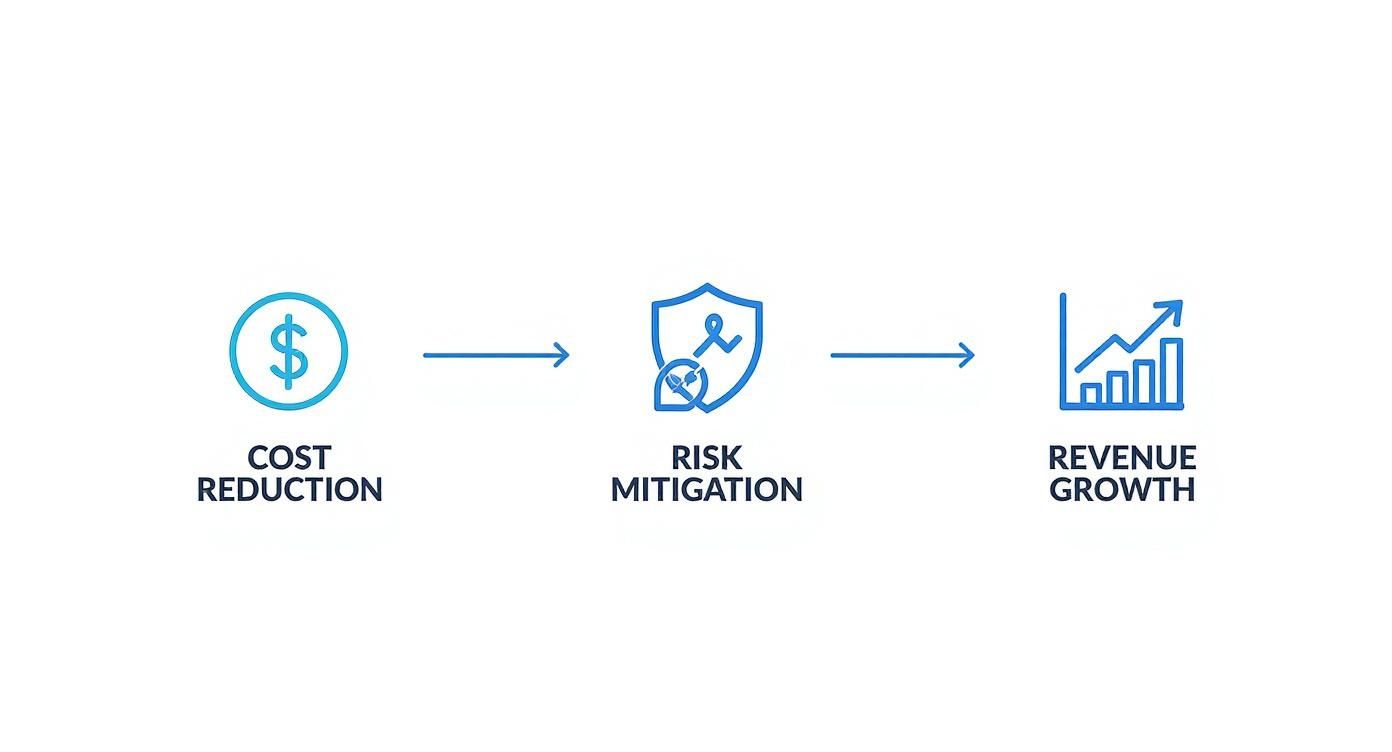
These improvements lead to cost savings, lower risk, and opportunities for revenue growth.
Phase 4: Governance and Optimization
Finally, the project transitions from a one-time implementation to an ongoing program of governance and continuous improvement. This is how you sustain the benefits. Formalize data stewardship by creating a data governance council to set and enforce data quality standards across the enterprise.
Your data quality software becomes the central hub for this activity, with dashboards that track key metrics against your goals. This provides continuous visibility into data health. This phase ensures that data quality becomes a permanent part of your company’s operations.
Answering Common Questions About Data Quality Software
When evaluating data quality software, several practical questions often arise. Here are answers to common questions from data leaders to help plan a technical deployment.
How Does This Software Actually Fit into Our Cloud Stack?
Modern data quality platforms are designed to operate within cloud ecosystems like Snowflake, Databricks, and Google BigQuery. They use native connectors and APIs to integrate.
This native integration allows you to run data quality checks directly where your data resides, within existing pipelines. This avoids moving large datasets to another system, which improves security and efficiency.
What’s a Realistic Timeline for Seeing a Return on Investment?
The timeline for ROI depends on the project's scope, but most organizations begin to see tangible returns within six to nine months. This is particularly true when starting with a focused, high-impact pilot project.
The full ROI, which includes strategic benefits like more reliable analytics and improved operations, typically materializes over a 12 to 18-month period.
Synthetic Example: A financial services firm focused its pilot on deduplicating its customer data. In two quarters, they measured a 5% to 7% reduction in direct marketing waste against their Q4 baseline. This quick win helped build support for a company-wide rollout.
Do We Need to Hire a Special Team Just to Manage This?
Not necessarily, but successful data quality requires a collaborative effort. It involves both technical and business-side personnel.
Data engineers typically manage the technical implementation. Business experts, or data stewards, from departments like marketing, sales, and finance define what constitutes "good" data. They set the business rules and quality standards that the software enforces.
Many modern tools offer no-code or low-code interfaces. This allows business users to manage quality rules directly, which reduces the workload on technical teams and fosters a sense of shared ownership. This collaboration ensures the rules are practical and aligned with business needs.
Ready to turn your data from a potential liability into your most powerful asset? The expert team at DSG.AI designs and builds enterprise-grade AI and data solutions that deliver measurable value from day one. See how our architecture-first approach can fuel your most critical initiatives by exploring our past projects.