
Written by:
Editorial Team
Editorial Team
The modern supply chain is a complex network of producers, suppliers, logistics providers, and customers. It is under constant pressure from market volatility, rising costs, and unexpected disruptions. Minor inefficiencies can cascade into major problems, impacting everything from profit margins to customer satisfaction. For supply chain managers and logistics directors, the core challenge is clear: how to enhance visibility, reduce operational friction, and build a more resilient, responsive network.
This challenge often manifests as struggles with inaccurate demand forecasts leading to excess inventory or stockouts, inefficient transportation routes driving up fuel costs, and siloed data preventing proactive risk management. This article addresses this problem directly by providing ten specific, technology-driven ways to improve supply chain efficiency. Our goal is to educate you on these advanced methods, moving beyond generic advice to offer a clear, quantifiable blueprint for implementation.
We will explore how artificial intelligence and automation can deliver measurable results, such as reducing forecast errors by up to 40% or cutting fuel costs by 15% or more. The strategies detailed here are designed to be comprehensive, covering planning, logistics, and operational management. Before diving into these advanced, AI-focused solutions, those looking for foundational improvements can explore more general actionable strategies to improve supply chain efficiency to set a strong baseline.
This guide provides the tactical steps needed to transform your supply chain from a cost center into a significant competitive advantage. Let's examine the practical methods your organization can adopt to achieve operational excellence.
1. AI-Driven Demand Forecasting and Predictive Analytics
Traditional forecasting relies on historical sales averages, which often fail to account for market volatility and emerging trends. This older method is a primary source of inefficiency, leading to costly overstock or damaging stockouts. AI-driven demand forecasting is one of the most effective ways to improve supply chain efficiency by replacing static calculations with dynamic, self-learning models.
These systems analyze vast datasets, including historical sales, seasonality, market trends, and even external factors like weather patterns or social media sentiment. Machine learning algorithms identify complex patterns invisible to human analysts, producing granular forecasts at the SKU level. This enhanced accuracy directly reduces inventory carrying costs and minimizes lost sales from unavailable products.
Implementation Blueprint
- Baseline and Scope: Begin by establishing baseline metrics for your current forecast accuracy (e.g., Mean Absolute Percentage Error) and inventory levels. Start the AI implementation with a high-value product category to demonstrate a clear ROI before scaling.
- Data Integration: Connect the AI platform to your core systems, such as your ERP and inventory management software. Ingest relevant external data feeds (e.g., economic indicators, competitor pricing) to enrich the model's predictive power.
- Model Monitoring: Plan for continuous model monitoring from the start. A model's accuracy can drift over time as market conditions change. Implement a process to track performance and trigger retraining when accuracy degrades below a set threshold.
Quantified Outcome Example: A consumer goods manufacturer leveraged AI forecasting over a six-month period. They achieved a 17% reduction in on-hand inventory while improving on-shelf availability by 8% compared to the previous year's baseline. Another synthetic example shows a retail chain cutting overstock by up to 30%, which frees up significant working capital. One project from DSG.AI involved optimizing retail planograms based on demand predictions, directly linking forecasting to in-store product placement and sales uplift. This approach transforms the supply chain from a reactive cost center into a proactive, data-driven operation.
2. Intelligent Route Optimization and Last-Mile Delivery
Static, predetermined routes are a significant drain on logistics resources. They often ignore real-time variables that impact delivery times and costs. This traditional approach leads to higher fuel consumption, increased driver overtime, and missed delivery windows, which directly erodes profit margins. Intelligent route optimization is one of the key ways to improve supply chain efficiency by using dynamic algorithms to solve complex vehicle routing problems in real time.
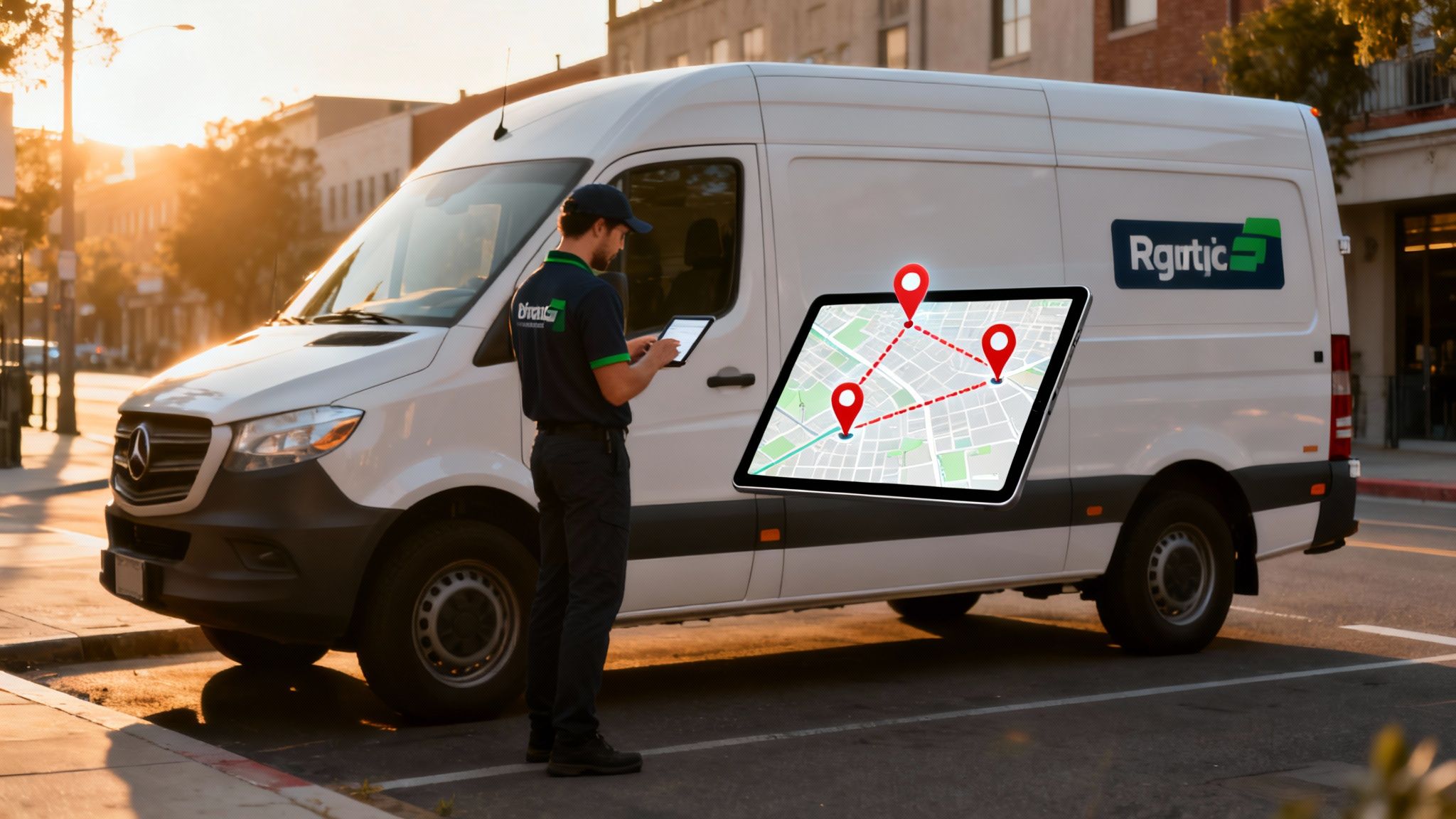
These systems process multiple constraints simultaneously, including traffic conditions, vehicle capacity, delivery time windows, and even driver-specific parameters. Machine learning models analyze historical delivery data to predict travel times and identify the most efficient sequences for hundreds or thousands of stops. The result is a substantial reduction in miles driven, lower operational costs, and a more reliable last-mile delivery service.
Implementation Blueprint
- Integrate Real-Time Data Sources: Connect your routing software with real-time traffic APIs (e.g., Google Maps, TomTom) and your order management system. Ensure a seamless flow of new orders and on-the-ground conditions to enable dynamic re-routing throughout the day.
- Establish a Driver Feedback Loop: Begin by validating optimized routes against driver expertise. Implement a formal process for drivers to report routing discrepancies or suggest improvements. Use this feedback to refine the algorithm's parameters and build trust in the system.
- Monitor Core Logistics KPIs: Track key performance indicators like on-time delivery rate, cost per delivery, and fuel consumption per vehicle. Set a baseline before implementation and monitor these metrics continuously to quantify ROI and identify areas for further optimization.
Quantified Outcome Example: According to multiple industry case studies, parcel delivery companies have used intelligent routing to cut annual transportation costs by 12% to 18% while increasing delivery capacity. A synthetic example: a last-mile delivery startup saw a reduction in cost per package of over 20% by minimizing drive time and fuel usage. In a related operational context, DSG.AI's work with logistics email classification shows how AI can streamline workflows by automating data extraction and routing, providing crucial insights that feed into broader optimization strategies. This transforms logistics from a fixed-cost function into a dynamic, efficient operation.
3. Intelligent Warehouse Automation and Inventory Management
A warehouse is no longer just a storage facility. It is a dynamic hub where manual processes can create bottlenecks and errors. Traditional warehouse management often struggles with labor shortages, inaccurate inventory counts, and slow order fulfillment cycles. Intelligent warehouse automation is one of the most direct ways to improve supply chain efficiency. It leverages AI to orchestrate physical and digital operations, transforming the warehouse into a responsive, precise, and cost-effective asset.
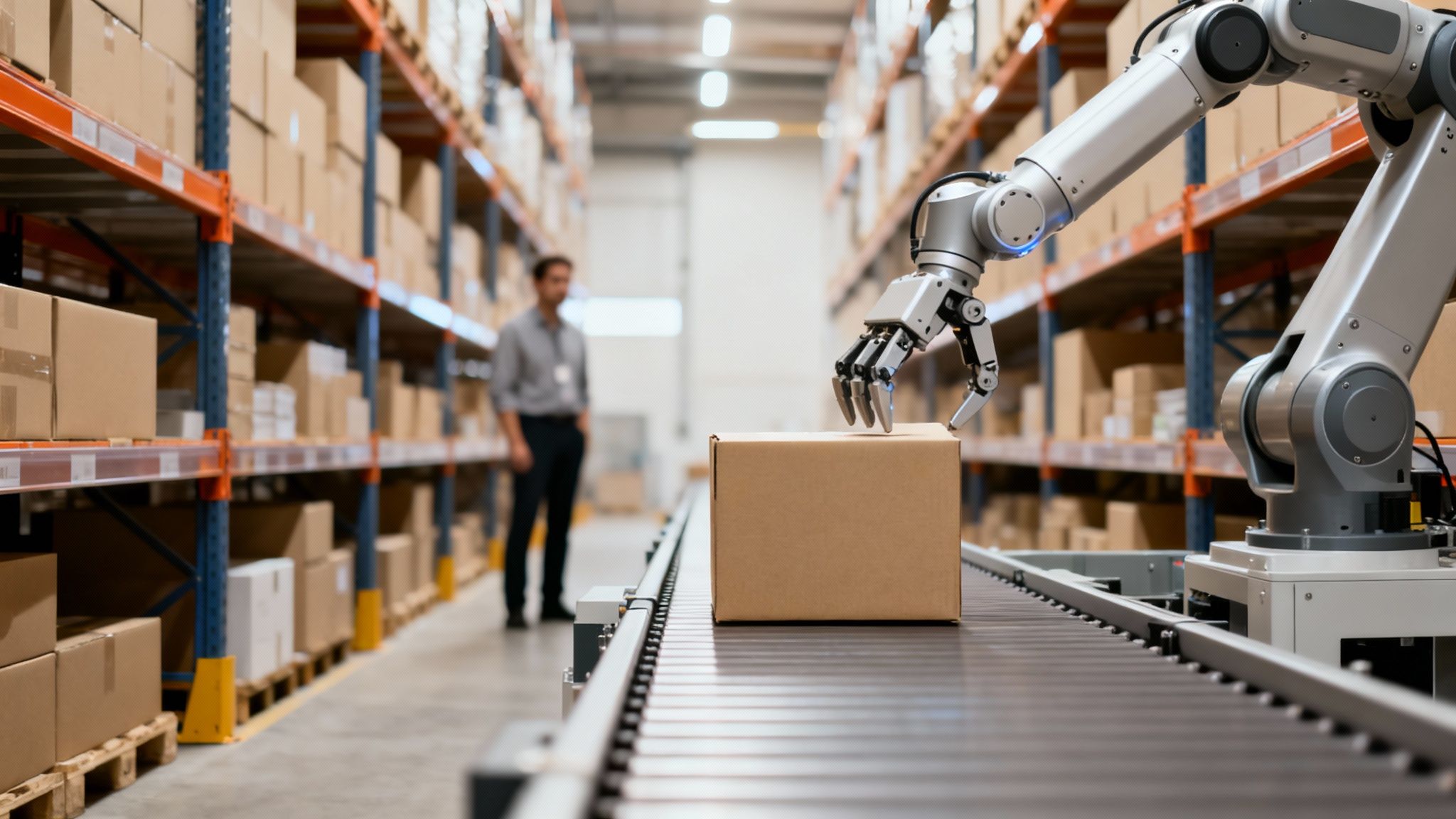
These AI-driven systems integrate with your Warehouse Management System (WMS). They use data from IoT sensors, computer vision, and robotics to optimize every action. Algorithms determine the most efficient product slotting based on demand forecasts, orchestrate autonomous mobile robots (AMRs) for picking and packing, and even predict equipment maintenance needs before a failure occurs. This layer of intelligence reduces reliance on manual labor for repetitive tasks, minimizes human error, and accelerates order throughput from receiving to shipping.
Implementation Blueprint
- Establish Baselines and Target Zones: Start by measuring current warehouse KPIs, such as order picking accuracy, dock-to-stock time, and fulfillment cycle time. Identify a high-volume, high-complexity zone, like a fast-moving consumer goods picking area, for an initial pilot project to demonstrate value quickly.
- System Integration and Workflow Design: Ensure the automation platform can seamlessly integrate with your existing WMS and ERP systems for real-time data exchange. Redesign workflows to accommodate human-robot collaboration, clearly defining tasks for staff versus automated systems.
- Phased Rollout and Training: Deploy automation in controlled phases, zone by zone, to minimize operational disruption. Prioritize comprehensive staff training on the new AI-assisted workflows and safety protocols well before each phase goes live to ensure a smooth transition.
Quantified Outcome Example: According to reports from robotics providers, e-commerce fulfillment centers have utilized autonomous mobile robots to reduce order picking times by over 25% while improving order accuracy to 99.8% or higher. A 3PL provider, as detailed in a case study by Geek+, implemented a goods-to-person AMR solution that increased its warehouse storage capacity by 50% and improved overall operational efficiency by three times. This application of AI turns the warehouse from a labor-intensive cost center into a key driver of customer satisfaction.
4. Supplier Quality and Risk Management (TPRM)
Relying on a single supplier or failing to monitor their health creates a single point of failure that can cripple an entire supply chain. Traditional, manual supplier vetting and periodic reviews are not sufficient to manage modern geopolitical, financial, and compliance risks. Enhanced Third-Party Risk Management (TPRM) is a critical way to improve supply chain efficiency by shifting from reactive crisis management to proactive risk mitigation.
Modern TPRM systems use AI to continuously monitor a vast ecosystem of supplier data. These platforms track financial stability, operational performance, cybersecurity posture, and compliance with regulations like FDA or EMA requirements. Machine learning models can assess the probability of a supplier defaulting, flag concentration risks in specific regions, and provide early warnings on potential disruptions. This enables data-driven diversification and contingency planning.
Implementation Blueprint
- Define Risk Thresholds: Establish clear, quantifiable thresholds for key risk indicators (KRIs) like financial distress scores or compliance infractions. Define a formal escalation procedure for when a supplier crosses a predefined threshold to ensure a rapid and standardized response.
- Integrate Data Streams: Connect the TPRM platform with your procurement and payment systems for a holistic view of supplier interactions. Enrich this internal data with external feeds on geopolitical events, regulatory changes, and adverse media mentions to build a comprehensive risk profile.
- Monitor Tier-N Suppliers: Extend monitoring beyond your direct (Tier 1) suppliers to critical indirect suppliers (Tier 2+). A disruption with your supplier's supplier can have an equally damaging impact on your operations. Start by identifying the most critical components and mapping their upstream supply chains.
Quantified Outcome Example: A synthetic example: an automotive manufacturer used AI-powered TPRM to get an early warning on a key Tier 2 component supplier facing financial distress. This allowed them to pre-emptively secure an alternative source and avoid an assembly line shutdown that would have cost millions per day. In another case, a pharmaceutical company leveraged continuous compliance monitoring to identify a supplier's deviation from EMA standards, preventing a costly product recall. This proactive stance transforms supplier management from a procurement function into a strategic risk intelligence capability.
5. Demand-Driven Supply Chain Planning (S&OP/IBP)
Functional silos between sales, operations, and finance are a significant bottleneck. They cause misaligned plans, excess inventory, and missed revenue opportunities. Demand-driven supply chain planning, through Sales & Operations Planning (S&OP) or Integrated Business Planning (IBP), breaks down these barriers. It creates a unified, collaborative process where all departments align on a single, consensus-based plan.
This approach synchronizes demand forecasts with inventory levels, production capacity, and financial constraints. AI enhances this process by enabling what-if scenario modeling and optimizing complex trade-offs automatically. Instead of reacting to disruptions with fragmented decisions, teams can proactively evaluate the financial and operational impact of different strategies. This organizational alignment is one of the most effective ways to improve supply chain efficiency.
Implementation Blueprint
- Establish Governance and Scope: Before adopting any new technology, form a cross-functional S&OP steering committee with clear decision-making authority. Start with a monthly planning cycle focused on a specific business unit to prove the model's value and refine the process.
- Integrate Data and Define Cadence: Connect your planning platform with core ERP, CRM, and supply chain management systems to create a single source of truth. Define a clear meeting cadence (e.g., demand review, supply review, executive S&OP) with set inputs and outputs for each stage.
- Empower with Scenario Analysis: Equip the team with AI-driven tools to run simulations. Model the impact of potential events like a supplier delay or a sudden demand surge. This shifts the S&OP/IBP process from a reporting function to a strategic decision-making engine.
Quantified Outcome Example: A synthetic example: a major consumer goods company leveraged an IBP process to reduce its planning cycle from four weeks to just five days, improving its response to volatile market demand. Similarly, food and beverage manufacturers have used demand-driven planning to improve product freshness and cut waste by 15% to 25%. This strategic alignment is a cornerstone of advanced supply chain management. Learn more about how AI can power this collaborative planning on dsg.ai.
6. Computer Vision for Quality Control and Compliance
Manual visual inspections are a significant bottleneck in many supply chains. They are prone to human error, fatigue, and inconsistency. This traditional approach to quality control often relies on statistical sampling, leaving a substantial portion of products unchecked. Computer vision is one of the most transformative ways to improve supply chain efficiency. It automates visual inspection with high accuracy and speed, shifting from sample-based checks to 100% verification.
These AI-powered systems use cameras and deep learning models to analyze products and shipments in real-time. They can detect microscopic defects, verify correct labeling and packaging, count components, and confirm compliance with regulatory standards. By automating these repetitive tasks, businesses can reduce quality-related costs, prevent defective products from reaching customers, and create a rich dataset for root cause analysis.
Implementation Blueprint
- Data Collection and Scoping: Start by identifying a high-volume, critical inspection point where errors are costly, such as final product packaging. Capture a diverse and comprehensive image dataset that includes examples of both good products and all possible defect types under various lighting conditions.
- Model Training and Thresholds: Train a computer vision model on the labeled image dataset. Establish clear confidence thresholds for defect detection. Implement a "human-in-the-loop" workflow where borderline cases are flagged for manual review by an expert.
- Integration and Monitoring: Deploy the system on the production line, integrating it with conveyor systems and your Quality Management System (QMS). Continuously monitor the model's performance (precision, recall) against the ground truth provided by human reviewers and plan for model retraining when new products are introduced.
Quantified Outcome Example: A synthetic example: an electronics manufacturer can use computer vision to validate the precise placement of components on a circuit board, reducing field failure rates by up to 40%. In the pharmaceutical industry, these systems ensure 100% accuracy in pill counts and packaging integrity, preventing recalls and ensuring patient safety. Similar to how DSG.AI's technology can perform complex media moderation, supply chain vision systems provide consistent, auditable quality enforcement at a scale unachievable with human inspectors alone.
7. Predictive Maintenance and Asset Management
Reactive maintenance, where repairs happen only after a breakdown, is a significant drain on supply chain resources. It causes unplanned downtime, disrupts production schedules, and incurs high emergency repair costs. Predictive maintenance is one of the most impactful ways to improve supply chain efficiency. It shifts this paradigm from reactive to proactive, using data to anticipate equipment failures before they happen.
These AI-driven systems analyze real-time data from IoT sensors, maintenance logs, and operational history to detect subtle anomalies. Machine learning models then predict the optimal time for maintenance. This allows teams to schedule repairs during planned downtime, order parts in advance, and extend the lifespan of critical assets. This approach directly increases Overall Equipment Effectiveness (OEE) and reduces costly operational disruptions.
Implementation Blueprint
- Prioritize Critical Assets: Begin by identifying the most critical and failure-prone assets in your operation, such as key manufacturing machinery, warehouse conveyor systems, or delivery vehicles. Focusing on high-impact equipment will demonstrate a clear and rapid ROI.
- Data and Sensor Integration: Equip priority assets with relevant sensors to capture data like vibration, temperature, and usage hours. Integrate this data with your Computerized Maintenance Management System (CMMS) or ERP to provide a holistic view for the AI models.
- Establish Baselines and Monitor: Before full deployment, establish baseline metrics for current equipment uptime, Mean Time Between Failures (MTBF), and maintenance costs. Continuously monitor the predictive model’s performance and retrain it with new failure data to improve its accuracy over time.
Quantified Outcome Example: A DSG.AI project for a mining client provides a specific case. Predictive models analyzed sensor data from haul trucks, preventing catastrophic engine failures and saving an estimated $1.5 million per avoided incident in unscheduled downtime and repair costs. Based on industry reports, fleet operators using similar methods have cut vehicle breakdowns and roadside repair costs by scheduling maintenance based on predicted component failures rather than static mileage intervals. This makes maintenance a strategic contributor to supply chain reliability.
8. AI-Powered Supplier Performance Analytics and Optimization
Supplier relationships are a critical component of supply chain performance. Relying on periodic reviews and anecdotal evidence is not enough. It often masks underlying risks like quality degradation or delivery inconsistencies. AI-powered supplier performance analytics is one of the most strategic ways to improve supply chain efficiency. It transforms supplier management from a reactive, relationship-based function into a proactive, data-driven partnership.
These systems ingest and analyze performance data across multiple dimensions: on-time in-full (OTIF) delivery rates, defect percentages, and cost competitiveness. Machine learning algorithms identify subtle performance trends, predict potential disruptions before they occur, and benchmark suppliers against anonymized peer groups. This provides the objective evidence needed to conduct targeted supplier development programs and negotiate from a position of strength.
Implementation Blueprint
- Define a Balanced Scorecard: Develop a holistic supplier scorecard that moves beyond cost. Integrate metrics for quality (e.g., parts per million defects), delivery reliability (e.g., OTIF), innovation, and compliance. Start with your top 10% of suppliers by spend.
- Integrate Data Sources: Connect the analytics platform to your ERP, Quality Management System (QMS), and procurement software. Ingesting this data provides a comprehensive view of performance, removing departmental silos.
- Establish Collaborative Workflows: Use the analytics platform to create shared dashboards and action plans with key suppliers. Transparently communicating performance data and collaboratively setting improvement targets fosters trust and drives mutual accountability.
Quantified Outcome Example: A synthetic example: an automotive manufacturer used supplier analytics to predict which suppliers were at risk of production delays, reallocating orders proactively and avoiding an estimated $12 million in line-down costs. Similarly, electronics firms leverage these systems to monitor component quality trends, achieving a 20% to 25% reduction in final assembly defects. This data-first approach to vendor management is a core component of modern third-party risk management. For a deeper look, you can learn more about AI-powered supplier risk and performance management on dsg.ai.
9. AI-Enabled Document and Data Classification for Supply Chain
Manual document processing is a significant bottleneck in modern supply chains. Teams spend countless hours manually extracting data from purchase orders, invoices, and bills of lading. This work is not only slow but also susceptible to human error. It causes payment delays, incorrect shipments, and compliance failures. AI-enabled document and data classification automates this process. This is one of the most direct ways to improve supply chain efficiency by turning unstructured data into structured, actionable insights.
These systems use Natural Language Processing (NLP) and computer vision to read and understand various document types, regardless of format. The AI extracts key information like invoice numbers, delivery dates, and SKU details. It then classifies and routes the document to the appropriate workflow or system, such as an ERP or TMS. This reduces manual data entry, accelerates order-to-cash cycles, and ensures a high degree of data accuracy.
Implementation Blueprint
- Prioritize by Volume and Impact: Start by identifying the most time-consuming and highest-volume document workflows, such as invoice processing or customs declarations. A successful pilot in a high-impact area provides a clear business case for wider adoption.
- Establish a Training Data Pipeline: Collect a diverse set of example documents for each category you plan to automate. This should include variations in layout, language, and quality. This data is crucial for training a robust and accurate classification model.
- Integrate and Automate: Connect the AI platform with your existing document management systems and enterprise software. Implement a human-in-the-loop (HITL) process for exceptions. This allows operators to quickly validate low-confidence extractions, which simultaneously provides feedback to retrain and improve the model.
Quantified Outcome Example: A project from DSG.AI involved automating the classification of complex shipping documents for a customs broker. This resulted in a 65% reduction in manual data entry and a significant improvement in compliance accuracy. In procurement, similar systems have cut invoice processing time from days to hours, reducing late payment fees and improving supplier relationships. A synthetic example: logistics providers can use AI to automatically classify thousands of daily emails, reducing response times by over 70%. This turns a slow, error-prone administrative task into a streamlined, automated operation.
10. AI-Driven Supply Chain Risk and Resilience Planning
Global disruptions have exposed the fragility of traditional supply chains. A single point of failure can halt entire production lines. Relying on manual risk assessments is no longer sufficient. AI-driven risk and resilience planning represents a paradigm shift. It transforms reactive crisis management into proactive, predictive fortification. This is a vital way to improve supply chain efficiency over the long term.
These systems model the entire supply network to identify hidden vulnerabilities. Machine learning algorithms analyze diverse data sets, including geopolitical risk indexes, weather patterns, and transportation network congestion. They simulate the impact of various disruption scenarios, such as a key port closure or a sudden trade policy change. They then recommend mitigation strategies like supplier diversification, strategic inventory buffering, or pre-approved alternative logistics routes.
Implementation Blueprint
- Map Critical Nodes: Begin by mapping your Tier 1 and critical Tier 2 suppliers to identify single-source dependencies and geographic concentrations. Use this map as the foundational layer for your risk model.
- Integrate Risk Intelligence Feeds: Connect your AI platform to real-time external data sources for risk monitoring. This includes news feeds, weather alerts, shipping lane data, and financial market indicators to provide early warnings.
- Conduct Regular "War Games": Do not wait for a real crisis. Use the AI system to run regular stress tests and simulations based on emerging threats. This practice tests your contingency plans and refines your team’s response protocols in a controlled environment.
Quantified Outcome Example: A synthetic example: an automotive manufacturer used an AI-powered digital twin to simulate the impact of a semiconductor plant shutdown. The system identified the potential production shortfall six months in advance and recommended securing capacity with a secondary, pre-qualified supplier. This prevented an estimated $50 million in lost revenue. Similarly, food and beverage companies use these models to build resilience against agricultural disruptions by optimizing sourcing from different climate zones. This strategic foresight ensures business continuity and protects market share in the face of volatility.
10-Point Comparison: AI Supply Chain Efficiency Strategies
| Solution | Implementation complexity | Resource requirements | Expected outcomes | Ideal use cases | Key advantages |
|---|---|---|---|---|---|
| AI-Driven Demand Forecasting and Predictive Analytics | Medium–High: model development, monitoring, integration | Historical sales, external data, ML engineers, ERP integration | 20–40% lower forecast error, reduced inventory and stockouts | Retail, CPG, seasonal goods, procurement planning | Improved accuracy, dynamic pricing, scalable across SKUs |
| Intelligent Route Optimization and Last-Mile Delivery | Medium: routing algorithms, telematics integration | GPS/telematics, traffic APIs, fleet data, driver change management | 10–20% fuel savings, 15–25% faster deliveries, better on-time rates | Last-mile delivery, logistics fleets, cold chain distribution | Lower costs, dynamic rerouting, improved on-time performance |
| Intelligent Warehouse Automation and Inventory Management | High: robotics, CV, WMS integration, phased rollout | Cameras, robots, IoT sensors, WMS integration, capital investment | 20–30% throughput gains, 40–50% fewer picking errors, lower labor costs | Fulfillment centers, 3PLs, high-volume distribution centers | Higher accuracy, faster fulfillment, real-time inventory visibility |
| Supplier Quality and Risk Management (TPRM) | Medium: data aggregation, risk modeling, governance | Multiple data sources/APIs, financial and compliance feeds, analysts | Detect risks months earlier, 40–50% fewer disruption incidents | Manufacturing, pharma, regulated industries, global sourcing | Proactive risk alerts, compliance monitoring, concentration analysis |
| Demand-Driven Supply Chain Planning (S&OP/IBP) | High: cross-functional integration, strong governance | ERP/planning systems, data governance, change management resources | 15–25% better forecast accuracy, 40–50% faster planning cycles | Enterprise S&OP, seasonal businesses, integrated planning functions | Aligns sales/ops/finance, scenario modeling, reduces safety stock |
| Computer Vision for Quality Control and Compliance | Medium–High: camera systems, model training, lighting optimization | High-quality image datasets, cameras, edge/cloud compute, QMS integration | 95%+ defect detection, 30–40% fewer quality returns | Manufacturing, pharmaceuticals, food processors, electronics | 100% inspection capability, objective defect data, compliance trails |
| Predictive Maintenance and Asset Management | Medium–High: sensor deployment, RUL modeling, CMMS integration | IoT sensors, historical failure data, maintenance systems, analysts | 40–50% fewer unexpected failures, 20–25% lower maintenance costs | Heavy industry, manufacturing, fleet operators, utilities | Increased uptime, optimized spare parts, extended asset life |
| AI-Powered Supplier Performance Analytics and Optimization | Medium: data consolidation, scoring models, benchmarking | Supplier performance data, procurement systems, analytics team | Early underperformance detection, improved negotiation outcomes (~5–10%) | Automotive, electronics, apparel, strategic sourcing programs | Objective scorecards, peer benchmarking, targeted supplier development |
| AI-Enabled Document and Data Classification for Supply Chain | Low–Medium: NLP/OCR pipelines, integrations, exception flows | Diverse training docs, OCR tools, integration with ERP, human-in-loop | 60–80% less manual entry, 40–50% faster processing, ~99%+ accuracy | Procurement, AP, customs brokers, logistics communications | Rapid processing, high accuracy, reduced processing costs |
| AI-Driven Supply Chain Risk and Resilience Planning | High: network mapping, scenario simulation, cross-team buy-in | Comprehensive visibility data, simulation tools, GRC/TPRM integration | 30–40% faster disruption recovery, identification of critical vulnerabilities | Global manufacturers, retailers, food/agriculture, complex networks | Scenario-driven mitigation, prioritized resilience investments, stress testing |
Building Your High-Efficiency Supply Chain with Enterprise AI
The journey toward a more efficient supply chain is a continuous, strategic evolution. The ten strategies detailed in this guide offer a comprehensive roadmap for transformational change. These methods are interconnected components of a modern, data-centric operational ecosystem. Each provides a distinct yet complementary pathway to reduce operational costs, mitigate risks, and elevate customer service levels.
The core objective is to convert vast streams of operational data, often locked in disparate systems, into predictive intelligence and automated decisions. This transformation moves your organization from a reactive stance to a proactive one. You can anticipate challenges and optimize outcomes before they occur. Adopting these ways to improve supply chain efficiency is no longer an advantage; it is a competitive necessity.
From Insight to Impact: Your Actionable Next Steps
Mastering supply chain efficiency requires a deliberate, phased approach. Focus on a targeted implementation strategy that delivers measurable value quickly.
- Conduct a Value-Based Audit: Begin by identifying the single greatest point of friction or cost in your current supply chain. Is it inventory carrying costs (addressed by intelligent inventory management), rising fuel expenses (tackled by route optimization), or supplier unreliability (mitigated through AI-powered risk management)? Pinpoint the area where an initial 8% to 15% improvement would yield the most significant financial impact.
- Pilot a Focused AI Initiative: Select one of the ten strategies that directly addresses your primary pain point. For example, if quality control is a major cost center, a pilot project using computer vision for automated inspection can provide a clear, quantifiable ROI. This focused approach validates the technology's effectiveness.
- Establish Foundational KPIs: Before implementation, define the key performance indicators that will measure success. For a predictive maintenance initiative, this might include a targeted 20% reduction in unplanned downtime or a 10% decrease in maintenance-related costs within the first six months. These metrics are crucial for demonstrating value.
- Develop a Scalable Architecture: True transformation depends on an AI architecture built for the long term. This means ensuring solutions are reliable, scalable, and integrated with your existing enterprise resource planning (ERP), warehouse management systems (WMS), and other core platforms.
The ultimate goal is to create a resilient, agile, and intelligent supply chain that functions as a strategic asset. By systematically implementing these data-driven methods, you build an operation that not only withstands market volatility but also capitalizes on it. The ability to forecast demand more accurately, optimize logistics in real-time, and predict supplier disruptions is what separates market leaders from the rest. This is how you turn your supply chain from a cost center into an engine for growth and customer satisfaction.
Ready to translate these strategies into tangible business outcomes? At DSG.AI, we specialize in designing and building custom, enterprise-grade AI systems that solve your most complex operational challenges. Our architecture-first approach ensures your solution delivers measurable value and is built to scale with your business. Explore our successful projects and see how we can help you build a more intelligent and efficient supply chain at DSG.AI.