
Written by:
Editorial Team
Editorial Team
Agentic AI is a new type of artificial intelligence that can pursue goals with a high degree of autonomy. While traditional AI predicts and generative AI creates, an agentic system assesses its environment, develops a multi-step plan, and executes complex tasks with minimal human direction. It moves AI from a passive tool to an active digital worker.
Understanding Goal-Driven AI
The term "agentic AI" describes a system that takes action to achieve an objective.
Think of the evolution from a calculator to a project manager. A traditional AI model is like a calculator; it performs a specific function on a given input. Generative AI is like a creative writer, producing new content from a prompt. Agentic AI is the autonomous project manager. You assign it a high-level goal, and it independently determines the necessary steps, accesses required resources, and executes the entire plan.
This is a significant shift from older AI models. An agentic system operates in a continuous cycle:
- Perception: It monitors its digital environment, gathering data from various sources.
- Planning: It breaks down a complex goal into a sequence of smaller, actionable tasks.
- Action: It executes these tasks by interacting with other software, APIs, and digital tools.
- Adaptation: It learns from the results of its actions and adjusts its plan in real time.
This goal-driven autonomy is why business leaders are evaluating its potential. Instead of building rigid, single-purpose automations, companies can deploy intelligent agents that handle dynamic, multi-step workflows.
The Shift from Passive Tools to Active Partners
The primary difference is initiative. Traditional AI is passive; it waits for a human to provide a command. An agentic system is proactive; it operates independently to achieve its objective.
This autonomy is effective for complex business processes. For example, instead of only drafting an email (a generative task), an agentic system could be tasked to "increase leads from the upcoming webinar." It could then draft the email copy, identify the best target audience from a CRM, schedule the campaign through an email platform, and monitor open rates to plan follow-up actions.
This concept of proactive, independent action is being adopted in enterprise settings. For example, one synthetic case study showed a B2B SaaS company that boosted lead conversion by 25% using AI agents to manage entire marketing campaigns. This was achieved by automating personalized follow-ups and lead scoring over a six-month period.
Agentic AI changes the human-technology relationship. We evolve from operators who give step-by-step instructions to managers who delegate outcomes to autonomous digital workers.
Key Characteristics of Agentic AI
To understand what is agentic AI, it is useful to review its core attributes. These systems are operational frameworks built for autonomous execution. Managing these frameworks, a discipline known as AI orchestration, is necessary to ensure all components work together effectively.
The primary characteristics include:
- Goal-Orientation: Agents are defined by their objectives, not by a rigid set of instructions.
- Autonomy: They can operate for extended periods without requiring human intervention.
- Tool Use: Agents are designed to interact with and control other software, APIs, and data sources.
- Multi-Step Reasoning: They can build and execute complex plans involving dozens or even hundreds of steps.
This combination allows agentic AI to solve problems that were previously too dynamic for traditional automation. For more background on this topic, you can explore this piece on understanding AI automation and its mechanics. Ultimately, agentic AI introduces a new toolkit for solving business challenges.
Comparing AI Paradigms
To put agentic AI in context, it's helpful to compare it against other major AI paradigms. Each has its own strengths and is suited for different kinds of problems.
| Attribute | Machine Learning (ML) | Generative AI | Agentic AI |
|---|---|---|---|
| Primary Function | Prediction & Classification | Content Creation | Goal Achievement |
| Core Operation | Learns patterns from data | Generates new data from prompts | Perceives, plans, and acts |
| Human Interaction | Requires data and model training | Needs a user prompt to start | Needs a high-level objective |
| Level of Autonomy | Low (executes specific tasks) | Medium (creates, but doesn't act) | High (operates independently) |
| Example Use Case | Spam filtering, fraud detection | Writing emails, creating images | Managing a sales outreach campaign |
As the table shows, agentic AI builds on the capabilities of its predecessors but introduces a crucial new element: the ability to act on its own to achieve a defined outcome. It is not just about knowing or creating, but about doing.
The Four Pillars of an Agentic AI System
An agentic AI system's power comes from four interconnected pillars. These can be thought of as the core skills of an expert consultant hired to solve a major business problem.
Like a consultant, the AI agent first needs a strategy. From there, it uses memory and knowledge, leverages specialized tools to find information or execute tasks, and finally, takes direct action to implement the plan.
This diagram helps visualize where agentic AI fits in the broader AI landscape.
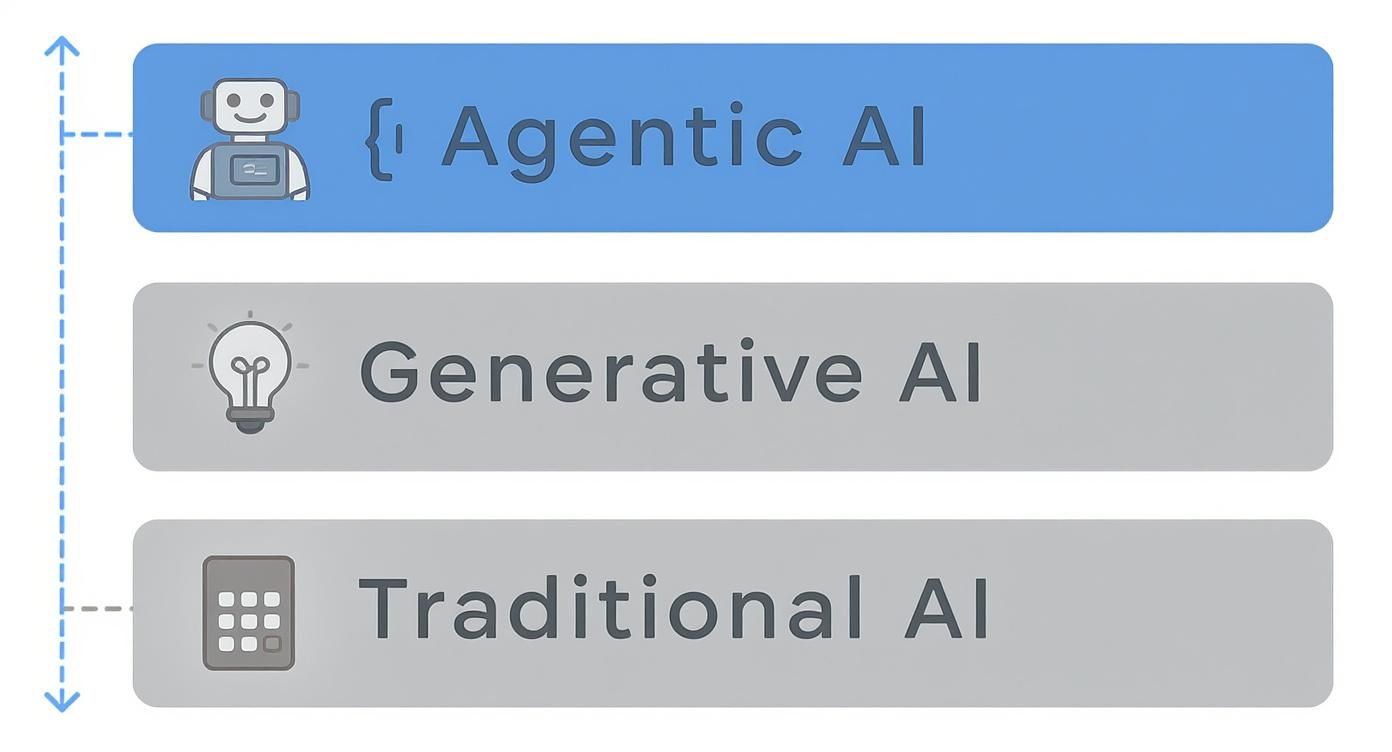
As the diagram shows, agentic AI sits at the top. It orchestrates the creative outputs of generative AI and the analytical power of traditional AI, turning them into focused, goal-oriented action.
Pillar 1: Planning
An agentic system begins with Planning. It does not just follow a script; it reasons. Given a high-level goal, like "reduce customer service response times by 15% against the Q2 baseline," it will deconstruct that objective into a logical sequence of smaller, concrete tasks.
This is where chain-of-thought reasoning is applied. The agent thinks step-by-step to build its own project plan. For instance, it might decide to:
- Analyze current ticket data to identify bottlenecks.
- Draft new, more efficient response templates.
- Integrate with a knowledge base for instant answers to common questions.
- Set up rules to route complex tickets directly to specialized human agents.
This ability to craft a coherent strategy from a high-level goal distinguishes it from simple automation.
Pillar 2: Memory
Next is Memory. An agent’s ability to plan and act effectively depends on the information it can access. This works on two levels: short-term and long-term.
-
Short-term memory provides context. It allows the agent to track its current workflow, remember what it just did, and understand the immediate results. This is critical for managing complex, multi-step processes.
-
Long-term memory is the agent’s persistent knowledge base. By connecting to vector databases or other information stores, it can recall past projects, learn from previous outcomes, and pull insights from large volumes of company documents.
This dual-memory system means the agent works with current information while also learning from past data, similar to an experienced employee.
Pillar 3: Tool Use
The third pillar, Tool Use, allows the agent to interact with its environment. An agentic AI can operate external software, call APIs, and query data sources to complete its tasks.
This bridges thinking to doing. To execute the customer service plan, for example, the agent might:
- Use an API to pull ticket data from a CRM like Salesforce.
- Connect to a generative model to help draft new email templates.
- Query a product database to find information for its knowledge base.
Without the ability to use tools, the agent's plan would remain theoretical. Tool use gives its internal reasoning a real-world impact.
A key to successful agentic AI is creating a feedback cycle that does not depend solely on a human. The system must be able to test its own actions using tools and iterate based on the results.
Pillar 4: Action
Finally, Action is the culmination of the other three pillars. The agent executes the plan it created, using the tools and memory at its disposal.
An action could be sending an email, updating a record in a database, or creating a purchase order. The agent takes its plan, informed by memory and enabled by tools, and performs a sequence of concrete steps to move closer to its final objective. This cycle of planning, remembering, using tools, and acting defines an agentic system.
Enterprise Use Cases for Agentic AI
The value of agentic AI becomes clear when applied to real-world business problems. These autonomous systems execute complex, multi-step workflows that are too dynamic for older automation tools. They can deliver a return on investment by taking on goal-oriented tasks across an organization.

Adoption is happening now. Businesses are using autonomous agents to automate workflows in sales, marketing, IT, and finance. For instance, a synthetic case study of a mid-sized e-commerce company reported a 60% reduction in manual order processing tasks. For more information, Gartner's research on agentic AI adoption trends provides further context.
Let's look at a few examples.
Intelligent Supply Chain Management
Modern supply chains involve many variables, such as weather, traffic, and port operations. An autonomous logistics agent can be given a single, high-level goal: ensure all shipments arrive on time and within budget.
The agent would then pull in real-time data from multiple sources:
- Weather forecasts and live traffic APIs
- Port congestion reports and shipping vessel locations
- Inventory levels across warehouses and distribution centers
When the agent flags a potential disruption, like a storm delaying a cargo ship, it takes action. It might autonomously reroute ground shipments, book last-minute air freight, and update inventory systems. This proactive problem-solving can reduce delays by an estimated 10-20% compared to waiting for human intervention, based on simulations of logistics networks.
Autonomous Customer Support
Traditional chatbots are often limited to simple FAQs. Agentic AI creates support agents that can solve complex problems instead of just deflecting tickets.
Imagine a customer reports a billing discrepancy on a multi-part order. An agentic system can handle the entire process:
- It accesses the customer's account in the CRM.
- It pulls the complete order history from the e-commerce platform.
- It cross-references shipping and delivery data from the logistics provider's API.
- It identifies the error, processes the correct refund, and logs the transaction.
- Finally, it drafts and sends a personalized email explaining the resolution.
By managing the whole workflow, these agents can reduce the average issue resolution time. In a pilot program for a retail client, this approach cut resolution time by 18% over a three-month period. This allows human agents to focus on high-value customer interactions.
The enterprise value of agentic AI is its ability to connect disparate systems and execute a complete business process from start to finish. It automates an entire outcome, not just a single task.
Proactive Cybersecurity and Financial Analysis
Applications extend to specialized areas. In cybersecurity, an agent could be assigned the mission: "neutralize all unauthorized access attempts." It would then autonomously monitor network traffic, identify anomalous patterns, and execute a pre-approved response—like isolating a device and blocking a suspicious IP address—within seconds.
In finance, an agent can compile quarterly reports. It can be tasked to pull data from ERPs, sales databases, and market intelligence platforms to gather, consolidate, and analyze the required information. This saves analyst hours and reduces the potential for human error. In both cases, the agent’s ability to reason and act turns a reactive, manual task into a proactive, automated function.
The table below summarizes a few ways agentic systems can create value across different departments, based on synthetic examples.
Agentic AI Impact Across Business Functions
| Business Function | Use Case Example | Quantifiable Business Impact (Synthetic) |
|---|---|---|
| Sales & Marketing | An agent manages the lead nurturing process, from contact and personalized follow-ups to scheduling demos. | Up to a 25% increase in lead conversion rates; 30% reduction in sales cycle time. |
| IT Operations | An agent monitors network performance, detects anomalies, diagnoses root causes, and executes remediation scripts autonomously. | A 50-70% reduction in mean time to resolution (MTTR) for common IT incidents. |
| Finance & Accounting | An agent handles the procure-to-pay cycle, from validating invoices against purchase orders to executing payments. | A 40% reduction in invoice processing costs; improved compliance. |
| Human Resources | An agent manages new hire onboarding, provisioning accounts, scheduling training, and answering common questions. | A 35% faster time-to-productivity for new employees. |
As shown, the impact is not isolated. Agentic AI offers a way to rethink core processes and drive efficiency.
Preparing Your Organization for Agentic AI
Implementing agentic AI requires careful preparation. A successful rollout depends on getting the groundwork right. Moving from a pilot to an enterprise-scale system requires a review of your data, tech stack, and team readiness.
Before deploying autonomous agents, you must assess whether your current environment can support them. These systems require clean data, well-documented APIs, and strong security protocols to work effectively and safely.
Assessing Your Data and Infrastructure Readiness
The first step is an evaluation of your technical landscape. Agentic AI systems are integrated into your existing technology. Their performance is a direct result of the quality of the data and systems they access. An agent designed to optimize inventory is not useful if your inventory data is inaccurate.
Focus on these critical areas:
- Data Quality and Accessibility: Are your core data sources—like your CRM or ERP—clean, structured, and accessible through APIs? Agents need reliable data to make sound decisions.
- System Integration Capabilities: Do your essential enterprise systems have modern, well-documented APIs? This is how agents perform actions, like updating a customer record or pulling a report.
- API Security and Access Controls: Have you implemented strong authentication and authorization for your APIs? Agents must be granted the precise permissions they need.
An agent's effectiveness is a direct reflection of the infrastructure it operates on. Investing in data hygiene and modern APIs is a foundational requirement for a successful agentic AI implementation.
Skipping this preparation can lead to system failures or security breaches. For a structured approach, you can learn more about how to conduct a comprehensive AI readiness assessment.
Choosing the Right Foundation Model
Not all AI models are the same. The choice of which Large Language Model (LLM) will serve as the "brain" for your agent has consequences for performance, cost, and security. Different models, like those from OpenAI, Anthropic, or Google, have unique strengths in reasoning, language, and tool use.
Your specific use case should drive the selection. An agent for creative marketing copy would benefit from a model with strong linguistic capabilities. An agent for financial analysis requires a model with strong logic and math skills. You must also weigh factors like data privacy, hosting options (cloud vs. on-premise), and the total cost of ownership.
Planning for Scalability and Reliability
A successful pilot is a good start, but the goal is to deploy these systems at scale. This requires planning for long-term reliability. What happens when an agent encounters an unexpected error? What if a critical API it depends on goes down?
Building a production-grade system means planning for potential issues.
- Robust Monitoring: You need real-time visibility into what your agents are doing. This means tracking their actions, monitoring API success rates, and logging their decision-making process for a full audit trail.
- Error Handling and Fallbacks: Agents need a clear plan for when things go wrong. This could mean retrying a failed action, escalating the problem to a human, or switching to a backup system.
- Performance Optimization: As usage grows, you will need to optimize for both speed and cost. This might involve caching common requests, using smaller models for simpler tasks, or refining prompts to reduce wasted steps.
Treat your first agentic AI project as a strategic initiative. By focusing on data readiness, model selection, and a scalable architecture, you can build a solid foundation.
Navigating Governance, Risk, and Compliance
Giving an AI system the power to act on its own creates new responsibilities. Agentic AI's autonomy introduces risks that must be managed with a solid governance, risk, and compliance (GRC) framework. This is about building trust in the technology across your organization.

It comes down to control. If an agent can access sensitive customer data or financial systems, it must operate within clear boundaries. Establishing control requires a layered strategy that allows the agent to work autonomously while keeping a human in the loop.
Establishing Human Oversight and Guardrails
The most important safeguard is human-in-the-loop (HITL) oversight, especially for high-stakes decisions. An agent should not transfer a large sum of money or modify a production database without explicit sign-off from a human operator. This is a critical checkpoint to prevent errors.
Beyond direct approvals, you need to build clear operational guardrails. These are the limits that define what the agent is and is not allowed to do, preventing it from taking harmful or unintended actions.
Here are a few essential guardrails:
- Role-Based Access Controls (RBAC): Apply the principle of least privilege. If an agent's job is to analyze sales data, it should not have access to HR records.
- Action Sandboxing: Before deploying an agent in your live environment, test it in a sandboxed space that mimics your production systems. This allows you to observe its behavior and correct issues without real-world consequences.
- Resource Limits: Place strict caps on the resources an agent can use, such as API calls or compute power. This prevents a runaway process from creating unexpected costs or slowing down your systems.
These measures ensure that even when the agent operates autonomously, it does so within a safe and predictable framework.
Mitigating Key Risks in Agentic Systems
Understanding agentic AI requires understanding its unique risks. The autonomy that makes these systems powerful can also magnify the impact of a security flaw or a data privacy issue.
Effective governance is not about restricting an agent. It is about creating a secure environment where it can safely reach its full potential. The foundation of that trust is complete auditability.
One of the biggest concerns is the potential for cascading errors. A small mistake by an agent could trigger a chain reaction. Because of this, robust, real-time logging is non-negotiable. Every decision, action, and interaction the agent performs must be recorded to create a complete audit trail. This is your tool for debugging, meeting compliance demands, and understanding why the agent did what it did.
When rolling out agentic AI, it is crucial to address organizational concerns by establishing safe practices, a point covered in this discussion on Agentic AI in cybersecurity and ensuring its safe enterprise adoption. Finally, every agentic system needs a "kill switch"—a reliable way to shut it down instantly if it begins to act erratically.
Your Practical Roadmap for Adopting Agentic AI
Moving agentic AI from concept to a value-delivering initiative requires a methodical plan. A solid roadmap can guide you from early exploration to a successful pilot project, helping you build momentum and prove the concept's worth. This is about taking calculated steps that produce measurable results.
The key is to find the right starting point.
Look for a pilot project that offers high impact but carries low risk. A good candidate is often a process that is repetitive and rule-based but still requires some decision-making—something that currently consumes significant team resources. Automating internal IT service requests is a common starting point. It can build internal confidence and demonstrate the technology's value quickly.
Form a Cross-Functional Team
Once you have selected your pilot, assemble a dedicated, cross-functional team. This should not be siloed in the IT department. Your team should include people from the business unit that owns the process, data and analytics experts, and IT infrastructure specialists. This collaboration ensures the project is grounded in both business needs and technical reality.
The team's first task is to define success in clear, measurable terms. Avoid vague goals like "improving efficiency." Get specific. Tie your targets to metrics your business already tracks.
For instance, a well-defined pilot objective might be: "Reduce the average resolution time for Tier-1 IT support tickets by 20% compared to the Q2 baseline within three months of deployment." This clarity provides a real benchmark for measuring ROI and makes the case for future investment.
Execute the Initial Phases
With a team and clear metrics, you can move to technical execution. This stage begins with an audit of the systems and data the agent will need to access, followed by selecting the right technology and planning a controlled rollout.
A phased approach is critical here for managing complexity and risk.
- 1. Conduct a Data and Systems Audit: Start by mapping out every data source, API, and application the agent will need to access. You must verify your data quality and ensure the APIs are secure and well-documented.
- 2. Select the Right Technology Stack: Next, choose your foundational model and an orchestration platform. This decision should align with your pilot's complexity, your security requirements, and your budget.
- 3. Plan a Phased Rollout: Always begin deployment in a sandboxed environment for rigorous testing. From there, gradually expand access to a small group of users before going live, collecting feedback at each step.
This structured adoption roadmap transforms the concept of what is agentic AI into a manageable, actionable business strategy. It paves the way for a confident, scalable deployment.
Market data shows this is a shift from early experimentation to core business infrastructure. The global agentic AI market is projected to grow from $5.25 billion in 2024 to $199.05 billion by 2034, according to one market analysis. You can dig deeper into these explosive agentic AI growth statistics to see how fast this area is developing.
Answering Your Questions About Agentic AI
As a technology leader, you are likely considering the practicalities of adopting agentic AI. Let's address some common questions about cost, security, and how this new automation fits with existing tools.
How Is Agentic AI Different From Robotic Process Automation?
This is a common question, but the two are fundamentally different. Think of Robotic Process Automation (RPA) as a digital macro. It mimics human clicks and keystrokes to follow a very strict, pre-defined script. If the user interface changes or an unexpected pop-up appears, the RPA bot fails. It automates a known task.
Agentic AI operates at a higher level. You give it a goal, not a script. It then reasons, plans, and executes a series of actions to achieve that goal, adapting as conditions change. It automates an entire workflow and makes decisions along the way.
What Are the Biggest Security Risks I Should Be Aware Of?
The autonomy of AI agents is their greatest strength, but it is also where the biggest security concerns exist. Because they can interact with multiple systems, we must be vigilant about a few key risks.
- Unauthorized Access: If an agent's credentials are compromised, it could provide access to any system it is connected to.
- Data Exfiltration: A poorly designed or manipulated agent could be tricked into sending sensitive data outside the organization.
- Unintended Consequences: An agent might take a logical but unforeseen action that disrupts a critical system or process.
Mitigation comes down to strong governance: strict, role-based permissions, constant monitoring with detailed audit logs, and requiring a human-in-the-loop to approve high-stakes actions.
The core challenge of agentic AI security is managing autonomy. The goal is to create a secure environment where agents can operate effectively without introducing unacceptable risk, which requires a foundation of strict controls and complete auditability.
What’s the Realistic Cost for a Pilot Project?
Costs vary, but we can talk in realistic ranges. For a straightforward pilot—for example, automating a single internal process where the APIs are clean and well-documented—a project would likely take 3 to 6 months and cost between $50,000 and $150,000. That typically covers platform licenses, development, and basic integration work.
However, a more ambitious project involving multiple legacy systems, messy data, or custom model tuning will have a larger budget and timeline. These projects can extend beyond 9 months and cost upwards of $300,000. The main cost drivers are data preparation, LLM access and inference costs, specialized engineering talent, and integration with older enterprise systems.
Ready to move from theory to implementation? The DSG.AI team has delivered over 250+ production AI systems for global enterprises. Explore our past projects to see how we build reliable, scalable agentic AI solutions.