
Written by:
Editorial Team
Editorial Team
Custom machine learning development creates AI models built from scratch for your business. It is the difference between an off-the-rack suit and a tailored one. The off-the-rack option is quick, but the custom-fit version is designed for a specific purpose, delivering better performance and lasting value.
When to Choose Custom ML Over Off-the-Shelf AI
Off-the-shelf AI tools are useful for standard tasks, but they often fail when faced with complex, business-specific problems. A one-size-fits-all model can lead to a low return on investment because its pre-built assumptions do not match your operational realities. At this point, a custom approach becomes a strategic need.
A generic AI model trained on public data does not understand the specifics of your supply chain, the subtle patterns in your customer behavior, or the details of your manufacturing process. Custom development means the model is trained exclusively on your data, learning the patterns and variables that directly affect your key business outcomes.
To make this clearer, let's compare the two approaches side-by-side.
Off-the-Shelf AI vs Custom Machine Learning Development
This table outlines the key differences between a generic solution and a tailored one.
| Attribute | Off-the-Shelf AI | Custom Machine Learning |
|---|---|---|
| Data Specificity | Trained on general, public datasets. | Trained on your proprietary business data. |
| Accuracy & Performance | Good for generic tasks, but lower for specific use cases. | Optimized for high accuracy on your unique problems. |
| Intellectual Property | You license the software; the vendor owns the IP. | You own the model and the code—it's your asset. |
| Integration | May require workarounds to fit into your existing systems. | Engineered to integrate with your tech stack. |
| Competitive Edge | Low barrier to entry; competitors can use the same tool. | Creates a unique, defensible advantage that is hard to replicate. |
| Scalability | Limited to the vendor's roadmap and feature set. | Scales and evolves with your business needs. |
The trade-off is between immediate convenience and long-term strategic value.
The Strategic Value of a Bespoke Solution
Investing in a custom model builds a proprietary asset that works only for you. Unlike licensing a third-party tool, you gain full intellectual property ownership. This asset becomes a competitive moat, enabling your organization to achieve outcomes that competitors relying on generic software cannot.
The benefits extend beyond performance.
- Pinpoint Accuracy: Models are fine-tuned to your operational environment, leading to more precise predictions and decisions.
- Frictionless Integration: The solution is built to fit into your existing technology and workflows, minimizing disruption.
- Full IP Ownership: You own the source code and the model, which means no vendor lock-in and a direct increase in your company's long-term value.
This targeted approach explains why the global machine learning market is projected to grow from USD 91.31 billion in 2025 to USD 1.88 trillion by 2035. Businesses are moving past generic tools because they need custom AI that solves their core challenges.
Unlocking Advanced Capabilities
The possibilities with custom development are expanding. Today, projects often go beyond traditional predictive models to include specialized LLM training for creating powerful, next-generation AI capabilities. This allows you to build sophisticated language-based tools that are finely tuned to your company's internal knowledge and communication style.
A custom model is more than just a piece of software. It’s a digital representation of your company's institutional knowledge, constantly refined by your data, and engineered for one single purpose: to drive your business forward.
Ultimately, choosing custom ML is a decision to invest in a solution that adapts to your business, not the other way around. To determine if your organization is ready to take this step, our AI readiness assessment can provide valuable insights.
The Six-Stage Roadmap for a Successful ML Project
Moving a machine learning idea from concept to production is a structured journey. A disciplined, six-stage lifecycle turns a complex technical project into a manageable and value-focused initiative. Following this roadmap helps manage risk and ensures the final system is tuned to your business goals.
The entire process converts raw information into a predictive model that generates tangible business value.
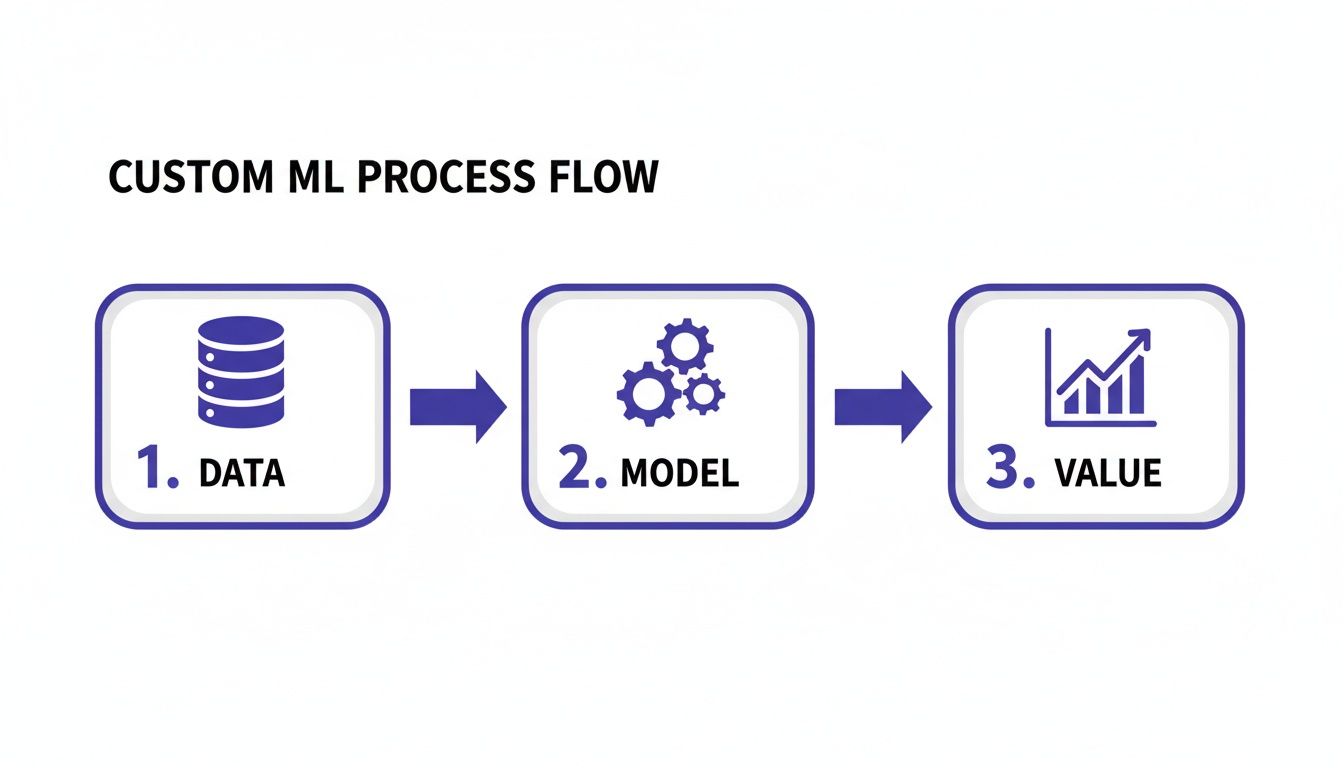
This journey from data to business outcome is built on the successful execution of these six project stages.
Stage 1: Discovery and ROI Framing
The most important work happens before any code is written. This initial phase translates a broad business problem into a specific, measurable objective. We define what success looks like in clear numbers.
For example, instead of a vague goal like "improve logistics," we frame it as "achieve an 8% to 12% reduction in last-mile delivery costs within six months, relative to the Q2 baseline." This clarity aligns everyone on the target and provides a clear benchmark for proving the project's return on investment.
Stage 2: Data Readiness and Preparation
A machine learning model is only as effective as the data it learns from. This stage ensures your data is clean, relevant, and comprehensive. It starts with a thorough audit of all data sources to identify quality issues.
The key activities involve:
- Data Aggregation: Bringing together information from different sources, such as databases, APIs, and system logs.
- Cleaning and Normalization: Fixing errors, handling missing values, and standardizing formats to create a consistent dataset.
- Feature Engineering: Selecting and transforming the specific data points (features) that will give the model the best predictive power.
Without this groundwork, even the most sophisticated algorithm will fail.
Stage 3: Iterative Model Design and Prototyping
This is where the data science work begins. We experiment with several modeling techniques to find the best fit for your problem. The team builds and tests multiple prototypes, starting with simple baseline models and progressing to more complex architectures like neural networks if necessary.
We measure each prototype's performance against the business metrics defined in the discovery phase. This iterative cycle allows for quick learning and course correction, ensuring the final model architecture delivers the most accuracy and business impact.
A strong prototype doesn't just "work"—it proves that the model can achieve the target business outcome. It is the evidence needed to confidently invest in a full-scale production build.
Stage 4: Production Engineering and MLOps
A working prototype is different from a production-grade system. This stage focuses on building the robust, scalable infrastructure needed to run the model reliably in a live environment. This is where MLOps (Machine Learning Operations) practices are essential.
MLOps automates the deployment pipeline, allowing the model to be updated, monitored, and maintained efficiently. We build a secure, resilient, and scalable system that is ready for enterprise-level demands.
Stage 5: Scalable Deployment and Integration
Once the system is built, it must integrate seamlessly into your existing workflows and software. The goal is to make the model's insights accessible and actionable for your team, whether through a new dashboard for operations managers or an API that feeds predictions directly into your ERP system.
A successful deployment causes no disruption. It should feel like a natural upgrade to your current processes, empowering your people with data-driven intelligence where they work.
Stage 6: Continuous Monitoring and Optimization
A machine learning model is never finished. The world changes, new data flows in, and a model's performance can degrade over time. This phenomenon is called model decay. This final stage is a continuous loop of monitoring, evaluating, and retraining.
Automated systems monitor the model's accuracy and its business impact, comparing them to the original baselines. If performance dips, the model is retrained on fresh data to keep it effective. This commitment to ongoing optimization is a core part of expert custom machine learning development services.
How to Select the Right AI Development Partner
Choosing the right partner for your custom AI project is a critical decision. It can determine the difference between a valuable business asset and a failed experiment.
A strong partner delivers a scalable, secure system that becomes part of your company's core value. A weak partner can leave you with a stalled project and an invoice.
To avoid that outcome, look past sales pitches and evaluate potential vendors on four key pillars. This framework will help you find a team that can build a real solution and create a lasting competitive edge.
Scalability Through an MLOps and Architecture-First Approach
A model that runs on a developer's laptop is one thing. A model that handles a flood of real-world data without failure is another. You need a partner who takes an architecture-first approach.
This means they think about building a resilient, scalable system from the beginning, not just chasing a high accuracy score.
This is where Machine Learning Operations (MLOps) is important. A team with a solid MLOps discipline has the processes and tools to deploy, monitor, and retrain your models reliably. Their ability to engineer a system for scale is a strong predictor of project success in production.
When you talk to a potential partner, ask: "Walk me through how you'd ensure our model can scale to handle 10x our current data volume." Their answer will reveal their real-world engineering capabilities.
The Machine Learning as a Service (MLaaS) market is projected to reach USD 271.88 billion by 2031. MLOps and Monitoring services are the fastest-growing part of that market because operational readiness is what separates successful projects from failures.
Guaranteed Intellectual Property Ownership
When you pay for a custom AI solution, you are building a proprietary business asset. You must retain 100% ownership of the intellectual property (IP) and all source code.
Accepting anything less creates vendor lock-in. If you have a disagreement or the vendor goes out of business, you could lose control of a system critical to your operations. A trustworthy partner will guarantee a complete handoff of all code, models, and documentation. It is your asset, and you should own it.
A Technology-Agnostic Mindset
Your business problem should determine the technology, not the other way around. Be cautious of partners who only work with a specific tech stack. The best teams are technology-agnostic.
This means they select the right tools for your specific challenge from the large ecosystem of open-source and commercial options. This flexibility ensures you get a solution optimized for performance and cost, not one limited by a vendor's preferences. Their job is to solve your problem.
Deep Expertise in Compliance and Governance
We operate in an era of intense regulatory scrutiny. Your partner’s understanding of AI governance is essential. New regulations like the EU AI Act establish strict standards for fairness, transparency, and accountability.
Your partner must be able to build a compliant system from the ground up.
They should be able to explain their process for mitigating bias, ensuring model explainability, and protecting data privacy. This expertise reduces your risk and builds trust with your customers. You can check our portfolio to see examples of compliant, enterprise-grade AI.
Navigating AI Governance and Regulatory Compliance
Building a powerful AI model is one challenge. Ensuring it’s fair, transparent, and accountable is another, equally critical challenge. As AI becomes more central to business operations, leaders face pressure to manage governance, risk, and compliance (GRC). This is about more than avoiding fines; it is about earning customer trust.
The principles of Responsible AI provide a practical framework for building ethical and effective systems. Any partner you consider for custom machine learning development services needs to demonstrate a hands-on understanding of these principles.

Proactive GRC in Custom ML Development
Good governance must be integrated into the machine learning lifecycle from the start. A proactive approach turns a potential compliance issue into a competitive advantage, ensuring your AI initiatives are built on a foundation of trust.
A partner with a mature GRC mindset integrates practical measures into the core engineering process to de-risk your project.
Key proactive GRC measures include:
- Integrated AI Monitoring: Constantly watching model performance for fairness, bias, and unexpected behavior. This helps catch issues before they affect users.
- Transparent Model Documentation: Maintaining detailed records of data sources, model architecture, and training methods to ensure the system is explainable.
- Systematic Risk Assessments: Identifying and addressing potential harms related to privacy, security, and ethics at the beginning of the project.
Understanding the EU AI Act and Its Impact
New regulations are setting a global benchmark, and the EU AI Act is a key example. This legislation classifies AI systems by their potential risk level, placing strict demands on "high-risk" applications like those used in hiring or credit scoring.
The EU AI Act is a global issue, affecting any company with users in the EU. Non-compliance can result in large fines.
Your development partner must be fluent in these regulations. They need to design solutions that are compliant from the start. This means engineering features that support human oversight, guarantee data quality, and offer clear explanations for automated decisions. For more details, see our guide on achieving EU AI Act readiness.
A partner with strong governance skills allows you to move forward with confidence. They ensure your custom AI solutions are reliable and trustworthy, turning a regulatory burden into a mark of quality.
Real-World Examples of Custom ML in Action
Theoretical benefits are one thing, but the real test of machine learning is how it solves tangible business problems. Custom ML models are specific tools built to address operational bottlenecks and produce financial gains. The best solutions have a direct, measurable impact on the bottom line.

From optimizing shipping routes to ensuring correct product placement, custom models are creating significant value. Let's examine a few synthetic examples that show a clear progression from problem to solution to result.
Optimizing Maritime and Agricultural Operations
Global supply chains contain too many variables for any person or team to track effectively. This complexity makes them a perfect environment for custom ML to drive efficiency and reduce costs.
- Maritime Fuel Reduction: A global shipping company faces unpredictable fuel costs. They could build a predictive routing model that processes real-time weather patterns, ocean currents, and historical vessel data. A realistic outcome is an 8% to 12% reduction in fuel consumption for piloted routes compared to the previous year's baseline.
- Agribusiness Yield Forecasting: An agricultural company needs to improve crop yield predictions to stabilize supply and pricing. By creating a custom model that analyzes satellite imagery, soil data, and weather forecasts, they could improve prediction accuracy by 20% against their 3-year seasonal average.
These examples are part of a larger trend. The AI as a Service market is projected to reach USD 240.48 billion by 2034, with machine learning as a primary driver. Companies use ML for critical functions like fraud detection and risk management because it delivers measurable results. You can explore more of these market growth insights on fortunebusinessinsights.com.
The power of a custom model is its ability to find patterns in your proprietary data that generic software would miss. This insight creates a lasting competitive advantage.
Enhancing Logistics and Retail Performance
Custom models are also changing internal workflows and customer interactions. The goal is often to automate tasks and enable data-backed decisions at a large scale.
A national logistics firm, for example, might be overwhelmed by customer emails. A custom natural language processing (NLP) model could be trained to read, interpret, and sort incoming messages, potentially automating over 95% of the classification work. This would free up support agents to focus on complex problems.
A major retailer might face a challenge with optimizing store layouts (planograms).
- The Problem: Inconsistent product placement reduces sales.
- The Solution: Develop a custom ML model that analyzes sales figures, foot traffic data, and product relationships to generate ideal planograms for each location.
- The Result: After implementing the new layouts, the retailer could see a 5% to 7% lift in sales for key product categories over a six-month period.
Each of these stories highlights the same idea: a well-defined, custom-built ML solution can deliver a clear return by solving a specific, high-value business problem.
Measuring the True ROI of Your ML Investment
How do you prove a custom machine learning solution was worth the investment? The data science team may focus on model accuracy, but executives want to see the impact on the bottom line. Success is measured in financial results, efficiency, and growth.
The real test is whether the model's technical performance translates into tangible business results. You must connect what the model does to its effect on financial reports, operational budgets, and customer satisfaction.
Tying ML Performance to Business KPIs
The key is to draw a straight line from a model's output to a meaningful business metric. A fraud detection model is not successful just because it has 99% accuracy. It is successful because it causes a measurable drop in fraudulent transaction costs.
As you scale these models, managing infrastructure costs becomes critical. Cloud cost optimization is a complex discipline. For a deeper look, see these 10 Practitioner-Led Cloud Cost Optimization Best Practices.
Here are a few ways to quantify the business impact:
- Cost Reduction: Pinpoint the exact decrease in operational spending. A logistics model, for example, might cut fuel costs by 8% to 15% compared to the previous quarter's baseline.
- Revenue Lift: Measure the direct sales increase. A dynamic pricing engine could boost the average transaction value by 4% to 6%.
- Efficiency Gains: Track how much faster your teams can operate. A customer support AI could reduce the average ticket resolution time from 48 hours to 12 hours.
- Risk Mitigation: Quantify how many negative events were avoided. An improved fraud detection system might lower chargeback rates by 25% year-over-year.
Tracking ROI is an ongoing process. It involves continuously monitoring how the model's performance influences the financial health and operational agility of the business.
This data-driven proof does more than justify the initial spending. It builds a business case for future AI projects, turning machine learning from a cost center into a proven engine for growth.
Frequently Asked Questions About Custom ML Development
When considering a custom machine learning project, it is normal to have questions about timelines, costs, and ownership. Clear answers are crucial for planning and ensuring the project delivers on its promise.
Here are the answers to the questions we hear most often.
What Is the Typical Timeline for a Custom ML Project?
Building a custom ML model is a staged process. This approach allows us to check progress and prove value at each step. The timeline depends on two main factors: data readiness and the complexity of integration into your current systems.
A project usually starts with a proof-of-concept (PoC), which can typically be delivered in 6 to 8 weeks. The goal is to quickly test the approach and show a working model that demonstrates business potential. After that, moving from a PoC to a full production-ready system usually takes another three to six months.
How Much Does a Custom Machine Learning Solution Cost?
The cost should be viewed as an investment tied to the business results it creates. The goal is to generate a return that outweighs the initial cost.
Several factors influence the final price:
- Model Complexity: A sophisticated deep learning model for computer vision requires more effort than a straightforward predictive model for sales forecasting.
- Data Readiness: If data requires significant cleaning, labeling, and organizing, this initial effort will be a larger part of the budget.
- Integration Scope: The engineering work needed to connect the model to your existing software is a major factor.
We frame the cost in terms of value. For instance, if a project is projected to cut operational costs by $2 million per year, the investment to build it becomes a clear strategic decision.
Who Owns the Intellectual Property?
This is an important question. When you commission a custom ML solution, you should receive full and unconditional ownership of all the intellectual property (IP), including all source code.
This guarantees you have a unique, defensible asset that belongs entirely to you. It is different from the restrictive licenses of off-the-shelf AI tools. Full IP ownership means you are not tied to any single provider. The final model, code, and documentation become valuable assets for your company, giving you the freedom to change, scale, and build on them as you wish.
At DSG.AI, we specialize in building enterprise-grade AI solutions that create tangible business value. Every project concludes with a complete handoff of all source code and IP, so you own the competitive edge you invested in. To see how our architecture-first approach delivers results, take a look at our successful projects.